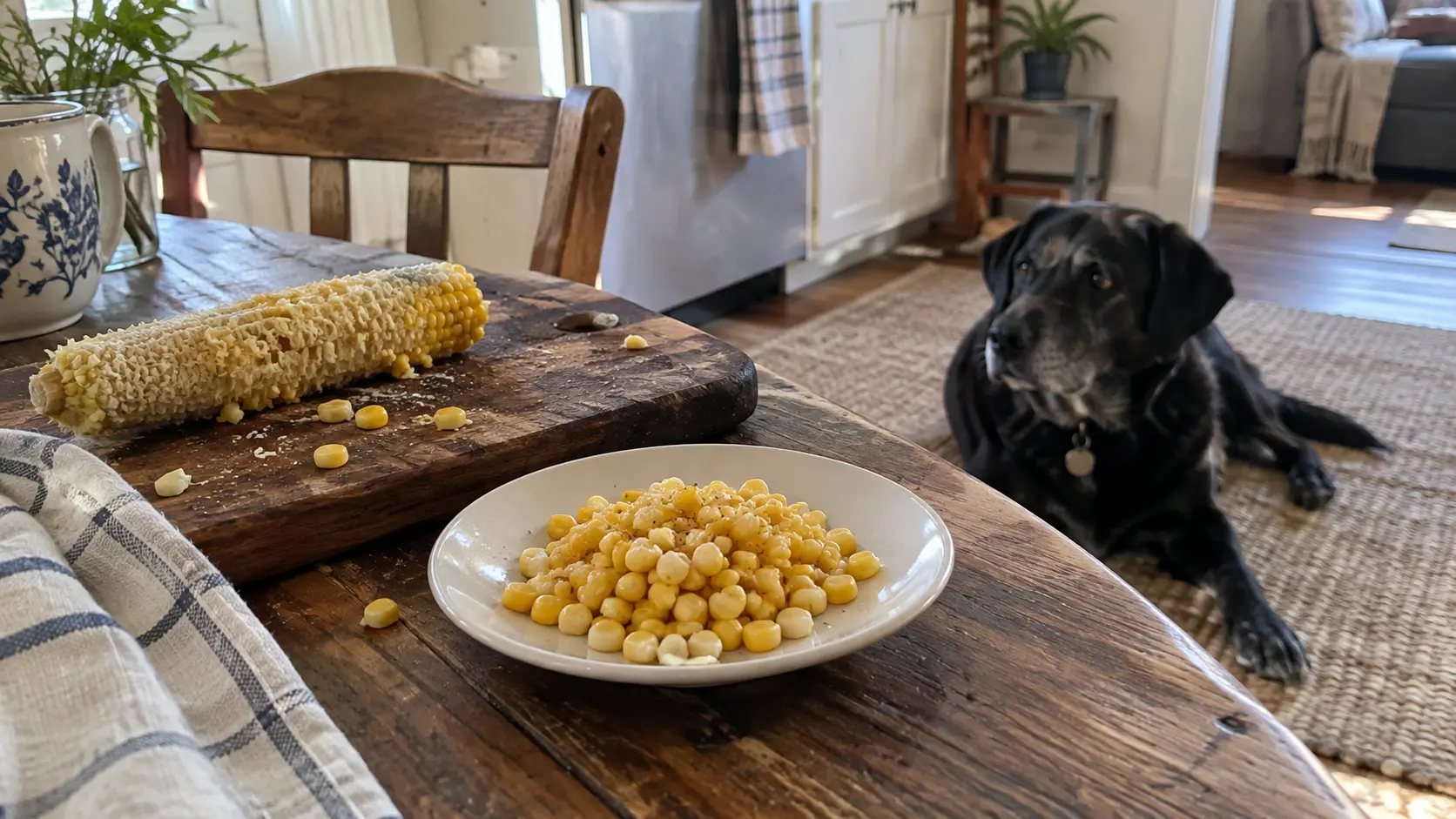
Yes, most healthy dogs can eat a small amount of plain corn kernels removed from the cob. Cooked, unseasoned corn is the simplest form to offer because cooking improves digestibility.
The corn cob is a completely different matter. Dogs should not be given cobs to chew or eat because pieces can become lodged in the digestive tract and cause a serious blockage.
Here is how to tell the safer forms of corn from the ones to avoid, how much to offer, and what to do if your dog has already swallowed part of a cob.
Can Dogs Eat Corn?
For most healthy dogs, plain cooked shrimp can be an occasio
Dogs can generally eat plain corn kernels in small amounts.
The safest approach is to remove the kernels completely from the cob, cook them without seasoning, let them cool, and offer only a small portion as an occasional extra.
Corn does not need to be added to a dog’s diet for nutritional completeness. If your dog already eats a complete and balanced food, corn is simply another treat or extra rather than an essential ingredient.
You may also see corn called maize. They refer to the same crop, so the same advice applies.
The basic distinction is simple:
nal treat.
Shrimp should be fully cooked and served without sauces, breading, butter, garlic, onion, or heavy seasoning. Removing the shell and tail also avoids unnecessary choking and foreign-body risks.
Shrimp is still an extra rather than a nutritionally necessary part of a dog’s diet. The World Small Animal Veterinary Association recommends keeping treats and other extras to no more than about 10% of a dog’s daily calories, with the main diet providing complete and balanced nutrition.
That 10% is an upper limit, not a target to fill with shrimp or other treats.
Dogs with prescription diets or medical conditions that require dietary restrictions may need different guidance.
- Plain corn kernels: generally fine in small amounts.
- Corn cob: should not be fed because it can cause a physical blockage.
Can Dogs Eat Corn on the Cob?
No. Dogs should not be intentionally given corn on the cob.
The concern is not that the cob suddenly makes corn poisonous. The problem is physical: a corn cob is firm, poorly digestible material that can act as a foreign body inside the digestive tract.
A swallowed piece can become stuck in the esophagus, stomach, or intestines and cause a partial or complete obstruction. Depending on where the piece becomes lodged and how severe the blockage is, veterinary treatment may involve imaging, endoscopic removal, or surgery.
There is also no reliable household rule for deciding that a particular piece is small enough to pass safely. A fragment that looks small compared with a large dog can still create a problem.
The kernel and the cob therefore need to be treated as two different safety questions: corn kernels can be food, while the cob can become a blockage.
My Dog Ate a Corn Cob: What Should I Do?
If your dog has swallowed a corn cob or a significant piece of one, contact your veterinarian promptly rather than waiting to see whether symptoms develop.
A dog may look normal immediately after swallowing something that later causes an obstruction. The timing and severity of symptoms vary, so a fixed rule such as “wait 24 hours” is not reliable.
Contact Your Veterinarian Promptly
When you call, be ready to explain:
- roughly when your dog swallowed the cob
- whether it was a whole cob or a piece
- your dog's approximate weight or size
- whether the cob was chewed into pieces or swallowed largely intact
- whether your dog is vomiting, eating normally, passing stool, or acting uncomfortable
- whether the corn had butter, garlic, onion, or other seasonings on it
That information helps the veterinarian decide what assessment is appropriate.
Do Not Try to Make Your Dog Vomit at Home
Do not give hydrogen peroxide or try another home method to make your dog vomit unless a veterinarian specifically instructs you to do so.
Whether vomiting is appropriate depends on what was swallowed, when it happened, the dog’s condition, and other factors. Trying to induce vomiting at home can create additional problems in some situations.
Signs of a Possible Blockage
Possible signs of gastrointestinal obstruction can include:
- repeated vomiting
- refusing food or eating much less than usual
- abdominal pain or obvious discomfort
- lethargy
- dehydration
- diarrhea
- reduced or difficult stool passage
These signs are not identical in every dog. If you already know your dog swallowed a cob, you do not need to wait for this list to appear before calling your veterinarian.
What Types of Corn Can Dogs Eat?
The safest corn is simple: plain kernels, completely removed from the cob.
Cooked Corn
Plain cooked corn is the easiest form to recommend.
Remove it from the cob first, cook it without salt, butter, oil, or seasoning, and let it cool before offering a few kernels.
Cooking helps make corn starch easier to digest, which is one reason cooked corn is preferable when you are intentionally feeding it.
Raw Corn
A few plain raw kernels are not the same hazard as swallowing a corn cob, and the available evidence does not support calling raw kernels poisonous.
However, cooking improves corn’s digestibility, so cooked kernels are the better everyday choice.
If your dog steals a few raw kernels, that is usually a different situation from swallowing the cob itself. The cob remains the part that deserves the greatest concern.
Fresh and Frozen Corn
Fresh corn can be offered after the kernels are removed from the cob and preferably cooked.
Plain frozen kernels can also be cooked and served in a small amount. Check frozen vegetable mixes before sharing them, because some products contain sauces, butter, salt, or seasoning.
If you are looking for other produce your dog may be able to eat, LumaPaw’s guide to fruits and vegetables dogs can eat covers the broader category.
Canned Corn
Canned corn is not automatically unsafe, but products vary considerably.
Some contain much more sodium than others, and flavored versions may include butter, sauces, garlic, onion, or other seasonings.
If you want to share canned corn, choose plain kernels with a simple ingredient list and avoid heavily seasoned versions.
Cream-style corn is less straightforward because recipes can contain different amounts of salt, sugar, dairy, fat, and seasonings. Plain kernels are the simpler option.
How to Prepare Corn for Your Dog
If you want to share a little corn, preparation can stay very simple:
- Remove the husk and silk.
- Take the kernels completely off the cob.
- Cook the kernels without seasoning.
- Let them cool.
- Offer only a small amount.
- Count the corn as part of your dog's other treats and extras.
- Stop offering it if it repeatedly causes digestive upset.
A practical approach at dinner is to set aside a few kernels before adding butter, salt, sauces, or seasoning to the rest of the corn.
Avoid handing your dog the whole cob, even if you expect them to chew rather than swallow it.
How Much Corn Can Dogs Eat?
There is no well-established veterinary tablespoon chart for corn based simply on a dog’s body weight.
A better rule is to keep corn as a small part of the dog’s overall treat allowance.
General veterinary nutrition guidance recommends that treats and other extras make up no more than about 10% of daily calories for a typical healthy dog, with the large majority of calories coming from complete and balanced food.
That does not mean corn itself should make up the entire 10%.
If your dog has never eaten corn before, start with just a small amount and see how they tolerate it rather than giving a large serving at once.
Dogs that are overweight, have medical conditions, or eat a prescribed veterinary diet may need more specific advice about extras from their veterinarian.
Is Corn Good for Dogs?
Corn can provide usable energy and nutrients, and properly processed corn is digestible for dogs.
It can contribute nutrients such as linoleic acid when used as part of a properly formulated dog food. That does not mean adding sweet corn to the bowl provides special health benefits.
A dog eating a complete and balanced diet does not need extra corn to avoid a nutritional deficiency.
So it is more accurate to think of plain corn as an acceptable occasional food, not a superfood and not a nutritional requirement.
Can Dogs Digest Corn?
Yes, although preparation matters.
Whole kernels may sometimes remain recognizable in a dog’s stool, especially when they have not been chewed thoroughly. That does not prove that dogs are incapable of digesting corn.
Grinding and cooking corn improve starch digestibility considerably. This is also why properly processed corn used in commercial dog food should not be judged by the occasional intact sweet-corn kernel seen in stool.
Do not induce vomiting or give medication unless a veterinarian or veterinary poison professional specifically instructs you to do so.
Seasonings and Toppings to Avoid
Plain corn is the safest version to share.
Skip heavy butter, oils, excessive salt, and seasoning blends. Garlic and onion are particularly important to avoid because they can be harmful to dogs, including when used in concentrated powdered seasonings.
High-fat toppings may also cause digestive upset and can be a poor choice for dogs that are susceptible to diet-related problems.
There is no need to panic if a healthy dog steals a single lightly seasoned kernel. The risk depends on what was added and how much was eaten.
For intentional feeding, though, there is little reason to make corn more complicated than plain cooked kernels.
Can Dogs Be Allergic to Corn?
Yes, an individual dog can have an adverse reaction to corn, but available veterinary evidence does not suggest corn is among the most commonly identified canine food allergens.
Do not assume corn is responsible simply because a dog develops itching, diarrhea, or another symptom. Many conditions can cause similar signs.
When a veterinarian genuinely suspects a food allergy, diagnosis usually involves a structured elimination diet followed by a food challenge rather than guessing from an ingredient list or relying on an unvalidated screening test.
Detailed food-allergy diagnosis belongs with your veterinarian rather than a corn-feeding experiment at home.
Is Corn in Dog Food Bad for Dogs?
Not automatically.
Properly processed corn can be digestible and can contribute nutrients to a complete dog-food formula. Calling every use of corn “filler” is too simplistic.
What matters more is whether the overall diet is nutritionally complete and appropriate for the dog’s life stage and individual needs.
The question of corn in commercial dog food is broader than whether your dog can eat a few sweet-corn kernels, so it should not be used as a reason either to praise or reject a food based on one ingredient alone.
Can Puppies Eat Corn?
A puppy that is already eating solid food can generally have a very small amount of plain cooked corn removed from the cob.
The bigger concern is nutritional balance. Puppies have specific requirements for growth, so treats and table foods should not displace a complete and balanced puppy diet.
Puppies and young dogs may also be more likely to chew or swallow objects they should not, which makes keeping corn cobs out of reach especially important.
Frequently Asked Questions
Is maize the same as corn for dogs?
Yes. Maize and corn are two names for Zea mays. The same guidance applies: plain kernels can be offered in small amounts, while the cob should not be fed.
Can dogs eat corn husks or corn silk?
It is better not to feed them. Remove the husk, silk, and cob before giving your dog any corn.
The strongest evidence of obstruction risk concerns corn cobs, but other fibrous or poorly digestible plant material is unnecessary and can create additional swallowing concerns.
Can a dog pass a small piece of corn cob?
Some swallowed foreign objects can pass through the digestive tract, but you cannot reliably determine at home which corn-cob fragment will pass safely.
Do not assume a piece is harmless because it looks small or because your dog is large. Contact your veterinarian after known cob ingestion.
Why can I sometimes see corn in my dog's poop?
The outer part of a whole kernel may remain recognizable when it was not thoroughly broken down during chewing and digestion.
That does not mean dogs cannot digest corn. Cooking, grinding, and processing improve starch digestibility.
Is the houseplant called “corn plant” safe for dogs?
No. The ornamental plant commonly called corn plant, Dracaena fragrans, is not the same plant as edible maize.
It is considered toxic to dogs, so advice about eating corn kernels does not apply to that houseplant.
Can Dogs Eat Corn? The Bottom Line
Dogs can eat corn when the kernels are removed from the cob, cooked plainly, and served in a small amount. Corn should remain an occasional extra rather than replacing complete and balanced dog food.
The most important exception is the cob. A corn cob can cause a physical obstruction even though ordinary corn kernels are not considered poisonous.
If your dog swallows a cob or a significant piece of one, contact your veterinarian promptly rather than waiting for symptoms.
For more foods you may be considering sharing, see LumaPaw’s guide to safe human foods dogs can eat.