A dry cat food labeled “sensitive stomach” can contain chicken, fish, egg, several grains, or a combination of digestive-support ingredients. That makes choosing the right food less straightforward than the packaging might suggest.
Some recipes use prebiotic fiber, while others include added probiotics, alternative protein sources, or specially shaped kibble. These differences can help narrow your options, but no food is guaranteed to stop vomiting or diarrhea.
We've compared eight complete dry cat foods across different price ranges, ingredients, and feeding needs. Purina Pro Plan Lamb & Rice and Hill's Science Diet Chicken & Rice are useful starting points for adult cats, while the other formulas offer alternatives for tighter budgets, particular ingredient preferences, and different digestive-support approaches.
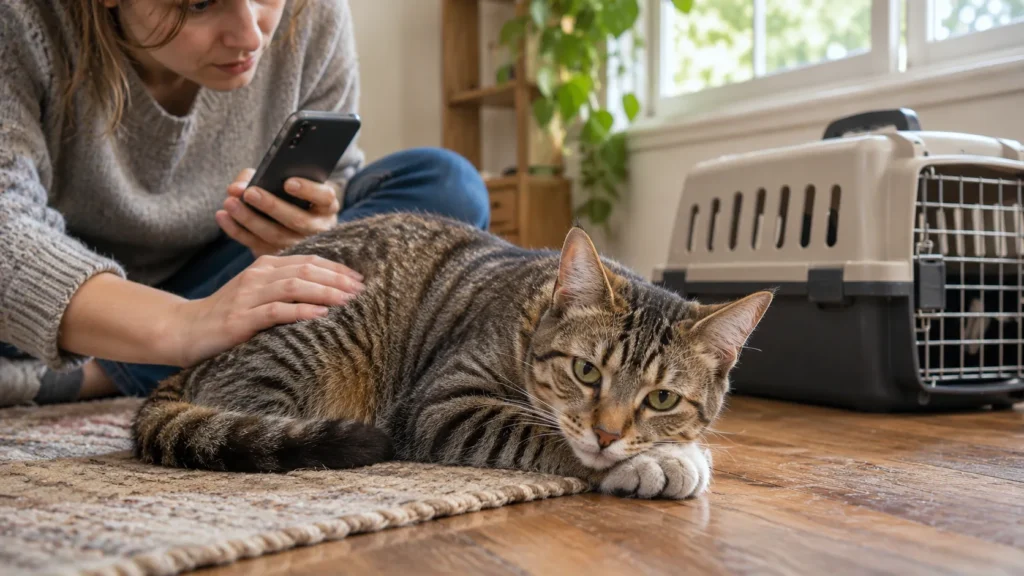
If your cat frequently vomits, has persistent diarrhea, loses weight, or eats less than usual, speak with your veterinarian before relying on a food change.
Affiliate disclosure: LumaPaw may earn a commission from qualifying purchases made through links in this article, at no additional cost to you. As an Amazon Associate I earn from qualifying purchases. Our assessments are based on manufacturer information, retailer listings, and customer-feedback patterns—not personal feeding trials or laboratory testing.
Compare the 8 Dry Cat Foods at a Glance
| Dry cat food | Why consider it | Important limitation | Recorded price per lb |
|---|---|---|---|
| Purina Pro Plan Lamb & Rice, 7 lb | Lamb-first adult formula with digestive-support ingredients | Contains chicken and other animal proteins | $4.01 |
| Hill's Science Diet Chicken & Rice, 7 lb | Adult nutrition supported by AAFCO feeding tests; prebiotic fiber | Higher cost and multiple protein ingredients | $5.57 |
| Purina ONE +Plus Sensitive, 16 lb | Turkey-first formula with good bulk value | Contains chicken, soy, and several grains | $2.15 |
| Purina Cat Chow Gentle, 13 lb | Lowest recorded price among these options | Poultry by-product meal first; broad ingredient list | $1.41 |
| Royal Canin Digestive Care, 6 lb | Fiber blend and distinctive ring-shaped kibble | Expensive; kibble shape doesn't suit every cat | $7.17 |
| Nulo Prowess Sensitive Stomach, 13 lb | Prebiotic fiber and guaranteed added probiotic | Small kibble; contains chicken and turkey | $3.54 |
| GO! Solutions Sensitivities Salmon, 12 lb | Salmon-focused recipe without listed chicken ingredients | Grain-free, legume-rich, and relatively expensive | $5.00 |
| Wholesomes Salmon & Rice, 10 lb | Fish-based recipe with grains at a moderate price | Contains multiple fish proteins; limited review evidence | $2.50 |
Prices are from Chewy one-time purchase listings recorded in November 2026. Prices, promotions, and availability can change. Cost per pound does not necessarily reflect the cost of feeding an equal number of calories.
Most of these foods are formulated for adult maintenance. GO! Solutions and Wholesomes have nutritional adequacy statements covering all life stages. Always check the statement on the package you purchase.
How We Researched These Dry Cat Foods
We compared manufacturer ingredient lists and nutritional information with Amazon and Chewy listings, focusing on protein sources, digestive-support ingredients, life-stage suitability, price, and practical limitations.
Customer reviews helped identify recurring experiences with food acceptance, stool consistency, vomiting, kibble texture, and packaging. We considered both favorable and critical feedback without treating individual reports as proof of a food's effectiveness.
Where manufacturer and retailer information differed, we avoided presenting uncertain specifications as settled facts. No product was selected simply because it had a high rating or a recognizable brand name.
The 8 Dry Cat Foods for Sensitive Stomachs
1. Purina Pro Plan Sensitive Skin & Stomach Lamb & Rice (7 lb)
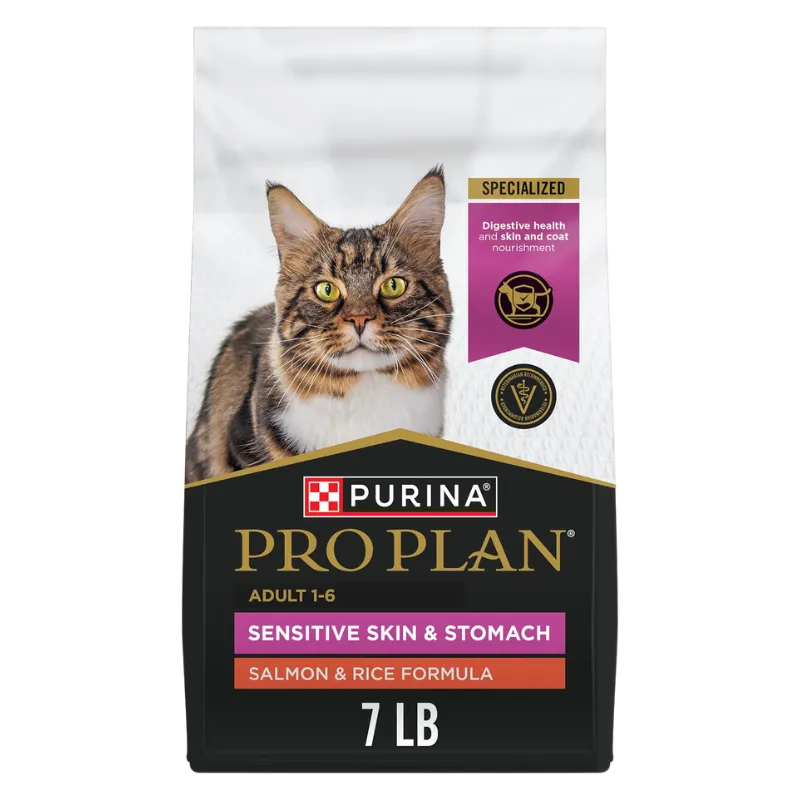
Everyday lamb-first sensitive-digestion formula
Purina Pro Plan Lamb & Rice is a useful starting point for adult cats whose owners want a complete dry food specifically formulated for digestive and skin support.
Lamb is the first ingredient, and the recipe includes rice and dried chicory root, a source of prebiotic fiber. It provides a conventional adult feeding option rather than an unusually restrictive ingredient list.
That distinction matters because lamb-first doesn't mean lamb-only. The published formula also contains chicken meal, fish meal, dried egg product, and soy ingredients.
For an owner avoiding those proteins, the recipe may not be suitable, even though lamb is featured prominently on the bag.
Customer feedback includes accounts of improved stool consistency and good acceptance. Some owners, however, report continued digestive problems or dissatisfaction with differences between purchases.
Compared with Hill's Science Diet, Purina Pro Plan offers a lamb-first alternative at a lower recorded price per pound. Both are complete adult foods with digestive-support ingredients, and neither has been shown here to work better for every sensitive cat.
Its main appeal is straightforward: a targeted everyday formula with substantial product documentation and a price below several specialty alternatives.
Who should consider it? Owners of adult cats who can tolerate the listed ingredients and want a conventional sensitive-digestion formula.
Main drawback: It contains several animal protein sources, making it a poor fit for a restricted-protein feeding plan.
2. Hill's Science Diet Sensitive Stomach & Skin Chicken & Rice (7 lb)
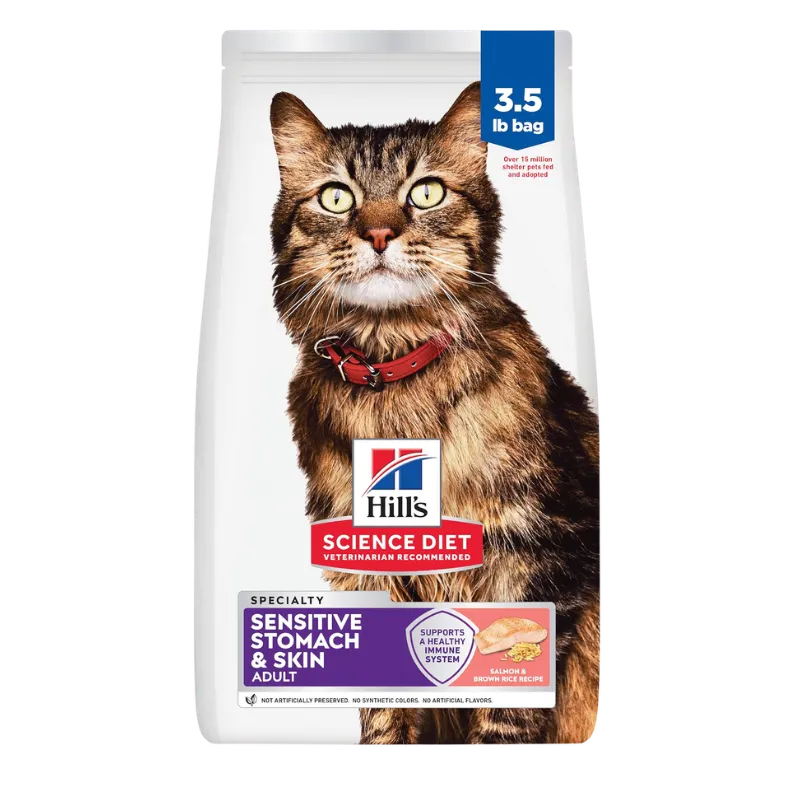
Chicken & rice formula with prebiotic fiber
Hill's Science Diet takes a chicken-and-rice approach, combining adult nutrition with added fiber ingredients intended to support digestive health.
The formula includes fructooligosaccharides (FOS), a prebiotic ingredient, alongside other fiber sources. Hill's also states that animal feeding tests using AAFCO procedures substantiate the food's complete and balanced nutrition for adult maintenance.
That feeding-test statement is meaningful nutritional documentation. It does not, however, establish that this food is more effective at reducing vomiting or diarrhea than competing formulas.
One reason to compare Hill's with Purina Pro Plan is the difference in their named primary animal ingredients. Hill's emphasizes chicken, while Purina Pro Plan emphasizes lamb. Both contain additional ingredients, so neither should be mistaken for a single-protein diet.
Customers frequently describe satisfactory acceptance and digestive tolerance. Critical feedback includes reports of digestive upset and perceived recipe changes, although those accounts do not establish what caused the symptoms.
Price is the clearest practical drawback. In our recorded comparison, Hill's costs substantially more per pound than Purina ONE or Cat Chow Gentle.
For owners who value its particular formulation and feeding-test substantiation, the higher cost may be acceptable. Others may find a less expensive complete adult food more practical.
Most suitable for: Adult cats whose owners prefer a chicken-and-rice formula with prebiotic fiber and documented nutritional adequacy.
Important limitation: It contains multiple ingredients that may be unsuitable for cats with specific dietary restrictions.
3. Purina ONE +Plus Sensitive Skin & Stomach (16 lb)
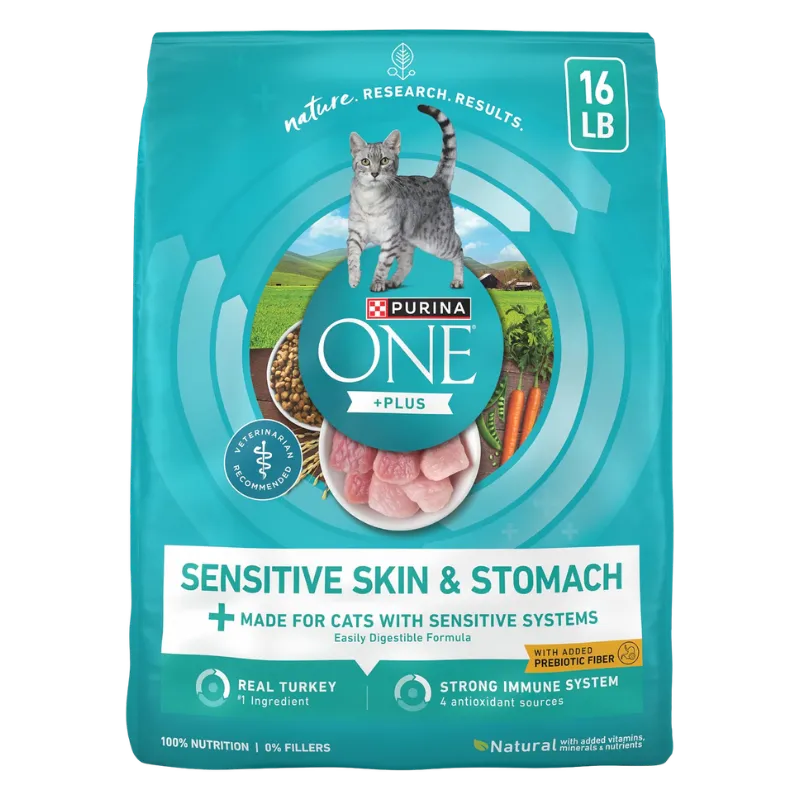
Value-oriented turkey-first formula
Purina ONE +Plus deserves attention from households trying to balance digestive-support ingredients with the ongoing cost of feeding their cats.
Turkey is the first ingredient, and the recipe includes dried chicory root for prebiotic fiber. The 16-lb bag was considerably less expensive per pound than Purina Pro Plan and Hill's during our comparison.
That difference becomes more important when feeding multiple cats or buying food regularly.
There's a catch, though: a large bag is a better investment once you know your cat will eat and tolerate the recipe. Buying 16 pounds for a first trial can leave you with a considerable amount of unused food.
The ingredient list is also broad. Chicken by-product meal, corn-based ingredients, and soy are included, so this isn't a suitable substitute for a limited-ingredient diet.
Customer experiences reflect both sides of that trade-off. Some owners describe better stools, less vomiting, and good appetite. Others mention continued digestive upset, food refusal, or differences in freshness and acceptance between bags.
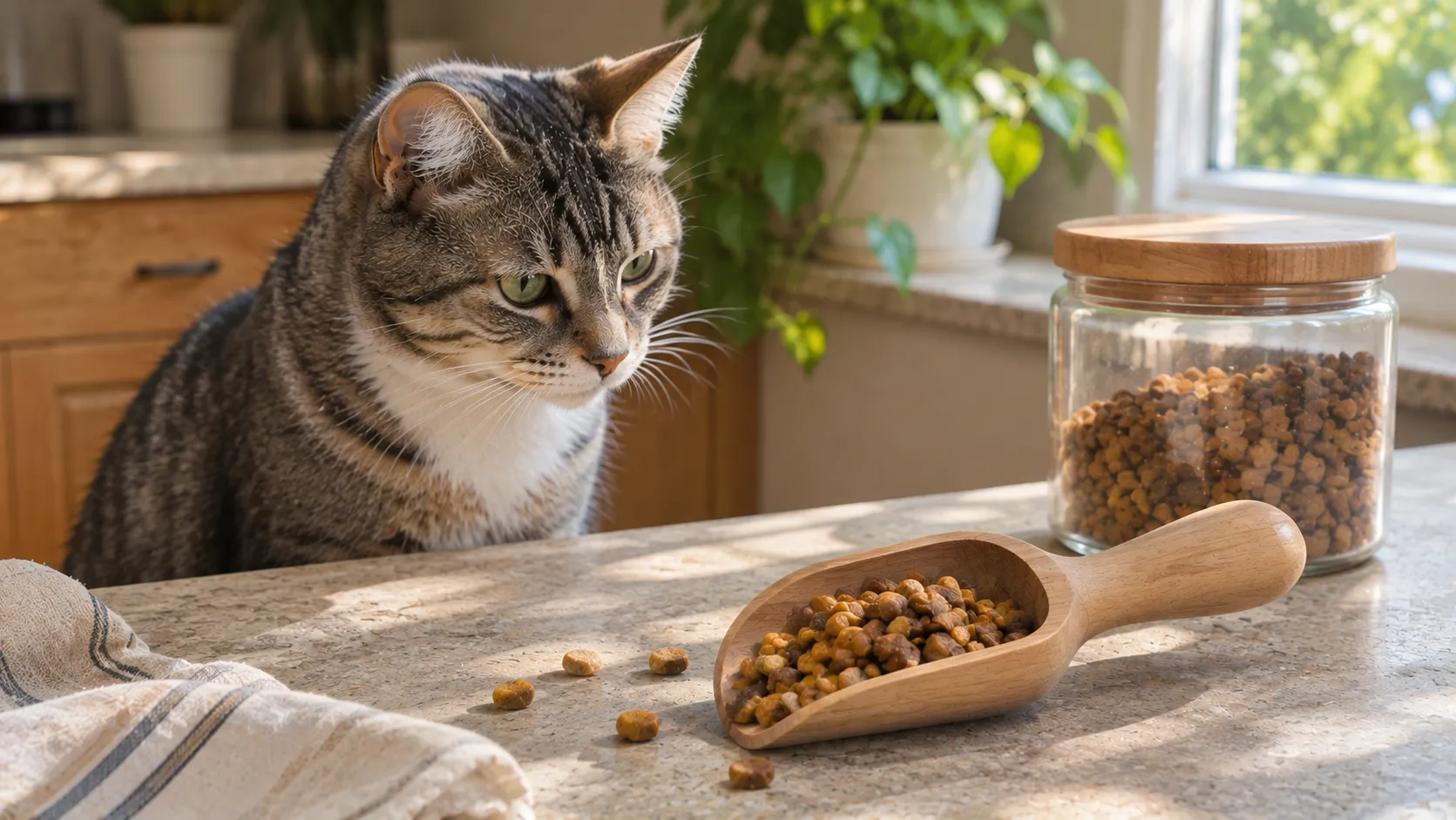
Storage deserves attention with a package this size. Keep the kibble in its original bag inside a clean, sealed container, away from excessive heat and moisture. Follow the product's freshness and storage guidance.
For a cat already doing well on the food, the large package may offer sensible value. For a first purchase, trying a smaller available size would reduce the risk of wasted food.
4. Purina Cat Chow Gentle (13 lb)
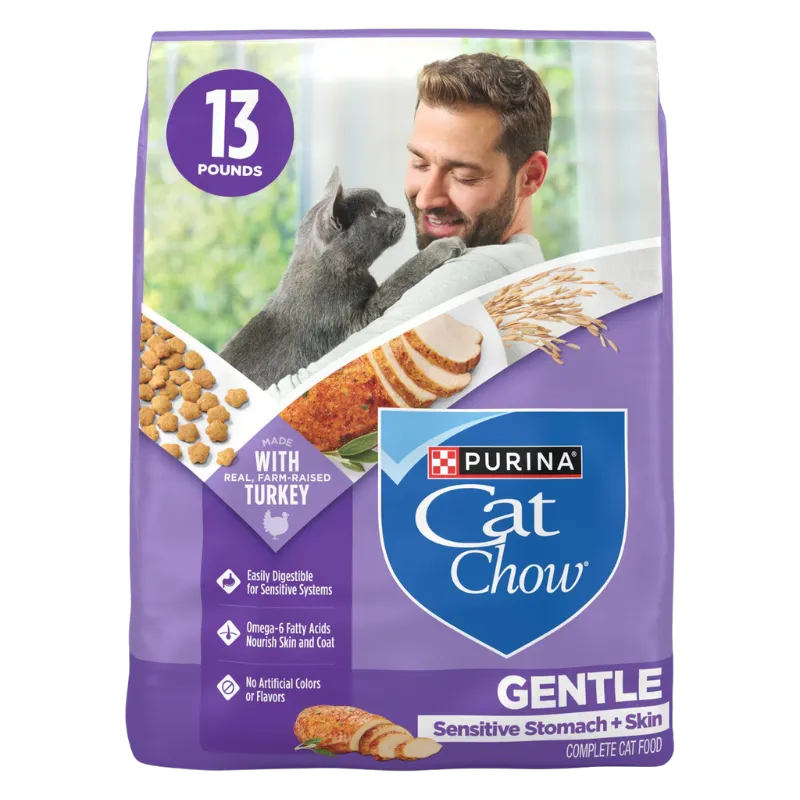
Lowest recorded price per pound
Purina Cat Chow Gentle was the least expensive food in our comparison, with its 13-lb bag listed at approximately $1.41 per pound.
That price makes it worth considering for owners who need an affordable, complete adult diet rather than assuming that only expensive foods can provide suitable nutrition.
Purina identifies the recipe as complete and balanced for adult maintenance. It also includes dried chicory root and is marketed for sensitive stomachs and skin.
The ingredients deserve a closer look.
Although the packaging highlights turkey, poultry by-product meal is the first ingredient, with turkey appearing much farther down the list. Corn protein meal, soybean meal, rice, and wheat are also included.
Poultry by-products aren't automatically poor-quality ingredients. They can contribute valuable nutrients when appropriately sourced and formulated. The Tufts veterinary nutrition team explains why by-products shouldn't be judged by their name alone.
Still, Cat Chow Gentle's broad ingredient list makes it less appropriate when a veterinarian has recommended avoiding specific proteins or other ingredients.
Many customer comments emphasize price and satisfactory acceptance. There are also reports of loose stools, refusal to eat the food, and excessive crumbs in some bags.
Compared with Purina ONE, Cat Chow offers a clearly lower recorded price but a different ingredient composition. The cheaper option isn't automatically worse, just as the more expensive one isn't automatically more digestible.
For adult cats without identified dietary restrictions, Cat Chow Gentle may be a practical everyday option. If your cat needs a carefully controlled ingredient trial, a broad formula like this is less useful.
5. Royal Canin Digestive Care Adult (6 lb)

Fiber-focused formula with ring-shaped kibble
Royal Canin Digestive Care has one of the most recognizable physical differences in this comparison: its ring-shaped kibble.
Royal Canin says the shape is intended to encourage chewing and slower eating. The recipe also contains a combination of fibers, including psyllium and prebiotic ingredients, as part of its digestive-support formulation.
The unusual shape is an interesting design choice, but its usefulness depends on how an individual cat eats.
Some customers report better stool consistency or good acceptance. Others say their cats swallow the pieces whole, struggle with the shape, or continue regurgitating after meals.
That makes the kibble a genuine trade-off rather than a guaranteed advantage.
If your cat frequently brings up food soon after eating, don't assume that switching to ring-shaped kibble will solve the problem. Vomiting and regurgitation can have different causes, and recurring episodes deserve veterinary assessment.
Royal Canin is also the most expensive option per pound in our recorded comparison. At approximately $7.17 per pound, the price difference is substantial.
Its fiber blend and kibble design make it worth comparing, particularly for owners interested in a different feeding experience. But a cat already doing well on a less expensive complete food may not benefit from changing.
Who might prefer it? Owners comparing different kibble designs and fiber-focused adult formulas.
Main limitation: The distinctive shape doesn't work equally well for every cat, and the food carries a considerable price premium.
6. Nulo Prowess Sensitive Stomach Chicken (13 lb)
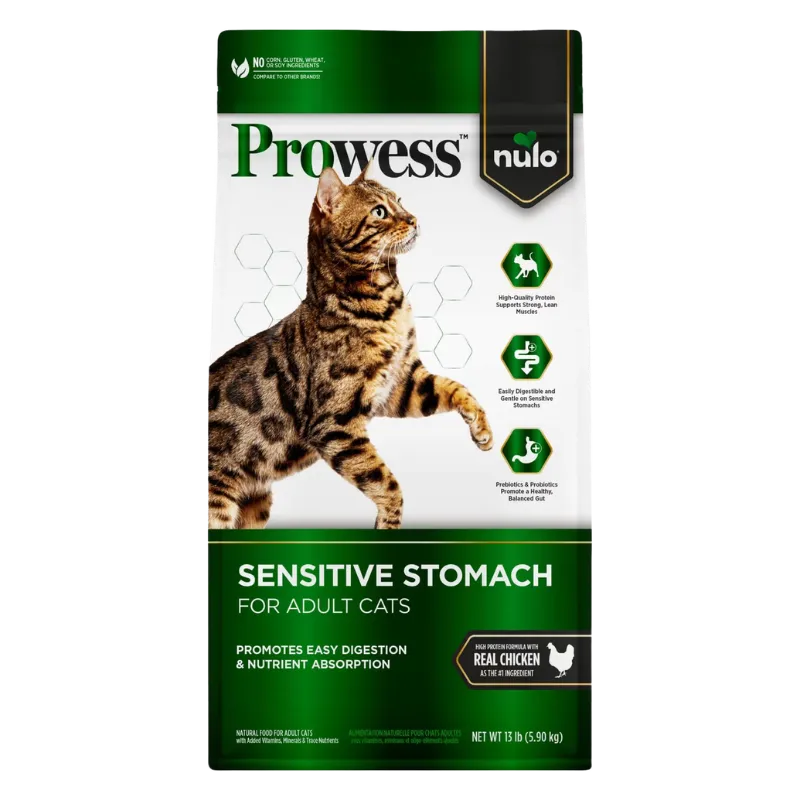
Formula with guaranteed added probiotic
Nulo Prowess distinguishes itself through a combination of prebiotic fiber and an added microbial ingredient with a published guarantee.
Its chicken-based adult recipe includes deboned chicken, chicken meal, and turkey meal, alongside fermentable fiber sources.
The standout specification is its Bacillus coagulans content. Nulo's product information lists a minimum of 80 million colony-forming units (CFU) per pound.
That is more specific than a general claim about digestive support. However, the presence of a guaranteed probiotic does not establish that this formula will prevent vomiting, resolve diarrhea, or provide better digestive outcomes than another complete food.
There is also a practical detail worth knowing before buying: the kibble is small.
Customer feedback includes reports of satisfactory acceptance and digestive tolerance, but some owners describe pieces scattering around feeding areas, food refusal, or ongoing stomach problems. Some favorable retailer reviews were incentivized, which limits how much weight they should carry in the overall assessment.
If your cat prefers larger kibble or tends to swallow small pieces rapidly, the texture and shape may influence whether this is a suitable choice.
Compared with Royal Canin, Nulo provides a different kind of digestive-support feature. Royal Canin emphasizes kibble design and a fiber combination; Nulo offers a documented added microbial ingredient.
Neither approach has been established as universally better.
Nulo is most relevant for adult-cat owners interested in a complete chicken-based food with guaranteed probiotic content. It isn't appropriate for diets that need to exclude chicken or turkey.
7. GO! Solutions Sensitivities Limited Ingredient Salmon (12 lb)
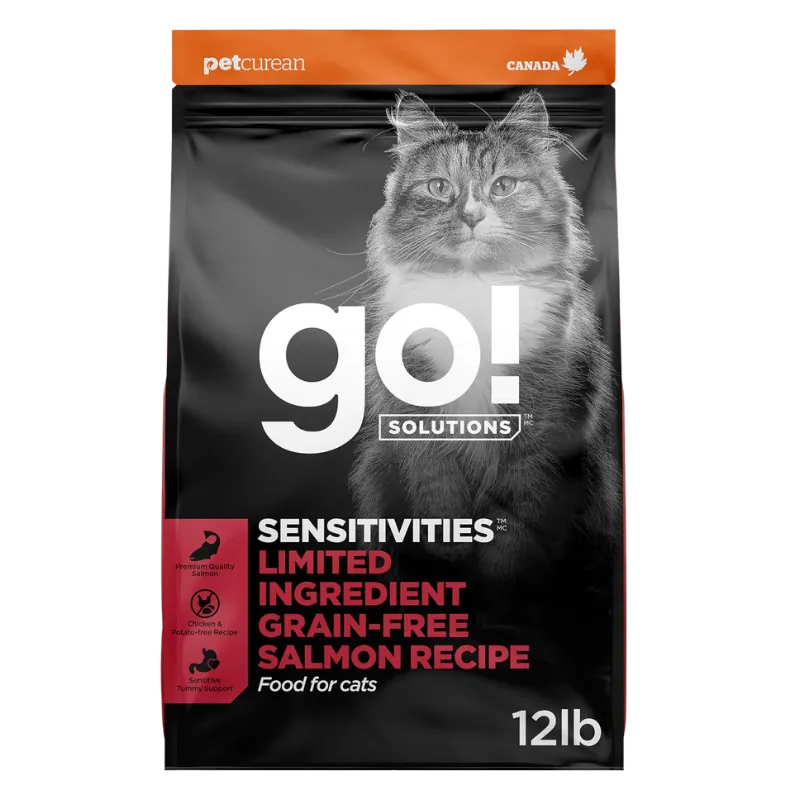
Salmon-focused limited-ingredient formula
GO! Solutions is different from most of the preceding foods because its published recipe focuses on salmon as the identified animal-protein source.
Deboned salmon and salmon meal lead the formula. It is also grain-free, with peas, lentils, chickpeas, and other plant ingredients contributing to the recipe.
The absence of listed chicken ingredients is useful for owners who need to avoid chicken in an ordinary commercial diet.
That doesn't make the food hypoallergenic. Salmon can itself be an allergen, and retail foods may be subject to cross-contact with other proteins during manufacturing.
If your veterinarian suspects a food allergy, a properly controlled elimination diet may be more appropriate than choosing a food based on a limited-ingredient label.
There is also no reason to assume that grain-free food is inherently gentler on a cat's stomach. This particular recipe replaces grains with a substantial amount of legumes and other plant ingredients, which may or may not suit an individual cat.
The available reviews illustrate that uncertainty. Some owners report better tolerance after moving away from poultry-based diets, while others describe vomiting, diarrhea, or outright refusal.
The review sample is smaller than that of several mainstream products, so it offers less evidence about how consistently cats accept the formula.
Price is another consideration. At roughly $5 per pound in our recorded comparison, this is an expensive choice for everyday feeding.
GO! Solutions makes the most sense when its ingredient selection serves a genuine need or preference. If your cat tolerates a less expensive complete food, the limited-ingredient positioning alone may not justify switching.
8. Wholesomes Sensitive Skin & Stomach Salmon & Rice (10 lb)
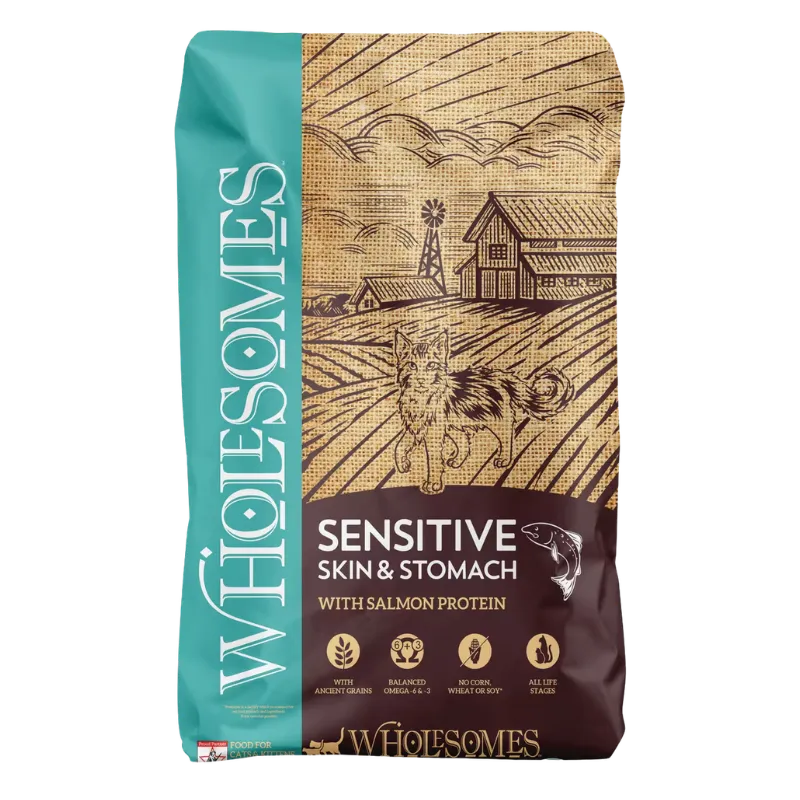
Affordable fish-based formula with grains
Wholesomes provides another option for owners interested in fish-based food, but its formulation is different from GO! Solutions.
Salmon meal is the first ingredient, followed by grains including brown rice, oatmeal, and barley. Whitefish meal adds another animal-protein source.
Instead of removing grains, the recipe includes them as part of a complete diet. It also costs considerably less than GO! Solutions in the selected package sizes.
That combination is its main appeal: a fish-based, grain-inclusive food at a more accessible price.
Wholesomes states that the formula meets nutritional adequacy requirements for all life stages, including growth. That makes its stated life-stage suitability broader than the adult-maintenance foods elsewhere in this comparison.
Still, owners feeding kittens need to follow growth-appropriate feeding guidance and seek veterinary advice if digestive symptoms persist.
The main evidence limitation is customer-feedback coverage. There are fewer reviews than for several of the better-established alternatives in this roundup.
Some buyers report good acceptance or improved stool consistency. Negative experiences include vomiting, refusal, and concerns about kibble size. The available reports are useful, but not sufficient to predict how most cats will respond.
For someone comparing chicken-free listed recipes, Wholesomes is a meaningful alternative to GO! Solutions. It contains grains and multiple fish proteins rather than a salmon-focused, grain-free ingredient arrangement.
It's worth considering when your cat can tolerate fish and grains, and price is an important part of the decision.
How to Choose Dry Cat Food for a Sensitive Stomach
How to Switch to a New Dry Cat Food
When a Sensitive-Stomach Formula Isn't Enough
Frequently Asked Questions
Can kittens eat sensitive-stomach dry cat food?
Only if the food is nutritionally appropriate for their growth stage.
Most products in this comparison are intended for adult maintenance. GO! Solutions and Wholesomes have all-life-stages adequacy statements, but portion sizes and overall suitability still depend on the kitten's age and health.
For growth-appropriate foods when digestive sensitivity is a concern, see our sensitive-stomach kitten food guide. For general kitten nutrition, see our guide to choosing food for kittens.
Kittens experiencing recurring vomiting, diarrhea, poor appetite, or inadequate weight gain need veterinary attention rather than repeated food experiments.
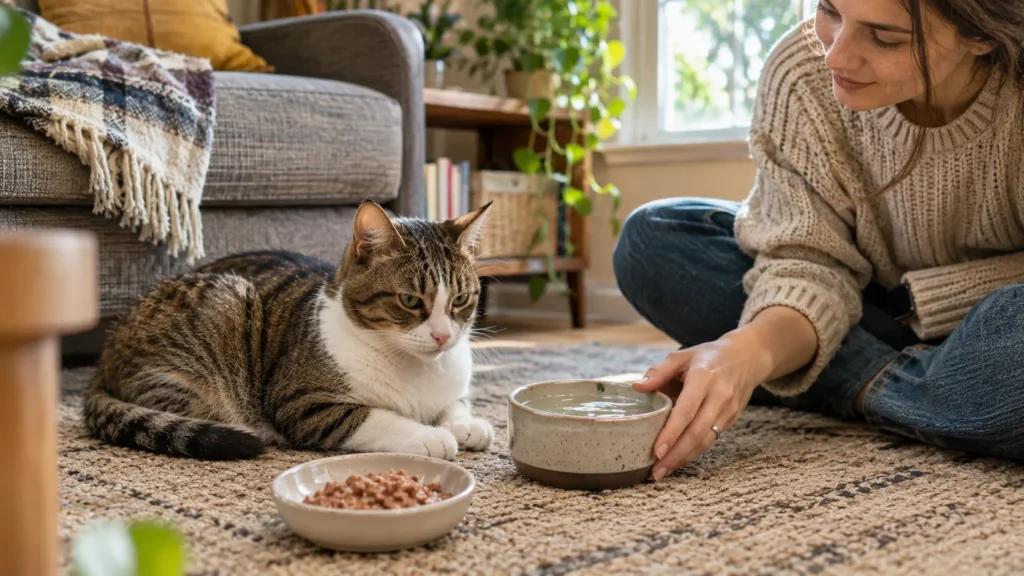
Can you mix sensitive-stomach dry food with wet food?
Yes, provided both foods are suitable for your cat and the combination meets its nutritional needs.
Account for calories from both foods to avoid overfeeding. If your cat has a diagnosed food allergy or follows a therapeutic diet, check with your veterinarian before adding another product.
Introduce dietary changes gradually and monitor your cat's response.
Which Dry Cat Food Should You Choose?
Start with your cat's actual needs rather than the most expensive bag or the strongest digestive-health claim.
For everyday adult feeding, compare the ingredient profiles and nutritional documentation of Purina Pro Plan and Hill's. If ongoing cost is the priority, Purina ONE and Cat Chow Gentle provide two different price points.
Royal Canin and Nulo are worth comparing for their distinct digestive-support formulations. GO! Solutions and Wholesomes offer alternatives when avoiding listed chicken ingredients is important.
Whichever food you consider, check that it's complete for your cat's life stage, suitable for any dietary restrictions, and affordable enough to feed consistently.
And if digestive symptoms continue, finding out why your cat is unwell matters more than choosing another food labeled “sensitive stomach.”