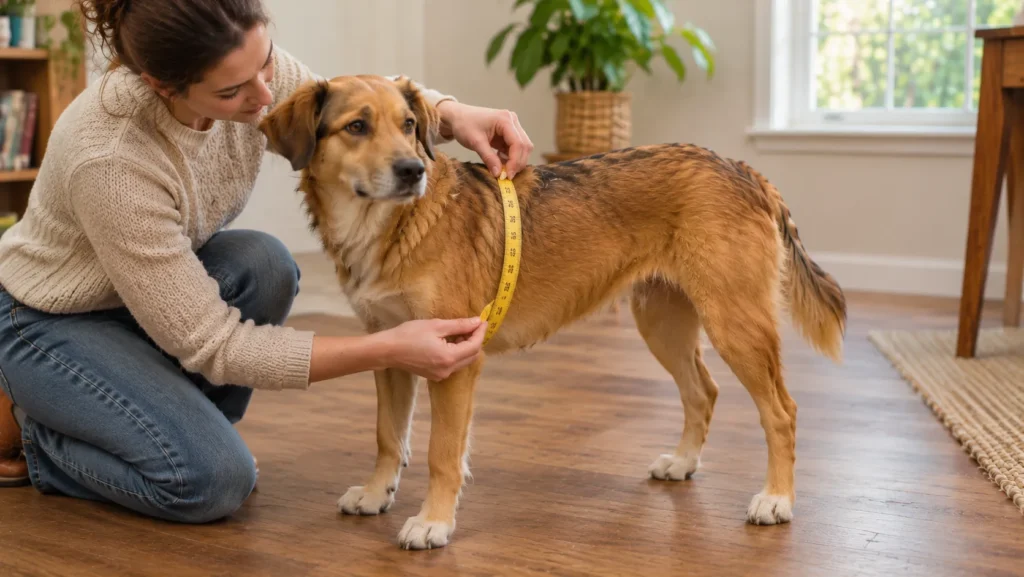

A step-in dog harness can make daily walks easier when your dog dislikes having equipment pulled over their head. Instead of slipping a neck opening into place, you guide your dog's front paws through the harness and fasten it across the back.
But step-in harnesses aren't all alike. Some are soft mesh vests with limited adjustment. Others use adjustable straps, low-cut designs, or mechanisms intended to make backing out more difficult. The right choice depends on your dog's measurements, body shape, and how they behave on a leash.
We compared six step-in dog harnesses based on their construction, sizing, closures, customer feedback, and practical limitations. Whether you're shopping for a small dog or want a less bulky walking harness, these options offer different reasons to consider them.
Affiliate disclosure: LumaPaw may earn a commission from qualifying purchases through links on this page, at no additional cost to you. Our recommendations are based on product information, retailer listings, and customer feedback—not hands-on testing.
The 6 Best Step-In Dog Harnesses at a Glance
| Step-In Dog Harness | Our Pick | Main Limitation |
|---|---|---|
| Voyager Step-In Air | Best Simple Mesh Vest | Limited adjustability |
| Voyager Step-In Lock | Best for Adjustable Mesh Fit | More buckles and adjustments |
| Gooby Escape Free Easy Fit | Contracting Harness for Backing-Out Attempts | Security depends on fit and leash tension |
| Gooby Comfort X Step-In Lite | Best Low-Cut X-Frame Design | Limited independent adjustment |
| LupinePet Basic Solid Step-In | Best Minimal-Coverage Webbing Design | Not ideal for strong pullers or escape-prone dogs |
| Gooby Simple Step-In III | Best Without Hook-and-Loop Fastening | Fit limitations and plastic leash ring |
Select a harness name in the table to jump straight to its full review.
For a straightforward mesh vest, start with the Voyager Step-In Air. If you need more adjustment, the Voyager Step-In Lock is worth comparing. Gooby's two specialty designs offer different approaches to body coverage and backing-out concerns.
If you're not sure a step-in design suits your dog, our guide to choosing a dog harness covers other walking styles and attachment options.
How We Researched These Step-In Dog Harnesses
We compared manufacturer specifications, Amazon and Chewy listings, sizing charts, materials, fastening systems, leash attachments, and available customer feedback.
We focused particularly on the problems that can make a harness frustrating or unsuitable: confusing size charts, straps that loosen, closures that wear, rubbing behind the front legs, and dogs slipping out during walks.
Customer reviews helped identify experiences worth considering, but they have limitations. A harness that fits one dog well may sit awkwardly on another, and a single report of broken hardware doesn't establish a widespread defect.
We also looked for meaningful differences between products. A basic mesh vest, an adjustable nylon harness, and a contracting design shouldn't receive interchangeable recommendations simply because they all allow step-in entry.
LumaPaw has not physically tested these harnesses. The assessments below reflect documented product features, reported owner experiences, and comparisons between designs.
The 6 Step-In Dog Harnesses Reviewed
1. Voyager Step-In Air — Best Simple Mesh Vest
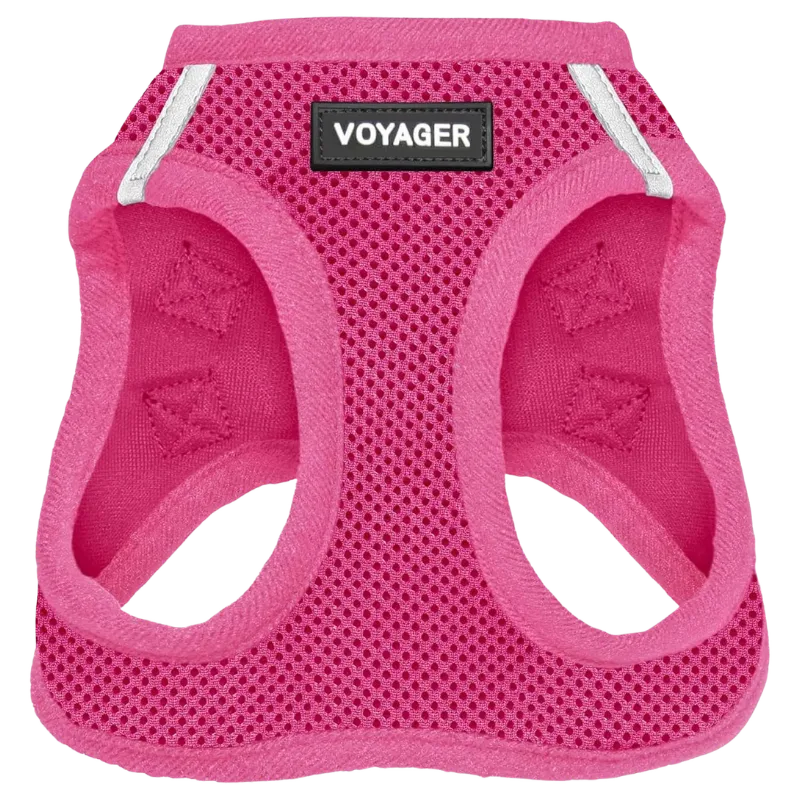
Product snapshot: Fuchsia with Matching Trim, Small; approximately 14.5–16-inch chest range in the manufacturer's sizing information; polyester air mesh; hook-and-loop fastening, back buckle, two metal D-rings, and reflective bands.
The Voyager Step-In Air is the simplest place to begin if you want a conventional mesh step-in harness without several straps to adjust.
Lay it open, guide your dog's front paws into the openings, bring the sides together, secure the hook-and-loop fastening, and close the buckle. Its two metal leash rings sit at the back, where they're brought together for the leash connection.
The mesh vest spreads fabric coverage across more of the chest than a narrow nylon strap design. It also feels less complicated to put on once you've found the right size.
That simplicity is the main attraction. The tradeoff is that the Air offers relatively little adjustment. Unlike the Voyager Lock, it doesn't have separate straps that you can tighten around different parts of your dog's body.
Many owners appreciate how quickly the Air goes on and how little it weighs, particularly for small dogs. Fit is the recurring concern: some find it too tight or too loose, while others report dogs backing out or problems with the closures.
Those experiences make careful measurements particularly important. A soft vest isn't necessarily secure if the leg openings don't suit your dog's proportions.
Pros
- Straightforward step-in dressing with no overhead opening.
- Lightweight mesh with reflective bands.
- Hook-and-loop fastening, buckle, and two leash rings.
Cons
- Limited adjustment compared with strap-based alternatives.
- Fit and escape complaints appear in customer feedback.
- Hook-and-loop fastening needs regular inspection for wear.
Best for: Small dogs that tolerate paw handling, fit the available measurements well, and need an uncomplicated everyday walking harness.
Avoid if: Your dog frequently backs out of harnesses, falls between sizes, or needs extensive fitting adjustments.
2. Voyager Step-In Lock — Best for Adjustable Mesh Fit
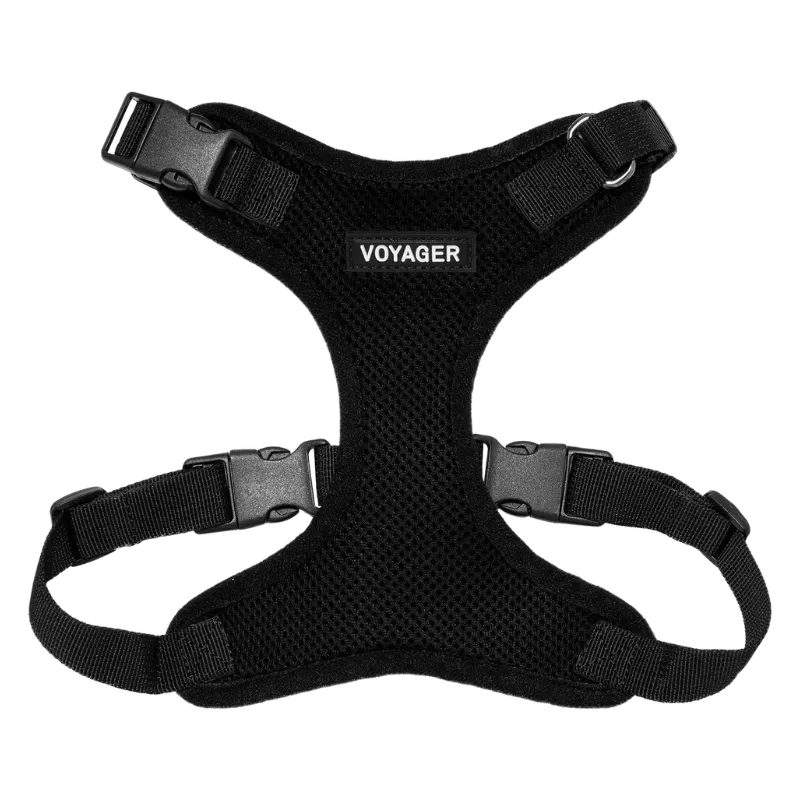
Product snapshot: Black, Medium; 17–21-inch chest in the reviewed listing; breathable padded mesh, adjustable neck and chest straps, rear leash hardware, and buckle closures.
The Voyager Step-In Lock addresses the main limitation of the Air: not every dog fits neatly into a mostly fixed-shape vest.
Its adjustable neck and chest straps provide more control over how the harness sits. That can be useful for dogs with proportions that make a conventional mesh vest awkward, although the available adjustment still has limits.
The Lock uses a wider padded mesh shape with a rounded neckline. It retains step-in entry, so there's no need to pull the harness over the dog's head.
The benefit becomes clearer when comparing two dogs with similar chest measurements but different neck or shoulder proportions. A fixed-size vest may fit one comfortably while leaving too much space around the other. Separate adjustment points give you more room to refine the fit.
The extra adjustment also means more straps and buckles to manage. Some owners appreciate the flexibility, while others report awkward sizing, buckles that are difficult to release, or the harness shifting during walks.
The added flexibility is worthwhile only if you take the time to adjust everything correctly and check that it stays in position.
Pros
- Adjustable neck and chest sections.
- Padded mesh construction with step-in entry.
- More fitting flexibility than Voyager Air.
Cons
- More closures and adjustments to manage.
- Some owners report difficult buckles or awkward sizing.
- No guarantee against backing out.
Best for: Owners who prefer a mesh step-in harness but need more adjustment than a conventional vest provides.
Avoid if: You want the simplest possible fastening process or your dog becomes impatient with repeated adjustments.
3. Gooby Escape Free Easy Fit — Contracting Harness for Backing-Out Attempts
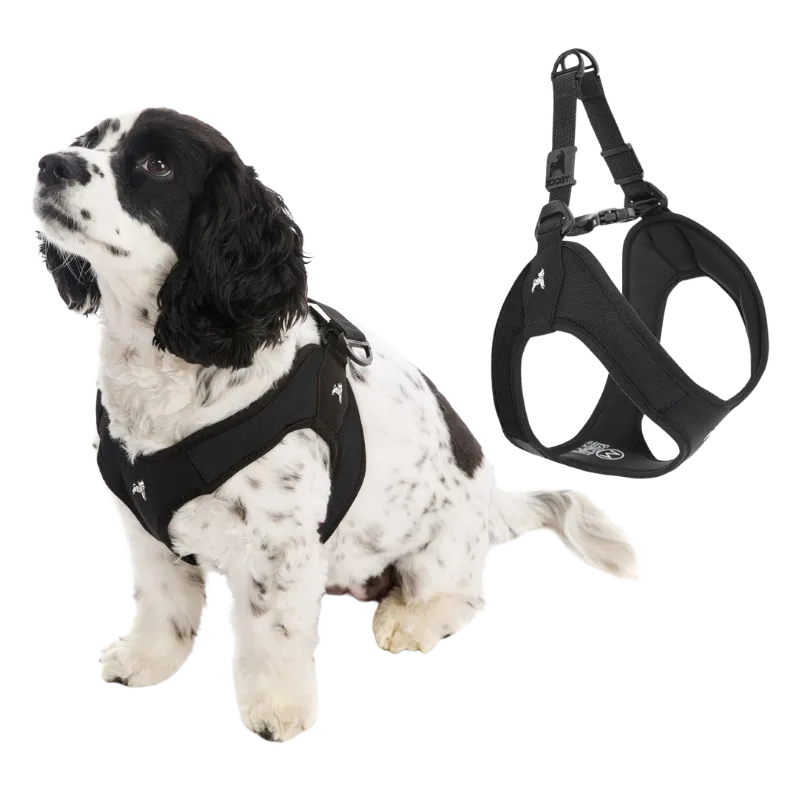
Product snapshot: Black, Large; 20.25–24.75-inch chest; neoprene body, padded shoulder areas, microsuede trim, adjustable tabs, quick-release buckle, and POM plastic leash ring.
Some dogs don't simply walk forward when they dislike a harness. They stop, plant their feet, and pull backward. Depending on the design and fit, that movement can allow them to slip out.
The Gooby Escape Free Easy Fit takes a different approach from ordinary step-in vests.
According to Gooby, its patented construction contracts around the dog's chest when active tension develops on the leash, including during backward pulling. When that tension disappears, the harness loosens again.
The Easy Fit also uses a neoprene body with compressed-foam padding around the shoulders. Compared with a broad mesh vest, it offers a different balance of material coverage, adjustment, and contact points.
Some owners report that the Easy Fit helped with dogs that had slipped out of ordinary harnesses. Others describe sizing problems, continued escapes, or concerns about the plastic leash hardware.
That doesn't make the mechanism useless. It means its effectiveness depends on circumstances that a product description cannot fully predict.
The manufacturer itself acknowledges that the design cannot prevent every escape. The contracting action also relies on active leash tension, so it should not be treated as a permanent restraint mechanism.
Pros
- Distinct contracting design activated by leash tension.
- Step-in entry without pulling the harness over the head.
- Padded neoprene construction with adjustable tabs.
Cons
- Not escape-proof.
- Uses a POM plastic leash ring rather than metal.
- Costs more than several conventional step-in harnesses.
Best for: Owners concerned about backward slipping who want to investigate a different harness mechanism and can achieve a close, comfortable fit.
Avoid if: Your dog repeatedly escapes equipment, pulls forcefully in several directions, or needs a harness with independently adjustable straps and different leash-attachment options.
4. Gooby Comfort X Step-In Lite — Best Low-Cut X-Frame Design
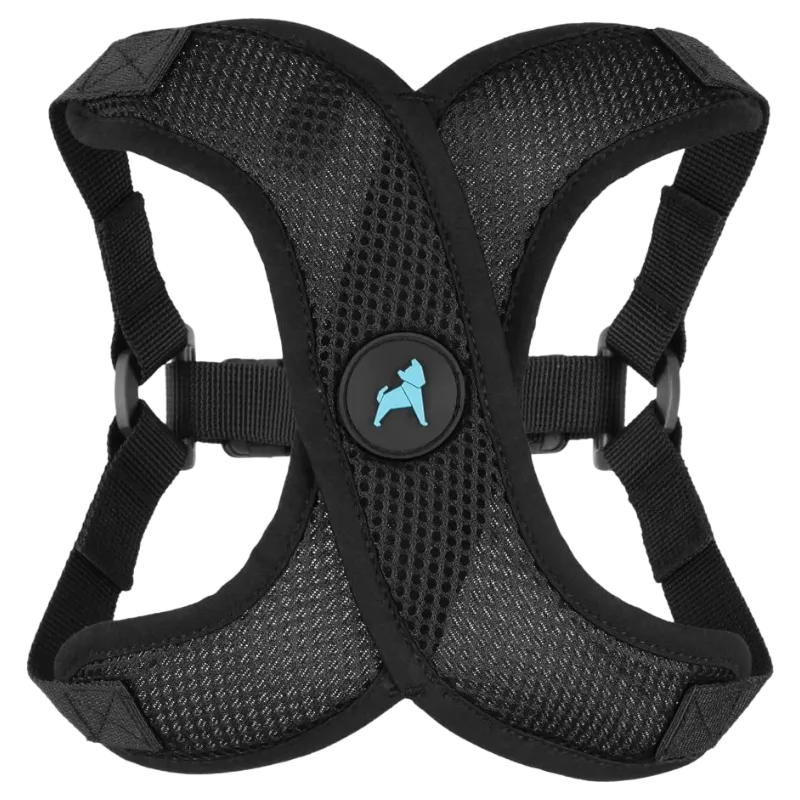
Product snapshot: Black, X-Large; 22–28-inch chest; lightweight mesh, deep-V X-frame, microsuede trim, quick-release buckle, metal D-rings, and sizing-adjustment tab.
The Gooby Comfort X Step-In Lite stands out because of its front-body shape rather than simply its fastening system.
Its X-frame creates a deep V-shaped opening intended to sit below the throat. That gives it a different contact pattern from mesh vests that wrap more broadly around the upper chest.
The design may appeal to owners who dislike how a conventional vest sits high across their dog's front. However, the shape alone cannot establish that the harness eliminates neck pressure or discomfort in every dog.
Gooby also includes a tension-activated contracting feature in this model. That's important because the Comfort X isn't simply an ordinary mesh harness with an unusual neckline.
It differs from the Escape Free Easy Fit in its lighter mesh construction, X-frame geometry, and metal leash rings. The Easy Fit uses a neoprene body and POM plastic ring instead.
The Comfort X has a sizing-adjustment tab, but it doesn't offer the same independent neck and chest adjustment as some strap-based harnesses. Owners who like the lightweight mesh and low-cut shape also report occasional looseness, shifting straps, and sizing difficulties.
Some reviews also discuss earlier configurations of Gooby harnesses. Those accounts shouldn't automatically be applied to every current version.
Pros
- Distinct deep-V X-frame construction.
- Lightweight mesh and metal leash rings.
- Step-in entry with a quick-release buckle.
Cons
- Limited independent adjustment.
- Fit may be difficult for dogs between size ranges.
- The X-frame doesn't guarantee protection from neck pressure.
Best for: Owners seeking a low-cut, mesh step-in design with less material positioned high across the front of the neck.
Avoid if: Your dog needs extensive individual strap adjustments or has medical concerns requiring a veterinarian's advice on suitable walking equipment.
5. LupinePet Basic Solid Step-In — Best Minimal-Coverage Webbing Design
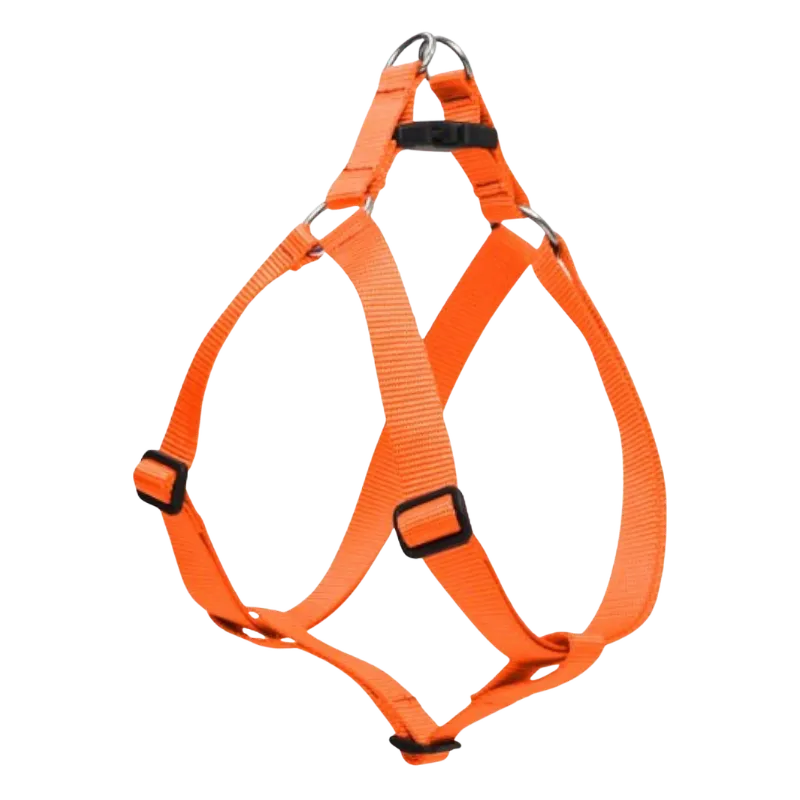
Product snapshot: Blaze Orange, Large; 1-inch nylon webbing; 24–38-inch adjustable size range; multiple adjustment points, welded steel hardware, and a back buckle.
Not everyone wants a mesh vest covering their dog's chest. The LupinePet Basic Solid Step-In offers a more traditional arrangement of nylon straps.
Its webbing construction leaves more of the dog's body uncovered while allowing adjustment around several areas. The selected Large variation uses 1-inch-wide straps and accommodates a broader chest range than the smaller mesh harnesses reviewed above.
LupinePet uses woven nylon webbing, welded steel leash hardware, and adjustable straps. The leash is intended to connect to both rear rings.
The reduced fabric coverage is useful for owners who prefer a simpler strap-based design, although it doesn't automatically make the harness cooler or more comfortable. Narrow straps can rub or concentrate pressure if they're poorly positioned.
LupinePet also offers an Even if Chewed replacement program. That is a useful ownership benefit, but it isn't a claim that the product cannot be damaged. The program generally provides one replacement for eligible accidental damage, subject to the manufacturer's conditions and possible shipping charges.
Owners describe positive experiences with the adjustable fit, construction, and ease of dressing, including some reports of satisfactory long-term use. Others mention difficult fitting, webbing wear, or dogs backing out.
One limitation deserves particular attention: LupinePet itself recommends considering its Roman-style harness for excitable dogs or those that pull, acknowledging that some dogs can escape step-in designs.
That manufacturer caution makes the intended use clearer than an unqualified durability or security claim would.
Pros
- Adjustable nylon-webbing construction.
- Metal leash hardware and relatively little fabric coverage.
- Manufacturer replacement program for eligible damage.
Cons
- More expensive than several mesh alternatives in the researched listings.
- Strap placement requires careful fitting.
- Not the manufacturer's preferred style for strong pullers or escape-prone dogs.
Best for: Owners who prefer adjustable traditional webbing over a fabric vest, especially when a step-in entry method is important.
Avoid if: Your dog frequently backs out, pulls hard, or develops irritation where narrow straps contact the skin.
6. Gooby Simple Step-In III — Best Without Hook-and-Loop Fastening
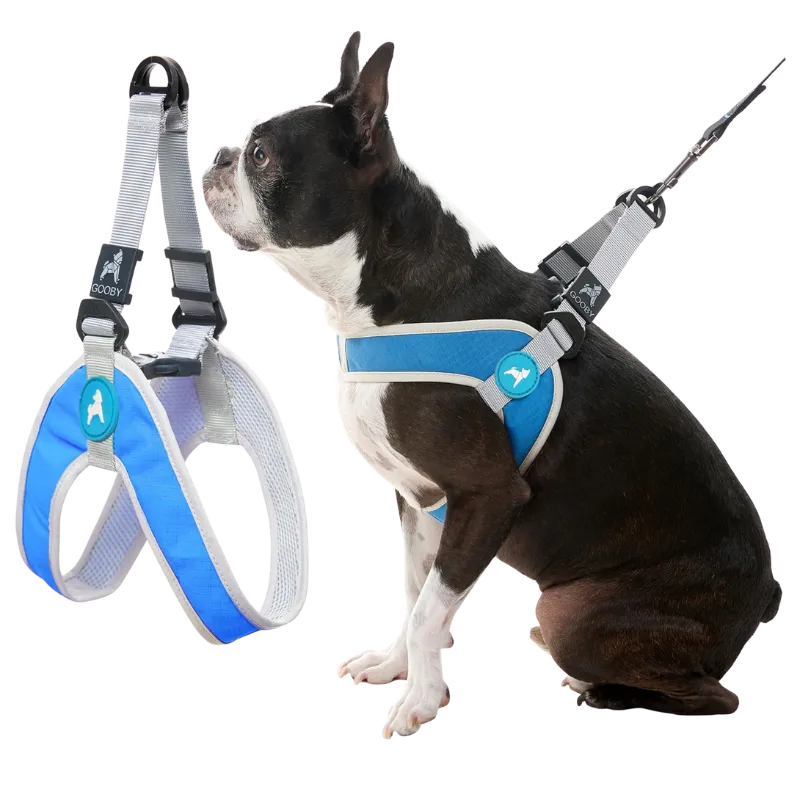
Product snapshot: Blue, Medium; 16.75–21.5-inch chest; breathable inner mesh, synthetic outer layer, quick-release buckle, sliding chest adjustment, and POM plastic leash ring.
The Gooby Simple Step-In III is worth considering for a fairly specific reason: it avoids the hook-and-loop fastening found on several conventional mesh vests.
Instead, it uses a buckle and sliding adjustment arrangement. That may appeal to owners who dislike dealing with fabric fasteners that collect hair or gradually lose their grip.
The harness combines an inner mesh lining with an outer layer that Gooby describes as scratch-resistant. It has a relatively compact shape without the broad padded coverage of some traditional vests.
The Simple Step-In III doesn't use the same tension-activated contracting mechanism as Escape Free Easy Fit. Its sliding adjustment is intended to establish the fit rather than automatically tighten in response to backward pulling.
Some owners appreciate the uncomplicated dressing process and lighter construction. Others report sizing difficulties, straps shifting, or dogs slipping out. A few also describe the plastic leash ring as inconvenient when attaching a leash.
Those drawbacks matter most when the harness is being considered for an unusually shaped dog or one that frequently pulls backward.
Pros
- No hook-and-loop fastening.
- Simple buckle and sliding-adjustment arrangement.
- Lightweight inner mesh and compact construction.
Cons
- Limited adjustment compared with multi-strap harnesses.
- POM plastic leash ring.
- Not designed around the Easy Fit contracting mechanism.
Best for: Owners seeking a straightforward step-in harness without hook-and-loop fastening for a dog that fits the available measurements.
Avoid if: Your dog needs substantial fitting adjustments or repeatedly attempts to escape.
Common Questions About Step-In Dog Harnesses
Are Step-In Dog Harnesses Good for Dogs That Pull?
They can be used for walking, but step-in entry doesn't automatically provide pulling control.
Most of the harnesses reviewed here attach the leash at the back. That arrangement may be convenient for relaxed walking, but it won't necessarily redirect a dog that pulls strongly.
Gooby's contracting harnesses have a different mechanism intended to respond to leash tension. That should not be confused with loose-leash training or a guarantee that pulling will stop.
If pulling is your primary concern, compare front-clip dog harnesses and consider reward-based leash training. A well-fitted harness can be part of the solution, but it doesn't teach walking manners by itself.
Can Dogs Wear Step-In Harnesses All Day?
A harness intended for ordinary walks shouldn't automatically be left on throughout the day.
Extended wear may create opportunities for rubbing, trapped moisture, or irritation, particularly around straps and the front legs. Loose or damaged equipment may also catch on objects during unsupervised activity.
Remove the harness when your dog no longer needs it for walking, unless a veterinarian has specifically advised otherwise for a medical or mobility-related purpose.
Check the skin and coat regularly, especially when introducing a new harness. Replace equipment with damaged stitching, unreliable buckles, or worn attachment hardware.
Which Step-In Dog Harness Should You Choose?
The right step-in harness depends less on a universal product ranking and more on how its construction works for your dog.
For a basic mesh vest, the Voyager Step-In Air offers straightforward daily dressing, provided its limited adjustment suits your dog's proportions.
If you want mesh with more flexibility, the Voyager Step-In Lock offers adjustable neck and chest sections.
The Gooby Escape Free Easy Fit is worth examining for its tension-activated contracting design, while the Gooby Comfort X Step-In Lite offers a different low-cut front shape with its own contracting feature.
For owners who prefer less fabric, the LupinePet Basic Solid Step-In provides traditional adjustable nylon webbing. The Gooby Simple Step-In III offers another straightforward option without hook-and-loop fastening.
None of these harnesses is the right choice for every dog. Measure carefully, check the closures and fit, and pay attention to how your dog moves and responds while wearing it.
A harness that fits securely and comfortably is more useful than one chosen because of a bestseller badge or an impressive product description.