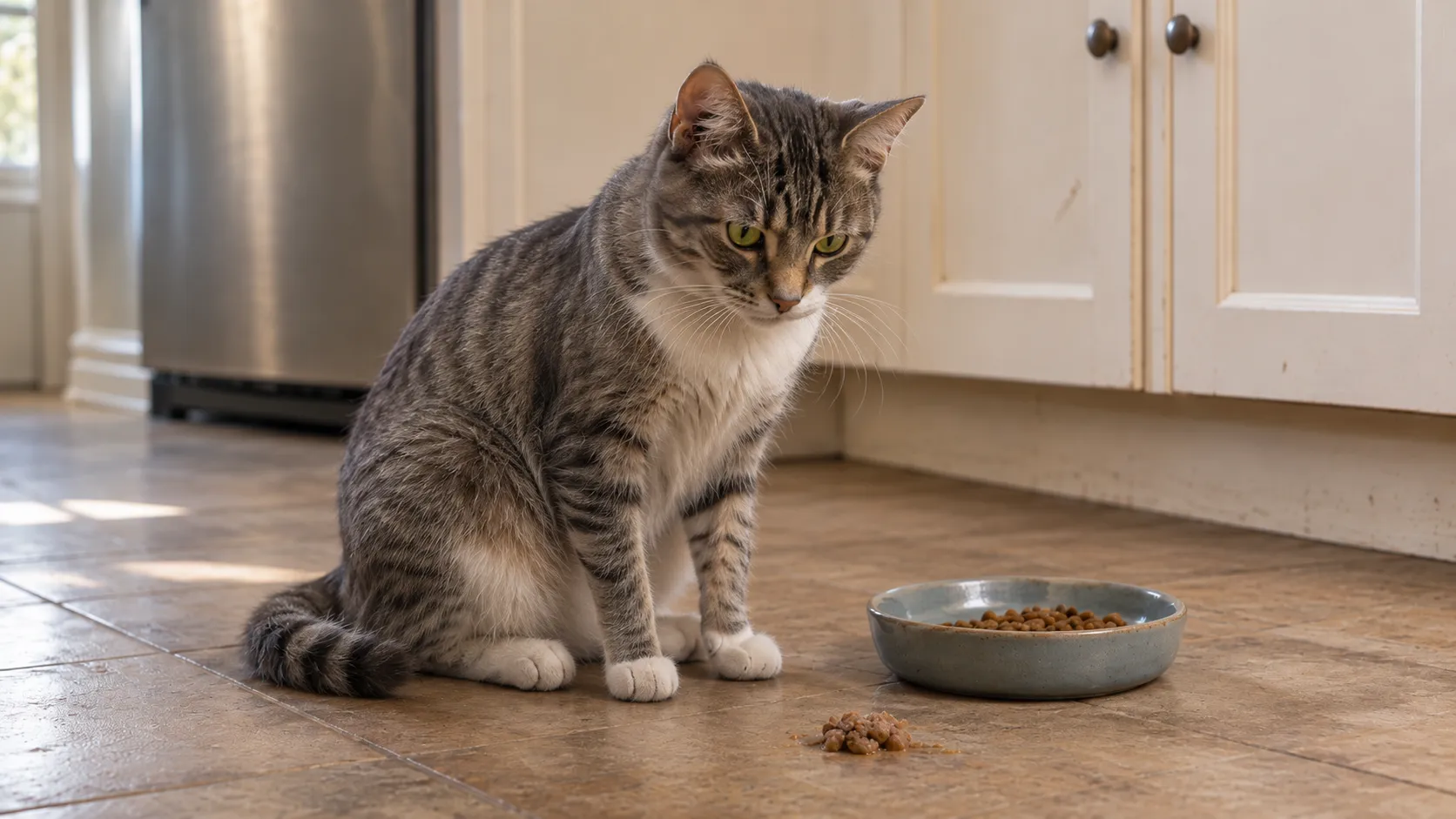
If your cat throws up after eating, the problem could be related to eating too quickly, large meals, a recent food change, or an underlying health condition. Sometimes, what looks like vomiting is actually regurgitation, which happens when food comes back up without the muscular effort associated with vomiting.
An isolated episode in an otherwise healthy adult cat may not indicate a serious problem. However, bringing up food regularly, even when your cat seems perfectly fine afterward, deserves veterinary attention.
Understanding how your cat brings up food, when it happens, and whether other symptoms are present can help you decide what to do next.
Seek immediate veterinary care if your cat may have swallowed a dangerous object or toxic substance, appears severely ill, or cannot keep water down.
Is Your Cat Vomiting or Regurgitating?
Although both can leave a pile of food on the floor, vomiting and regurgitation are different processes. Watching what happens just before your cat brings up food can provide more useful information than examining the food alone.
How to Recognize Regurgitation
Regurgitation is generally a passive process in which food or liquid returns from the esophagus, the tube connecting the mouth to the stomach.
Your cat may suddenly bring up recognizable pieces of food with little warning or visible effort. This often happens shortly after eating or drinking.
Eating too quickly can contribute to regurgitation, but repeated episodes may also indicate a problem affecting the esophagus.
How to Recognize Vomiting
Vomiting usually involves noticeable muscular effort. Before bringing up food, your cat may become restless, lick their lips, drool, or swallow repeatedly.
You may then notice retching and contractions of the abdominal muscles. The material brought up can contain partially digested food, undigested food, liquid, or foam.
VCA Animal Hospitals explains that observing the physical effort involved can help distinguish vomiting from regurgitation.
| Feature | Regurgitation | Vomiting |
|---|---|---|
| Physical effort | Usually minimal | Noticeable abdominal contractions |
| Signs of nausea | Usually absent | May include drooling or lip licking |
| Timing | Often shortly after eating | Can occur immediately or later |
| Food appearance | Often undigested | May be digested or undigested |
These differences are useful clues, not a way to diagnose your cat at home. Undigested food, for example, can be present in both vomiting and regurgitation.
When Should You Worry About Your Cat Throwing Up?
The frequency of episodes, your cat's general health, and any accompanying symptoms matter more than whether the food looks digested.
Signs That Your Cat Needs Emergency Care
Seek emergency veterinary attention if your cat:
- Cannot keep water down because of repeated vomiting.
- May have swallowed string, ribbon, medication, a toxic plant, or another dangerous substance.
- Has severe abdominal pain or noticeable abdominal swelling.
- Collapses, struggles to stand, or appears extremely weak.
- Has difficulty breathing.
- Vomits blood, even in small amounts, or brings up dark material resembling coffee grounds.
Do not wait to see whether a feeding adjustment helps in these situations.
When to Contact Your Veterinarian
Arrange prompt veterinary assessment if vomiting or regurgitation becomes recurrent, particularly when accompanied by:
- Reduced appetite or refusal to eat.
- Unexplained weight loss.
- Diarrhea or constipation.
- Unusual tiredness or hiding.
- Changes in drinking or urination.
- Episodes after several meals.
VCA's veterinary urgent-care guidance recommends urgent veterinary assessment if your cat vomits more than twice within 24 hours. However, you should not wait for a third episode if your cat seems unwell, refuses food, or develops other concerning symptoms.
Be especially cautious with kittens, senior cats, and cats with existing medical conditions. Contact your veterinarian sooner rather than trying to manage repeated vomiting through dietary changes alone.
What If Your Cat Throws Up but Acts Normal?
A healthy adult cat that brings up food once and quickly returns to normal behavior may be monitored closely if there are no other symptoms or suspected dangerous exposures.
Keep an eye on appetite, drinking, litter box habits, and whether another episode occurs.
A cat that repeatedly throws up but continues playing, eating, and behaving normally still needs veterinary assessment. Looking comfortable between episodes does not rule out an underlying illness.
7 Reasons Cats Throw Up After Eating
The cause is not always related to the food itself. Eating habits, digestive disorders, and health conditions elsewhere in the body can all contribute.
1. Eating Too Quickly
Some cats finish their meals so rapidly that food comes back up shortly afterward.
This may be particularly noticeable in households with several cats. A cat that rushes through breakfast whenever another pet approaches its bowl may benefit from eating in a separate, quieter space.
However, if your cat continues bringing up food despite eating slowly, something other than feeding speed may be responsible.
2. Eating Too Much at Once
Even a cat that eats at a normal pace may struggle to keep down an unusually large meal. If your cat tends to bring up food after its biggest meal of the day, rather than after smaller portions, meal size could be contributing to the problem.
3. Sudden Changes in Cat Food
Think about whether the episodes started after opening a different bag of kibble, introducing a new wet food, or changing your cat's regular diet.
An abrupt dietary change can cause digestive upset. Switching repeatedly between different foods in an attempt to find one that works may make it harder to identify what is contributing to the symptoms.
Gradual transitions are generally preferable unless your veterinarian recommends a different approach for medical reasons.
4. Food Intolerance or Allergies
Some cats develop digestive symptoms in response to particular food ingredients. A food allergy involves an immune reaction, while food intolerance does not necessarily involve the immune system. Both can cause digestive problems, making it difficult to distinguish between them based on vomiting alone.
Vomiting alone does not tell you whether your cat is allergic to chicken, fish, grains, or another ingredient.
If a food allergy is suspected, your veterinarian may recommend a controlled elimination and food challenge trial to investigate the reaction. Simply switching to a grain-free or sensitive-stomach formula cannot confirm a food allergy.
5. Hairballs
Cats swallow loose hair while grooming. Some of that hair can collect in the stomach and eventually be brought up as a hairball.
If your cat vomits after eating and you notice a recognizable clump of fur among the contents, swallowed hair may have contributed to the episode.
Regular brushing can help reduce the amount of loose hair your cat swallows. However, frequent hairballs, repeated retching, or vomiting without producing a hairball should not be dismissed as routine grooming-related behavior.
6. Swallowed Objects or Digestive Blockages
String, ribbons, hair ties, and pieces of toys can become dangerous if swallowed.
An object lodged in the digestive tract may interfere with the normal movement of food and cause vomiting, reduced appetite, or abdominal discomfort.
A digestive obstruction can become life-threatening. If you suspect your cat has swallowed something dangerous, seek veterinary care immediately. Never pull on string or ribbon hanging from your cat's mouth or rear end, as it may be caught inside the digestive tract. Do not try to make your cat vomit.
7. Underlying Health Conditions
Persistent vomiting sometimes has little to do with how quickly a cat eats or which food is in its bowl.
Possible medical causes include intestinal inflammation, parasites, infections, kidney disease, pancreatitis, hyperthyroidism, and other disorders. Recurrent regurgitation may also result from problems affecting the esophagus.
The Cornell Feline Health Center identifies a wide range of digestive and systemic conditions associated with feline vomiting.
This is why repeated episodes deserve investigation, even when your cat has eaten the same food for years without any previous problems.
What the Timing and Appearance Can Tell You
Knowing how soon your cat brings up food after a meal can help narrow down the possibilities. It is particularly useful information to share with your veterinarian.
Cat Throws Up Immediately After Eating
When recognizable pieces of food come back up almost immediately and without much effort, regurgitation is a possibility.
Rapid eating or a large meal may contribute, but an esophageal problem can produce similar symptoms.
If the episode involves obvious retching or abdominal contractions, it may be vomiting instead, even when it happens just moments after a meal.
Cat Throws Up Undigested Food Hours After Eating
Bringing up recognizable food several hours after a meal is not necessarily a sign that your cat ate too fast.
Food that comes back up several hours after eating may reflect a problem affecting how food moves through the esophagus or stomach. However, recognizable pieces of food do not necessarily mean that digestion has stopped. The timing, physical effort involved, and frequency of these episodes are more useful when considered together.
Record how long it has been since your cat last ate. Repeated delayed episodes should be discussed with your veterinarian.
Cat Throws Up After Every Meal
A cat that cannot consistently keep meals down needs prompt veterinary assessment.
Even if your cat seems hungry again immediately afterward, repeated vomiting or regurgitation can interfere with normal nutrition and hydration.
Do not continue experimenting with new foods, feeding bowls, or supplements while waiting for the problem to resolve on its own.
What to Do When Your Cat Throws Up After Eating
If episodes keep happening, contact your veterinarian first. The feeding adjustments below may be helpful for otherwise healthy cats with occasional feeding-related problems or when your veterinarian considers them appropriate.
Offer Smaller, More Frequent Meals
Instead of serving the entire daily food allowance in one or two large portions, try dividing it into several smaller meals.
A timed feeder may be useful if your schedule makes frequent feeding difficult.
Continue providing the appropriate daily amount of complete and balanced food for your cat's age, weight, and nutritional needs.
Help Your Cat Eat More Slowly
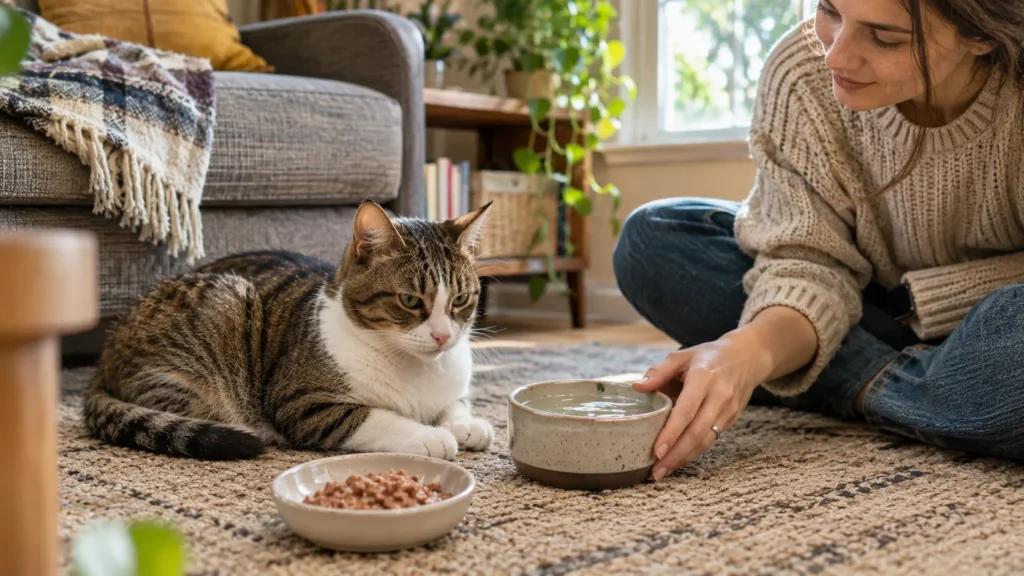
A slow-feeding bowl or a suitable food puzzle can encourage some cats to take more time over their meals.
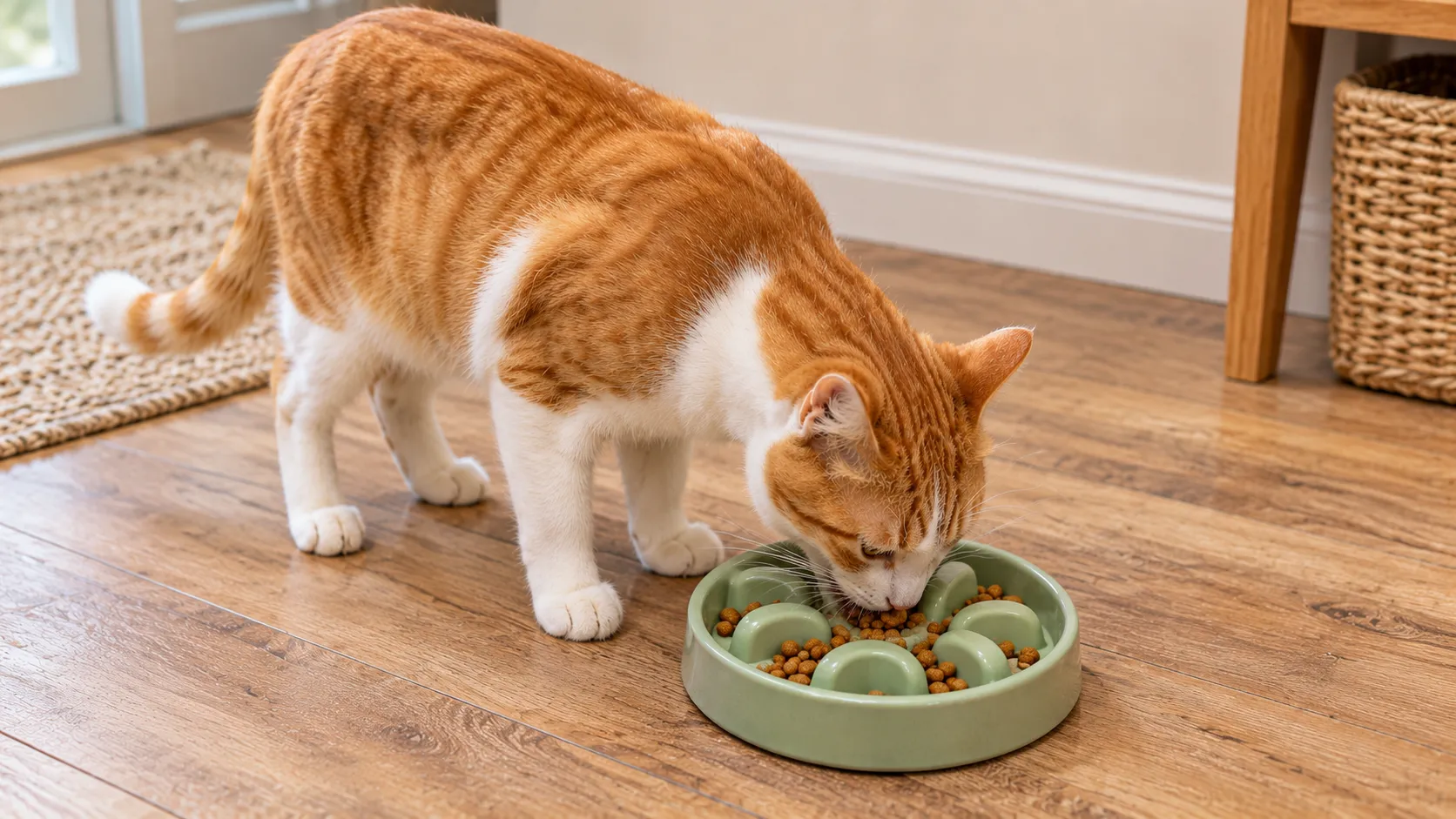
In a multi-cat household, try feeding each cat in a separate area. Removing competition may help a cat that normally rushes through its food.
According to veterinary guidance on regurgitation, slow feeders can help in certain cases, although they are not effective for every cat.
Observe how your cat uses the feeder. If it causes frustration, interferes with normal eating, or fails to improve the problem, reconsider the approach rather than assuming the cat needs more time to adjust.
Review Recent Food Changes
If the symptoms began around the time you introduced a different food, make a note of the previous diet, the new recipe, and how quickly you made the transition.
Cats Protection recommends introducing dietary changes gradually to reduce the likelihood of stomach upset.
For a routine transition in a healthy cat, this generally means mixing increasing amounts of the new food with decreasing amounts of the previous food over several days.
If your cat is currently unwell or vomiting repeatedly, ask your veterinarian which diet and transition schedule are appropriate before making further changes.
Could Switching Between Wet and Dry Food Help?
Some cats tolerate one food format better than another. Texture, ingredients, meal size, and eating habits may all influence how a cat responds to a particular recipe.
Wet food also provides more dietary moisture than dry kibble, but this does not mean it will necessarily stop vomiting.
Similarly, a cat that brings up dry food may not have an intolerance to kibble itself. Eating speed or another medical issue could be involved.
When your veterinarian recommends a dietary change, discuss whether a different food format, a more easily digested diet, or a veterinary therapeutic formula is appropriate for your cat.
If a dietary change is appropriate after veterinary assessment, our guide to cat food for sensitive stomachs compares general feeding options. For a more focused product comparison, see our cat food for cats that vomit guide. Neither guide can establish or treat the underlying cause of repeated vomiting.
Avoid Unsafe Home Remedies
Keep fresh drinking water available. If your cat repeatedly vomits after drinking or cannot keep water down, seek veterinary care.
Do not give human nausea medications, antacids, or other medicines without veterinary approval. Avoid deliberately withholding food for extended periods. Cats that stop eating can develop serious health complications, so contact your veterinarian promptly if your cat refuses food or cannot keep meals down.
If you suspect poisoning, never attempt to induce vomiting yourself. The ASPCA Animal Poison Control Center warns that common household methods, including hydrogen peroxide, can be dangerous for cats.
Contact a veterinarian or animal poison-control service immediately for instructions.
What to Tell Your Veterinarian
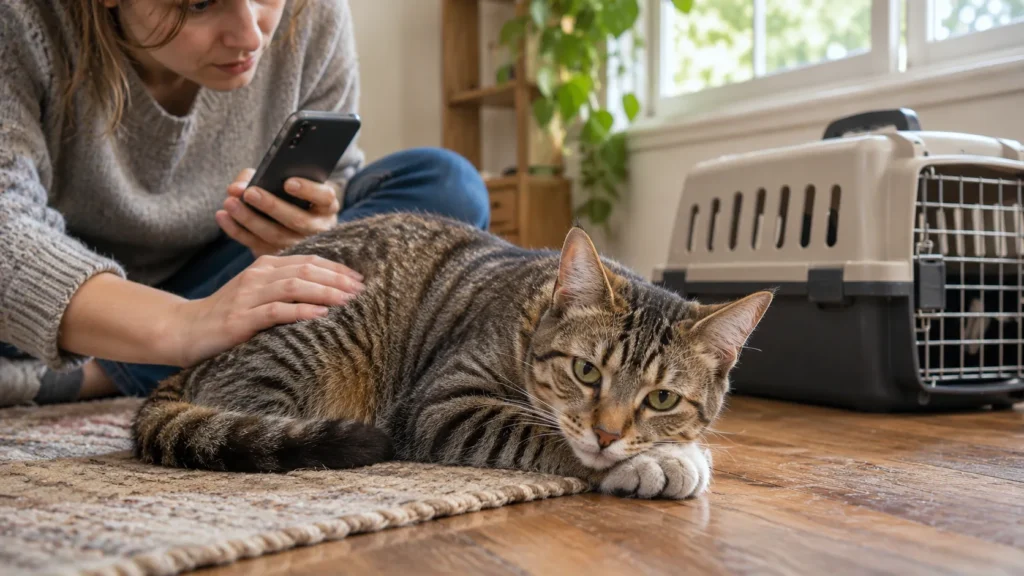
It can be difficult to describe an episode once your cat is back to behaving normally. Keeping a few simple notes can give your veterinarian a clearer picture of what has been happening.
Record the following information when possible:
- Timing: How soon after eating or drinking does the episode occur?
- Frequency: How often has your cat been bringing up food?
- Physical effort: Does your cat retch and strain, or does the food come up with little effort?
- Appearance: Is the material recognizable food, liquid, foam, fur, or blood?
- Feeding history: Have you changed food, treats, portion sizes, or feeding routines?
- Other symptoms: Have you noticed weight loss, appetite changes, diarrhea, or unusual drinking habits?
- Possible exposure: Could your cat have accessed medications, toxic plants, string, or small objects?
A short video of an episode may also help your veterinarian distinguish vomiting from regurgitation, provided recording it does not delay necessary care.
Depending on the symptoms, your veterinarian may recommend a physical examination, blood tests, stool testing, X-rays, or an ultrasound to investigate the cause.
Final Thoughts
An occasional episode after a rushed meal may improve with changes to your cat's feeding routine. But if your cat repeatedly brings up food, loses weight, stops eating normally, or develops other symptoms, finding the underlying cause is more important than finding another cat food to try.