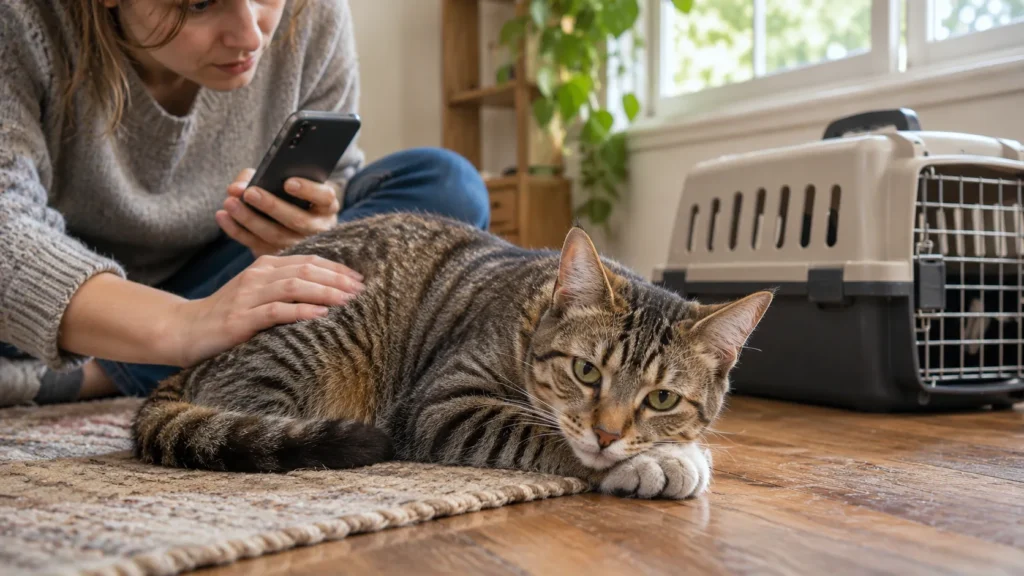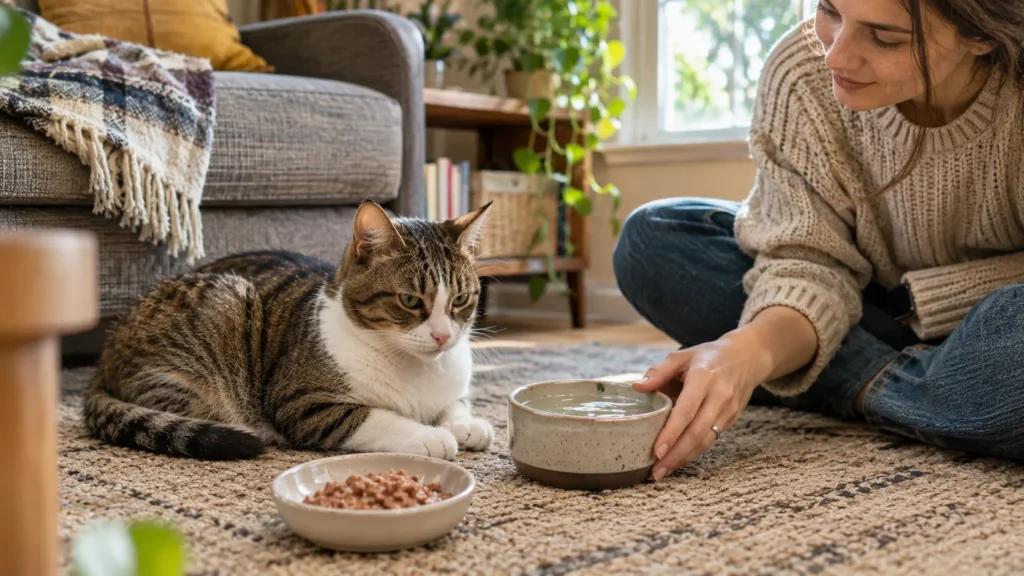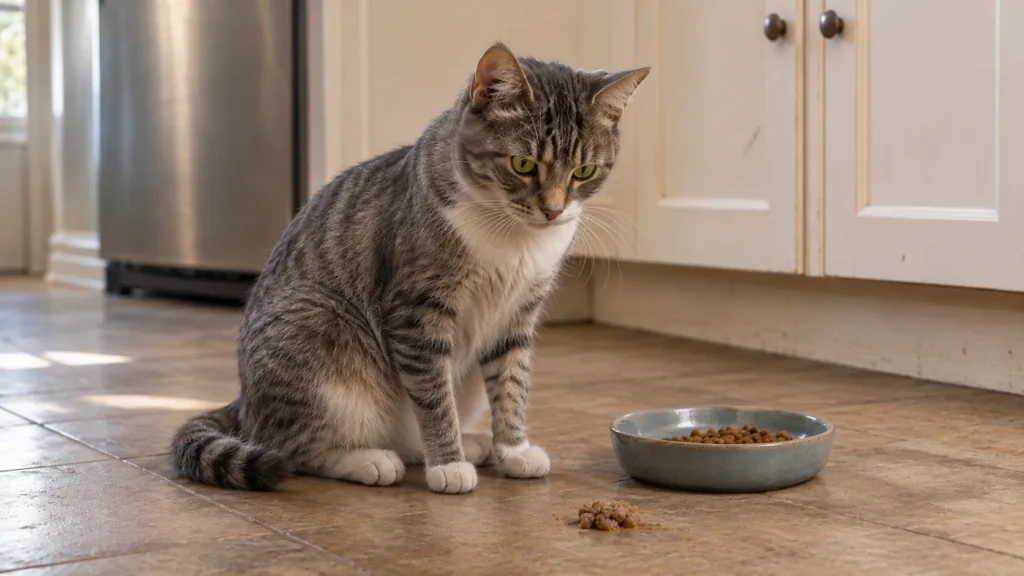
When your cat brings food back up after eating, changing diets can seem like the obvious next move. Sometimes a digestive-support formula is worth considering. But eating too quickly, regurgitation, and medical conditions can cause similar-looking episodes—and a new food won't address every cause.
For everyday adult feeding, Purina ONE +Plus Sensitive Skin & Stomach is the affordable dry-food choice in this comparison. Blue Buffalo True Solutions Digestive Care and Royal Canin Digestive Care offer different wet-food textures. The other two options, Hill's Prescription Diet i/d and Royal Canin Hydrolyzed Protein HP, belong in veterinarian-directed feeding plans.
We compared their intended uses, ingredients, nutritional suitability, cost, and owner-reported limitations. None is proven to stop vomiting in every cat. If your cat vomits repeatedly or has other concerning symptoms, veterinary assessment matters more than switching brands.
Affiliate disclosure: LumaPaw may earn a commission when you purchase through links on this page, at no additional cost to you. Our recommendations are based on manufacturer information, retailer listings, and customer-feedback research—not personal product testing.
Quick Comparison: 5 Cat Foods for Different Digestive Needs
| Cat food | Format | Main reason to consider it | Important limitation |
|---|---|---|---|
| Purina ONE +Plus Sensitive Skin & Stomach | Dry | Affordable everyday digestive-support food | Contains several protein sources |
| Blue Buffalo True Solutions Digestive Care | Wet | Lower-cost wet option with prebiotic fiber | Thick texture may not appeal to every cat |
| Royal Canin Digestive Care | Wet | Thin slices in gravy | Higher regular feeding cost |
| Hill's Prescription Diet i/d | Veterinary wet | Gastrointestinal nutritional management | Requires veterinary authorization |
| Royal Canin Hydrolyzed Protein HP | Veterinary dry | Hydrolyzed protein for suspected food sensitivities | Requires veterinary authorization and a carefully managed feeding plan |
The first three are non-prescription adult foods. The final two are veterinarian-directed diets intended for different clinical circumstances.
How We Researched These Cat Foods
We compared manufacturer information, nutritional adequacy statements, Amazon and Chewy listings, prices recorded during research, and available customer reviews. Each food needed a useful distinction—not simply a familiar brand name or a high star rating.
Reviews helped us identify practical concerns such as food refusal, changing textures, and continued digestive problems. Reports of less vomiting are individual experiences, not evidence that a product reliably prevents it. We did not personally test these foods or conduct feeding trials.
Everyday Cat Foods for Sensitive Digestion
These three foods are designed for daily feeding and digestive support. They are not veterinary treatments for persistent vomiting, inflammatory bowel disease, or confirmed food allergies.
1. Purina ONE +Plus Sensitive Skin & Stomach — Affordable Everyday Dry Food
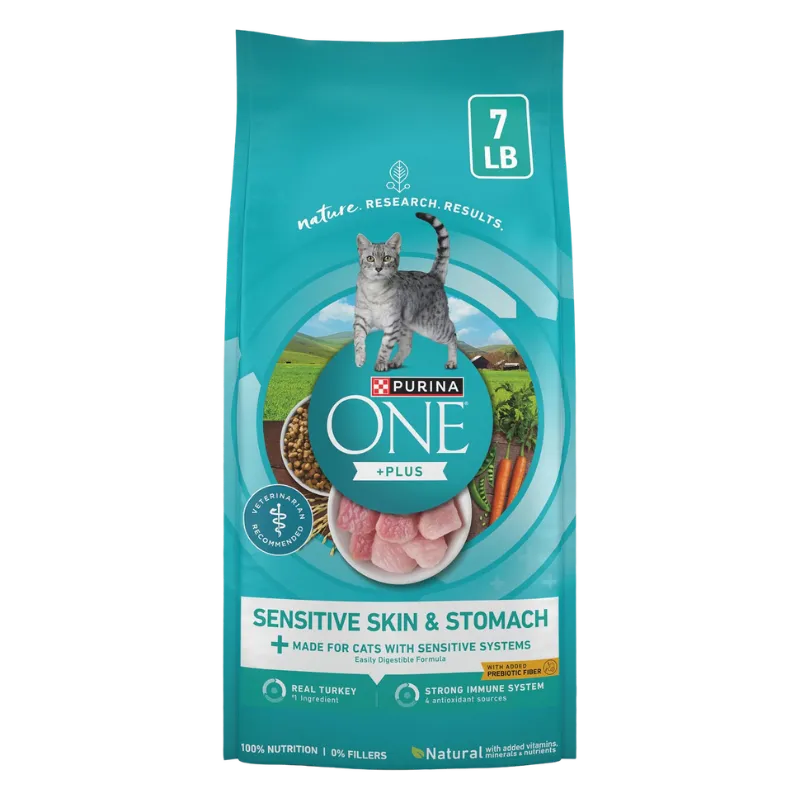
Selected formula: Turkey, 7-lb bag
Food type: Dry adult cat food
Main advantage: Accessible price with prebiotic fiber
Purina ONE +Plus is a straightforward option for an adult cat that eats kibble and needs an everyday digestive-support formula. Turkey leads the ingredient list, and the food includes prebiotic fiber alongside complete-and-balanced adult-maintenance nutrition.
Its price is the clearest advantage. At the regular Chewy prices recorded during our research, this 7-lb bag cost substantially less per pound than several other sensitive-stomach dry foods. That is a practical reason to consider it—not evidence that it works better for vomiting.
What stands out
- Complete adult-maintenance nutrition.
- Turkey as the first ingredient.
- Added prebiotic fiber.
- Multiple bag sizes.
- Relatively affordable regular feeding cost.
Many owners say their cats accept the kibble and experience fewer digestive problems after switching. Others report continued vomiting or food refusal. Those reviews are helpful for setting expectations, but they cannot predict how an individual cat will respond.
Important limitations
Despite the turkey-focused name, this is not a single-protein diet. It also contains chicken-derived ingredients, egg, and plant protein sources.
That makes it inappropriate as a substitute for a veterinarian-prescribed food-elimination trial. It is also a dry food, so owners who prefer to feed wet meals may find the next two options more suitable.
Who should consider it? Owners of adult cats who need a reasonably priced, complete dry food with digestive-support features.
Who should avoid it as a self-directed switch? Cats with known reactions to its ingredients, cats already on a prescribed diet, or cats with frequent unexplained vomiting.
Buying note: The 7-lb bag is a reasonable value-oriented option. If your cat has never eaten the formula, a smaller available size may reduce waste if they dislike it.
2. Blue Buffalo True Solutions Digestive Care — Better-Value Wet Food
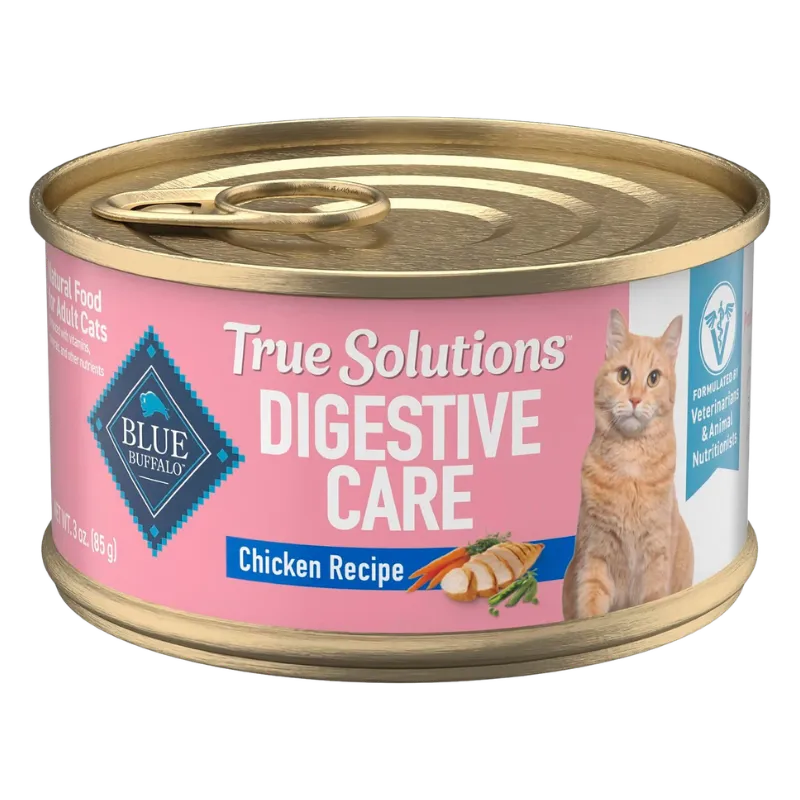
Selected formula: Chicken Recipe, 24 × 3-oz cans
Food type: Wet adult cat food
Main advantage: Complete wet nutrition at a comparatively accessible feeding cost
For cats that prefer a softer wet meal, Blue Buffalo offers a complete adult food rather than a topper. Chicken is the first ingredient; the recipe also contains broth, chicken liver, whitefish, fiber sources, and fructooligosaccharides, a prebiotic ingredient.
Value sets it apart from Royal Canin. Based on the regular Chewy prices and calorie information available during our research, Blue Buffalo cost less per 100 calories. That can make a difference when wet food is a cat's main diet, though the current price is worth checking before buying.
It also adds moisture through food. That's useful dietary context, not a reason to expect it to resolve vomiting or dehydration from illness.
What owners report
Some customers describe improved stool consistency or fewer vomiting episodes after changing to this food. Others mention good acceptance, particularly among cats that prefer soft wet meals.
Texture is the clearest recurring drawback. Several owners describe the food as thick or sticky, and some cats refuse it or eat only a little. Others report digestive problems despite the switch.
Main advantages
- Complete wet nutrition for adult cats.
- Chicken-first recipe.
- Prebiotic fiber.
- Useful dietary moisture.
- Comparatively affordable cost per calorie among the wet foods we researched.
What to consider before buying
The formula contains both chicken and whitefish. It is not suitable for a controlled single-protein food trial and may be inappropriate for cats with known reactions to either ingredient.
Its consistency is another deciding factor. If your cat strongly prefers food in gravy rather than a dense, soft texture, Royal Canin may be the more practical choice.
Best suited to: Adult cats whose owners want an everyday digestive-support wet food with a softer texture and relatively manageable regular feeding cost.
Avoid if: Your cat requires an elimination diet, has a relevant confirmed ingredient allergy, or consistently rejects thick wet-food textures.
Buying note: Chewy also offers a smaller case variation. Trying fewer cans first may be more economical than committing immediately to 24 cans.
3. Royal Canin Digestive Care — Gravy-Based Digestive-Support Wet Food
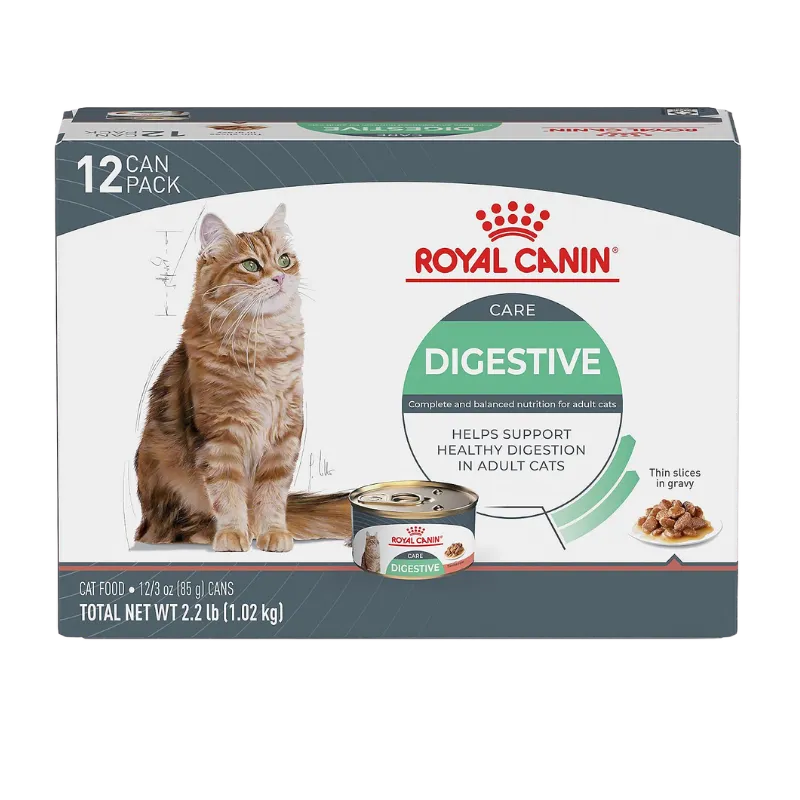
Selected formula: Thin Slices in Gravy, 12 × 3-oz cans
Food type: Wet adult cat food
Main advantage: Small food pieces served in gravy
A cat that turns away from pâté but enjoys pieces in gravy may be more interested in Royal Canin Digestive Care. Its thin slices give owners a genuinely different texture to try, rather than another similar soft wet food.
Royal Canin formulates Digestive Care to support healthy digestion and stool quality in adult cats. It is a complete-and-balanced everyday food, not the same as the company's veterinary Gastrointestinal diets.
The recipe contains multiple animal-derived ingredients, including pork- and chicken-derived ingredients, alongside other components that contribute to its nutritional profile.
What owners notice
Many reviews praise the taste and ease of acceptance, and some owners describe better digestive tolerance. More specific complaints concern the amount or consistency of gravy; a few cats rejected cans that looked different from earlier purchases. The feedback cannot establish an anti-vomiting effect or a confirmed manufacturing problem.
Strengths worth considering
- Complete adult-maintenance wet food.
- Digestive-support formulation.
- Distinct thin-slices-in-gravy texture.
- Dietary moisture.
- Multiple case-size options.
The trade-off
Royal Canin was noticeably more expensive per feeding calorie than Blue Buffalo at the prices examined during our research.
It also contains multiple protein sources, so it is not a limited-ingredient food or an appropriate substitute for a veterinarian-supervised elimination diet.
The extra cost may be reasonable if your cat reliably prefers the texture, but it should not be mistaken for evidence of better vomiting outcomes.
Best suited to: Adult cats that prefer small pieces in gravy and whose owners want a complete wet food with digestive-support positioning.
Less suitable for: Cats needing a strict food trial, households prioritizing the lowest feeding cost, or cats that dislike sliced textures.
Buying note: The selected 12-can case offers a smaller initial commitment than a 24-can case. Confirm that the retailer selection says Thin Slices in Gravy, since Royal Canin also sells other textures.
Veterinarian-Directed Diets for Specific Digestive Needs
If a cat vomits frequently, a veterinarian may recommend diagnostic testing and a targeted feeding plan.
Depending on the findings, that plan could involve a therapeutic gastrointestinal diet or a controlled trial for suspected food reactions.
These next two products have different purposes. Neither should be viewed as an automatic upgrade from everyday sensitive-stomach food.
4. Hill's Prescription Diet i/d — Veterinarian-Directed Gastrointestinal Wet Diet

Selected formula: Chicken & Vegetable Stew, 24 × 2.9-oz cans
Food type: Veterinary gastrointestinal wet food
Main advantage: Specialized nutritional support for digestive disorders
Hill's i/d belongs to a veterinary feeding plan, not a trial-and-error switch between ordinary sensitive-stomach foods. It is designed for gastrointestinal nutritional management when a veterinarian recommends that approach.
Hill's describes the Chicken & Vegetable Stew as highly digestible and includes its ActivBiome+ Digestion prebiotic blend, intended to support the gut microbiome. The recipe provides wet nutrition using conventional animal proteins and several fiber sources. That clinical purpose—not a claim of universal effectiveness—is what distinguishes it from the three everyday foods above.
Some customer reviews describe improved stools, better appetite, or fewer digestive episodes while cats were receiving this diet. Others report food refusal, continued symptoms, or difficulty justifying the cost.
Because many of these cats were also receiving veterinary treatment, customer reviews cannot establish that the food alone produced the reported improvements.
Main advantages
- Veterinary-directed gastrointestinal nutrition.
- Formulation focused on digestibility and digestive support.
- Prebiotic fiber blend.
- Wet stew format.
- Complete nutrition for its intended use.
Important limitations
The diet is relatively expensive and requires veterinary authorization through Chewy.
It also contains conventional animal-derived ingredients, so it should not be confused with a hydrolyzed-protein food for diagnosing suspected allergies.
A cat that refuses the stew or continues vomiting may need the veterinary plan reassessed rather than another unsupervised food change.
Who should consider it? Owners whose veterinarian specifically recommends Hill's i/d for their cat's gastrointestinal condition.
Who should not choose it independently? Owners simply looking for a stronger version of ordinary sensitive-stomach food.
Buying note: Check the exact case quantity before ordering. The selected Chewy listing is a case of 24 cans, and veterinary authorization is required.
5. Royal Canin Hydrolyzed Protein HP — Veterinarian-Directed Hydrolyzed-Protein Diet
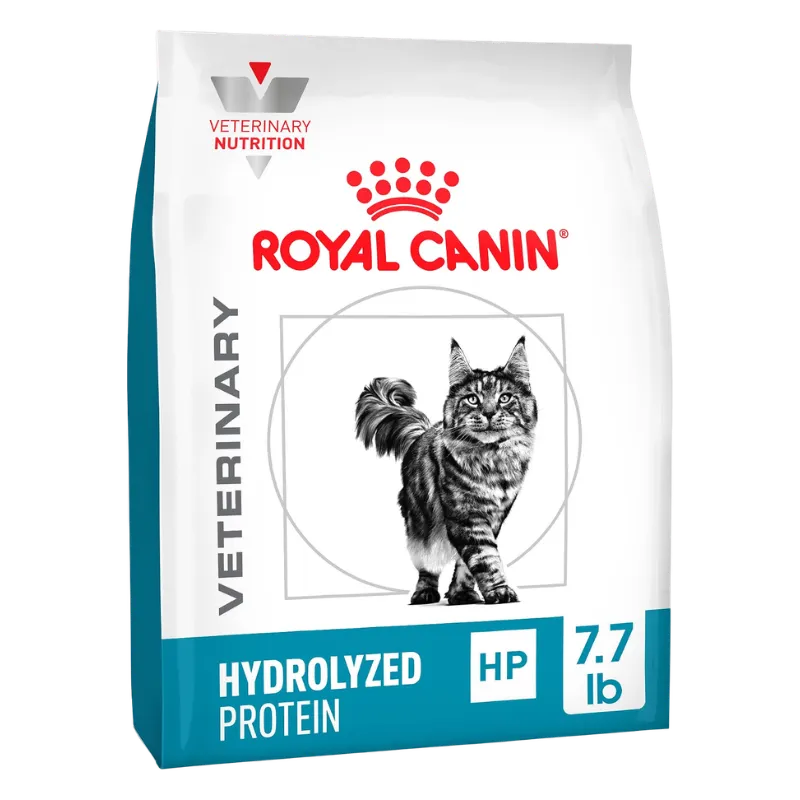
Selected formula: Adult dry, 7.7-lb bag
Food type: Veterinary hydrolyzed-protein diet
Main advantage: A specialized protein approach for certain suspected food reactions
Royal Canin HP is the specialist option when a veterinarian suspects a food-related reaction rather than simply recommending general gastrointestinal support. Its hydrolyzed soy protein is broken into smaller fragments to reduce the chance of triggering a response in some sensitive cats.
This type of diet can be useful when a veterinarian recommends an elimination trial to investigate whether food ingredients are contributing to a cat's symptoms.
Royal Canin HP also contains other ingredients, including brewers rice and added fat sources, and provides complete adult-maintenance nutrition.
Why is this different from limited-ingredient cat food?
A food labeled limited ingredient is not necessarily appropriate for a diagnostic allergy trial. Such products may contain ingredients unsuitable for the individual cat, and ordinary retail foods may not follow the same manufacturing controls as veterinary elimination diets.
As explained in VCA Animal Hospitals' guide to elimination-challenge diet trials, a carefully controlled feeding trial is needed to investigate suspected food allergies.
That means following the veterinarian's instructions about treats, supplements, flavored medications, and any other foods. Even small departures from the prescribed plan may interfere with interpreting the results.
Strengths
- Hydrolyzed soy protein.
- Specific veterinary food-sensitivity purpose.
- Complete adult nutrition.
- Digestive-support formulation.
- Smaller package option available for discussing a trial with the veterinarian.
Customer experiences include reports of improved digestive tolerance and reduced skin-related symptoms. Other owners mention high cost, food refusal, or continued vomiting.
Customer reviews cannot determine whether a particular cat has a food allergy; that requires a veterinary assessment and, when appropriate, a controlled trial.
Important drawbacks
This is among the most expensive foods in our selection. It also requires veterinary authorization through Chewy.
It is not intended as a casual experiment for every cat that throws up, and its use should be coordinated with a veterinarian who can determine whether an elimination diet is appropriate.
Best suited to: Adult cats whose veterinarian recommends hydrolyzed-protein nutrition for suspected food sensitivities or a controlled food trial.
Avoid as a routine purchase: When your cat has unexplained vomiting but no veterinary assessment indicating this type of diet is appropriate.
How to Choose Cat Food When Your Cat Keeps Throwing Up
When Vomiting Needs Veterinary Attention
An occasional vomiting episode does not always mean a cat has a serious illness. But frequent or unexplained vomiting should not be treated as normal.
According to the Cornell Feline Health Center, cats vomiting more than once a week or showing additional concerning symptoms should be evaluated promptly.
Contact a veterinarian if your cat:
- Vomits repeatedly or more frequently than usual.
- Cannot keep food or water down.
- Has blood in the vomit.
- Stops eating or shows a marked reduction in appetite.
- Becomes weak, lethargic, or unusually withdrawn.
- Loses weight.
- Has vomiting alongside diarrhea or other concerning symptoms.
Repeated vomiting, suspected ingestion of a foreign object or toxin, or an inability to retain water can require urgent veterinary assessment.
Kittens, elderly cats, and cats with existing medical conditions may become unwell more quickly and should receive particular attention.
Vomiting can result from many causes, including gastrointestinal disease, parasites, foreign objects, and medical conditions unrelated to food.
Changing cat food is not a substitute for identifying the cause.
Common Questions About Cat Food and Vomiting
Is Grain-Free or Limited-Ingredient Food Better for a Cat That Vomits?
Not necessarily.
Grain-free food is not automatically more digestible, and grains are not the cause of vomiting in every cat.
Similarly, limited-ingredient formulas may be useful in some feeding situations, but their labels do not establish that they prevent vomiting or diagnose food allergies.
If a veterinarian suspects a food allergy, a carefully controlled elimination trial may be needed. That often involves a veterinary hydrolyzed-protein or appropriately selected novel-protein diet.
The important question is not whether a formula excludes grains. It is whether the food is nutritionally appropriate and addresses an identified dietary need.
Can Kittens Eat These Sensitive-Stomach Cat Foods?
The foods in this comparison are primarily intended for adult cats, and they should not automatically replace a kitten's growth-formulated diet.
Kittens need nutrition suited to growth and development. A product designed for adult maintenance may not meet those requirements.
If your kitten has digestive sensitivity, choose a complete-and-balanced food appropriate for growth, with veterinary guidance when necessary.
For kittens with digestive sensitivities, see our sensitive-stomach kitten food guide. For more general guidance on growth-appropriate diets, see our guide to the best food for kittens.
If your kitten is vomiting repeatedly, contact a veterinarian promptly rather than experimenting with multiple foods.
Final Thoughts: Choose Food for the Cat, Not Just the Symptom
The right food depends on whether your cat needs an everyday meal, a different wet-food texture, or a veterinarian-directed diet.
Purina ONE +Plus Sensitive Skin & Stomach is a reasonable everyday dry-food option for owners prioritizing affordability. Blue Buffalo True Solutions Digestive Care offers complete wet nutrition at a comparatively accessible feeding cost, while Royal Canin Digestive Care gives cats a different, gravy-based texture.
When a veterinarian identifies a need for more specialized nutrition, Hill's Prescription Diet i/d and Royal Canin Hydrolyzed Protein HP serve distinct clinical purposes and should be chosen with professional guidance.
The most useful decision isn't simply which food has the highest rating or the longest ingredient list. It's whether the food suits your cat's nutritional needs, eating habits, ingredient history, and health.
If your cat keeps vomiting, finding out why is more important than finding another bag of food.