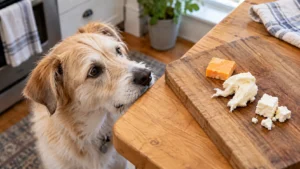
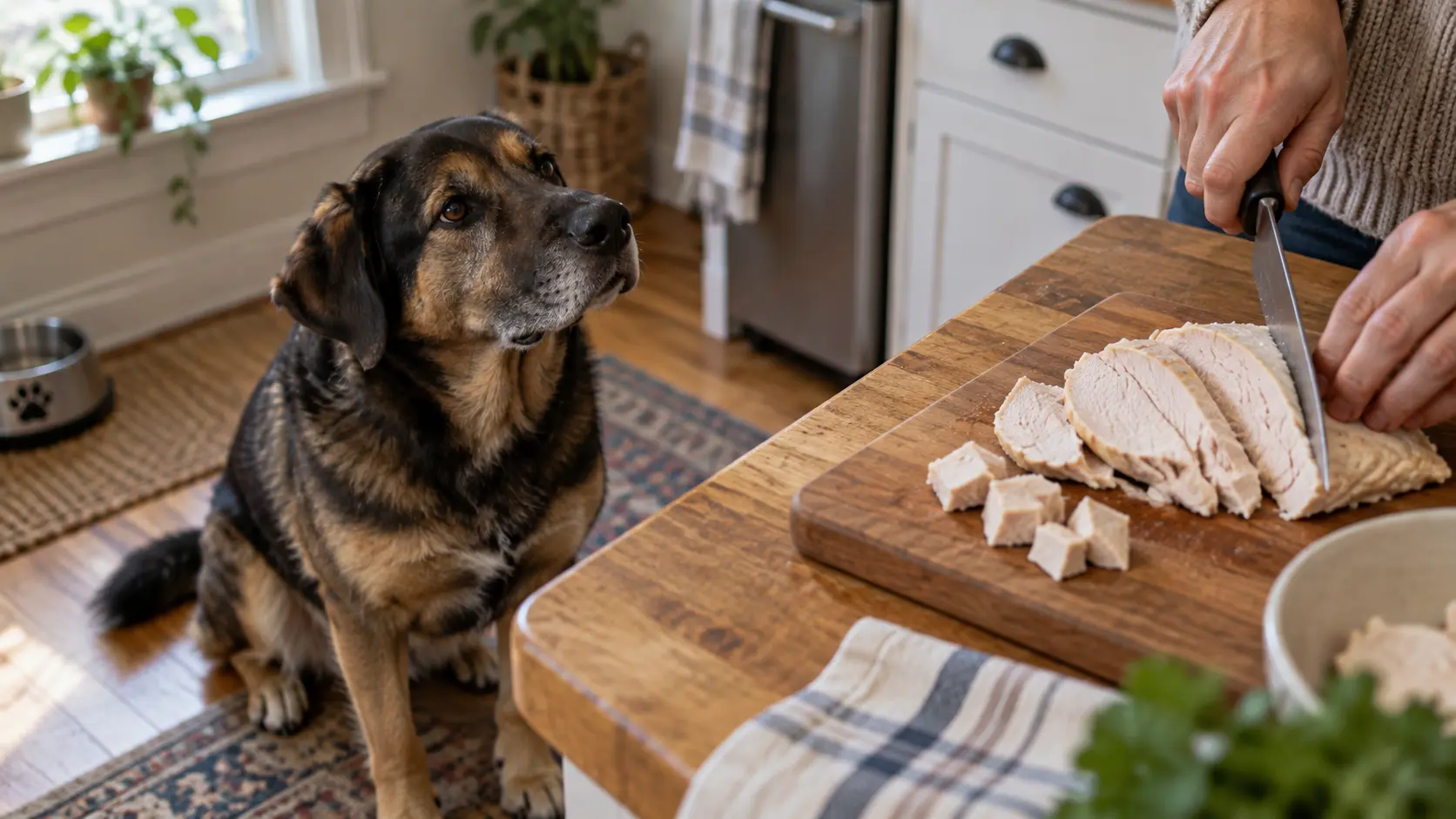
Yes, most healthy dogs can eat a small amount of plain, fully cooked, boneless turkey. The answer changes, though, when that turkey comes with bones, fatty skin, gravy, seasonings, or processing such as bacon or deli meat.
If you are deciding whether to share turkey with your dog—or your dog already stole some—the first thing to check is what kind of turkey it was and how it was prepared. Plain cooked meat is very different from a turkey bone, raw ground turkey, or leftovers covered in onion gravy.
Turkey is one of several human foods dogs can eat when prepared appropriately, but it should still be treated as an occasional extra rather than a replacement for a balanced diet.
Can Dogs Eat Turkey? The Short Answer
Dogs can generally have plain, fully cooked, boneless turkey in modest amounts. ASPCA Poison Control specifically advises that if turkey is shared with a pet, it should be fully cooked and bone-free. (ASPCA)
Preparation is what often changes the safety picture.
A few pieces of plain cooked turkey breast are very different from turkey skin, a cooked drumstick bone, raw turkey, or Thanksgiving leftovers made with onion, garlic, butter, and gravy.
Dogs with pancreatitis, prescribed low-fat diets, food sensitivities, elimination diets, or other veterinary dietary restrictions may also need different advice. In those cases, even an otherwise ordinary food should fit the diet your veterinarian has recommended.
What Kind of Turkey Did Your Dog Eat?
A quick way to assess turkey is to look at the exact form rather than asking whether “turkey” as a whole is safe.
Turkey type |
General guidance |
Main concern |
|---|---|---|
Plain, fully cooked turkey |
Usually suitable in small amounts |
Portion size |
Plain cooked ground turkey |
Usually suitable |
Fat level and added ingredients |
Skinless turkey breast |
Good lean option |
Portion size |
Skinless dark meat |
Small amounts can be suitable |
Higher fat than breast |
Turkey skin or drippings |
Best avoided |
High fat and digestive upset |
Raw or undercooked turkey |
Don’t intentionally feed |
Foodborne pathogens |
Turkey bones or necks |
Don’t intentionally feed |
Choking, dental injury, obstruction, GI injury |
Onion- or garlic-seasoned turkey |
Avoid |
Allium toxicity |
Turkey bacon, sausage, deli, or smoked turkey |
Poor routine choices |
Sodium, fat, processing, variable ingredients |
The key distinction is that these foods do not all carry the same kind of risk. A turkey bone is a physical hazard. Raw turkey creates a microbial risk. Onion and garlic create a toxicity risk. Fatty skin and gravy are primarily a digestive and fat-related concern.
Which Types of Turkey Can Dogs Eat?
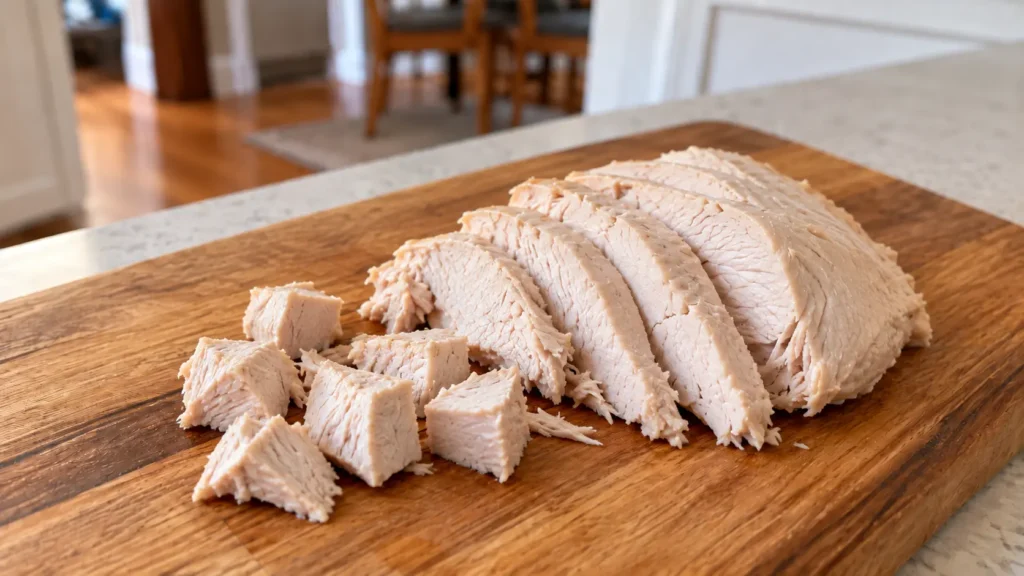
Plain Cooked Turkey
For intentional feeding, the simplest choice is plain turkey that is:
- fully cooked
- boneless
- preferably skinless
- free from gravy, marinades, onion, garlic, and rich sauces.
USDA food-safety guidance says turkey, including ground poultry, should reach a minimum internal temperature of 165°F (73.9°C). A food thermometer is more reliable than judging doneness by color. (Cornell Vet Medicine)
Let the meat cool before serving it, remove any bones you find, and cut it into pieces appropriate for your dog’s size.
Can Dogs Eat Ground Turkey?
Yes, dogs can generally eat plain ground turkey when it has been thoroughly cooked.
The same basic rules apply as with other turkey: no onion, garlic, heavy seasoning, sauces, or other ingredients that change the safety of the meal.
Ground turkey is not one standardized food, either. Products can vary in fat content, and pre-seasoned mixtures may contain ingredients you would not want to feed your dog.
Cook ground turkey to 165°F (73.9°C) and check the package if it came pre-seasoned or was formed into burgers, meatballs, or another prepared food. (Cornell Vet Medicine)
White Meat vs. Dark Turkey Meat
Skinless turkey breast is generally the leaner choice, which makes it easier to use as an occasional treat.
Dark turkey meat contains more fat, but that does not make plain skinless dark meat toxic. A small amount can still be suitable for many healthy dogs.
The distinction matters more for dogs that need tight fat control. If your dog has had pancreatitis or has been prescribed a low-fat diet, follow your veterinarian’s feeding advice rather than treating white and dark meat as interchangeable.
When Turkey Becomes Riskier for Dogs
Can Dogs Eat Raw Turkey?
Raw turkey is not a good choice for intentional feeding.
FDA guidance says raw animal-based pet foods are more likely than processed foods to contain harmful bacteria such as Salmonella and Listeria monocytogenes. Contamination can affect the dog and can also expose people through food preparation, bowls, surfaces, saliva, or feces. (U.S. Food and Drug Administration)
That does not mean every dog that steals one piece of raw turkey will become ill. It does mean there is an avoidable foodborne-pathogen risk when the turkey could simply be cooked.
Can Dogs Eat Turkey Bones or Turkey Necks?
Turkey bones are best kept away from dogs.
WSAVA advises that both raw and cooked bones can be dangerous when chewed or swallowed. Bones can contribute to choking, broken teeth, gastrointestinal injury, and obstruction. (WSAVA)
Turkey necks contain bone, so they belong in the same category. LumaPaw does not recommend intentionally feeding raw or cooked turkey necks.
This is a physical hazard rather than a toxicity issue. The turkey meat around a bone may be perfectly edible while the bone itself creates the problem.
Can Dogs Eat Turkey Skin, Drippings, or Gravy?
Turkey skin, drippings, and rich gravy are very different from lean turkey meat because they can contain much more fat.
Fatty table foods can trigger vomiting or diarrhea and are a particular concern for dogs with pancreatitis or a history of it. Cornell also lists meat trimmings and gravy among fatty holiday foods that can contribute to digestive trouble and pancreatitis. (Cornell Vet Medicine)
That does not mean one piece of turkey skin automatically causes pancreatitis. The risk depends on the dog, the amount eaten, the total fat load, and other individual factors.
Gravy creates another problem: its ingredients. It may contain onion, garlic, butter, salt, or other additions that would not be present in plain turkey.
What About Onion, Garlic, and Seasoned Turkey?
Seasoning can turn an otherwise straightforward piece of turkey into a different safety question.
Onion, garlic, chives, and leeks belong to the Allium group. Merck Veterinary Manual reports toxicosis in dogs after ingestion of onion and garlic in raw, cooked, dehydrated, and granulated forms. These compounds can damage red blood cells and lead to hemolytic anemia. (Merck Veterinary Manual)
Powders and concentrated seasonings deserve particular attention because a small-looking amount of seasoning can contain concentrated ingredients.
Signs from Allium exposure can also be delayed for several days rather than appearing immediately. (Merck Veterinary Manual)
Before sharing seasoned turkey—or assessing leftovers your dog stole—check what was used in:
- gravy
- stuffing
- spice rubs
- marinades
- stock or broth
- seasoning packets.
Plain carved turkey and turkey covered in onion gravy should not be treated as the same food.
Can Dogs Have Turkey Bacon, Deli Turkey, Sausage, or Smoked Turkey?
These foods are not equivalent to plain turkey meat.
Turkey bacon, deli slices, smoked turkey, sausages, and hot dogs can contain varying amounts of:
- sodium
- fat
- spices
- curing ingredients
- flavorings and seasonings.
That makes the ingredient label more useful than the word “turkey” on the front of the package.
They are generally poor choices for routine dog treats, especially when plain cooked turkey is available instead.
At the same time, there is no reason to describe every tiny accidental bite of turkey bacon as poisoning. The concern depends on the exact product, amount eaten, ingredients, and the dog’s health.
Is Turkey Good for Dogs?
Turkey provides animal protein and other nutrients, but that does not mean adding turkey to a dog’s diet automatically improves health.
A dog eating an appropriate complete-and-balanced diet should already receive the nutrients required for its life stage.
AAFCO explains that “complete” means a food contains all required nutrients, while “balanced” means those nutrients are present in appropriate ratios. Plain turkey meat alone does not meet that standard. (AAFCO)
For most dogs, turkey is better thought of as an occasional food extra rather than a necessary supplement.
Claims that turkey will improve a dog’s coat, boost immunity, strengthen the heart, or provide similar specific health benefits go beyond what can be concluded simply from its nutrient content.
How Much Turkey Can a Dog Eat?
There is no single tablespoon or ounce recommendation that works for every dog.
A Chihuahua and a Labrador have very different calorie needs, and even dogs of the same weight can differ because of age, activity, body condition, health, and their regular diet.
A practical guideline is to keep all treats and extras combined at no more than about 10% of daily calories. AAHA and WSAVA both use this limit to help prevent treats and table foods from displacing nutritionally balanced meals. (AAHA)
That 10% is a ceiling, not a goal. Your dog does not need to receive the full allowance every day.
When introducing turkey for the first time, a small piece is more sensible than calculating the maximum amount your dog could theoretically eat.
How to Serve Turkey to Your Dog Safely
If you want to intentionally share turkey, keep the preparation simple.
- Start with plain turkey. Avoid pre-seasoned, smoked, cured, or sauced meat.
- Cook it thoroughly. Turkey should reach an internal temperature of 165°F (73.9°C). (Cornell Vet Medicine)
- Remove every bone. Do not offer turkey necks or pieces containing bone.
- Remove the skin. This keeps the treat leaner.
- Skip gravy and seasoning. Especially avoid foods containing onion or garlic.
- Cut the meat into manageable pieces. Size them for your dog rather than handing over a large strip of meat.
- Start with a modest amount. This is especially sensible if your dog has never eaten turkey before.
- Treat it as an extra. Do not replace a significant part of the regular complete diet with turkey.
One common mistake is assuming turkey is “plain” because no seasoning is visible. Meat that has been cooked under stuffing, basted repeatedly, soaked in marinade, or covered in gravy may have absorbed ingredients you would not intentionally give your dog.
My Dog Ate Turkey: What Should I Do?
A dog stealing a small piece of plain cooked turkey is very different from swallowing a drumstick bone or eating half a tray of seasoned leftovers.
Start by identifying exactly what happened.
First, Work Out What Was Eaten
Check:
- Was it raw or cooked?
- Was there a bone?
- Did the dog eat skin or drippings?
- Did the recipe contain onion or garlic?
- Was there gravy, stuffing, marinade, or seasoning?
- Was it turkey bacon, sausage, deli meat, or another processed product?
- Approximately how much was eaten?
- When did it happen?
- How large is your dog?
- Is your dog showing any symptoms?
- Does your dog have pancreatitis, digestive disease, or another relevant medical condition?
A small amount of plain, fully cooked, boneless turkey in an otherwise healthy dog is usually a much lower-concern situation than the examples below. ASPCA guidance considers a small bite of fully cooked, boneless turkey acceptable. (ASPCA)
If Your Dog Ate a Turkey Bone
Don’t assume that every swallowed bone will cause an obstruction, but don’t intentionally wait for severe symptoms before seeking advice either.
Contact your veterinarian for case-specific guidance after a swallowed turkey bone, particularly if the bone was large, sharp, or swallowed whole.
Do not make your dog vomit unless a veterinarian specifically tells you to. Bringing sharp bone fragments back through the esophagus can create additional injury, and VCA specifically lists sharp objects such as bone fragments among situations in which inducing vomiting can be hazardous. (Vca)
Active choking or difficulty breathing is an emergency.
If Your Dog Ate Seasoned, Raw, or Very Fatty Turkey
If it was seasoned, find the recipe or ingredient label. Onion and garlic are more important than simply knowing that “spices” were used.
If it was raw, monitor your dog for signs of illness. Contact your veterinarian if symptoms develop or if your dog’s age or health makes infection more concerning.
If your dog ate a large amount of skin, drippings, gravy, or another rich meal, watch for significant digestive symptoms. Extra caution is appropriate for dogs with a previous history of pancreatitis or a prescribed low-fat diet.
Signs That Need Veterinary Attention
Contact a veterinarian promptly if your dog develops concerning or worsening symptoms, particularly:
- repeated vomiting
- marked weakness or lethargy
- obvious abdominal pain
- refusal to eat
- choking or difficulty breathing
- collapse
- pale or yellowish gums after possible onion or garlic exposure
- dark or reddish urine after possible Allium exposure
- persistent or worsening digestive symptoms.
Bones can cause obstruction or injury, while onion and garlic exposure can produce delayed signs, so the absence of immediate symptoms does not always mean there is no problem. (Merck Veterinary Manual)
Dogs That Need Extra Caution With Turkey
Plain turkey may fit easily into one dog’s diet and be inappropriate for another.
Check with your veterinarian before adding turkey regularly if your dog:
- has previously had pancreatitis
- is on a prescribed low-fat diet
- eats a veterinary therapeutic or prescription diet
- is undergoing an elimination diet
- has a known or suspected food reaction
- has significant chronic digestive disease
- has been given specific calorie or sodium restrictions.
There is no good reason to create a list of “turkey-sensitive breeds.” The individual dog’s diet, health history, and amount eaten matter more than breed alone.
FAQs About Dogs and Turkey
Can Puppies Eat Turkey?
Fully weaned puppies can generally have a very small amount of plain, fully cooked, boneless turkey as an occasional extra.
Their main food is much more important. Puppies have specific nutritional requirements for growth, so turkey treats should not replace a complete-and-balanced puppy diet. AAFCO recognizes growth as a distinct nutritional life stage because puppies require different nutrient amounts and ratios from adult dogs. (AAFCO)
Can Dogs Eat Turkey Every Day?
Turkey can appear every day as an ingredient in a commercial food that is formulated to provide complete-and-balanced nutrition.
That is different from adding home-cooked turkey meat to the bowl every day. Plain turkey alone is not nutritionally complete, and regular extras can gradually displace calories and nutrients from the dog’s main diet.
If you want turkey to make up a substantial part of a long-term homemade diet, the diet should be properly formulated rather than built around meat alone.
Can Dogs Be Allergic to Turkey?
Dogs can develop adverse reactions to dietary proteins, so turkey should not be described as universally “hypoallergenic.”
If your veterinarian has placed your dog on an elimination diet to investigate a suspected food reaction, do not add turkey unless it is specifically part of that diet plan. An unplanned treat can interfere with the purpose of the diet trial.
Can Dogs Eat Turkey? Final Takeaway
Can dogs eat turkey? Yes—plain, fully cooked, boneless turkey can be an occasional treat for many healthy dogs.
What matters is what comes with it. Raw turkey brings foodborne-pathogen concerns, bones and turkey necks can cause physical injury or obstruction, onion and garlic can be toxic, and fatty skin or rich gravy can cause digestive trouble.
For intentional feeding, keep turkey plain, cooked, boneless, skinless, and modest in portion. If your dog has already eaten turkey, identify the exact food, ingredients, amount, and whether bones were involved before deciding what to do next.