
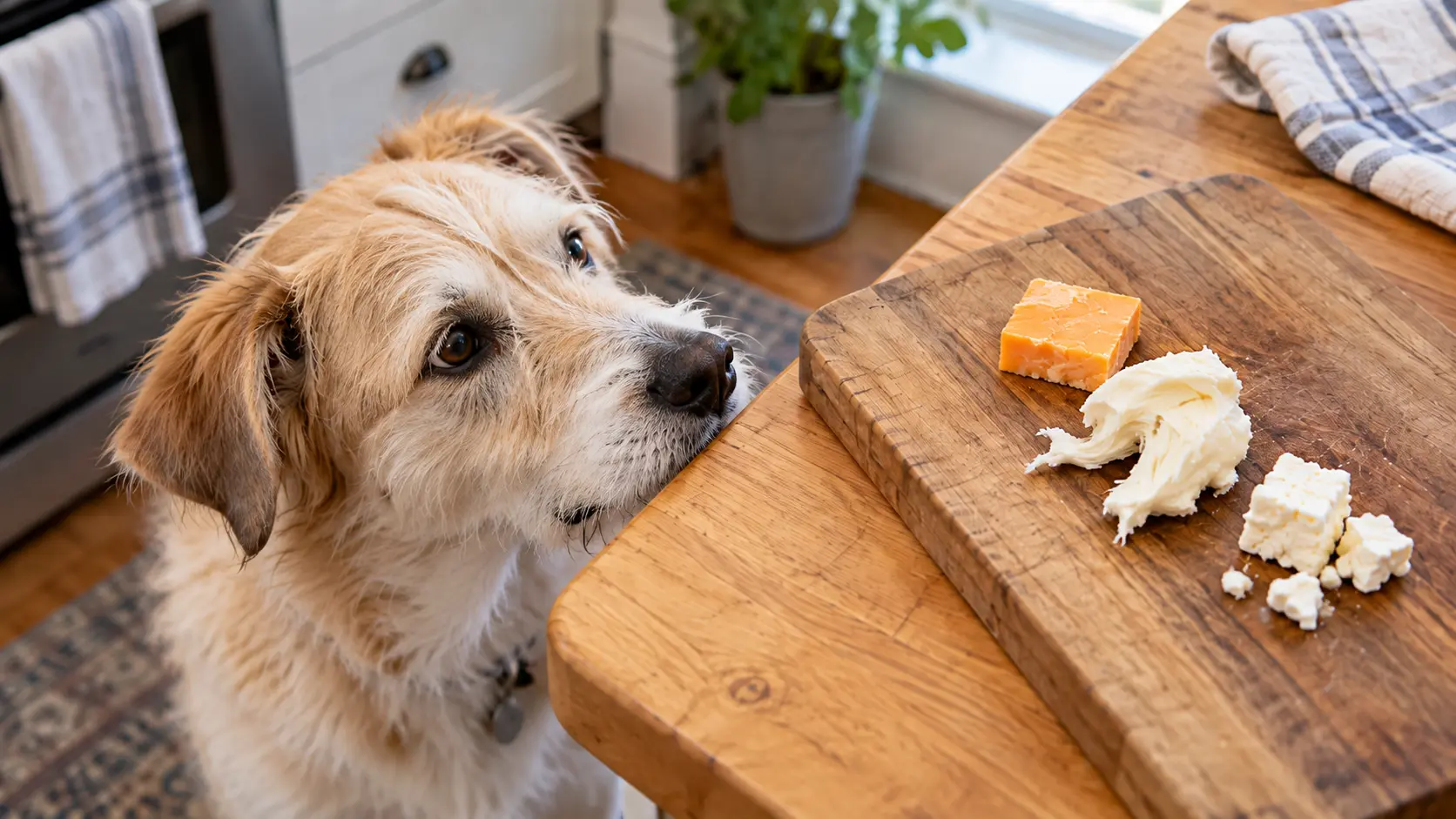
Can dogs have cheese? Some dogs can tolerate a small amount of plain cheese occasionally, but cheese is not suitable for every dog or every type of cheese. The answer depends on the ingredients, portion, fat and calorie content, sodium, residual lactose, and your dog’s health and digestive tolerance.
A tiny piece of plain cheddar, for example, is very different from a large serving of salty feta, flavored cream cheese, or spoiled moldy cheese. This guide explains those differences, how to think about portions, and what to check if your dog has already eaten cheese.
Can Dogs Have Cheese? The Short Answer
Most plain cheeses are not inherently poisonous to dogs, and some healthy dogs can handle a small amount without problems. But cheese is an optional treat rather than something dogs need in their diet.
Some dogs develop loose stool, gas, bloating, or other digestive problems after dairy. Rich cheeses can also add a surprising number of calories and a lot of fat, while certain varieties are high in sodium. Flavored products may introduce more serious concerns if they contain ingredients such as onion, garlic, or chives.
So “safe for a small taste” does not necessarily mean “healthy enough to feed regularly.”
If you want a broader look at sharing people food safely, see our guide to which human foods are safe for dogs.
Is Cheese Good or Bad for Dogs?
Cheese contains nutrients such as protein and calcium, but that does not make it a necessary addition to a dog’s diet. A dog eating an appropriate complete-and-balanced food should already receive the nutrients required for its life stage.
That means cheese makes more sense as an occasional extra than as a source of calcium, protein, or vitamins. This matters especially for puppies: cheese should not be used as a calcium supplement or allowed to replace a balanced growth diet.
Whether a particular cheese is a reasonable treat depends on more than one characteristic.
An aged cheddar may contain relatively little lactose but still be rich in fat and calories. A lower-fat cottage cheese may contain more residual lactose or sodium than someone expects. A cheese can therefore look favorable on one measure and still be a poor everyday choice on another.
The better question is not simply whether cheese is “good” or “bad.” It is whether that specific cheese, in that amount, is appropriate for that specific dog.
Why Can Cheese Cause Problems for Dogs?
Several different issues can make cheese unsuitable. They should not all be grouped together as “lactose intolerance.”
Lactose and Individual Tolerance
Lactose is the natural sugar in milk. Dogs use an intestinal enzyme called lactase to digest it, and lactase activity is highest early in life and decreases as dogs mature.
That does not mean every adult dog is equally lactose intolerant. Individual tolerance varies. Some dogs can eat a small piece of cheese without noticeable problems, while others develop diarrhea, gas, bloating, or abdominal discomfort. One episode of loose stool also does not prove lactose intolerance; portion size, fat, another ingredient, or another digestive issue may be responsible.
Cheeses also differ in residual lactose. Long-ripened cheeses often contain less than fresh cheeses, but the exact amount depends on the product and manufacturing process.
Calories and Fat
Cheese can be calorie dense, which becomes especially relevant when it is used repeatedly during training. Several tiny rewards can add up quickly.
Rich, high-fat foods may also be inappropriate for dogs that have had pancreatitis or need a veterinary low-fat diet. It would be inaccurate to say that cheese automatically causes pancreatitis; diet is one risk consideration, and many cases do not have one identifiable cause.
Sodium
Salt levels vary considerably between cheeses. A salty cheese is not automatically a poisoning emergency after one small bite, but it may be a poor treat choice, especially for a dog whose veterinarian has prescribed sodium restriction.
Added Ingredients
With flavored cheeses, spreads, and dips, the ingredient list may matter more than the cheese itself.
Onion, garlic, chives, and leeks can harm dogs. Concentrated forms such as powders are also relevant. Xylitol is a separate serious concern if it is actually present in a sugar-free or specialty product; it is not a routine ingredient in ordinary cheese.
What Types of Cheese Can Dogs Have?
There is no single cheese that can accurately be called “the best” for every dog. Fat, sodium, calories, lactose, and added ingredients vary independently.
Cheese type |
Practical verdict |
Main concern |
What to check |
|---|---|---|---|
Cheddar |
Small occasional amounts may be tolerated |
Calories, fat, sodium |
Portion and label |
Cream cheese |
Plain version is not inherently toxic, but not ideal routinely |
Fat, calories, lactose |
Flavorings and ingredients |
Mozzarella |
Plain versions may be suitable occasionally |
Nutrition varies by form |
Whole-milk, part-skim, fresh or string |
Feta |
Usually a poor routine treat |
High sodium |
Portion and any diet restrictions |
Cottage cheese |
Depends heavily on product |
Lactose and sodium can vary |
Fat level, sodium, tolerance |
Blue cheese |
Better avoided deliberately |
Mold-related compounds and uncertainty |
Avoid intentional feeding |
Spoiled/moldy cheese |
Do not feed |
Tremorgenic mycotoxins |
Veterinary advice after concerning exposure |
Can Dogs Have Cheddar Cheese?
Some dogs can tolerate a small amount of plain cheddar. Aged cheddar may contain very little residual lactose, but that does not make it a low-calorie or low-fat food.
The same basic advice applies to sharp cheddar and white cheddar: check the actual product and keep portions small rather than making cheddar a routine snack.
Can Dogs Have Cream Cheese?
Plain cream cheese is not established as inherently toxic to dogs. Veterinary sources even mention small quantities as one possible way to hide medication in some situations.
That does not mean it is an ideal everyday treat. Cream cheese can be rich in calories and fat and can contain residual lactose. Flavored versions may also contain ingredients that dogs should not eat.
A tiny amount of plain cream cheese may be tolerated by some healthy dogs, but it is easy to overfeed.
Can Dogs Eat Mozzarella Cheese?
Plain mozzarella may fit the same occasional-treat approach, but “mozzarella” is not one nutritionally identical food.
Fresh mozzarella, low-moisture mozzarella, whole-milk mozzarella, part-skim mozzarella, and string cheese can differ in fat, sodium, calories, and residual lactose. That is why it is better to check the particular package than assume all mozzarella is low-fat or low-lactose.
String cheese is often mozzarella-style cheese, but its ingredients and nutrition still depend on the product.
Can Dogs Eat Feta Cheese?
Feta is not inherently poisonous, but it is often quite salty. That makes it a poor choice for deliberate, routine treating compared with a small amount of a less salty plain cheese.
A small accidental bite is not the same thing as salt poisoning. Dogs on sodium-restricted veterinary diets, however, should not be given feta without professional guidance.
What About Cottage Cheese?
Cottage cheese is sometimes recommended simply because lower-fat versions exist. That does not make every cottage cheese a low-lactose or low-sodium option.
Residual lactose, sodium, and fat all vary. Check the actual label and judge it based on your dog’s needs rather than assuming cottage cheese is universally the healthiest choice.
Blue Cheese and Mold-Ripened Cheese
Blue and other mold-ripened cheeses are better left off the dog’s treat menu.
The reason needs some nuance. Compounds such as roquefortine C can occur in blue cheeses, but a universal canine toxic threshold from ordinary commercial blue cheese has not been established. The clearer veterinary toxicology concern is spoiled or accidentally moldy food, which can contain tremorgenic mycotoxins associated with vomiting, tremors, loss of coordination, and seizures.
There is no nutritional reason to experiment with blue or mold-ripened cheese when simpler options exist.
How Much Cheese Can a Dog Have?
There is no evidence-based rule saying a dog of a certain weight can safely eat a certain number of cheese cubes.
Veterinary nutrition guidance generally recommends that all treats and extras combined stay at about 10% or less of an average healthy dog’s daily calories. That 10% is not a cheese allowance. Cheese would have to share that budget with every other treat and extra the dog receives.
A more useful approach is to look at the calorie information on the specific cheese, consider what other treats your dog has already had, and offer only a very small amount at first.
Dogs that need weight control may be better off with a less calorie-dense treat. For example, properly prepared carrots can be a lower-calorie treat option for many dogs.
How to Give Cheese to a Dog More Safely
For a healthy dog with no diet restrictions, a cautious first trial is simple:
- Choose a plain, unseasoned cheese and read the ingredient list first. Avoid deliberately feeding blue, spoiled, or moldy cheese. Offer only a very small piece, count it as part of the day's overall treat intake, and watch for digestive changes afterward. If cheese repeatedly causes diarrhea, gas, discomfort, or other problems, stop offering it.
Tiny pieces of cheese can also work as a high-value training reward for some dogs, but repeated rewards can add up quickly.
Cheese is sometimes used to hide tablets or capsules as well. Follow the instructions for the specific medication, because not every medicine should be given with food or dairy. When in doubt, ask the prescribing veterinarian or pharmacist before using cheese as a pill wrapper.
My Dog Ate Cheese: What Should I Do?
If your dog has already eaten cheese, the most useful first step is identifying what was actually eaten, rather than assuming every cheese exposure has the same risk.
Check the package if you still have it. Determine whether the cheese was plain or flavored, whether it was blue or spoiled/moldy, and whether it was part of another food. Look specifically for ingredients such as onion, garlic, chives, leeks, or xylitol where relevant.
Then estimate the amount eaten and when it happened. Consider your dog’s size and health history, particularly previous pancreatitis, chronic digestive problems, or a prescription diet.
For an otherwise healthy dog that eats a small amount of ordinary plain, non-moldy cheese and remains normal, digestive upset is generally a more plausible concern than poisoning.
When to Contact a Veterinarian Urgently
Seek veterinary or animal poison guidance after a known toxic ingredient exposure, a significant moldy-food exposure, or if your dog develops concerning symptoms.
Depending on what was eaten, warning signs can include repeated vomiting, marked abdominal pain, profound lethargy or collapse, pale or yellow gums, dark urine, tremors, loss of coordination, or seizures.
Do not induce vomiting or give home remedies unless a veterinarian or animal poison professional specifically instructs you to do so. The correct response depends on what was eaten and the dog’s condition.
Which Dogs Should Avoid Cheese or Need Veterinary Advice?
Cheese deserves extra caution when a dog has a medical or nutritional reason to avoid rich or salty extras.
That includes dogs with previous pancreatitis, a prescribed low-fat diet, chronic gastrointestinal disease, repeated problems after dairy, substantial weight-control needs, a sodium-restricted diet, or another therapeutic/prescription diet.
These dogs may have different limits from a healthy adult dog, so general treat guidance should not override their veterinary feeding plan.
Puppies are not automatically prohibited from tasting a tiny amount of suitable plain cheese, but their main diet matters much more. Cheese should not displace balanced puppy food or be used as a calcium supplement.
There is also no credible rule that particular breeds simply cannot eat cheese. Existing health conditions and individual tolerance are more useful considerations than breed alone.
Frequently Asked Questions
Can Puppies Have Cheese?
Some puppies may tolerate a small amount of suitable plain cheese, but it should remain an occasional extra. Growing puppies need an appropriate complete-and-balanced growth diet, and cheese should not be used as a calcium supplement or allowed to replace normal meals.
Can Dogs Have Cheese Every Day?
Cheese is better treated as an occasional extra rather than a daily nutritional requirement. Feeding it every day can make calories easy to underestimate, especially when the dog also receives training treats, chews, or table scraps.
Can Dogs Have Shredded or Sliced Cheese?
The shape does not determine whether the cheese is appropriate. Check what kind of cheese it is, how much you are offering, and the ingredient list. Pre-shredded or processed sliced products can differ from a plain block of cheese in ingredients, sodium, fat, and calories.
Why Does Cheese Give My Dog Diarrhea?
Possible reasons include poor lactose tolerance, the fat content, eating too much at once, or another ingredient in the product. One episode does not prove lactose intolerance. Stop offering the cheese and speak with your veterinarian if diarrhea is significant, keeps happening, or is accompanied by other concerning symptoms.
Can Dogs Have Cheese? The Bottom Line
Can dogs have cheese? Yes, some dogs can tolerate a small amount of plain cheese occasionally, but there is no single cheese or serving size that works for every dog.
Check the actual product rather than judging cheese by name alone. Ingredients, calories and fat, sodium, residual lactose, portion size, and your dog’s health all matter.
For a healthy dog, keep cheese small and occasional. For dogs with medical or dietary restrictions—or after an exposure involving toxic ingredients, spoiled food, or significant symptoms—get veterinary guidance instead of relying on general feeding advice.