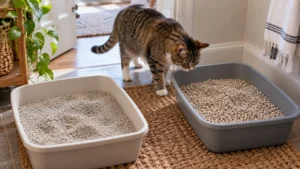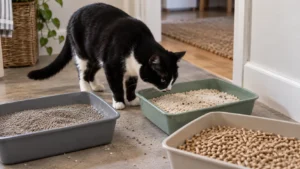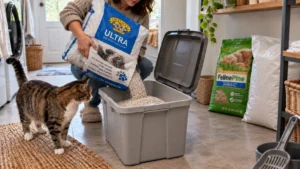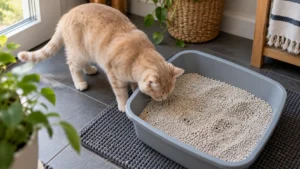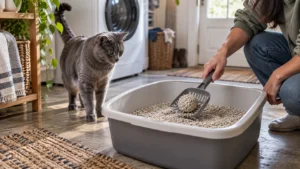
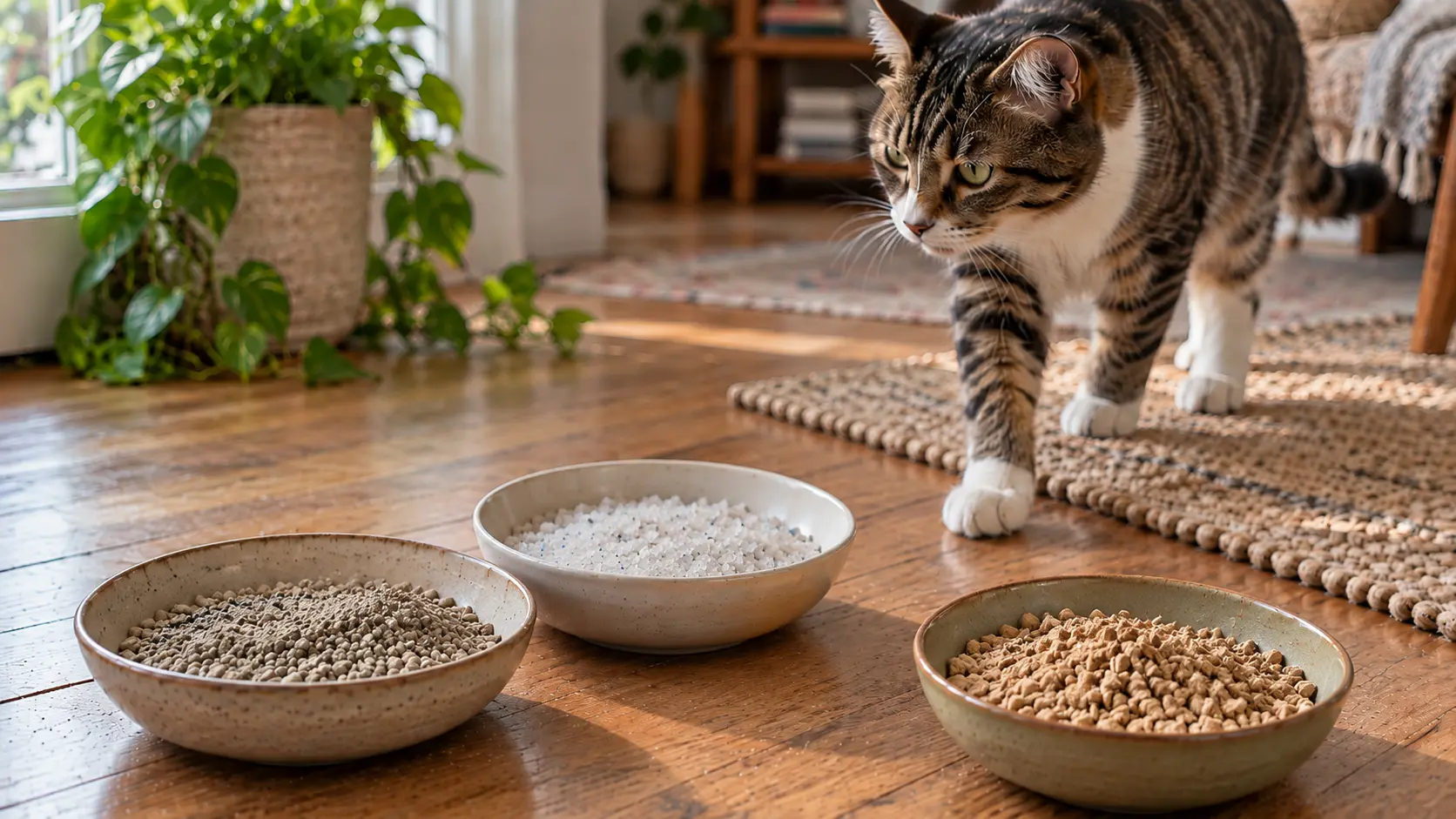
If you have ever wondered what is kitty litter made of, there is no single ingredient that applies to every bag. Cat litter can be made from absorbent clay or other minerals, porous silica gel, or plant and recycled materials such as corn, wheat, wood, paper, grass, walnut shells, and processed plant fibers.
The material named on the package is only part of the story. Some formulas also contain ingredients that help with clumping, odor control, fragrance, or processing. Knowing the difference between the main material and those added ingredients makes litter labels much easier to understand.
What Is Kitty Litter Made Of? The Short Answer
Most cat litters fall into three broad material groups:
Category |
Common examples |
Main role |
|---|---|---|
Clay and mineral |
Bentonite and other absorbent clays |
Absorb moisture; some clay minerals swell strongly |
Silica |
Porous silica gel |
Takes up moisture through its porous structure |
Plant and recycled |
Corn, wheat, wood, paper, grass, walnut, plant fibers |
Absorption and, in some formulas, clumping |
Added ingredients |
Starch, gums, activated carbon, baking soda, fragrance |
Binding, odor control, scent, or processing |
Some litters rely mostly on the properties of their base material. Others combine that material with binders, odor-control ingredients, fragrance, or other additives.
If you want to compare these materials by use and performance rather than composition, see our guide to the different types of cat litter.
Cat Litter Has a Base Material—and Sometimes Added Ingredients
The easiest way to understand a litter formula is to separate the base substrate from the extra ingredients.
The base substrate is the bulk material in the bag: clay, silica gel, corn, paper, wood fiber, or another material.
Functional ingredients may be added for a specific job. Depending on the formula, these can include starch or guar gum to help particles bind, activated carbon or baking soda for odor control, fragrance, zeolite, or processing aids.
That means two bags described as “corn litter” or “clay litter” do not necessarily contain identical formulas.
A clay litter might use bentonite as its main material but also contain odor-control ingredients. A plant-based litter might use corn or other fibers as its base while relying on starch or gum to improve clumping.
So a material name tells you where to start, but not always everything that is inside the bag.
What Is Clay Cat Litter Made Of?
Clay litter is made from naturally occurring mineral materials, but the word “clay” covers more than one mineral or formula.
Many clumping clay litters use bentonite, a natural material rich in clay minerals from the smectite group. Montmorillonite is one mineral within that group, so bentonite and montmorillonite are related terms but are not exact synonyms.
Why sodium bentonite clumps
Some sodium-rich smectite clays swell strongly when they come into contact with water. That swelling helps wet litter particles bind together into a mass that can be removed with a scoop.
Calcium-rich clay materials generally do not swell to the same extent, which is one reason different clay litters can behave differently when wet.
The clumping effect should not be described as urine “activating glue” inside the litter. It comes from the physical behavior of swelling clay minerals, although the final performance also depends on how the product is formulated and processed.
What is Fuller’s earth?
You may also see the term Fuller’s earth in explanations of traditional absorbent litter.
Fuller’s earth is not one specific mineral. It is a broader term for naturally occurring earth or clay materials valued for their high absorptive capacity. Calling all Fuller’s earth “calcium bentonite” would be too simplistic.
For a deeper look at mineral types, clumping behavior, and practical use, see our full guide to clay cat litter.
What Is Crystal Cat Litter Made Of?
Crystal litter generally uses porous silica gel.
Despite the name, silica gel should not be confused with crystalline silica such as quartz. Silica gel is an amorphous, or non-crystalline, form of silicon dioxide. That distinction matters because discussions of occupational crystalline-silica exposure do not automatically describe silica-gel litter.
Silica gel contains many tiny pores and a large internal surface area. Water can be taken up on those surfaces, which helps explain why the material can hold moisture without behaving like swelling clay.
That does not mean every commercial crystal formula is identical, or that every type of dust associated with every mineral litter has the same composition. The accurate point is narrower: silica gel itself is not the same material as crystalline silica.
If you want the practical differences, limitations, and product considerations, our separate guide covers crystal cat litter in more detail.
What Are Plant-Based and Recycled Cat Litters Made Of?
Non-mineral litter can be made from a surprisingly wide range of processed plant or recycled materials.
Corn, wheat, grass, and walnut
Commercial litters may use processed corn, wheat, grass, or ground walnut shell as their main substrate.
Some of these materials can clump without bentonite. Depending on the formula, manufacturers may rely on the properties of the plant material itself or combine it with starches, gums, or other binders.
A package labeled “corn litter” still does not necessarily mean that corn is the only ingredient in the bag.
If you want to compare finished products made from corn, wood, wheat, walnut, grass, and other plant-derived materials, our natural cat litter guide looks at those options from a buying perspective.
Wood and recycled paper
Wood litter may use processed wood fibers, sawdust, or compressed pellets. Paper litter commonly uses recycled paper that has been processed into pellets or granules.
These are useful examples of why material and format are different things. Wood might appear as pellets, while paper can be formed into different shapes and particle sizes.
What is tofu litter made of?
“Tofu litter” is a commercial category rather than a standardized recipe.
Formulas may use processed soybean fiber, pea fiber, or similar plant materials, often alongside starches or binders. Some technical formulations also include corn-derived ingredients or odor-control additives.
So it is safer to describe tofu litter as a plant-fiber litter category rather than saying it is always made from soy or literally made from the tofu sold as food.
Our tofu litter guide goes deeper into how these formulas vary and how they are used.
What Makes Kitty Litter Clump?
Clumping is a behavior, not an ingredient.
This distinction clears up a common misunderstanding.
Many clumping clay formulas use sodium bentonite because the clay swells when hydrated and helps wet particles bind together. But bentonite is not the only way to make a clumping litter.
Plant-based litters can also clump. Some use starches or gums as binders, while others rely more heavily on the natural behavior of the processed substrate.
That means the label “clumping litter” does not tell you exactly what the litter is made from.
For the practical difference in cleaning, maintenance, and use, see our guide to clumping vs non-clumping litter.
What Else Can Manufacturers Add to Cat Litter?
The main substrate does most of the physical work, but some formulas include other ingredients for specific purposes.
Binding and clumping aids
Plant-based formulas may use ingredients such as:
- starch;
- pregelatinized starch;
- guar gum.
These can help particles stick together when wet.
Odor-control ingredients
Depending on the product, odor-control ingredients may include:
- activated carbon or charcoal;
- baking soda;
- zeolite.
These are not present in every litter, and a litter can also manage odor partly through moisture absorption and regular scooping.
Fragrance and processing aids
Some litters contain added fragrance. Others are sold as unscented.
“Unscented” generally means no added fragrance; it does not necessarily mean the product has no odor-control ingredients.
Some formulas also use processing ingredients such as mineral oil. The exact reason and amount depend on the product, so these examples should not be treated as a standard ingredient list for all cat litter.
How Is Kitty Litter Made?
The manufacturing process depends on the raw material.
Clay litter
Clay is typically mined and then physically processed. General industrial steps can include drying, crushing or grinding, particle-size control, additional processing, and blending before packaging.
The exact sequence varies by manufacturer and product, so no single flowchart applies to every clay litter.
Silica gel litter
Industrial silica gel can be produced from soluble silicate materials that are converted into a gel. Washing and drying create the porous solid structure.
Those porous particles are then processed into the form used by the manufacturer.
Plant-based litter
Plant and recycled formulas vary even more.
Production may involve grinding or pulping the raw material, mixing it with binders or other ingredients, forming pellets or granules, drying them, and screening the final particles before packaging.
The process is worth understanding, but the main takeaway is simple: the material named on the front of the bag has usually been processed into a form designed for litter-box use.
How to Tell What Your Cat Litter Is Really Made Of
You do not need to memorize mineral chemistry to understand a litter label. Start with four questions:
- What is the main substrate? Look for clay, silica gel, corn, wheat, wood, paper, grass, walnut, or another plant fiber.
- What makes it clump? It may be swelling clay, starch, gum, the substrate itself, or a formula that does not fully disclose its mechanism.
- What handles odor? Look for ingredients such as activated carbon, baking soda, zeolite, or added fragrance.
- What else has been added? Some products include fragrance, processing aids, color-changing indicators, or other treatments.
This approach is more useful than relying on a single marketing word. “Natural,” “crystal,” and “clumping” each describe only part of the product.
Safety Notes: What the Material Does—and Does Not—Tell You
Material names can help you understand a litter, but they do not automatically tell you whether one formula is safer for every cat.
Dust and respiratory sensitivity
Dusty litter may irritate sensitive airways and is considered a possible trigger for cats with respiratory sensitivity. That does not establish that clay litter, bentonite, or crystal litter causes feline asthma.
If your cat has diagnosed asthma, persistent coughing, wheezing, or breathing difficulty, discuss litter and other environmental triggers with your veterinarian rather than relying only on a material label.
What if a cat eats litter?
A tiny amount of litter picked up while grooming is different from deliberately eating it.
Repeated litter eating may be associated with pica or an underlying medical or behavioral problem and deserves veterinary attention.
If a cat may have swallowed a significant amount of litter and then develops repeated vomiting, loss of appetite, abdominal pain or swelling, or marked lethargy, contact a veterinarian promptly. Those signs can occur with gastrointestinal obstruction.
There is no useful universal “safe amount” because risk depends on the material, quantity, particle form, and the individual cat.
A few labels do not mean what people assume
Natural does not automatically mean safer.
Biodegradable does not automatically mean suitable for backyard compost or plumbing.
Crystal does not mean crystalline silica.
And clumping does not mean a litter is automatically unsuitable for every kitten. Veterinary life-stage guidance does not support a blanket ban on clumping litter for all kittens. A kitten that repeatedly eats litter, however, should be evaluated separately.
If your veterinarian gives you specific litter instructions after surgery, follow those instructions even if they differ from what you normally use.
Frequently Asked Questions
What is scented kitty litter made of?
Scented litter can use the same base materials as unscented litter, including clay, silica, or plant-based substrates. The difference is that fragrance has been added. Fragrance and odor-control ingredients are not the same thing; an unscented litter may still contain activated carbon, baking soda, or another odor-control ingredient.
Is tofu litter actually made from tofu?
Not necessarily. “Tofu litter” usually describes a processed plant-fiber litter made from soybean, pea, or similar fibers, often with starches or binders. There is no single standardized tofu-litter recipe, so it should not be assumed to be literal food-grade tofu.
Can kittens use clumping litter?
There is no evidence-based blanket rule that clumping litter is unsuitable for every kitten. AAHA/AAFP life-stage guidance includes unscented clumping litter as a reasonable starting option. A kitten that repeatedly eats litter is a different situation and should be discussed with a veterinarian.
Can biodegradable cat litter be flushed or composted?
Not automatically. “Biodegradable” describes the material’s ability to break down under suitable conditions; it does not guarantee that the litter belongs in a backyard compost pile or plumbing system. EPA guidance advises against putting cat litter in backyard compost and says cat litter should not be flushed into septic systems. Some manufacturers make product-specific flushability claims, so also check the package and local wastewater rules.
What Is Kitty Litter Made Of? The Useful Takeaway
When you want to understand what is kitty litter made of, look beyond the material name on the front of the bag.
Identify the base substrate, then check what makes the litter clump, what handles odor, and whether fragrance or other additives are present. Clay, silica gel, paper, corn, wood, grass, tofu-style fibers, and other materials can all be formulated differently.
If you want to move from ingredients to practical comparisons, our guide to types of cat litter explains how the major formats differ, while our best cat litter guide covers product selection.