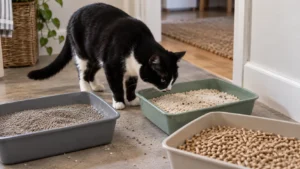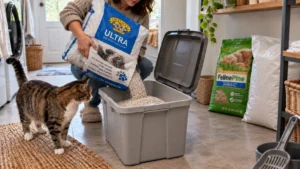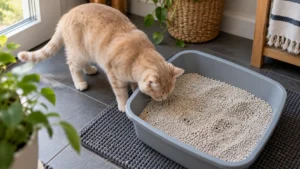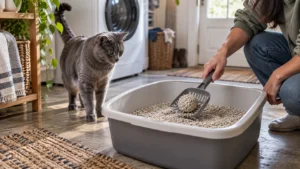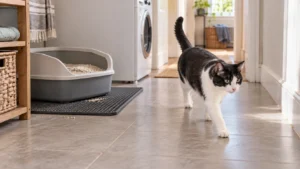
If you’re comparing clumping vs non clumping litter, the biggest difference is simple: clumping litter forms removable masses around urine, while non-clumping litter absorbs or manages moisture without creating scoopable urine clumps.
That usually makes clumping litter easier to spot-clean. Many adult cats also tend to prefer soft, unscented clumping litter. But that does not make clumping automatically better for every cat.
Dust, tracking, odor control, texture, material, cost, and safety all depend on more than whether a litter clumps. Your cat’s own preference matters too.
This guide compares the practical differences so you can choose based on cleaning, odor, cost, texture, health considerations, and the way your cat actually uses the box.
Clumping vs Non-Clumping Litter: The Short Answer
For many healthy adult cats, a soft, unscented clumping litter is a reasonable starting point. The AAHA/AAFP Feline Life Stage Guidelines note that most adult cats tend to prefer clumping litter and that plain, unscented litter is generally preferred.
Still, individual cats can have strong preferences of their own.
Non-clumping litter can work perfectly well when a cat likes the texture, when a particular material suits the household, or when there is no reason to change a litter the cat already accepts.
Factor |
Clumping litter |
Non-clumping litter |
|---|---|---|
Urine handling |
Forms removable clumps |
Absorbs or manages moisture without forming a scoopable urine clump |
Daily cleaning |
Usually easier to remove urine selectively |
Usually easier to remove urine selectively |
Cat preference |
Often preferred by adult cats, especially soft unscented options |
Some cats prefer particular non-clumping textures |
Odor |
Removing urine promptly may help |
Depends heavily on material, formulation, and cleaning |
Dust |
Product-dependent |
Product-dependent |
Tracking |
Product-dependent |
Product-dependent |
Cost |
No universal winner |
No universal winner |
Automatic boxes |
Works with some systems |
Depends on the machine |
Kittens |
No evidence-based universal age ban |
May suit some kittens, but format alone does not determine safety |
The main mistake is treating the two formats as complete opposites. Clumping versus non-clumping tells you mainly what happens when the litter gets wet. It does not tell you everything else about the product.
What Is the Difference Between Clumping and Non-Clumping Cat Litter?
How clumping litter works
Clumping litter is designed so wet particles bind together into a cohesive mass. When a cat urinates, the affected litter forms a clump that can usually be removed with a scoop.
That lets you remove both feces and much of the urine-contaminated litter while leaving the unaffected litter in the box.
Many traditional clumping clay litters use sodium bentonite because of its strong water-absorbing and binding properties. But bentonite is not what defines clumping litter.
Plant-based materials can clump too.
How non-clumping litter works
Non-clumping litter absorbs or otherwise manages urine without turning the wet area into a removable clump.
You can still scoop feces, but urine-contaminated litter generally stays within the litter bed until part or all of the substrate is refreshed according to the product directions and your cleaning routine.
That difference in urine removal is the main practical distinction between the two formats.
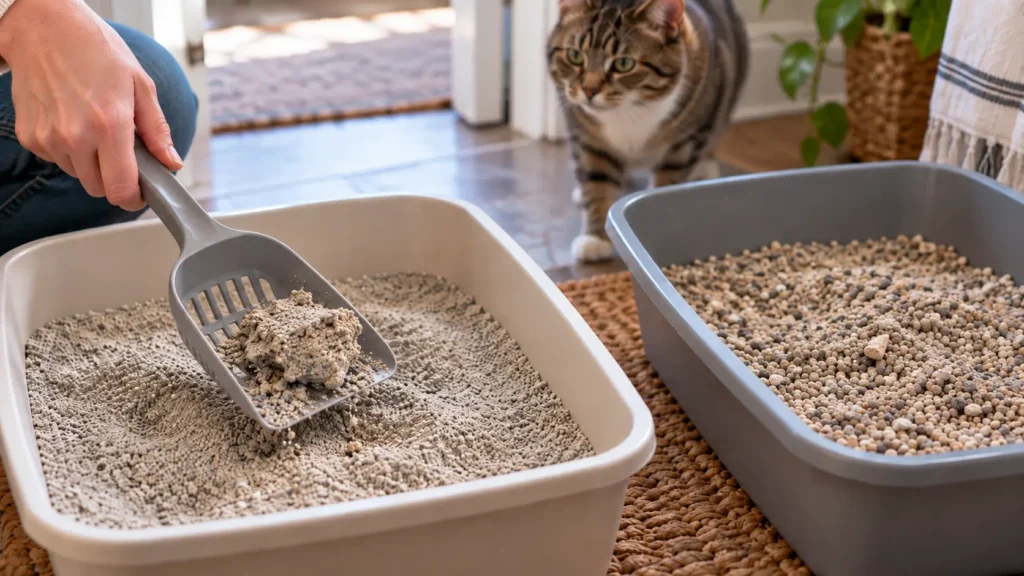
Clumping does not mean “clay”
This is where many comparisons become misleading.
Clumping is a behavior. Clay is a material.
Likewise:
- pellets describe physical form;
- silica or crystal describes a material category;
- wood and paper describe materials;
- plant-based litter can be either clumping or non-clumping depending on the product.
So a statement such as “clumping litter is dusty” or “non-clumping litter tracks less” is too broad unless the actual material and product design are considered.
If you want a broader look at those differences, see our guide to different cat litter materials and formats.
Clumping vs Non-Clumping Litter: Side-by-Side Differences
Cleaning and daily maintenance
Clumping litter has a clear practical advantage when it comes to targeted urine removal.
If a cat urinates twice in a clumping litter box, you may be able to remove two separate clumps during scooping. With a non-clumping litter, that moisture is instead absorbed or distributed through part of the litter bed.
That does not mean non-clumping litter is inherently dirty. It simply requires a different maintenance routine.
The AAHA/AAFP recommends regular litter-box cleaning and daily scooping. International Cat Care likewise recommends removing solid waste at least daily, along with urine when a clumping litter is used.
Avoid rigid rules such as “change clumping litter every two weeks” or “replace non-clumping litter every seven days.” Replacement frequency depends on the product, number of cats, amount of litter, box size, and manufacturer directions.
A more reliable rule is:
Remove visible waste at least daily and follow the specific litter manufacturer’s guidance for topping up, full replacement, and box cleaning.
Daily feces removal also matters for human health. The CDC notes that Toxoplasma gondii typically requires time after being shed in feces before becoming infectious, which is one reason daily litter-box cleaning is recommended.
Odor control
Clumping litter can have a practical odor advantage because urine-contaminated litter can be physically removed instead of remaining in the box.
But that does not prove that every clumping litter controls odor better than every non-clumping one.
Odor performance also depends on:
- litter material;
- formulation;
- odor-control additives;
- how often the box is scooped;
- how often the litter is refreshed;
- the number of cats using the box.
Research comparing cat-litter formulations has found meaningful differences in odor performance between products. Those differences do not map neatly onto clumping status alone.
If odor is the main problem you’re trying to solve, our guide to litter designed specifically for odor control is more useful than choosing solely on whether the litter clumps.
Dust and tracking
Neither clumping nor non-clumping litter is automatically lower in dust.
Dust depends on the material and formulation. A low-dust clumping product may produce less airborne dust than a dusty non-clumping product.
That distinction matters particularly for cats with respiratory disease. Cornell’s Feline Health Center lists dusty litter among possible environmental triggers for feline asthma, but that does not mean clumping litter itself causes asthma.
Tracking is similar.
How much litter leaves the box can depend on:
- particle size;
- particle weight;
- shape;
- litter depth;
- paw and coat characteristics;
- how vigorously the cat digs;
- the design of the box and litter mat.
So “non-clumping tracks less” is not a reliable rule.
For those specific concerns, see our guides to low-dust cat litter and lower-tracking litter options.
Cost and value
There is no clear category-wide winner on cost.
Clumping litter may reduce how much unaffected litter is thrown away because you can remove the urine-contaminated portion selectively.
On the other hand, some non-clumping litters may cost less to buy.
Actual monthly cost depends on:
- price;
- package size;
- density;
- number of cats;
- how much litter is used;
- how frequently it is topped up;
- how often the whole box needs refreshing.
Price per pound alone can also be misleading because two litters with the same weight may occupy different volumes or require different usage amounts.
It is safer to judge value from real household use than to assume either format is automatically cheaper.
Which Type of Litter Do Cats Usually Prefer?
Many adult cats appear to prefer clumping litter, but the clumping property may not be the only reason.
Veterinary guidance also points toward preferences for soft, fine-textured, unscented substrates.
A recent litter-preference study found clear preferences among different litter products, but the tested litters also differed in grain size, texture, and weight. That means the results cannot be reduced to “cats prefer clumping clay.”
Texture may matter just as much.
For example, imagine a cat moving from fine clumping litter to large non-clumping wood pellets. The owner has changed two important things at once:
- whether the litter clumps;
- how the litter feels under the paws.
If the cat avoids the pellets, you cannot know that the lack of clumping caused the problem.
For a healthy adult cat with no established preference, a soft, unscented clumping litter is a reasonable starting option. But if your cat already uses a different litter comfortably and consistently, there is no need to switch simply because another format is more commonly preferred.
Which Is Better for Different Cats and Households?
Healthy adult cats
For most healthy adult cats without an established litter preference, soft, unscented clumping litter is a reasonable place to start.
That is a starting point, not a rule.
If the cat prefers another substrate and uses the box reliably, the cat’s response matters more than choosing the format that is most popular.
Multi-cat homes
Clumping litter may make a busy multi-cat box easier to maintain because urine can be removed during routine scooping.
That is a convenience advantage, not proof that clumping litter is biologically better for multiple cats.
Cleanliness and adequate access to litter boxes matter more. AAHA/AAFP commonly recommends one litter box per cat plus one additional box, with suitable placement around the home.
Senior cats and cats with mobility problems
For an older cat, box accessibility and substrate comfort may matter more than clumping behavior.
Cats with arthritis or other mobility problems may find hard pellet-style substrates uncomfortable, and high-sided boxes can also become difficult to enter.
A soft litter and an easily accessible box may therefore be more useful than simply deciding between clumping and non-clumping.
A new litter-box problem in an older cat should not automatically be blamed on preference. Pain, constipation, urinary disease, diabetes, and other medical problems can also change elimination behavior.
Cats with asthma or respiratory sensitivity
Choose based on dust level, not merely on clumping status.
Cornell includes dusty litter among potential environmental triggers for feline asthma. A cat with diagnosed respiratory disease may therefore benefit from minimizing dusty exposures, but “non-clumping” does not automatically mean “low dust.”
If your cat has asthma or another significant respiratory condition, ask your veterinarian whether litter or other environmental triggers may need to be adjusted.
Is Clumping Litter Safe for Kittens?
You may see advice telling owners never to use clumping litter until a kitten is three or four months old.
The stronger feline veterinary guidance reviewed for this article does not support a universal age cutoff.
In fact, the AAHA/AAFP kitten checklist includes unscented clumping sand litter and/or the litter the kitten was already accustomed to as appropriate starting options.
That does not mean litter ingestion should be ignored.
Young cats may investigate objects with their mouths, and persistent eating of litter or other non-food materials can be a sign of pica or another medical or behavioral problem.
Repeated ingestion of non-food material can also create gastrointestinal risks.
Contact your veterinarian if a kitten repeatedly eats litter, especially if you also notice signs such as:
- vomiting;
- reduced appetite;
- unusual lethargy;
- abdominal discomfort.
Do not assume that a kitten licking a few stray grains from its paws will automatically develop an intestinal blockage. The evidence does not support that common claim as a predictable outcome of normal clumping-litter use.
The useful distinction is between ordinary litter-box use and repeatedly swallowing litter.
Can You Use Clumping Litter in an Automatic Litter Box?
Sometimes—but the answer depends on the machine.
Some automatic litter boxes use a sifting system that requires compatible clumping litter. Litter-Robot, for example, specifies clumping litter that can pass through its sifting system and advises against certain strictly absorbent non-clumping or pellet-style litters.
Other automatic systems may have different requirements.
Check the manufacturer’s manual before switching litter types. Do not assume that every automatic box requires clumping litter or that every clumping product will work properly in every machine.
How to Switch Between Clumping and Non-Clumping Litter
Cats can be sensitive to substrate changes, so changing everything at once can make it difficult to know what they dislike.
If you simply want to change litter
A gradual transition may be easier for a cat that dislikes sudden changes.
You do not need to follow an arbitrary seven-day or fourteen-day formula. The goal is simply to avoid making an abrupt change if your cat is sensitive to new textures or smells.
Watch for normal litter-box use during the transition.
If you want to find out which litter your cat prefers
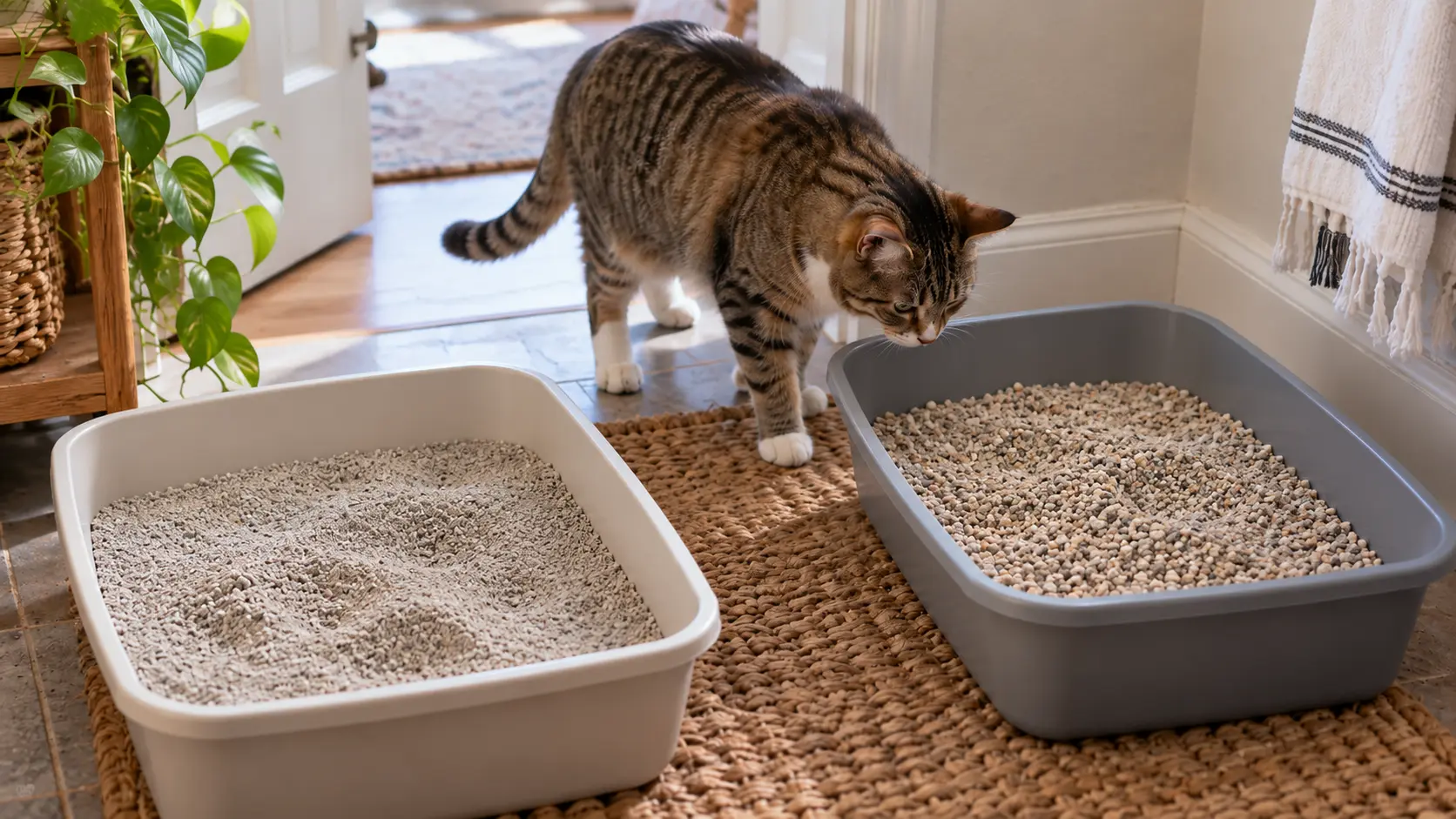
A side-by-side preference test is more informative than mixing the litters together.
- Offer two separate, clean litter boxes.
- Keep the box style, location, and other conditions as similar as practical.
- Keep the box style, location, and other conditions as similar as practical.
- Observe which box your cat repeatedly chooses.
- Avoid changing the box, location, fragrance, and litter texture all at the same time.
AAHA/AAFP guidance supports offering different substrates in separate boxes when trying to determine a cat’s preference.
Mixing two litters can be useful during some transitions, but it is less useful as a preference test because the cat no longer has two clearly different options to choose between.
When the Problem May Not Be the Litter
A cat that suddenly stops using the litter box is not necessarily objecting to clumping or non-clumping litter.
Start by checking simple environmental factors:
- Did you recently change the litter?
- Is the box dirty?
- Has its location changed?
- Is the box difficult to access?
- Has something stressful changed in the home?
- Could another cat be blocking access?
But do not stop there if the behavior is sudden or persistent.
Medical problems can also affect litter-box use. Veterinary guidance links elimination changes with conditions including urinary disease, constipation, pain, diabetes, and mobility problems.
Contact a veterinarian if the change is persistent or is accompanied by pain, vomiting, appetite changes, blood in the urine, or unusual urinary behavior.
Repeated trips to the litter box, straining, obvious distress, or attempts to urinate with little or no urine should not be treated as a litter-preference experiment. Urinary obstruction can become a serious emergency.
So, Should You Choose Clumping or Non-Clumping Litter?
Clumping litter may make more sense when:
- you want urine to be removable during daily scooping;
- your cat prefers a soft, fine clumping substrate;
- your automatic litter box specifically requires compatible clumping litter;
- visible urine clumps help you notice changes in litter-box habits.
- Has something stressful changed in the home?
- Could another cat be blocking access?
Non-clumping litter may make sense when:
- your cat clearly prefers that particular substrate;
- a specific non-clumping material works well in your home;
- your current litter is accepted and performing well;
- your veterinarian has recommended a particular substrate for your cat.
If you decide clumping is the better format for your household, see our guide to the best clumping cat litter. If your cat does better with the other format, compare our best non-clumping cat litter.
The most useful rule is not “clumping is better” or “non-clumping is better.”
Choose in two stages.
First, decide whether you want urine to form removable clumps or remain absorbed in the litter until the substrate is refreshed.
Then separately consider the litter’s:
- material;
- texture;
- dust;
- fragrance;
- tracking
- odor performance;
- maintenance needs;
- compatibility with your equipment;
- acceptance by your cat.
Frequently Asked Questions
Is clumping or non-clumping litter better for odor?
Frozen shrimp can be suitable once it is thoroughly cooked and served plain with the shell and tail removed.
Do not treat freezing as a substitute for cooking raw shrimp. Freezing does not reliably eliminate all harmful bacteria.
Can you mix clumping and non-clumping litter?
The words “shrimp” and “prawn” are often used for closely related crustaceans, with usage differing by region.
For ordinary cooked prawns, the same basic advice applies: cook them thoroughly, remove the hard external parts, serve them plain, and offer only a small amount.
That does not mean every type of shellfish has exactly the same safety considerations.
Does clumping litter last longer than non-clumping litter?
The plain cooked shrimp itself may be suitable once the shell and tail are removed, but the sauce is a separate question.
Cocktail-sauce recipes vary and may contain ingredients or seasonings you would not intentionally give to a dog. Check the ingredients rather than assuming every shrimp cocktail is the same.
Is non-clumping litter less dusty?
Shrimp is a type of crustacean shellfish, but safety advice for shrimp should not automatically be applied to crab, lobster, oysters, mussels, clams, scallops, and every other shellfish.
Those foods have their own preparation and safety considerations.
Clumping vs Non-Clumping Litter: The Bottom Line
When choosing between clumping vs non clumping litter, focus first on the practical difference: clumping litter lets you remove urine as formed clumps, while non-clumping litter manages moisture without producing scoopable urine masses.
Many adult cats favor soft, unscented clumping litter, so it is a reasonable starting point when a cat has no established preference. But the label alone does not tell you whether a litter will be low-dust, low-tracking, affordable, comfortable, or good at odor control.
If your cat already uses another litter comfortably, there is no reason to switch simply because one format is more popular.
For a broader comparison of litter options, you can also compare our overall cat litter picks.