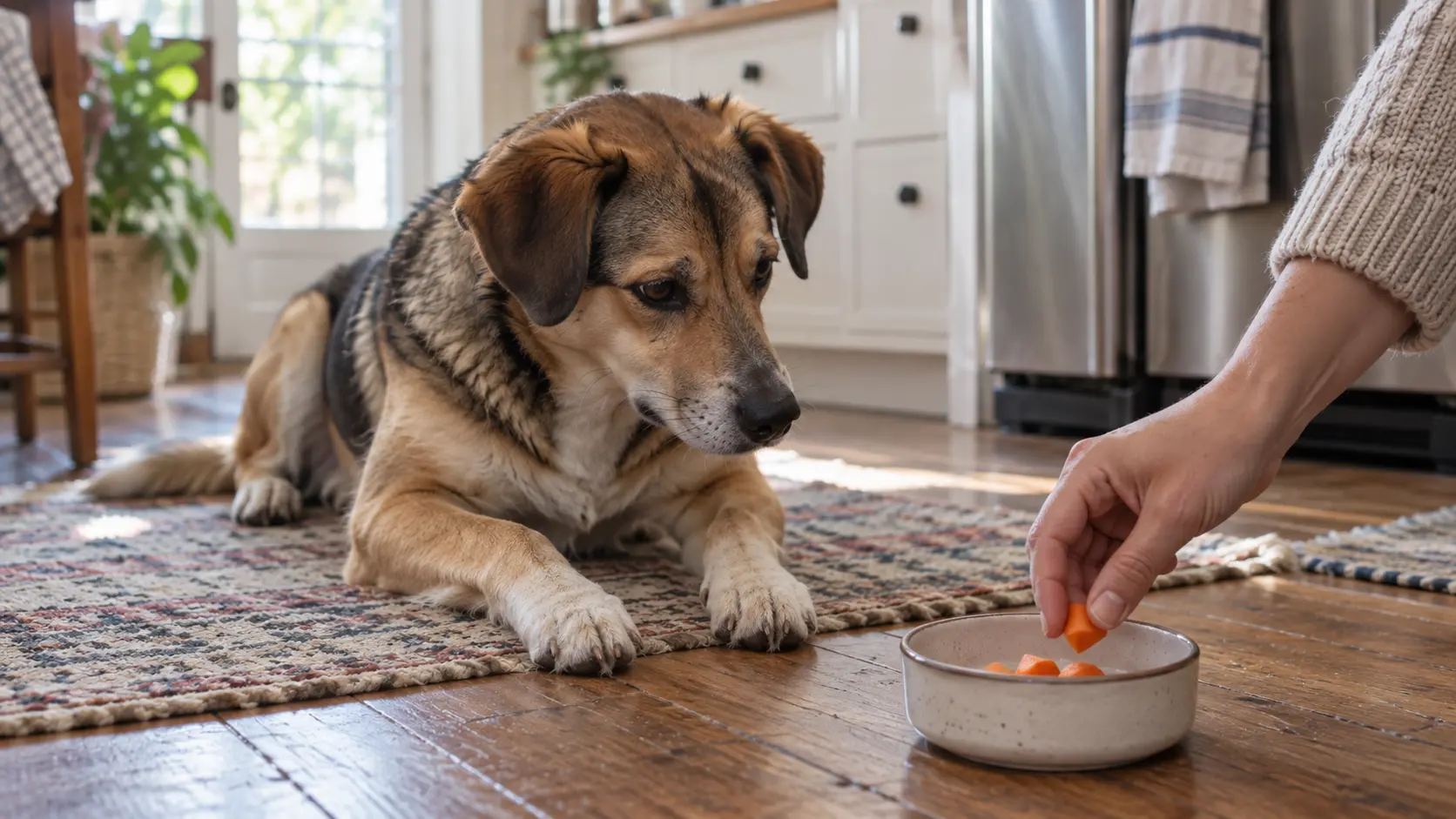
Yes, carrots are generally good for dogs when they are served plain and in sensible amounts. They are relatively low in calories and provide fiber and carotenoids such as beta-carotene.
That does not mean dogs need carrots as a nutritional supplement. A dog eating a complete and balanced diet should already receive the essential nutrients it needs. Carrots are better treated as an occasional extra, just like other human foods dogs can eat.
How much you offer, whether the carrot is raw or cooked, and how your dog chews matter more than broad claims about carrots being a canine “superfood.”
Are Carrots Good for Dogs? The Short Answer
For most healthy dogs, plain carrots can be a safe and useful treat.
You can offer them raw or plainly cooked, provided the size and texture suit your dog. They can be especially practical when you want a lower-calorie alternative to richer treats.
The main limits are straightforward: carrots should not replace a complete diet, they still contribute calories, and hard or poorly sized pieces can be a choking concern for dogs that gulp food.
Dogs on prescription diets or with conditions such as diabetes or a history of certain urinary stones may need more individualized advice before extra foods are added.
What Do Carrots Actually Offer Dogs?
Carrots do contain useful nutrients, but it helps to separate what is in the vegetable from what feeding a few pieces has actually been shown to do.
Beta-carotene and vitamin A
Carrots contain carotenoids, including beta-carotene. Dogs can convert provitamin A carotenoids such as beta-carotene into vitamin A.
Vitamin A has essential roles in the body, but that does not mean adding carrots to an already balanced diet will improve a healthy dog’s eyesight or correct a nutritional problem.
For most dogs, carrots are simply another food that contributes nutrients rather than a necessary source of them.
Fiber
Carrots also provide dietary fiber.
A small amount can fit easily into a dog’s diet, but more fiber is not automatically better. Large servings or a sudden change in food can cause soft stool or other digestive upset in some dogs.
If you are introducing carrots for the first time, a small serving gives you a chance to see how your dog tolerates them.
Relatively few calories
Plain carrots are relatively low in calories compared with many rich table foods and treats.
That can make them useful as a substitute for a more calorie-dense snack. It does not mean carrots themselves cause weight loss.
A few carrot pieces might be a sensible alternative to fatty leftovers, for example, but they still count toward your dog’s total daily treat intake.
What Carrots Don't Do
Their beta-carotene content does not prove that ordinary carrot treats improve a healthy dog’s eyesight. Likewise, there is not good evidence that feeding carrots by themselves boosts immunity, improves heart health, creates a healthier coat, or prevents disease.
The distinction is simple: a food containing a nutrient involved in a body function is not the same as showing that eating that food improves the function in an already well-nourished dog.
Carrots can still be a worthwhile treat without needing exaggerated health claims.
Can Dogs Eat Raw or Cooked Carrots?
Both raw and cooked carrots can work for dogs. The better option depends more on your dog’s chewing habits, mouth, and preferences than on one form being universally healthier.
Can dogs eat raw carrots?
Yes. Many dogs can eat fresh raw carrots.
Wash fresh carrots under running water before preparing them. Because raw carrots are firm, think about how your dog actually eats rather than relying only on body size.
A dog that slowly chews food presents a different situation from one that tries to swallow treats almost whole.
Raw carrot pieces should therefore be sized and shaped with your individual dog in mind, and dogs that tend to gulp food should be supervised closely.
Dogs with painful teeth or difficulty chewing hard food may also do better with a softer preparation.
Can dogs eat cooked carrots?
Plain cooked carrots are also suitable for many dogs.
Boiling or steaming softens the carrot, which can make it easier to chew. Serve cooked carrots plain rather than coated with butter, rich sauces, or heavy seasoning.
Avoid dishes prepared with ingredients that are unsafe for dogs, including onion or garlic.
Cooking can also change how easily some carotenoids become available during digestion. Food-science research suggests processing may increase beta-carotene bioaccessibility, but that does not prove cooked carrots produce better health outcomes in dogs.
There is no need to declare raw or cooked carrots the healthier choice.
How Much Carrot Can a Dog Eat?
There is no universal number of carrot pieces that is right for every dog.
A more useful guideline is to keep all treats and extras combined to no more than about 10% of a dog’s daily calories, with the main diet supplying the large majority of nutrition.
The 10% figure is a ceiling for treats, not a goal for how much carrot your dog should eat.
For example, if your dog already gets training treats, a dental chew, peanut butter, or other snacks during the day, those calories belong to the same overall treat allowance.
This is why rigid advice such as “give three baby carrots to a small dog and five to a larger dog” can be misleading. Dogs of the same weight can have different energy needs depending on age, activity, body condition, health, and other factors.
Start with a small amount, especially if carrots are new to your dog.
Small servings can fit into the diet regularly if your dog tolerates them and the overall diet remains balanced, but there is no nutritional reason a dog needs carrots every day.
How to Serve Carrots Safely
Carrots do not require complicated preparation.
- Wash fresh carrots under running water. There is no need to wash produce with soap or detergent.
- Serve them plain. Skip sauces, heavy seasoning, onion, garlic, and other ingredients from prepared human dishes.
- Choose an appropriate size and texture. Consider your dog's mouth, chewing style, age, and dental condition.
- Start with a small amount. This is especially useful when your dog has not eaten carrots before.
- Watch how your dog eats them. A dog that gulps food may need a different preparation from one that chews carefully.
- Count carrots as treats. They still contribute calories even though they are vegetables.
- Reduce or stop them if they repeatedly cause digestive upset.
Cooking and softening carrot can be useful for dogs that struggle with firm raw pieces.
One common mistake is assuming that smaller automatically means safer. Tiny pieces may work well for some dogs, while others swallow small treats without chewing at all. The goal is a preparation that suits the individual dog.
Can Puppies Eat Carrots?
Healthy puppies that are already eating solid food can generally have small amounts of plain carrot.
The important priority is still a complete diet formulated for growth. Puppies have specific nutritional requirements, and carrot treats should not displace the food supplying those nutrients.
Puppies also have smaller mouths and may still be learning how to chew different foods. Choose a size and texture appropriate for the puppy and supervise feeding, especially with firm raw carrot.
There is no need to introduce carrots simply because they contain vitamins. They are an optional treat, not a requirement for healthy development.
Risks and When Carrots May Not Be a Good Choice
Carrots are not considered a normally toxic food for dogs, but that does not make every amount or preparation risk-free.
Choking and swallowing large pieces
The main immediate concern with firm carrot is physical rather than toxic.
A hard or poorly sized piece can be difficult to chew or swallow, particularly for a dog that tends to gulp food.
Risk depends on several factors:
- the size and shape of the carrot;
- how hard it is;
- your dog's size;
- chewing behavior;
- age;
- dental condition.
Seek urgent veterinary help if your dog develops signs suggesting an airway obstruction, such as marked difficulty breathing or severe distress.
A dog that swallows a large piece and later develops repeated vomiting, obvious abdominal discomfort, difficulty eating, or unusual lethargy also needs veterinary assessment rather than continued home feeding experiments.
What happens if a dog eats too many carrots?
There is no ordinary carrot quantity known to suddenly become a toxic dose.
Eating too much is more likely to cause practical problems such as excessive treat calories, disruption of the normal diet, or digestive upset.
A dog that steals several small carrot pieces but remains comfortable and normal is different from a dog that swallowed a large chunk or develops repeated vomiting, pain, or other concerning symptoms.
If carrots cause recurring loose stool, stop offering them and discuss persistent digestive problems with your veterinarian.
Dogs on medically controlled diets
Generic carrot advice may not apply to every dog.
Talk with the veterinarian managing your dog’s diet before adding carrots or other extras if your dog has:
- diabetes;
- a prescription diet;
- a history of calcium-oxalate urinary stones;
- a food-elimination trial;
- chronic gastrointestinal disease;
- a tightly controlled weight-loss plan.
Dogs with diabetes are not automatically forbidden from eating carrots, but treats need to fit the dog’s established calorie intake, meal schedule, and diabetes-management plan.
Similarly, carrots should not be described as causing bladder stones in healthy dogs. The concern is more specific: carrots are considered a moderate-oxalate food in dietary guidance for dogs already being managed for calcium-oxalate stones.
FAQs About Carrots for Dogs
Are baby carrots good for dogs?
Frozen shrimp can be suitable once it is thoroughly cooked and served plain with the shell and tail removed.
Do not treat freezing as a substitute for cooking raw shrimp. Freezing does not reliably eliminate all harmful bacteria.
Are frozen carrots good for dogs?
The words “shrimp” and “prawn” are often used for closely related crustaceans, with usage differing by region.
For ordinary cooked prawns, the same basic advice applies: cook them thoroughly, remove the hard external parts, serve them plain, and offer only a small amount.
That does not mean every type of shellfish has exactly the same safety considerations.
Can dogs eat carrots every day?
The plain cooked shrimp itself may be suitable once the shell and tail are removed, but the sauce is a separate question.
Cocktail-sauce recipes vary and may contain ingredients or seasonings you would not intentionally give to a dog. Check the ingredients rather than assuming every shrimp cocktail is the same.
Can dogs eat carrot cake?
Shrimp is a type of crustacean shellfish, but safety advice for shrimp should not automatically be applied to crab, lobster, oysters, mussels, clams, scallops, and every other shellfish.
Those foods have their own preparation and safety considerations.
Are carrots good for dogs' teeth?
Shrimp is a type of crustacean shellfish, but safety advice for shrimp should not automatically be applied to crab, lobster, oysters, mussels, clams, scallops, and every other shellfish.
Those foods have their own preparation and safety considerations.
Are Carrots Good for Dogs? The Bottom Line
For most healthy dogs, carrots are good as an optional, relatively low-calorie treat. They provide fiber and beta-carotene, and dogs can eat them either raw or plainly cooked.
Their benefits do not need to be exaggerated. Carrots are not proven treatments for eyesight, immunity, dental disease, or other health problems.
Serve them plain, choose a size and texture that matches how your dog chews, introduce them gradually, and keep carrots within the dog’s overall treat allowance.
For more produce options and their individual precautions, see our guide to fruits and vegetables dogs can eat.