
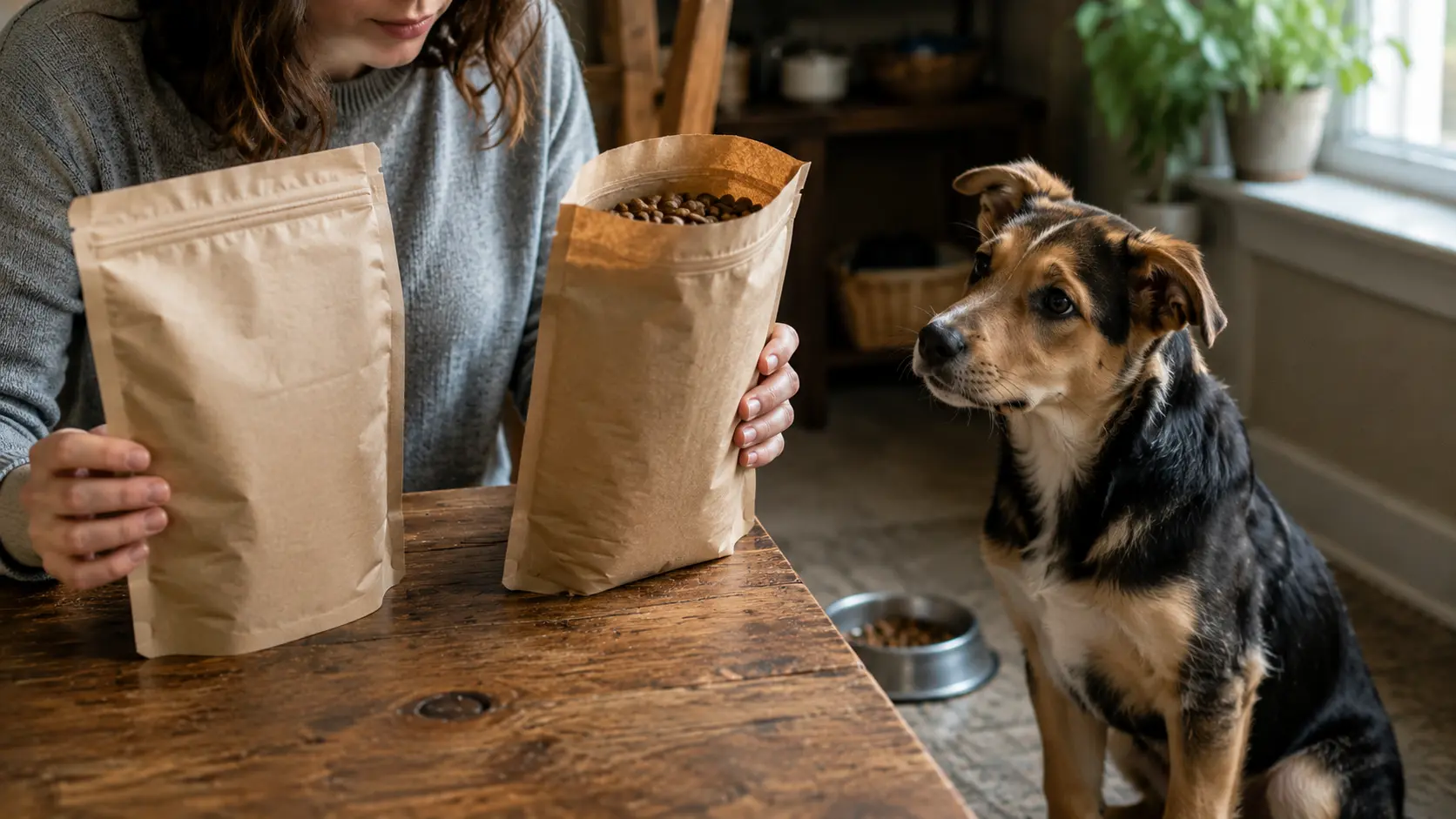
High-protein puppy food can sound like an obvious upgrade. Puppies are growing quickly, protein supports growing tissues, and a bag showing 32% protein may seem better than one showing 26%.
The reality is more complicated.
Puppies do need enough protein and essential amino acids for healthy growth, but a healthy puppy does not automatically need food specifically marketed as “high protein.” A larger crude-protein number is also not a reliable way to rank puppy foods from best to worst.
A better approach is to check whether the food is complete and balanced for growth, understand what its protein percentage actually means, compare foods fairly, and consider your puppy’s expected adult size, calorie needs, body condition, and health.
Is High-Protein Food Good for Puppies?
High-protein food can be appropriate for puppies, but “high protein” by itself does not tell you whether a food is suitable or better.
Protein supplies amino acids that puppies need while building and maintaining tissues during growth. Too little usable protein can be a genuine nutritional problem.
That does not mean that increasing the crude-protein percentage indefinitely provides additional benefits.
Research supports the importance of adequate protein during puppy growth, but it does not establish a simple rule that a food with 35% crude protein is healthier than an otherwise appropriate growth diet containing 28%.
Higher-protein formulas are not inherently bad, either. The point is that protein needs to be judged as part of the whole diet.
A useful way to think about the decision is:
Protein requirement ≠ “high protein” marketing claim ≠ best food for your individual puppy.
For most healthy puppies, the first question should be whether the food provides complete nutrition appropriate for growth—not whether it has the largest protein number on the shelf.
What Does “High Protein” Actually Mean in Puppy Food?
One reason this topic becomes confusing is that “high protein” sounds like a precise nutritional category.
It is not.
There Is No Universal “High Protein” Percentage
AAFCO does not establish a single numerical percentage at which dog food officially becomes “high protein.”
That means claims such as “anything above 30% is officially high protein” should be treated cautiously. A manufacturer, retailer, or publisher may use its own working definition, but that does not make the threshold a universal nutritional standard.
The phrase is better understood as a relative marketing description.
Two foods could both be advertised as high protein while containing different protein levels, calorie densities, moisture levels, mineral profiles, and other nutrients.
Minimum Protein Requirements Are Different From High-Protein Claims
Puppies have different nutritional needs from adult dogs, and diets intended for growth have different nutrient standards from diets intended only for adult maintenance.
But a nutrient minimum for puppy growth should not be confused with the point at which a food becomes “high protein.”
Those are separate ideas.
AAFCO’s current public guidance puts the minimum crude-protein level for growth and reproduction diets at about 22% on a dry-matter basis. That is an adequacy benchmark, not a definition of “high protein,” and it does not mean a food containing 30%, 32%, or 35% protein is automatically better for a puppy.
A complete puppy diet also has to provide the required essential amino acids and the rest of the nutrients needed for growth.
A food can provide enough protein for puppy growth without carrying a high-protein claim. Likewise, seeing “high protein” on the front of a bag does not prove that the food is the better choice for a growing puppy.
What Crude Protein on the Label Really Tells You
Most pet-food labels show a crude-protein percentage in the guaranteed analysis.
That number is useful, but it has limits.
“Crude” Does Not Mean Low Quality
The word “crude” refers to the analytical method used to estimate the nutrient content. It does not mean the protein is poor quality, contaminated, or inferior.
The crude-protein percentage on a guaranteed analysis is also a minimum guarantee. It is not necessarily the exact average protein concentration found in every batch of food.
A Protein Percentage Does Not Tell the Whole Story
Puppies ultimately need usable amino acids from an adequately formulated diet.
Digestibility matters. Amino-acid balance matters. The entire formulation matters.
Older controlled research in growing puppies helps illustrate this point: when the digestibility of the protein mixture changed, the crude-protein concentration needed to support comparable growth also changed.
That does not give owners a modern “ideal protein percentage.” It shows why crude protein alone cannot tell you exactly how effectively a puppy will use the protein in a complete food.
A food with a slightly higher percentage is not automatically providing better protein nutrition.
Do Not Judge Protein Quality From the First Ingredient Alone
Ingredient lists can help identify what is in a food, especially if a dog has a specific dietary restriction.
They are much less useful as a simple quality-ranking system.
“Meat is the first ingredient” does not, by itself, prove that the finished food provides better nutrition. Likewise, the presence of a by-product or a plant protein does not automatically make a formula poor quality.
Organizations such as WSAVA encourage owners to look beyond ingredient-list impressions and consider the manufacturer’s nutritional expertise, quality-control practices, and the nutritional adequacy of the finished food.
How to Compare Protein in Wet and Dry Puppy Food
A common mistake is comparing protein percentages from wet and dry foods directly.
Moisture can make those numbers look dramatically different even when the foods contain similar—or reversed—amounts of protein once the water is removed.
As-Fed vs Dry-Matter Basis
The guaranteed analysis normally shows nutrients on an as-fed basis, meaning the water in the food is still included.
A dry-matter comparison removes the effect of moisture.
The calculation is:
Dry-matter protein % = as-fed protein % ÷ (100 − moisture %) × 100
Consider two hypothetical puppy foods. A dry puppy food with 28% protein and 10% moisture contains approximately 31.1% protein on a dry-matter basis.
A wet puppy food with 10% protein and 75% moisture contains approximately 40.0% protein on a dry-matter basis.
Looking only at the package, the 28% dry food appears to contain almost three times as much protein as the 10% wet food.
After adjusting for water, the wet food in this example is actually more protein-dense on a dry-matter basis.
That does not make it nutritionally superior. It simply allows a fairer protein comparison.
Also remember that guaranteed crude protein is a minimum value, so this calculation is useful for comparing labels but should not be treated as laboratory-precision data.
If you are specifically comparing canned and moist diets, see LumaPaw’s guide to wet puppy food options.
How to Choose a High-Protein Puppy Food
If you are looking for the best high-protein puppy food, start by changing the question slightly.
Instead of asking, “Which food has the most protein?” ask, “Which food is nutritionally appropriate for my puppy, and what role does its protein level play?”
Check That the Food Is Appropriate for Growth
Start with the nutritional adequacy statement.
A puppy needs a diet appropriate for growth, not simply an adult food with a high crude-protein number.
“Complete and balanced” also has a specific nutritional meaning. It is more useful than front-of-package phrases such as “protein packed” or “high performance.”
You may also see people describe foods as “AAFCO approved.” That wording is inaccurate. AAFCO develops model standards and nutrient profiles; it does not approve or certify individual bags of pet food.
Consider Your Puppy’s Expected Adult Size
Expected adult size matters, especially for large and giant breeds.
For these puppies, growth nutrition cannot be reduced to protein alone. Energy intake, body condition, calcium and other aspects of the complete growth formulation deserve attention.
A food with an impressive protein percentage is not automatically the right large-breed puppy diet.
Compare Protein Correctly
If two foods have similar moisture levels, their guaranteed-analysis protein percentages are easier to compare directly.
If one is wet and the other dry, use a dry-matter comparison before deciding which is actually more protein-dense.
Look Beyond Protein
Protein is only one part of a puppy diet.
Also consider:
- whether the food is appropriate for growth;
- calorie and energy density;
- mineral balance;
- your puppy’s expected adult size;
- body condition and growth;
- digestive tolerance;
- any known medical conditions.
A higher-protein formula may fit perfectly well into that picture. It simply should not replace the rest of the picture.
Look at the Company Behind the Food
Food quality cannot be determined from a single ingredient or marketing claim.
Useful questions include whether the company employs qualified nutrition expertise, maintains meaningful quality-control procedures, provides useful nutrient information, and can explain who formulates and manufactures the food.
If you are ready to compare specific diets rather than protein percentages alone, LumaPaw’s guide to choosing the right puppy food covers the broader decision.
Can Too Much Protein Be Bad for Puppies?
There is no single universal “too much protein” percentage that applies to every puppy.
Research clearly supports avoiding inadequate protein during growth. What it does not support is turning crude protein into a scale where a larger number automatically means a healthier puppy.
That distinction matters because high-protein foods are sometimes credited with benefits that actually depend on the entire diet.
For example, protein is needed to build and maintain tissues, but that does not prove that increasing protein beyond an already adequate level automatically creates more muscle.
Similarly, a food’s energy density is not determined by protein alone. Fat contributes substantially more energy per gram than either protein or carbohydrate in standard pet-food calorie calculations.
Claims that high protein automatically provides more energy, stronger immunity, a better coat, or healthier growth should therefore be treated carefully unless the benefit has been demonstrated for the complete diet.
For a healthy puppy, the practical goal is not maximum protein. It is adequate nutrition and appropriate growth.
High Protein and Large-Breed Puppies
Large- and giant-breed puppies are often mentioned in warnings about high-protein diets, particularly the idea that protein makes them grow too quickly and causes skeletal problems.
The evidence is more nuanced.
Does Protein Make Large-Breed Puppies Grow Too Fast?
A controlled study in Great Dane puppies compared diets with substantially different protein levels and did not demonstrate that protein concentration itself caused abnormal calcium metabolism or skeletal development.
That study has real limitations. It was small, involved a single giant breed, and is more than three decades old. It should not be used to claim that protein level can never matter in any situation.
But it also does not support the simple rule that large-breed puppies must eat low-protein food to avoid joint problems.
Current veterinary growth guidance puts more emphasis on an appropriate growth diet, maintaining lean body condition, managing energy intake, and avoiding excessive calcium.
So if you have a large or giant puppy, do not use crude protein as the main orthopedic-safety test.
For more detailed guidance on growth formulation, minerals, calories, and specific foods, see choosing food for a large-breed puppy.
What About Kidneys, Liver Disease, or Other Health Problems?
Protein and kidney health are another area where overly simple claims are common.
The research reviewed for this guide did not establish that an appropriately formulated higher-protein growth diet causes kidney disease in otherwise healthy puppies.
That does not mean high protein has been proven safe for every dog under every medical condition.
Much of the dog research used in discussions about protein and kidneys involves adult dogs, older studies, or experimental models of existing kidney damage rather than healthy growing puppies. Different studies have also produced different findings depending on the degree of renal disease and the diets used.
For that reason, there is no responsible universal protein target for a puppy with kidney disease.
The same caution applies to liver disease and other medical problems. Therapeutic nutrition is different from general feeding advice.
If your puppy has diagnosed kidney or liver disease, abnormal growth, unexplained weight changes, or another significant health problem, deliberately increasing or restricting protein should be discussed with your veterinarian.
Common High-Protein Puppy Food Mistakes
Protein labels are easy to overinterpret. These are some of the mistakes worth avoiding.
Choosing the Food With the Highest Protein Percentage
A 34% formula does not automatically beat a 28% formula.
Compare growth suitability, moisture, calories, overall nutrient balance, expected adult size, and the individual puppy—not just one number.
Feeding High-Protein Adult Food to a Puppy
An adult-maintenance food does not become puppy food simply because it contains plenty of protein.
Growth and adult maintenance have different nutritional requirements.
Check the nutritional adequacy statement rather than relying on the crude-protein percentage.
If you are wondering when adult food actually becomes appropriate, see LumaPaw’s guide on when to switch from puppy to adult food.
Adding Meat, Eggs, or Protein Powder Just to Raise Protein
A small appropriate treat is very different from deliberately rebuilding a complete puppy diet around extra protein.
If the main food is already complete and balanced for growth, routinely adding large amounts of meat, eggs, protein powders, or other extras can change calorie intake and dilute the balance of essential nutrients.
AAHA generally recommends that complete and balanced food supply the large majority of a healthy pet’s calories, with treats and other extras kept relatively limited.
The concern is not that a bite of cooked egg is automatically harmful. It is that chasing one nutrient can disrupt a diet designed to supply many nutrients in the right proportions.
This becomes even more important with homemade puppy diets. Published clinical cases have documented severe mineral and vitamin deficiencies and skeletal disease in growing puppies fed poorly balanced meat-heavy homemade diets.
Protein alone cannot replace calcium, phosphorus, vitamins, and the other nutrients required for normal growth.
Assuming Grain-Free Means High Protein
Grain-free and high-protein describe different characteristics.
A grain-free food can be higher, lower, or similar in protein to a grain-inclusive formula. Removing grains does not automatically make a puppy food protein-rich or nutritionally superior.
For the diet-type question itself, see LumaPaw’s guide to grain-free puppy food.
When to Ask Your Veterinarian About Protein
Most healthy puppies eating an appropriate complete growth diet do not need an individualized protein target.
Veterinary guidance becomes more useful when the nutritional situation is no longer routine.
Talk with your veterinarian if your puppy has:
- known kidney or liver disease;
- persistent vomiting or diarrhea;
- poor or unusual growth;
- unexplained weight loss or gain;
- poor body condition or noticeable muscle loss;
- a condition requiring a therapeutic diet;
- substantial dietary supplementation;
- a primarily homemade diet;
- large- or giant-breed growth or orthopedic concerns.
If you want to use a home-prepared diet as your puppy’s main food, formulation is especially important during growth. Working with an appropriately qualified veterinary nutrition professional is safer than trying to create a high-protein puppy diet by combining meat and supplements yourself.
Frequently Asked Questions
Can puppies eat high-protein adult dog food?
Not simply because it is high in protein. A food intended only for adult maintenance may not provide the complete nutrient balance required for puppy growth. Check the nutritional adequacy statement and choose a diet appropriate for the puppy’s life stage.
Should I add meat or eggs to increase my puppy’s protein?
Usually not just to increase the protein number. If your puppy already eats a complete and balanced growth diet, routinely adding substantial amounts of other foods can change calories and dilute the nutrient balance. Small treats are different from deliberately reformulating the diet.
Does high-protein food cause kidney problems in puppies?
The evidence reviewed does not establish that appropriately formulated higher-protein food causes kidney disease in otherwise healthy puppies. However, dogs with kidney disease can have very different nutritional needs, so a puppy with diagnosed or suspected renal disease should have its diet selected with veterinary guidance.
Do large-breed puppies need lower-protein food?
There is no well-supported universal rule that large-breed puppies need a low-protein diet. Appropriate growth nutrition, controlled energy intake, lean body condition, and mineral balance are more useful considerations than choosing food by crude protein alone.
Is grain-free puppy food also high in protein?
Not necessarily. Grain-free refers to the absence of particular grains, while high protein refers to protein content or a protein-related marketing claim. One does not automatically imply the other.
Choosing Protein in Context
High protein puppy food can be perfectly appropriate, but the label should not turn feeding into a contest for the largest percentage.
Start with a food that is nutritionally appropriate for growth. Understand that crude protein is a minimum analytical value, compare wet and dry foods on a dry-matter basis when needed, and consider calories, minerals, expected adult size, body condition, and health alongside protein.
For most healthy puppies, the goal is not to maximize protein. It is to provide enough usable protein within a complete diet that supports appropriate growth.
When you are ready to compare complete diets rather than individual nutrient numbers, LumaPaw’s puppy food guide is the better next step.