
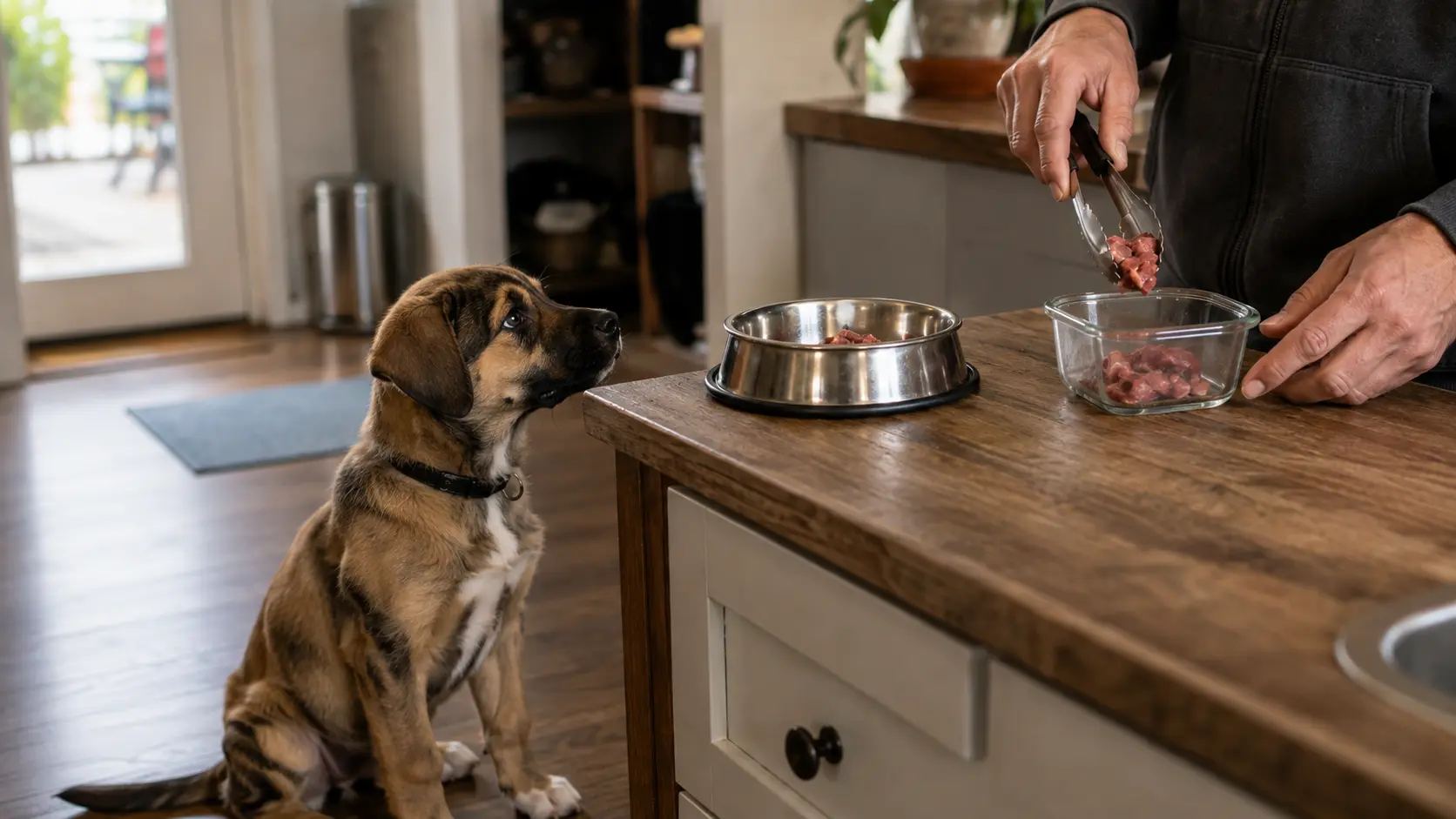
If you’re considering puppies and raw food, the first thing to know is that a puppy being able to eat raw meat does not automatically make a raw diet recommended or risk-free.
Growing puppies have specific nutritional needs, and mistakes with nutrients such as calcium and phosphorus can matter more during growth than they would for a healthy adult dog. Raw animal foods also carry a food-safety risk from bacteria such as Salmonella, E. coli, and Listeria.
That does not mean every raw-fed puppy will become sick or that every commercial raw food is nutritionally inadequate. The important questions are whether the diet is complete and balanced for growth, what additional risks come from feeding it raw, and whether those risks are manageable in your household.
This guide explains what to check before making that decision.
Can Puppies Eat Raw Food?
Puppies can physically eat raw animal foods once they are eating solid food. The more useful question is whether a raw diet is an appropriate and reasonably safe way to meet a growing puppy’s nutritional needs.
The CDC does not recommend feeding raw pet food to dogs and cats. It also identifies young animals, including puppies, as being more likely to become ill from foodborne germs.
That creates two separate issues owners need to consider.
First, the food must provide appropriate nutrition for growth. Puppies need more than meat or a mix of ingredients that looks varied. Their overall diet needs the right energy, protein, fat, vitamins, minerals, and other nutrients in appropriate amounts and proportions.
Second, feeding animal products raw adds a microbiological risk that does not disappear just because a diet is nutritionally complete.
A commercial raw food can potentially be complete and balanced for puppy growth. So “raw” does not automatically mean nutritionally deficient. But a label that simply says “raw puppy food,” “natural,” or “premium” is not enough to tell you whether it should make up your puppy’s entire diet.
If you are still deciding what type of diet makes sense, our guide to choosing a complete puppy food covers the wider food-selection picture.
What Does a Raw Diet for Puppies Actually Mean?
Raw feeding can describe several quite different diets, which is one reason broad claims about “raw food” can be misleading.
Commercial raw diets
Commercial raw dog foods may be sold frozen, refrigerated, freeze-dried, or dehydrated.
Some are formulated as complete diets. Others are intended only as toppers, treats, mixers, or supplemental foods.
That distinction matters. A complementary raw product can be useful for its intended purpose without being nutritionally suitable as a puppy’s main food.
Homemade raw diets
Home-prepared raw diets may contain combinations of muscle meat, organs, eggs, bones, vegetables, or other ingredients.
You may also see terms such as BARF or prey-model feeding. These describe particular approaches to assembling raw diets, but following a meat-and-organ ratio does not by itself prove that the final diet meets all of a puppy’s nutrient requirements.
Frozen, freeze-dried, and dehydrated raw foods
Processing raw food does not necessarily make it sterile.
The CDC notes that freezing, freeze-drying, and dehydrating may reduce some germs but do not eliminate all foodborne pathogens. A dry-looking freeze-dried product still needs to be treated according to the manufacturer’s raw-food handling instructions.
Why Raw Feeding Is More Complicated for a Growing Puppy
A puppy’s diet is supporting active growth, not simply maintaining an adult body. That makes nutritional accuracy especially important.
Puppies need nutrition formulated for growth
Puppies have different energy and nutrient requirements from adult dogs, and those needs change as they grow.
A meat-rich diet can look nutritious without actually being balanced. Muscle meat alone, for example, does not supply nutrients in the proportions needed for normal skeletal development.
This is why the nutritional adequacy of the whole diet matters more than whether individual ingredients appear wholesome or biologically appealing.
Calcium and phosphorus matter during growth
Calcium and phosphorus are particularly important during skeletal development.
Both too little and too much of certain minerals can cause problems. Meat also tends to supply substantial phosphorus relative to calcium, so feeding an unsupplemented meat-only diet can create a serious imbalance.
The risk is not merely theoretical. A 2024 veterinary case series described four large-breed puppies that had been fed exclusively boneless, unsupplemented raw meat diets. All developed severe skeletal abnormalities. Because this was a small case series, it cannot tell us how common such problems are among raw-fed dogs, but it does demonstrate how serious an inadequately formulated growth diet can become.
The goal should not be to calculate calcium at home from a few internet ratios. It should be to make sure the complete diet has been formulated appropriately for growth.
Large and giant-breed puppies need extra attention
Large and giant-breed puppies have additional concerns around mineral intake and growth rate. Excessive calcium and excessive energy intake are particularly undesirable during rapid skeletal growth.
If your puppy is expected to become a large dog, check that a commercial diet’s nutritional adequacy statement is appropriate for growth of large-size dogs.
Our guide to nutrition for large-breed puppies goes into that size-specific issue in more detail.
Commercial Raw vs Homemade Raw Puppy Food
Commercial and homemade raw diets should not be treated as nutritionally equivalent.
What to check on commercial raw puppy food
If a commercial raw food will make up most or all of your puppy’s diet, look for a nutritional adequacy statement indicating that it is complete and balanced for growth or otherwise appropriate for the puppy’s life stage.
The FDA explains that a “complete and balanced” claim generally relates to meeting an AAFCO nutrient profile or passing an appropriate AAFCO feeding trial.
Be careful with terminology. A food should not be described as “AAFCO-approved” or “AAFCO-certified.” AAFCO establishes model standards and feeding-test procedures; it does not personally approve every food on the shelf.
Also check whether the product says something similar to:
Complete and balanced for growth
rather than:
For intermittent or supplemental feeding only
The second type may be perfectly appropriate as a topper or treat, but it should not automatically replace a complete puppy diet.
Why homemade raw diets are harder to balance
Homemade diets give owners more control over ingredients, but that does not make nutrient balancing easier.
AAHA has noted that many home-prepared diet recipes fail to provide complete and balanced nutrition. UC Davis veterinary nutrition guidance also emphasizes that ingredient substitutions and supplement changes can significantly alter the nutrient profile of a recipe.
For a growing puppy, a generic formula such as “this percentage meat, this percentage bone, this percentage organ” is not a reliable substitute for nutritional formulation.
If you want to use a home-prepared raw diet as your puppy’s primary food, this is a strong reason to work with a veterinary nutrition specialist rather than improvising the recipe yourself.
What Are the Main Risks of Raw Food for Puppies?
The strongest evidence around raw feeding concerns microbiological contamination, nutritional imbalance, and injuries associated with bones.
Bacteria and foodborne illness
Raw animal products can contain disease-causing bacteria.
FDA testing has detected organisms including Salmonella and Listeria monocytogenes in commercial raw pet-food samples, and the agency has concluded that raw pet foods are more likely than many processed foods to contain harmful bacteria.
This does not mean every package of raw food is contaminated. The accurate conclusion is that the risk is higher, not universal.
A dog can also carry or shed organisms without appearing severely ill, which matters because raw-food safety is not only about whether the puppy develops symptoms.
Your puppy may not be the only one exposed
Raw food can contaminate more than the food bowl.
Handling can spread organisms to:
- hands
- preparation surfaces
- utensils
- bowls
- floors around the feeding area
- other foods
- potentially the dog’s feces and surrounding environment
That makes household circumstances part of the decision.
The CDC identifies children under five, pregnant people, adults 65 and older, and people with weakened immune systems as being at greater risk of serious foodborne illness.
A household containing someone in one of those groups has more reason to avoid unnecessary exposure to raw animal products.
Freezing and freeze-drying do not make raw food sterile
Freezing can reduce the risk from some parasites under appropriate conditions, but it should not be treated as a general sterilization step.
Bacteria can survive freezing.
Freeze-drying and dehydration also do not guarantee that harmful organisms have been eliminated.
Some manufacturers use high-pressure processing, commonly called HPP, to reduce microbial contamination. That may lower bacterial loads, but an HPP claim should not be interpreted as proof that a product is sterile or free of every pathogen.
Raw bones are not risk-free
One common raw-feeding claim is that uncooked bones are safe while cooked bones are dangerous.
That distinction is too simple.
Veterinary sources including WSAVA and VCA warn that bones can cause:
- fractured teeth
- choking
- esophageal or intestinal obstruction
- constipation
- gastrointestinal injury or perforation
Raw bones also retain the microbiological concerns associated with raw animal products.
There is therefore no good basis for telling puppy owners that a raw bone becomes “completely safe” once it is the correct size.
Does a Raw Diet Have Proven Benefits for Puppies?
Raw-feeding advocates commonly report better stools, improved coat condition, more energy, better digestion, stronger immunity, and fewer allergies.
The evidence is much less certain than those claims often suggest.
What research has found
Studies comparing raw and processed diets have found differences in areas such as:
- apparent nutrient digestibility
- stool characteristics
- gut microbiome composition
- blood or fecal metabolites
Those findings are scientifically interesting, but they do not automatically mean the raw-fed dogs were healthier.
Diet studies can differ in ingredients, fiber, fat, protein, processing, calorie density, and many other factors at the same time. That makes it difficult to attribute every measured difference to “rawness” alone.
Current evidence has not established that raw feeding provides superior long-term health outcomes compared with appropriately balanced commercial or cooked diets.
Claims that remain uncertain
Benefits such as a shinier coat or higher energy are commonly reported by owners, but they should not be presented as guaranteed or uniquely caused by raw feeding.
Allergy prevention also deserves caution.
One Finnish observational questionnaire study found an association between certain raw-food exposures during puppyhood and fewer owner-reported allergy or atopy signs later in life. Because the research was observational, it cannot establish that raw feeding caused the difference.
That is not enough evidence to recommend raw feeding as a way to prevent allergies.
That is not enough evidence to recommend raw feeding as a way to prevent allergies.
If You Still Want to Feed Raw, Check These Things First
Some owners will choose raw despite the additional risks. If that is your decision, a few checks can make the choice more informed.
Talk with your veterinarian first
This is especially worthwhile for:
- very young puppies
- large or giant breeds
- puppies with medical conditions
- puppies with abnormal growth or body condition
- anyone planning a homemade raw diet
A veterinarian can also help you decide whether a referral to a veterinary nutrition specialist makes sense.
Confirm that the diet is complete and balanced for growth
Do not rely on front-of-package marketing.
Check the nutritional adequacy statement and make sure the food is intended to serve as a complete diet for a growing dog.
For larger puppies, confirm that the statement is appropriate for their expected adult size.
Ask how the manufacturer manages pathogens
Useful questions include:
- Does the company test finished products for organisms such as Salmonella, E. coli, and Listeria?
- What pathogen-reduction process is used?
- Who formulates the food?
- Is a qualified nutrition professional involved?
- How does the company handle positive pathogen tests or recalls?
A vague claim such as “human-grade ingredients” does not answer these questions.
Raw meat sold for human use is generally expected to be cooked before eating. “Human-grade” should not be treated as a guarantee that uncooked meat is free of pathogens.
Handle raw puppy food like raw meat
Follow the storage and handling directions for the specific product.
Good basic habits include:
- thawing frozen food in the refrigerator
- keeping raw pet food separate from human food
- washing hands after handling it
- cleaning bowls, utensils, and preparation surfaces
- preventing raw food or juices from contacting ready-to-eat foods
- following manufacturer guidance for how long food can remain out before disposal
FDA also advises against rinsing raw meat, because splashing water can spread contaminated droplets around the kitchen.
Monitor your puppy rather than relying only on a chart
A feeding guide gives you a starting point, not a guarantee that the amount is correct for one individual puppy.
Watch your puppy’s:
- weight and growth trend
- body condition
- appetite
- stools
- activity
- overall health
Young dogs grow quickly, so feeding decisions should change when their needs change.
When Can Puppies Start Raw Food?
Puppies usually begin transitioning from milk to solid food during the early weaning period, commonly starting at around three to four weeks.
That is a developmental milestone for solid food, not a scientifically established age when raw food becomes safe.
There is no age at which raw animal products suddenly become free of pathogen risk. In fact, the CDC specifically includes puppies among animals that are more susceptible to illness from foodborne germs.
If you are trying to work out when a young puppy should move from milk or formula to soft food and eventually regular puppy food, see our guide to when puppies start eating solid food.
That broader weaning timeline should be decided separately from whether the solid food itself is raw.
How Much Raw Food Should a Puppy Eat?
There is no trustworthy universal rule saying every puppy should receive a fixed percentage of body weight in raw food.
The correct amount depends on factors including:
- age
- current weight
- expected adult size
- calorie density of the food
- growth rate
- activity
- body condition
- individual metabolism
If you use a complete commercial raw food, its feeding directions can provide a starting point. The amount should then be adjusted according to your puppy’s actual growth and body condition.
For a home-prepared diet, follow the quantities in the formulation created for that puppy rather than replacing them with an online raw-feeding calculator.
For general meal frequency and portion planning, our puppy feeding amounts and meal frequency guide covers that topic in more detail.
How Should You Transition a Puppy to a New Diet?
Changing foods gradually can help reduce digestive upset.
For many dogs, spreading a change over roughly a week is a reasonable starting approach, although some puppies may need a slower transition and others may tolerate changes more easily.
A gradual transition does not make raw food microbiologically safer. It is intended to help the digestive system adapt to a new diet.
Do not assume significant diarrhea, repeated vomiting, or marked lethargy are normal “detox” effects of switching to raw.
If your puppy becomes noticeably unwell during a diet change, stop treating the problem as a routine adjustment and contact your veterinarian.
What Supplements Does a Raw-Fed Puppy Need?
There is no universal supplement list for puppies on raw diets.
A properly formulated commercial food that is complete and balanced for growth may not need additional vitamin or mineral supplementation.
A home-prepared diet may need very specific supplements, but those additions depend on everything else in the recipe.
Adding calcium, vitamin D, minerals, fish oil, multivitamins, probiotics, or other supplements simply because another raw-feeding plan recommends them can upset the nutrient balance rather than improve it.
Calcium deserves particular caution during puppy growth. More is not automatically better, especially for large and giant-breed puppies.
If a home-prepared diet requires supplementation, the safest approach is to use the exact products and amounts specified as part of a properly formulated recipe.
When to Contact a Veterinarian
Mild stool changes can happen whenever a puppy’s diet changes, but significant illness should not be managed indefinitely at home.
Contact your veterinarian if a puppy develops signs such as:
- persistent or bloody diarrhea
- repeated vomiting
- fever
- marked lethargy
- loss of appetite
Raw bones create another set of warning signs. Choking, difficulty swallowing, repeated vomiting, severe abdominal discomfort, or inability to pass stool can indicate an obstruction or gastrointestinal injury and may require urgent veterinary care.
Growth problems also deserve attention.
Unexplained lameness, bone pain, weakness, difficulty standing or rising, reluctance to move normally, or abnormal limb development should not be treated simply by changing ingredients or adding calcium at home.
If you want a homemade raw diet to provide most or all of a growing puppy’s nutrition, veterinary nutrition guidance is worth getting before problems develop.
Frequently Asked Questions
Is raw food better than kibble for puppies?
Current evidence has not established that raw feeding produces better long-term health outcomes than an appropriately formulated commercial or cooked diet.
Some studies have found differences in digestibility, stools, microbiome composition, or other measurements, but those findings do not prove that raw-fed puppies are healthier overall.
The quality and nutritional adequacy of the specific diet matter more than assuming one processing method is automatically superior.
Can puppies eat raw meat from the grocery store?
They can physically eat it, but meat sold for human consumption is not guaranteed to be free of pathogens when raw.
Raw human food is generally expected to be cooked before eating. Buying meat from a grocery store therefore does not remove concerns about Salmonella, E. coli, or other microorganisms.
It also does not make plain meat a complete puppy diet.
Is freeze-dried raw food safer than frozen raw food?
The processing methods are different, and pathogen levels can vary between individual products, but freeze-dried should not be treated as another word for sterile.
CDC guidance notes that freeze-drying, dehydration, and freezing do not necessarily kill all foodborne germs.
If a freeze-dried product is marketed as raw, follow its handling instructions accordingly.
Can puppies eat raw bones?
Raw bones are not risk-free.
They can fracture teeth or contribute to choking, constipation, obstruction, and gastrointestinal injury. They can also carry microorganisms associated with raw animal products.
For that reason, it is misleading to promise that a particular raw bone is completely safe simply because it is uncooked or appropriately sized.
Can I Feed My Puppy Raw Food and Kibble?
Using raw food and kibble in the same overall diet does not make the key raw-feeding concerns disappear.
What matters is whether the total diet remains nutritionally appropriate for growth and whether the raw portion is handled with the same food-safety precautions as any other raw animal product.
Be particularly careful when adding raw meat, toppers, or other extras to an otherwise complete puppy food. Enough unbalanced extras can change the nutritional profile of the overall diet.
A Practical Bottom Line on Puppies and Raw Food
The decision about puppies and raw food is more complicated than deciding whether dogs are capable of eating raw meat.
A growing puppy needs a diet that reliably provides the nutrients required for development. Raw animal products also introduce a documented pathogen risk to the puppy and potentially to people in the household. At the same time, current evidence has not established that raw feeding produces superior long-term health outcomes.
If you still choose raw, look beyond marketing claims. Confirm that the main diet is complete and balanced for growth, consider your puppy’s expected adult size, investigate the manufacturer’s food-safety practices, handle the food carefully, and involve your veterinarian when the diet is homemade or your puppy has special needs.
The useful question is not simply “Is it raw?” It is “Is this diet appropriate for my puppy’s growth, and am I comfortable managing the additional food-safety risk?”