

Choosing puppy food is not just a matter of finding the bag with the highest protein percentage or the most five-star reviews. Puppies need food that is appropriate for growth, and the right formula also depends on expected adult size, calorie needs, food format, budget, and any ingredients your puppy needs to avoid.
After comparing current formula information, nutritional details, retailer availability, and customer feedback, Purina Pro Plan Development Chicken & Rice is our Best Overall puppy food. It combines clearly documented puppy nutrition with DHA, disclosed calcium and phosphorus levels, several bag sizes, and broad availability.
That does not make it the right choice for every puppy. Purina ONE offers a more affordable alternative, Hill’s has a useful prebiotic-fiber angle, Purina Pro Plan’s salmon recipe gives owners a chicken-free option, Natural Balance has a more focused animal-protein profile, and Freshpet provides a refrigerated alternative to kibble.
Affiliate disclosure: LumaPaw may earn a commission when you buy through some links on this page, at no extra cost to you. Product rankings are based on research and comparison, not payment for placement
Best Puppy Foods at a Glance
Best Overall Puppy Food
Purina Pro Plan Development Chicken & Rice
Dry, grain-inclusive puppy food with chicken as the first ingredient. Its combination of growth-stage nutrition, DHA, clearly disclosed calcium and phosphorus, availability, and customer feedback makes it our strongest general pick.
Main limitation: It contains several animal-derived ingredients as well as wheat and corn, so it is not a simple or limited-ingredient formula.
Best Budget Puppy Food
Purina ONE +Plus Healthy Puppy
A lower-cost dry food that still provides puppy-specific nutrition, DHA, and clearly disclosed growth nutrients.
Main limitation: It is another multi-ingredient chicken formula, and some buyers report inconsistent amounts of the softer pieces or crumbs in the bag.
Best with Prebiotic Fiber
Hill’s Science Diet Puppy Chicken & Brown Rice
A mainstream chicken-based puppy food with Hill’s ActivBiome+ prebiotic-fiber blend, giving it a clearer point of difference than simply calling it a premium food.
Main limitation: It contains chicken along with wheat, corn, and soy ingredients and costs more than our budget choice.
Best Salmon-Based Puppy Food
Purina Pro Plan Sensitive Skin & Stomach Puppy Salmon & Rice
Salmon is the first ingredient, and the recipe is chicken-free. It also provides DHA and digestive-support ingredients.
Main limitation: It is relatively expensive and should not be confused with a veterinary elimination diet for food allergies.
Best Limited-Ingredient Puppy Food
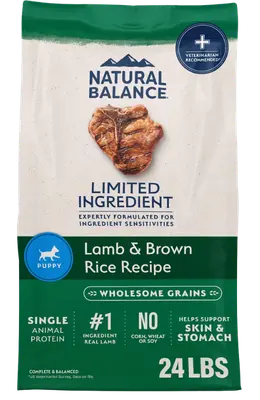
Natural Balance Limited Ingredient Lamb & Brown Rice Puppy
A poultry-free, grain-inclusive formula with lamb as its single animal protein source, giving owners a more focused protein profile.
Main limitation: It costs more than the general-purpose choices and is not a substitute for a veterinarian-directed elimination diet.
Best Refrigerated Puppy Food
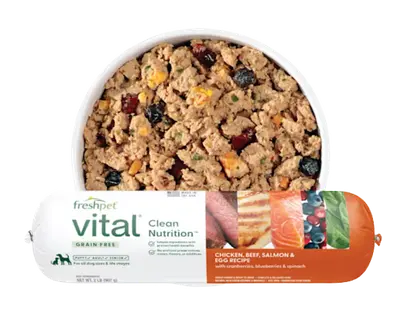
Freshpet Vital Puppy Chicken, Beef & Salmon
A refrigerated, soft, ready-to-portion option for owners who want something different from dry kibble.
Main limitation: It needs refrigeration, must be used relatively quickly after opening, and local availability can be less convenient.
How We Researched the Best Puppy Foods
AAFCO does not ‘approve’ individual pet foods. Our comparison is based on current product and label information, nutritional analysis, feeding information, retailer availability, customer feedback, and how well each formula fills a useful role for puppy owners.
Growth-stage suitability came first
A product being sold beside puppy food does not tell us enough on its own. We looked at whether the exact formula is intended to provide complete nutrition appropriate for growth.
AAFCO does not “approve” individual pet foods, so we avoid phrases such as “AAFCO-approved puppy food.” What matters is the nutritional adequacy statement on the current product and the life stage it covers.
Expected adult size matters too. A puppy that is likely to reach 80 or 90 pounds as an adult may need different considerations from one expected to remain much smaller. Where large-size growth suitability was relevant, we treated the exact label wording as more useful than a retailer simply classifying a product as “all breeds.”
We compared the formula, not marketing words
We looked at protein and fat, DHA where disclosed, calcium and phosphorus where available, calories, food format, and the main animal-protein sources.
We did not automatically rank the food with the highest protein percentage first. More protein does not by itself prove that a puppy food is better.
We also did not treat words such as “natural,” “premium,” or “holistic” as evidence of superior nutrition.
Customer reviews were supporting evidence
Customer feedback is useful for identifying patterns such as:
- whether puppies tend to eat the food readily
- texture or kibble complaints
- damaged or inconsistent product
- packaging issues
- individual digestive tolerance
Reviews are much weaker evidence for medical claims. If an owner says a food cured itching, diarrhea, or another health problem, that does not establish that the product will have the same effect in another puppy.
Price and availability mattered
A good puppy food also has to be practical to keep buying.
We considered package sizes, major-retailer availability, and value alongside nutrition. We did not choose a food simply because it was the cheapest, nor did we assume the most expensive formula was automatically the highest quality.
Our Best Puppy Food Picks

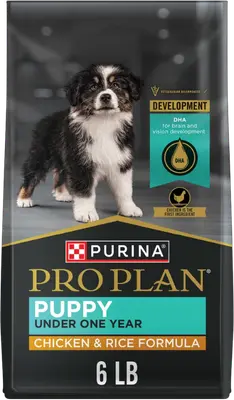
Purina Pro Plan Development Chicken & Rice — Best Overall Puppy Food
Best for: Owners looking for a broadly available, well-documented dry puppy food.
Avoid if: Your puppy needs a poultry-free or more limited-ingredient diet.
Honest buying note: This is our best general-purpose choice, not a claim that it is the healthiest food for every puppy. Puppies with allergies, chronic digestive problems, or other health conditions may need a different approach with veterinary guidance.
Purina Pro Plan Development Chicken & Rice earned our Best Overall position because it has the strongest all-around combination of documented puppy nutrition, availability, useful nutrient disclosure, and customer evidence.
Chicken is the first ingredient. The current formula provides 28% minimum protein, 18% minimum fat, 0.1% minimum DHA, 1.1% minimum calcium, and 0.9% minimum phosphorus. At roughly 456 calories per cup, it is also one of the more calorie-dense dry foods in this comparison, so feeding amounts should be based on the current label and your puppy’s body condition rather than simply copying the portion used with another kibble.
The recipe is not as simple as “chicken and rice.” It also contains poultry by-product meal, fish-derived ingredients, egg, wheat, corn, and other ingredients. That makes it a poor fit for puppies that need to avoid several proteins or specific ingredients.
Customer feedback is generally strong, particularly around palatability and kibble size. There are also puppies that refuse the food or do not tolerate it well, which is a useful reminder that even a strong general formula will not work equally well for every dog.
Pros
- Chicken is the first ingredient
- DHA is quantified
- Calcium and phosphorus are disclosed
- Multiple bag sizes
- Strong retailer availability
- Large customer-feedback base
Cons
- Contains several animal-derived ingredients
- Contains wheat and corn
- Relatively calorie-dense
- Not designed as a limited-ingredient formula

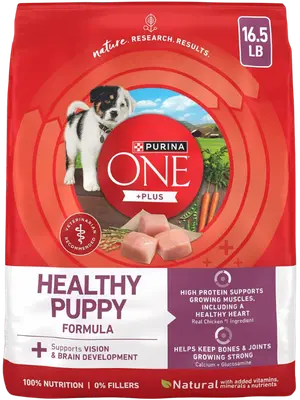
Purina ONE +Plus Healthy Puppy — Best Budget Puppy Food
Best for: Owners looking for good value from a widely available puppy kibble.
Avoid if: Your puppy needs to avoid chicken, corn, soy, or multiple animal-derived ingredients.
Honest buying note: If cost is an important part of feeding your puppy consistently, this is one of the most practical choices in our lineup. A food you can reliably afford and keep in stock is often more useful than a premium option that stretches the budget every month.
Purina ONE +Plus Healthy Puppy makes sense for owners who want a more affordable everyday dry food without moving away from a puppy-specific formula.
The current manufacturer information lists 28% minimum protein, 17% minimum fat, 0.05% minimum DHA, 1.1% minimum calcium, and 0.9% minimum phosphorus, with about 374 calories per cup.
Chicken is the first ingredient, but the recipe also includes ingredients such as chicken by-product meal, corn, soy, beef fat, and fish oil. It is therefore better viewed as a mainstream multi-ingredient formula than a food for puppies with complicated dietary restrictions.
One feature puppies may notice more than their owners do is the texture. Purina ONE combines crunchy kibble with softer meaty pieces. Many customer reviews mention that positively, although some buyers complain that the quantity or size of those softer pieces can vary between bags. Crumbs and food dust also appear in some feedback.
The main reason this product wins our Budget position is not that it is the cheapest puppy food on the market. It offers a useful balance of price, puppy-specific nutrition, wide availability, and a very large customer-feedback base compared with several more expensive choices.
Pros
- Strong price-to-nutrition balance
- Chicken first
- Contains DHA
- Large customer-review base
- Multiple bag sizes
- Widely available
Cons
- Multi-ingredient formula
- Contains corn and soy
- Softer pieces may be inconsistent between bags
- Not a limited-ingredient choice

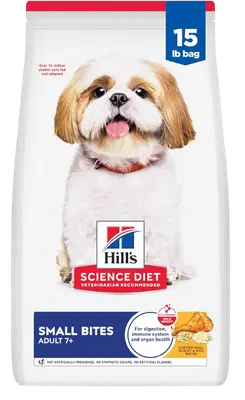
Hill’s Science Diet Puppy Chicken & Brown Rice — Best with Prebiotic Fiber
Best for: Owners who want a conventional grain-inclusive puppy food with a documented prebiotic-fiber feature.
Avoid if: Your puppy needs to avoid chicken, wheat, corn, or soy.
Honest buying note: Prebiotic fiber is a useful formula feature, but it does not guarantee that a particular puppy will have better digestion. Persistent diarrhea, vomiting, poor growth, or other digestive problems deserve veterinary attention rather than repeated food switching.
Hill’s Science Diet Puppy Chicken & Brown Rice occupies a narrower but useful position in this list.
Its main point of difference is ActivBiome+ Digestion, Hill’s blend of prebiotic fibers intended to support the gut microbiome and digestive system. That gives us a more defensible reason for including it than simply labeling it “Best Premium.”
The current formula provides about 23% minimum protein, 15% minimum fat, 0.02% minimum DHA, and 393 calories per cup. Chicken is the first ingredient, followed by ingredients that include brown rice, whole-grain wheat, chicken meal, chicken fat, corn, oats, pea protein, and soybean meal.
That ingredient profile will be fine for many puppies, but it is not a good match for every owner seeking a simpler formula. It contains chicken, wheat, corn, and soy ingredients.
Customer feedback is mostly positive, with palatability and digestive tolerance frequently mentioned. Some owners report the opposite, including loose stools, refusal, or changes in kibble appearance. Those reports do not establish a general problem, but they are worth considering if your puppy is particularly sensitive to food changes.
Pros
- Chicken is the first ingredient
- Prebiotic-fiber differentiation
- Contains DHA
- Large customer-feedback base
- Multiple package sizes
Cons
- Contains several common ingredients that some puppies need to avoid
- More expensive than Purina ONE
- Individual digestive tolerance varies

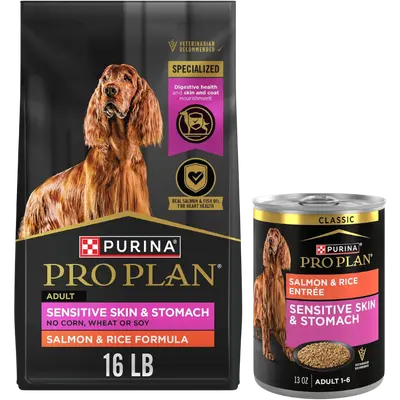
Purina Pro Plan Sensitive Skin & Stomach Puppy Salmon & Rice — Best Salmon-Based Puppy Food
Best for: Owners who want a salmon-first, chicken-free puppy food.
Avoid if: Your puppy needs a veterinarian-directed elimination diet or does not tolerate fish-based foods.
Honest buying note: This is a useful alternative protein profile, not a medical solution for itchy skin or chronic stomach problems. Speak with your veterinarian if you suspect a true food allergy.
For owners who specifically want to move away from chicken-based puppy kibble, Purina Pro Plan Sensitive Skin & Stomach Puppy Salmon & Rice is the strongest differentiated option in this roundup.
Salmon is the first ingredient. The recipe is chicken-free and does not contain corn, wheat, or soy. Current nutritional information lists 28% minimum protein, 18% minimum fat, 0.1% minimum DHA, 1.1% minimum calcium, and 0.9% minimum phosphorus.
At about 479 calories per cup, it is the most calorie-dense dry food among our six picks. That does not make it better or worse, but it means cup-for-cup comparisons with another kibble can be misleading.
The formula also includes fish oil, dried chicory root, and Bacillus coagulans. Many customer reviews describe good individual digestive tolerance, but there are also reports of strong fish odor, gas, loose stools, or puppies simply not being enthusiastic about the taste.
Most importantly, “chicken-free” does not mean “hypoallergenic.” It is not a veterinary elimination diet, and scratching or digestive trouble alone cannot confirm a food allergy.
Pros
- Salmon first
- Chicken-free
- No corn, wheat, or soy
- Quantified DHA
- Clearly disclosed calcium and phosphorus
- Strong retailer feedback
Cons
- Premium price
- High calorie density
- Fish smell may be noticeable
- Not an allergy-treatment diet

Natural Balance Limited Ingredient Lamb & Brown Rice Puppy — Best Limited-Ingredient Puppy Food
Best for: Owners looking for a poultry-free, grain-inclusive puppy food with a more focused animal-protein profile.
Avoid if: Your puppy needs a formal veterinary elimination diet or cannot tolerate lamb.
Honest buying note: “Limited ingredient” can make a label simpler to evaluate, but it does not automatically make a food healthier or suitable for a diagnosed allergy.
Natural Balance Lamb & Brown Rice stands out because it does something the general chicken formulas do not: it uses lamb as the single animal protein source in a poultry-free, grain-inclusive puppy recipe.
The current formula provides 24% minimum protein, 12.5% minimum fat, 0.04% minimum DHA, 1.2% minimum calcium, and 1.0% minimum phosphorus, with about 365 calories per cup.
Brown rice and other rice ingredients provide the grain component. Natural Balance describes lamb as the recipe’s single source of animal protein and the formula is poultry-free. If your puppy needs to avoid fish-derived ingredients as well, check the current ingredient panel before buying.
This makes Natural Balance a practical option for owners who want a more focused protein profile without automatically choosing grain-free food.
The tradeoff is price. It is not the economical choice in this group, and its customer-review base is much smaller than Purina, Hill’s, or Blue Buffalo. Feedback also includes occasional reports of loose stools, food refusal, and changes in kibble appearance between purchases.
Pros
- Lamb is the main and single animal protein source
- Poultry-free
- Grain-inclusive
- No corn, wheat, or soy
- DHA, calcium, and phosphorus disclosed
Cons
- More expensive
- Smaller review base
- Some reports of kibble/formula variation
- Not a therapeutic allergy diet

Freshpet Vital Puppy Chicken, Beef & Salmon — Best Refrigerated Puppy Food
Best for: Owners specifically looking for a soft, refrigerated complete puppy food.
Avoid if: You need shelf-stable food, travel often, have limited refrigerator space, or need to avoid several animal proteins.
Honest buying note: Fresh or refrigerated food is not automatically nutritionally superior to kibble. Its main advantage here is the format. Choose it because that format works for your puppy and household, not because “fresh” sounds healthier.
Freshpet Vital Puppy earns its place because it offers a genuinely different feeding format rather than another variation of dry chicken kibble.
This is a refrigerated, soft, slice-and-serve puppy food made with animal ingredients including chicken, beef, egg, and salmon. The current formula information lists 10.5% minimum protein, 8% minimum fat, and up to 76% moisture, with about 322 calories per half pound.
Do not compare that 10.5% protein figure directly with the 28% shown on a dry-food bag. Freshpet contains far more water, so the as-fed percentages are not directly comparable.
The recipe is intended as a complete puppy diet when fed according to the current label. Some owners also use fresh foods as toppers, but that does not mean this product is only a topper.
Its biggest drawback is convenience. It needs refrigeration and should be used within the stated period after opening. A growing puppy can also go through a two-pound roll quickly, making cost and frequent purchasing more noticeable than with a large bag of kibble. Local refrigerated stock may vary as well.
Customer feedback frequently mentions palatability and the soft texture, but the review base is smaller than for our dry-food picks, and a meaningful portion of the retailer feedback we reviewed was promotional or syndicated.
Pros
- Distinct refrigerated format
- Soft and easy to portion
- Complete puppy-food option
- Multiple animal protein sources
- Useful alternative to kibble
Cons
- Requires refrigeration
- Shorter opened-storage period
- Can become expensive for larger puppies
- Local availability varies
- Contains several animal proteins
What Makes a High-Quality Puppy Food?
A high-quality puppy food is not simply the one with the most meat on the front of the bag, the highest protein percentage, or the highest price.
Start with whether the food is nutritionally appropriate for growth. Then look at your puppy’s expected adult size, calorie density, protein sources, food format, and any individual health or dietary concerns.
Start With the Nutritional Adequacy Statement
Look for a nutritional adequacy statement showing that the food provides complete and balanced nutrition for growth or another life stage that includes growth.
AAFCO does not approve individual pet foods. Phrases such as “AAFCO approved” are therefore misleading.
The exact wording matters. Some formulas are appropriate for growth generally, while others specifically include the growth of dogs expected to weigh 70 pounds or more as adults.
That distinction is particularly important for large and giant breed puppies.
Consider Expected Adult Size
Current weight does not tell the whole story.
A 20-pound puppy that will eventually weigh 25 pounds has different growth considerations from a 20-pound puppy expected to reach 90 pounds.
If you are raising a larger dog, check whether the exact food is suitable for that growth pattern rather than assuming any bag labeled “puppy” is interchangeable.
For more targeted recommendations, see our guide to puppy food for larger breeds.
Small puppies have their own practical considerations, including kibble size, calorie needs, and portion sizes. If you’re shopping specifically for a smaller breed, see our small breed puppy food guide for size-focused recommendations.
Compare Calories, Not Just Cups
One cup of puppy food is not a standard nutritional unit.
Among the products we researched, calorie density varies considerably. That means switching from one food to another while feeding the same number of cups could noticeably change calorie intake.
Use the feeding directions for the exact formula as a starting point, then pay attention to growth and body condition.
If you are unsure whether your puppy is growing appropriately, your veterinarian can help assess body condition and adjust feeding amounts.
Protein and Fat Matter, but More Is Not Automatically Better
Protein and fat are important during puppy growth, but higher percentages do not automatically make one food better than another.
Instead of ranking foods by crude protein alone, consider the full nutritional profile, including whether the diet is appropriate for growth, its calorie density, DHA where disclosed, calcium and phosphorus, expected adult size, and how well the food suits the individual puppy.
Owners specifically comparing protein-focused formulas can read our high-protein puppy food guide for more detail.
- whether the diet is appropriate for growth
- protein and fat levels
- calorie density
- DHA where disclosed
- calcium and phosphorus
- expected adult size
- how the food fits the puppy eating it
Owners specifically comparing protein-focused formulas can read our high-protein puppy food guide for more detail.
Check the Actual Protein Sources
The front of a bag may emphasize chicken, salmon, or lamb, while the full ingredient list contains several animal sources.
That is not necessarily a problem. It simply matters when a puppy needs to avoid a particular ingredient.
Purina Pro Plan Chicken & Rice, for example, is not a single-protein food. Natural Balance Lamb & Brown Rice has a much more focused animal-protein profile.
If your puppy has repeated itching, vomiting, diarrhea, or another suspected food reaction, avoid diagnosing a food allergy from the ingredient list alone. A veterinarian can help determine whether a structured diet trial is appropriate.
Complete Meal vs Topper or Mixer
This is easy to overlook when shopping outside standard kibble.
Some fresh, dehydrated, freeze-dried, and raw-style foods are formulated as complete meals. Others are intended only as toppers, mixers, or base mixes that require additional ingredients.
Check the nutritional adequacy statement rather than assuming. If you’re comparing this format more broadly, our guide to dehydrated dog food explains how complete meals, base mixes, and similar options differ.
What Does “Vet Recommended Puppy Food” Really Mean?
There is no single puppy food universally recommended by every veterinarian.
A veterinarian may consider:
- life stage
- expected adult size
- growth rate
- body condition
- current health
- digestive history
- known food reactions
- medications or medical conditions
Puppy Food vs Adult Dog Food: What’s Different?
Puppy food is formulated around growth. Adult maintenance food is designed for dogs that have largely finished growing.
Puppy formulas often differ in calorie density and concentrations of nutrients involved in development. Many also include DHA, while calcium and phosphorus deserve particular attention during skeletal growth.
This is why replacing puppy food with adult maintenance food too early is not simply a matter of choosing smaller kibble or feeding a larger portion.
At the same time, puppies should not remain on growth food indefinitely just because they enjoy it.
The right transition point depends partly on expected adult size and how quickly that dog matures.
We cover the timing in more detail in our guide to when to switch puppy to adult food.
That is more useful than treating “vet recommended” as a universal product award.
For a healthy puppy without special medical needs, a sensible starting point is a complete growth-appropriate food that fits your puppy and is practical to feed consistently.
Types of Puppy Food
The best format is the one that provides appropriate nutrition and works reliably for your puppy and household.
Dry Puppy Food
Dry food is the most common format in our roundup.
Its practical advantages include:
- easy storage
- simple measuring
- larger package sizes
- generally good availability
- no refrigeration after opening
But dry foods can differ greatly in calories per cup, ingredients, kibble size, and price.
Wet Puppy Food
Wet food can be fed as a complete diet when the exact product is formulated for that purpose. It can also provide a softer texture and considerably more moisture than kibble.
Do not assume every can marketed around dogs or puppies is nutritionally complete. Some products are supplemental.
If canned or moist food is your main interest, our guide to wet puppy food compares that format separately.
Fresh and Refrigerated Puppy Food
Refrigerated foods such as Freshpet offer a soft texture without the storage characteristics of shelf-stable kibble.
Their tradeoffs are practical: refrigerator space, shorter storage after opening, local stock, and cost can all matter.
“Fresh” also does not automatically mean nutritionally superior. The exact formulation still matters.
Dehydrated, Freeze-Dried, and Other Formats
These products vary widely.
Some are complete meals. Others are toppers or base mixes. Some need water before serving, while others are fed dry.
Before using one as a puppy’s main diet, check both the life-stage statement and preparation instructions.
Does Breed Size Change Which Puppy Food You Need?
Yes, particularly when expected adult size is large.
Large and Giant Breed Puppies
For puppies expected to become large dogs, controlled growth and the exact growth-suitability statement deserve extra attention.
Do not assume a product is appropriate for large-size growth just because a retailer lists “all breeds.”
For detailed food comparisons, see our guide to puppy food for larger breeds.
Small Breed Puppies
Small puppies may benefit from food that is practical for their smaller mouths and calorie requirements.
If you’re shopping specifically for a smaller breed, see our small breed puppy food guide for size-focused recommendations.
Medium-Size Puppies
Many general puppy foods work across a broad range of expected adult sizes, provided their nutritional adequacy statement fits the dog.
If you are unsure how large your puppy is likely to become, breed information and veterinary guidance can help.
How Much and How Often Should You Feed a Puppy?
Start with the feeding directions for the exact food, but treat them as a starting point rather than an automatic prescription.
The amount a puppy needs depends on factors such as:
- age
- current and expected adult size
- calorie density of the food
- activity
- growth rate
- body condition
Young puppies are generally fed more frequently than older puppies. Meal frequency usually decreases as they mature.
Avoid copying a feeding amount from another brand. A cup of one formula may contain far more calories than a cup of another.
For age-by-age guidance, see our puppy feeding schedule covering how much and how often to feed a puppy.
When Can Puppies Start Eating Solid Food?
Puppies usually begin transitioning toward softened food during weaning rather than moving directly from nursing to hard kibble.
Very young or orphaned puppies need more specific feeding guidance, especially if they are not nursing normally.
See our guide to when puppies can start eating solid food for weaning, first meals, dry-food timing, and puppy formula questions.
When Should You Switch From Puppy Food to Adult Food?
There is no single birthday that works for every dog.
Small dogs generally reach maturity earlier than large and giant breeds, which can continue growing for considerably longer.
That is why you should consider expected adult size rather than switching solely because a puppy reaches a particular number of months.
If you are approaching the transition, read our full guide to when to switch puppy to adult food.
What About Special Puppy Diets?
Special diet labels should solve a real need rather than simply sound healthier.
Grain-Free Puppy Food
Grain-free does not automatically mean better puppy food.
Some puppies may need to avoid a specific ingredient, but most owners should not treat the absence of grains as a quality score.
Freshpet in our roundup happens to be grain-free, but it earned its position because it provides a useful refrigerated format, not because grain-free food is inherently superior.
Read what to know about grain-free puppy food before choosing one simply based on the label.
High-Protein Puppy Food
A higher crude-protein percentage does not make a formula automatically healthier.
Compare the complete nutritional profile, calorie density, growth suitability, and your puppy’s individual needs.
Our high-protein puppy food guide covers this topic without treating protein percentage as a competition.
Raw Food for Puppies
Raw feeding brings additional food-handling and nutritional-balance considerations, which are especially important during growth.
A homemade or commercial raw diet should not be assumed complete simply because it contains meat.
If you are considering this approach, read our guide to raw food for puppies and discuss major diet changes with your veterinarian.
How to Switch Puppy Food Safely
Before buying or opening a new puppy food, check the basics.
- Is it a complete meal? Do not use a topper or base mix as the entire diet unless it is intended and prepared that way.
- Is it appropriate for growth? Check the current nutritional adequacy statement.
- Does adult size matter? Large-size growth wording may be important.
- Does the current package match what you researched? Formulas can change.
- What are the calories? Do not assume equal cup measurements across brands.
- Are there ingredients your puppy needs to avoid?
- Is the package sealed and undamaged?
- Check the best-by date when the food arrives.
- Store it as directed. Refrigerated food and dry kibble have very different requirements.
- Transition gradually unless your veterinarian advises otherwise.
- Check whether supplements are actually needed. Adding vitamins or minerals to an already complete puppy diet without professional guidance can upset the nutritional balance.
If your puppy has a health condition, poor growth, ongoing digestive trouble, or suspected food allergy, product rankings should not replace individual veterinary advice.
Common Puppy Food Mistakes to Avoid
Choosing by Star Rating Alone
Thousands of positive reviews can tell you that a food is widely used and often well accepted.
They cannot tell you whether it is appropriate for your puppy’s growth stage, expected adult size, or health needs.
Assuming More Expensive Means Healthier
Price reflects many things besides nutritional suitability.
Purina ONE earned our Budget position because it provides a practical combination of puppy-specific nutrition, evidence, availability, and cost.
A more expensive food may still make sense for a particular protein source or format, but price itself is not proof of quality.
Judging the Food From the First Ingredient Alone
“Chicken first” can be useful information, but it is not a complete nutritional evaluation. The WSAVA nutrition guidance also explains why the ingredient list alone should not be used to judge the overall quality of a pet food.
Read the full formula and the nutritional adequacy statement.
Ignoring Expected Adult Size
This is one of the easiest mistakes to make when a large-breed puppy is still physically small.
Growth suitability should be based on where that puppy is going, not only what it weighs today.
Treating “Natural” or “Premium” as Proof
These words can be useful for describing products, but they do not automatically mean the diet is more nutritious.
Using a Topper as the Entire Diet
Some products are meant only to complement complete food.
Check before making any alternative-format food the main meal.
Changing Food Too Quickly
Even a suitable food can cause trouble if the diet changes abruptly.
Use a gradual transition unless there is a medical reason not to.
Feeding Puppy Food Indefinitely
Puppy food serves a growth stage. Once growth is largely complete, your dog’s nutritional needs change.
Frequently Asked Questions
What is the best food to feed a puppy?
For a general-purpose choice, our top pick is Purina Pro Plan Development Chicken & Rice because of its growth-stage documentation, disclosed DHA, calcium and phosphorus, availability, and substantial customer feedback.
That does not make it best for every puppy. Budget, adult size, food sensitivities, and preferred format can change the answer.
What makes a puppy food healthy?
A healthy puppy food should first be nutritionally appropriate for growth and suitable for the individual puppy.
Look beyond marketing terms. Consider the adequacy statement, expected adult size, calories, protein sources, fat, relevant growth nutrients, and whether the food is complete rather than supplemental.
What puppy food do veterinarians recommend?
There is no single food that every veterinarian recommends for every puppy.
Veterinary recommendations can depend on breed size, growth, body condition, digestive history, health conditions, and individual tolerance.
If your puppy is healthy, begin by choosing a complete growth-appropriate food. Puppies with medical or persistent digestive concerns may need more individualized advice.
Is dry or wet food better for puppies?
Neither format is automatically better.
A complete dry puppy food can be convenient, economical, and easy to store. A complete wet food provides more moisture and a softer texture.
The better option is the one that meets your puppy’s nutritional needs and works consistently for your household.
Our wet puppy food guide covers canned, soft, and moist options in more detail.
Can puppies eat all-life-stages dog food?
Sometimes.
The important detail is the exact nutritional adequacy statement. An all-life-stages formula may include growth, but owners of puppies expected to become large dogs should also check whether the statement includes large-size growth.
Can puppies eat adult dog food?
Adult maintenance food is not designed around the same growth requirements as puppy food.
A puppy should not be moved to adult food simply because it can chew the kibble. The correct transition depends on maturity and expected adult size.
See our guide to when to switch puppy to adult food for the full explanation.
Final Verdict: Choosing the Right Puppy Food
The best puppy food is the one that provides appropriate nutrition for growth and fits the puppy actually eating it.
For most owners looking for a general dry formula, Purina Pro Plan Development Chicken & Rice is our Best Overall pick. Purina ONE +Plus Healthy Puppy is the strongest budget choice, while Freshpet Vital Puppy gives owners a genuinely different refrigerated option.
The label on the front of the package matters less than the complete picture: growth suitability, expected adult size, calorie density, protein sources, format, individual tolerance, and whether you can feed the food consistently.
If you need help with breed size, wet food, feeding amounts, or moving to adult food, use the focused guides linked above.