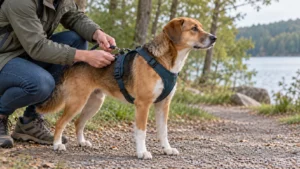
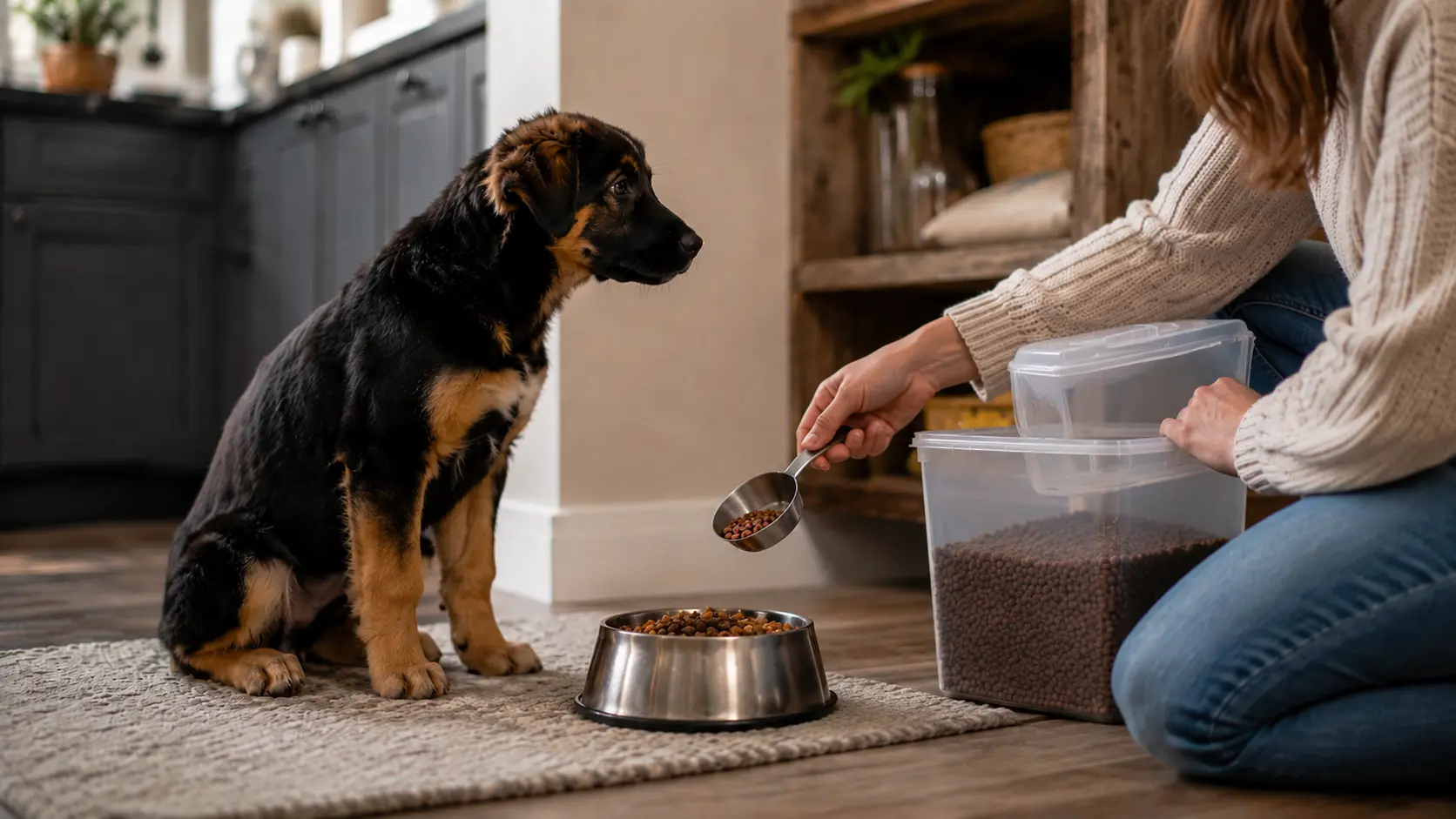
Knowing when to switch puppy to adult food is less about reaching a particular birthday and more about whether your dog is nearing the end of growth.
Many small dogs approach maturity around 9–12 months, while medium dogs are often closer to 12 months. Large breeds usually mature later, and some giant breeds may continue growing into roughly 18–24 months.
These are only starting points. AAHA notes that some large- and giant-breed dogs may not reach skeletal maturity until closer to 15–16 months, while other veterinary guidance places some giant breeds later still. Expected adult size, growth pattern, body condition, health, and veterinary assessment matter more than one fixed birthday.
Once the timing is right, changing foods gradually can also make the transition easier on the digestive system.
When Should You Switch Puppy to Adult Food?
A puppy should generally move from growth nutrition to adult-maintenance food when they are approaching skeletal maturity.
That means the common advice to switch every puppy at exactly 12 months is too simple.
As a practical starting point:
- Small dogs: often around 9–12 months
- Medium dogs: often around 12 months
- Large dogs: commonly around 12–18 months
- Giant dogs: sometimes closer to 18–24 months
- Individual dogs: timing can shift with expected adult size, growth, body condition, health, and veterinary assessment
AAHA specifically recommends growth-appropriate diets until skeletal maturity and notes the later timeline for some large and giant breeds.
These ages are ranges, not deadlines. A 12-month-old small dog may already be physically mature, while a 12-month-old giant-breed dog may still have substantial growing to do.
You may also see advice to switch once a puppy reaches a certain percentage of its expected adult weight. Be cautious with that shortcut. Veterinary guidance refers to skeletal maturity, which is not something owners can calculate precisely by weighing a puppy at home.
So if you are wondering how long to feed puppy food, use age and expected adult size to identify the likely window rather than treating one birthday as the deciding factor.
Why Breed Size Changes the Timing
Dogs do not all grow at the same rate.
A smaller dog generally reaches physical maturity sooner than a dog that will eventually weigh 70, 90, or 120 pounds. That difference matters because a dog that is still developing needs nutrition suitable for growth.
Small and Medium Dogs
Small breeds often approach physical maturity around 9–12 months, while many medium breeds are closer to 12 months.
That does not mean every small dog should have its food replaced on its first birthday. Look at the broader picture: age, expected adult size, growth trend, body condition, and whether the current diet is labeled appropriately for growth.
If your smaller puppy is still growing and you are deciding what food fits that stage, our guide to small-breed puppy food covers size-specific options in more detail.
Large and Giant Breed Puppies
Large and giant dogs deserve more caution because they typically mature later.
AAHA notes that some large and giant dogs may not achieve skeletal maturity until around 15–16 months. That is not a universal upper limit. Other veterinary guidance notes that some giant breeds may continue toward physical maturity until roughly 18–24 months, so expected adult size and individual growth still matter.
It also emphasizes maintaining a lean body condition and avoiding excessive calcium during giant-breed growth.
The goal is not to make a large puppy grow as quickly as possible. Appropriate growth nutrition supports controlled development rather than simply adding more calories or minerals.
If your puppy is expected to become a large dog and is not ready for adult maintenance yet, see our guide to food formulated for large-breed puppy growth.
How Can You Tell Whether Your Puppy Is Ready?
There is no single home test that proves a puppy has finished growing.
Instead, use several clues together:
- Expected adult size. Breed or known parentage can give you a useful starting point.
- Age. Compare your puppy's age with the usual maturity window for dogs of a similar size.
- Growth trend. A slowing rate of growth can suggest your puppy is getting closer to maturity.
- Body condition. Watch whether your dog is staying lean, gaining excess fat, or becoming too thin.
- Veterinary assessment. Your veterinarian can help when the remaining amount of growth is unclear.
- Current food label. Confirm whether the diet is intended for growth, adult maintenance, or all life stages.
A weight plateau by itself does not prove skeletal maturity. Temporary changes in appetite, activity, illness, or calorie intake can also affect weight.
What If You Have a Mixed-Breed Puppy?
Mixed-breed dogs can be harder to place into a neat size category, especially when the parents are unknown.
Use any reliable breed or parent information you have, but do not rely on a guess about adult weight alone. Tracking weight over several visits and monitoring body condition gives more context than one measurement.
If you are unsure whether significant growth remains, a veterinarian can help assess your dog’s development before you replace a growth diet with adult maintenance.
Puppy Food vs Adult Food: What Actually Changes?
The main difference between puppy and adult dog food is not simply the word printed on the front of the bag.
AAFCO recognizes different nutritional profiles for growth/reproduction and adult maintenance. FDA guidance likewise explains that pets at different life stages have different nutritional requirements.
A growth diet is formulated to support development. An adult-maintenance diet is formulated for a mature dog that is no longer growing.
That distinction matters more than broad claims such as:
“Puppy food always has more protein, fat, calcium, and calories.”
Actual nutrient and calorie levels vary from one product to another. It is more accurate to say that growth and adult-maintenance foods are designed around different life-stage requirements.
Why Large-Breed Growth Nutrition Needs Extra Care
For larger puppies, nutrient balance and controlled growth are particularly important.
AAHA recommends diets specifically formulated for large-breed growth for puppies predicted to reach at least 70 pounds as adults and warns against excessive calcium intake during growth.
More calcium is not automatically better, and adding calcium supplements to an already complete puppy diet should not be treated as a way to improve growth unless a veterinarian has identified a specific need.
Check the Nutritional Adequacy Statement Before You Switch
Before changing foods, turn the package around and find the nutritional adequacy statement.
AAFCO describes this statement as one of the most important parts of a pet-food label because it tells you which life stage the food is intended to support.
In simple terms:
- Growth: suitable for growing puppies
- Adult maintenance: intended for mature adult dogs
- All life stages: formulated to cover life stages that include growth/reproduction
The FDA also explains that a “complete and balanced” food must meet an established nutrient profile or satisfy an appropriate feeding-trial protocol.
This is more useful than judging the diet only by words such as “premium,” “natural,” or even “puppy” on the front of the package.
What If the Food Says “All Life Stages”?
You may not automatically need to change formulas simply because your dog becomes an adult.
WSAVA notes that all-life-stages diets are formulated to cover growth/reproduction requirements.
However, that does not make every all-life-stages diet ideal for every adult dog. Calorie density, activity, body condition, health, and individual needs still matter.
A dog that begins gaining unwanted weight after maturity may need a different feeding amount or diet even if the existing food technically remains nutritionally adequate.
How to Switch From Puppy Food to Adult Food
Once your puppy is ready, avoid replacing the entire diet in one meal.
A controlled study in healthy puppies found that gradual dietary transition reduced diarrhea compared with an abrupt diet change.
There is no single transition schedule that every dog must follow, but a simple example is:
Example Transition
- Days 1–2: Mostly the current puppy food with a small amount of the new food
- Days 3–4: Increase the proportion of adult food
- Days 5–6: Feed mostly the new food
- Around day 7: Move completely to the new food if stools and appetite remain normal
Treat that as a starting point, not a deadline.
Some dogs adjust easily. Others need a slower change over a longer period, particularly if they have a history of sensitive digestion.
During the transition, pay attention to:
- stool consistency;
- appetite;
- vomiting
- normal energy and behavior;
- body condition as calorie requirements change.
Also check the feeding directions on the new food. A scoop of adult food does not necessarily contain the same number of calories as the same volume of your puppy’s previous diet.
What If Your Puppy Gets Diarrhea or Vomits During the Transition?
A diet change can contribute to loose stools, particularly if it happens quickly. But diarrhea during a food transition should not automatically be blamed on the food.
Cornell University College of Veterinary Medicine lists dietary change among the possible causes of diarrhea, along with parasites, infections, foreign bodies, toxins, and other gastrointestinal problems.
If your puppy develops mild loose stool but is otherwise eating, drinking, active, and behaving normally, stop increasing the new food. Returning temporarily to the last well-tolerated ratio and restarting more slowly once stools improve can be reasonable.
Contact a veterinarian sooner if you notice:
- repeated vomiting;
- significant or persistent diarrhea;
- visible blood or black, tarry stool;
- unusual lethargy;
- loss of appetite;
- signs of dehydration;
- symptoms that are becoming worse rather than better.
Cornell advises veterinary attention when diarrhea persists rather than resolving, especially when other concerning symptoms are present.
Young and incompletely vaccinated puppies deserve extra caution. Canine parvovirus, for example, primarily affects young unvaccinated dogs and can cause serious vomiting, diarrhea, and dehydration.
Significant vomiting and diarrhea should not simply be treated as a normal part of changing foods.
Does Spaying or Neutering Mean It Is Time for Adult Food?
No. Spaying or neutering is not an automatic signal that a puppy is ready to switch to adult-maintenance food.
AAHA notes that energy needs can decrease after spaying or neutering, which may mean adjusting calorie intake. However, a puppy may still need growth-appropriate nutrition until physical development is complete.
Instead of switching foods simply because the surgery has taken place, monitor:
- body condition;
- weight trend;
- portion size;
- activity;
- remaining growth.
If your puppy begins gaining excess body fat after being spayed or neutered, speak with your veterinarian about adjusting calorie intake while still meeting growth needs.
Common Mistakes When Switching Puppy Food
A few shortcuts make this decision less reliable than it needs to be.
Switching every dog at exactly 12 months.
That works as a rough estimate for many dogs, but larger breeds may still be growing.
Changing foods immediately after spaying or neutering.
Calorie needs can change without growth requirements disappearing.
Replacing the entire diet overnight.
A gradual transition is less likely to disturb digestion than an abrupt change.
Assuming one stable weight means growth is finished.
Growth trend is useful context, but one measurement cannot prove skeletal maturity.
Choosing only from the front of the package.
Check the nutritional adequacy statement to see which life stage the diet actually supports.
Assuming extra calcium will help a large puppy.
Excessive calcium during large- and giant-breed growth can be undesirable.
Treating vomiting or significant diarrhea as normal.
Food changes are only one possible cause.
When to Ask Your Veterinarian About the Switch
Many healthy dogs can move from puppy to adult food without complications. Veterinary input becomes more useful when the timing or nutritional needs are less clear.
Ask your veterinarian if:
- you cannot estimate your puppy's expected adult size;
- you have a large or giant breed and are unsure how much growth remains;
- growth appears unusually fast or slow;
- your puppy is becoming too thin or carrying excess body fat;
- your dog has a medical condition;
- your puppy eats a therapeutic veterinary diet;
- digestive problems continue during the transition.
Your veterinarian can also help if you are simply unsure whether your dog is physically mature enough to leave a growth diet.
Frequently Asked Questions
What age should a puppy stop eating puppy food?
There is no single age for every puppy. Small breeds are often ready around 9–12 months, medium dogs around 12 months, large breeds commonly around 12–18 months, and some giant breeds may not be ready until roughly 18–24 months. These are general ranges rather than deadlines. The better endpoint is whether the dog is approaching physical or skeletal maturity.
Can a puppy eat adult dog food before one year old?
Eating a small amount of adult food accidentally is different from replacing a puppy’s normal diet with adult maintenance.
If the puppy is still growing, the regular diet should be nutritionally appropriate for growth. Whether a planned switch before one year makes sense depends on the individual dog’s maturity, size, and health.
Can adult dogs eat puppy food?
An adult dog can physically eat puppy food, but a growth-oriented diet may not be the best long-term match for every mature dog.
The concern is less about the label saying “puppy” and more about whether the diet’s nutritional profile and calorie density fit the adult dog’s needs. An all-life-stages food is a separate case because it is formulated to cover more than one life stage.
Do I need to change an all-life-stages food when my puppy becomes an adult?
Not necessarily.
All-life-stages diets are formulated to cover growth/reproduction requirements, so adulthood alone does not automatically require a different product.
Still, check body condition, calorie intake, activity, and health to decide whether the food remains a good fit.
Should I switch food and reduce meal frequency at the same time?
Not necessarily. The change from growth food to adult maintenance and the number of meals your dog eats are separate decisions.
If you are deciding how often your puppy should eat as they get older, see our puppy feeding schedule rather than changing both parts of the routine automatically on the same day.
The Right Time Depends on Growth, Not Just Age
The safest way to decide when to switch puppy to adult food is to use age as a guide, then look at expected adult size, growth, body condition, health, and the nutritional adequacy of the current diet.
Many small and medium dogs are ready around one year, while some large and giant dogs need growth nutrition longer. Once your puppy is ready, make the change gradually and keep an eye on appetite, stools, and body condition.
If your dog still has significant growing to do, our complete puppy food guide can help you understand the types of food designed for the growth stage. When maturity is uncertain—or digestive symptoms are more than mild—your veterinarian is the right person to guide the next step.