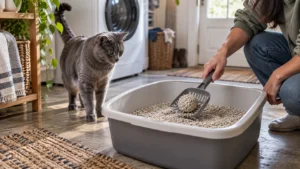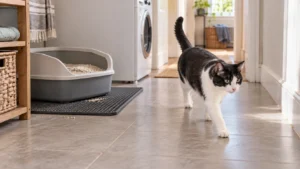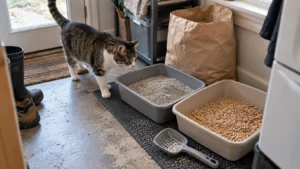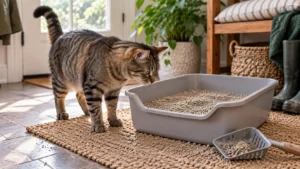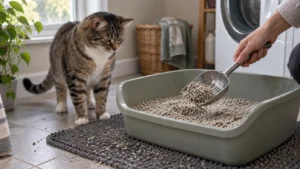
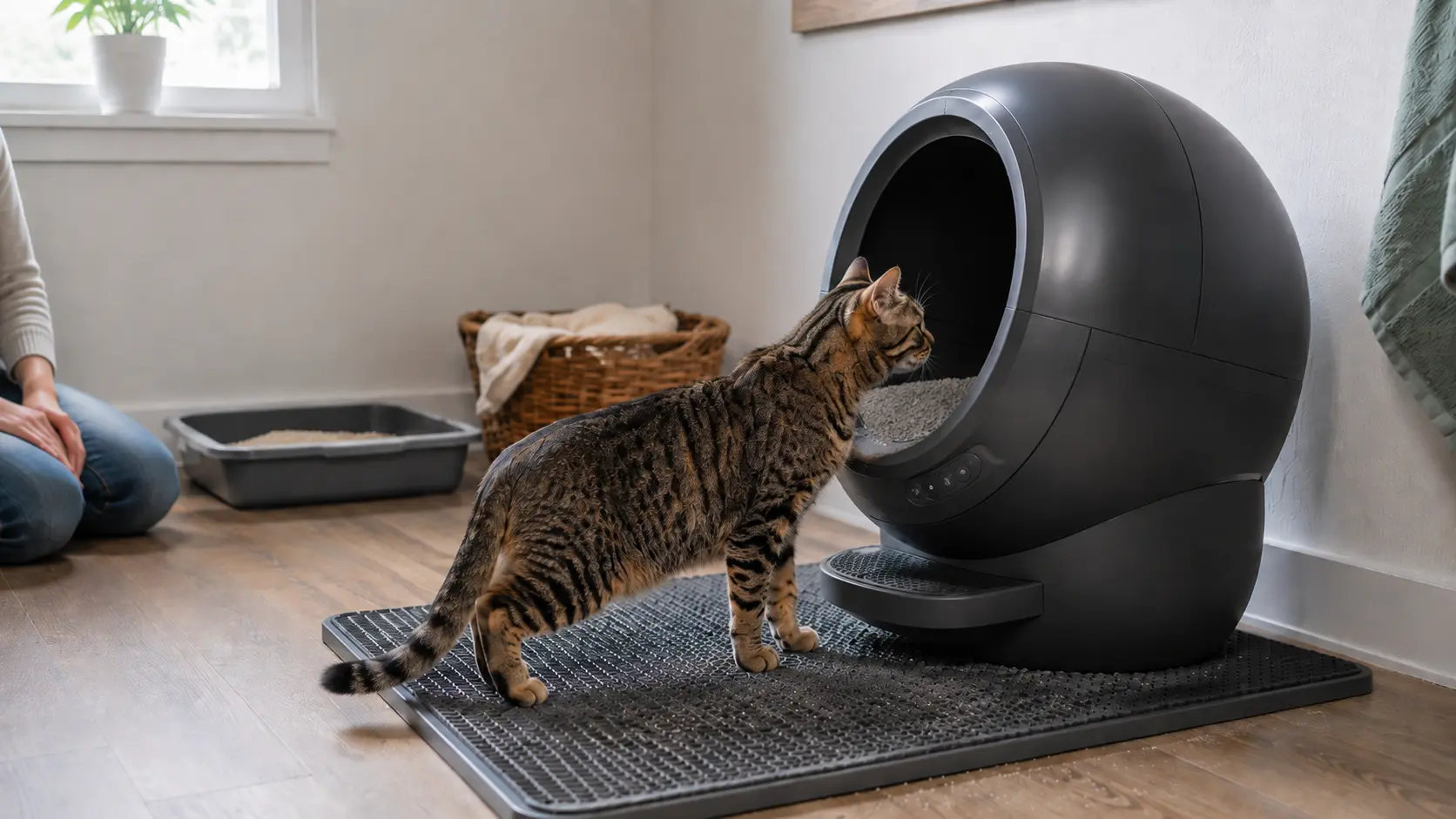
The best way to get a cat to use Litter-Robot is to introduce it as a quiet, stationary litter box before asking the cat to accept its movement and sound.
Keep the machine turned off at first. Place it near the familiar litter box, use litter your cat already recognizes when it is compatible, and allow voluntary investigation. Introduce one manual cleaning cycle only after your cat has started using the stationary machine comfortably.
Some cats investigate within hours. Others need days or several weeks. Progress should depend on your cat’s behavior, not a fixed deadline.
Important: Never place, hold, or trap your cat inside the globe. If your cat begins withholding, appears distressed, or eliminates elsewhere, restore access to a familiar clean litter box and slow the transition down.
How We Researched This Guide
We compared Whisker’s current Litter-Robot acclimation guidance with feline litter-box guidance and recurring problems reported by Litter-Robot owners.
Because cats respond differently to new objects, enclosed spaces, litter textures, and mechanical sounds, this guide focuses on observable behavior rather than guaranteed timelines. It also separates normal hesitation from physical-access problems, social tension, and elimination changes that may need veterinary attention.
First, Identify Why Your Cat Will Not Use Litter-Robot
A cat that ignores the machine needs a different solution from a cat that used it once and became frightened by the cleaning cycle.
Before changing the setup, watch what your cat actually does.
Your cat ignores the machine completely
The Litter-Robot may simply be an unfamiliar object in the cat’s territory.
The location could also be part of the problem. A machine placed in a busy hallway, beside a washing machine, or in a room the cat rarely visits may be easy to avoid.
Introducing a new box, a different litter, a new location, and automatic movement on the same day can also create too many changes at once.
Your cat approaches but will not enter
This often points to the entrance, interior space, or litter rather than the machine’s sound.
Check whether:
- The entrance feels too high
- A fence or step makes access awkward
- The globe feels more enclosed than the old box
- Your cat has enough room to turn comfortably
- The litter texture or scent has changed
- Another pet can wait near the exit
Your cat stopped after seeing it cycle
Treat this as fear of movement and noise.
The cat has already shown that the stationary box may be acceptable. The transition needs to return to that stage before the cleaning motion is introduced again.
One cat uses it but another refuses
Cats in the same household do not always share the same preferences.
One may accept the enclosed globe immediately, while another needs an open box, easier entry, a different location, or protection from a cat that guards the entrance.
The refusal started suddenly
A sudden change after previously normal litter-box use should not automatically be blamed on stubbornness or fear.
Pain, urinary trouble, digestive discomfort, constipation, or reduced mobility can all change how a cat uses a litter box. Contact a veterinarian when the change is sudden, persistent, or accompanied by other concerning signs.
Prepare the Litter-Robot Before Introducing Your Cat
A careful setup makes acclimation easier. It can also prevent the machine from becoming associated with a frightening first experience.
Choose a quiet, accessible location
Use a calm area your cat can enter and leave easily.
Avoid placing the machine:
- Beside loud appliances
- In a busy hallway
- In a tight dead-end closet
- Close to food and water
- Where a dog or another cat can block the entrance
- In a room the cat does not normally visit
The cat should be able to look around and leave without feeling cornered.
Place it near the familiar litter box
When practical, put the Litter-Robot near the existing box during the first stage.
Keep the traditional box available. Removing it immediately may leave a cautious cat without a toileting option it recognizes.
In a multi-cat home, boxes placed side by side may still function as one shared resource. Additional boxes in separate locations may still be necessary.
Use familiar compatible litter
Use the cat’s current litter at first if it is suitable for the machine.
A small amount of familiar used litter can help provide a recognizable toileting scent. You do not need to transfer a large amount, and the globe should not be filled above the model’s recommended level.
If the existing litter is unsuitable, change it gradually rather than switching the litter and the machine at the same time.
Keep the machine turned off
During the first stage, the Litter-Robot should behave like a stationary litter box.
Do not run an automatic cycle immediately after setup. A cautious cat may accept the opening and litter but become frightened when the globe suddenly begins moving.
Check the entrance
Make sure the opening is clear and easy to approach.
Depending on the model and its instructions, an optional front fence may be removable during acclimation. A stable ramp or wide step may also help a senior cat or a cat that struggles with the entrance height.
Any step or ramp should stay firmly in place and should not block the cat’s exit.
How to Get a Cat to Use Litter-Robot in Four Stages
Do not treat these stages as a four-day schedule. A cat may move through one stage quickly and need much longer at another.
Advance only when your cat looks relaxed and continues approaching voluntarily.
Stage 1: Let your cat investigate without pressure
Leave the machine turned off and allow your cat to discover it.
Do not carry the cat to the entrance or place the cat inside. This may create a negative association with the machine before the cat has had time to investigate it safely.
You can reward calm interest, including:
- Looking toward the machine
- Approaching it
- Sniffing the entrance
- Stepping onto the front step
- Entering voluntarily
Offer the reward after the cat moves away from the litter area. Do not place food inside the globe or establish a regular feeding spot beside the litter box.
Signs that your cat is becoming comfortable include approaching without immediately fleeing, returning to investigate, maintaining a relaxed body posture, and standing near the entrance without freezing or crouching.
Do not move to the next stage simply because several days have passed.
Stage 2: Encourage the first voluntary use
Keep both the traditional box and the Litter-Robot available.
Maintain a familiar litter scent and keep the Litter-Robot clean enough to be appealing. Wait for the cat to enter and eliminate voluntarily.
Some manufacturer and competitor advice suggests making the old box less attractive by cleaning it less often. A lower-pressure approach is to keep the old box usable while making the new box familiar and accessible.
Continue removing waste from the traditional box. If the cat begins using the robot, reward the cat after it has exited and moved away.
One successful visit is encouraging, but it does not necessarily mean the cat is ready for automatic cycling. Look for repeated, relaxed use before introducing movement.
Stage 3: Introduce the cleaning sound and movement
Once your cat has used the stationary Litter-Robot several times without obvious tension, introduce one manual cycle.
Let the cat leave the box and move to a comfortable distance first. Run the cycle while the cat is free to watch, approach, or leave.
A comfortable reaction may include:
- Watching without fleeing
- Returning to investigate afterward
- Walking normally around the room
- Grooming, resting, or playing normally
- Continuing to use the machine later
Fear signs may include:
- Running away
- Freezing
- Hiding
- Remaining tense after the cycle
- Refusing to return to the room
- Distressed vocalization
- New accidents outside the box
If your cat becomes frightened, stop. Do not run several more cycles in an attempt to force the cat to get used to it.
Return the machine to its stationary setting and rebuild comfort before trying again from a greater distance.
Cycle-delay options vary by model. Check the instructions for your exact machine before selecting a longer delay.
Stage 4: Switch to automatic mode gradually
Before enabling automatic operation, look for:
- Repeated voluntary use
- Relaxed behavior near the stationary machine
- A calm or manageable reaction to a manual cycle
- Normal urination and defecation
- No recent accidents caused by the transition
Supervise the first automatic cycles when possible. Continue checking the globe and waste drawer instead of depending only on app information.
Keep the traditional box during this final stage. If the cat becomes frightened, begins avoiding the room, or stops using the robot, turn automatic operation off and return to an earlier stage.
What to Do if the First Cleaning Cycle Frightened Your Cat
A cat may use the stationary machine successfully and still become frightened when the globe moves for the first time.
Turn automatic mode off again. Restore a clean familiar box if it has already been removed, and allow the cat to use the Litter-Robot as a stationary box.
Wait for relaxed, voluntary approaches to return. This may take longer than the original introduction because the cat now remembers the unexpected movement.
When the cat is comfortable again, run one manual cycle while the cat is farther away. The cat should have an open route out of the room and should never be held near the machine.
If the cat freezes, hides, or stops returning, increase the distance and wait longer before another attempt.
Use a longer suitable cycle delay if your model provides that option. The goal is to reduce the chance that the machine begins moving while the cat is still close to the entrance.
Some cats need the entire process restarted from Stage 1. That is not unusual, and rushing the second attempt may strengthen the fear.
What if Your Cat Approaches but Will Not Enter?
A cat that repeatedly inspects the machine but refuses to step inside may be reacting to the entrance or interior rather than the cleaning cycle.
Check the entrance height
Raised entry can be difficult for:
- Senior cats
- Cats with poor balance
- Cats with joint discomfort
- Small cats
- Cats accustomed to low-sided trays
A stable ramp or wide step may help, but it will not solve every mobility problem.
Remove optional entry barriers
If the manufacturer permits it for your model, temporarily removing an optional front fence may create a more open approach.
Do not remove structural parts or make unapproved modifications.
Consider the enclosed design
A cat accustomed to a wide open tray may hesitate inside a rounded globe. Even when the cat physically fits, the interior may feel restrictive during turning, digging, or choosing a posture.
Large and long-bodied cats may be especially sensitive to usable interior room.
Keep the exit clear
Do not place the opening toward a wall or narrow passage. Another animal should not be able to wait directly outside and block the cat’s route.
For a cat with ongoing mobility limitations, keep a low-entry traditional box available even if the robot is used occasionally.
How to Change Litter Without Causing More Avoidance
Changing the box and litter together makes it difficult to tell which change the cat dislikes.
Use familiar litter first when it is compatible. If a different formula is necessary, mix it into the familiar litter gradually and watch the cat’s response.
Avoid changing all of these at once:
- Box design
- Location
- Litter texture
- Fragrance
- Litter depth
- Cleaning sound
If your cat continues using the old box with familiar litter but avoids the Litter-Robot, texture or scent may be contributing to the refusal.
Litter also needs to work correctly with the machine. LumaPaw’s guide to compatible litter for Litter-Robot explains the main litter types and options in more detail.
One Cat Uses Litter-Robot but Another Refuses
Acclimate each cat as an individual.
Do not remove every traditional box simply because one cat has accepted the robot. The second cat may have different entry, space, litter, or location preferences.
Keep additional boxes in separate areas when possible. Two boxes next to each other may still be guarded as a single location.
Watch for subtle social pressure:
- One cat waiting outside the opening
- Chasing after another cat exits
- Blocking a doorway
- Following a nervous cat toward the box
- One cat using the area only when the other is asleep
App weight data may help identify which cat entered, but it should not replace direct observation of elimination habits and social behavior.
Accidents, Partial Use, and Medical Warning Signs
Not every transition problem looks like complete refusal.
Your cat urinates in it but will not defecate—or the reverse
Some cats prefer different places for urine and stool. Others may find the globe comfortable for one posture but not another.
Check the interior room, litter depth, texture, and ease of turning. Continue providing another clean box while you monitor the pattern.
Persistent or sudden selective use may also be connected to constipation, urgency, pain, or another health issue. Do not assume the cat is being stubborn.
Your cat has accidents outside the litter box
Restore access to an acceptable traditional box.
Clean accident areas thoroughly with a cleaner suitable for the surface. An enzymatic cleaner may help remove lingering odor, but follow its instructions carefully.
Reassess:
- Machine location
- Entry access
- Litter texture
- Cycle timing
- Recent frightening events
- Social blocking
- Whether too many changes happened together
Do not punish the cat or place it inside the machine after an accident. Restart the transition more slowly.
When to contact a veterinarian
Contact a veterinarian when litter-box avoidance is sudden, persistent, or accompanied by:
- Repeated visits with little or no urine
- Straining
- Vocalizing during elimination
- Blood in urine or stool
- Constipation or diarrhea
- Increased drinking or urination
- New balance or mobility problems
- Apparent pain
- Major changes in appetite or behavior
Repeated attempts to urinate with little or no urine should be treated as urgent and checked by a veterinarian immediately.
Litter-Robot Acclimation Mistakes to Avoid
Avoid these common mistakes:
- Turning on automatic mode immediately
- Placing or holding the cat inside
- Blocking the exit
- Removing every other litter box too soon
- Allowing the old box to become extremely dirty
- Changing the machine and litter simultaneously
- Placing it beside loud equipment
- Running repeated cycles to force exposure
- Punishing accidents
- Assuming every refusal is behavioral
- Assuming every cat will eventually accept the machine
A slower transition is usually easier to repair than a frightening first experience.
How Long Does It Take a Cat to Use Litter-Robot?
Some cats investigate or use the machine immediately. Others need several days, and cautious cats may need several weeks.
A cat frightened by an early cycle may need the process restarted.
The right time to move to the next stage depends more on your cat’s behavior than on the number of days that have passed. Look for relaxed, repeated, voluntary use.
When can you remove the old litter box?
Wait until:
- The cat uses the robot consistently
- Urination and defecation remain normal
- Cleaning cycles do not cause renewed avoidance
- No other household cat still depends on the old box
- There have been no recent accidents or withholding concerns
Some households may need to keep another box permanently.
When Litter-Robot May Not Be the Right Fit
Not every cat will accept an enclosed rotating litter box.
Another setup may be more appropriate when:
- The cat persistently rejects enclosed boxes
- Entry remains physically difficult
- The interior feels too restrictive
- Fear of movement continues despite gradual reintroduction
- Another cat repeatedly blocks access
- The cat consistently chooses an appropriate open box
- The transition is causing ongoing stress or house-soiling
The box may simply be a poor match for the cat’s physical needs or litter-box preferences.
You can compare automatic self-cleaning litter boxes with different entry styles and cleaning systems. LumaPaw also covers Litter-Robot alternatives with different designs.
If you are deciding whether to continue the transition, consider the wider Litter-Robot costs and limitations as well as your cat’s response.
Frequently Asked Questions
Should I leave Litter-Robot turned off at first?
Yes. Let your cat investigate and use it as a stationary litter box before introducing movement. Automatic cycling too early may frighten a cautious cat and make the transition more difficult.
Should I put used litter in Litter-Robot?
A small amount of familiar used litter may help provide a recognizable toileting scent. Do not add too much or fill the globe beyond the recommended level.
When should I turn on automatic mode?
Wait until your cat has used the stationary machine repeatedly, appears relaxed around it, and tolerates at least one manual cycle without persistent fear.
When can I remove the old litter box?
Remove it only after consistent robot use, normal elimination, and relaxed reactions to cycling. Do not follow a fixed number of days if your cat is still hesitant.
What if my cat is scared of the cleaning cycle?
Turn automatic operation off, restore a familiar box, and rebuild comfort with the stationary machine. Reintroduce one manual cycle later while the cat is at a greater distance.
Can I place my cat inside Litter-Robot?
No. Allow voluntary entry. Holding the cat inside or blocking the exit can create fear and may worsen litter-box avoidance.
Does a ramp help senior cats?
A stable ramp may reduce the effort required to reach the entrance. It does not solve every balance, joint, body-size, or interior-space problem, so keep a low-entry box available when needed.
What if my cat never accepts Litter-Robot?
Continue providing an appropriate litter box. Some cats strongly prefer open boxes, need easier access, or remain uncomfortable with movement. Another automatic design or a traditional box may be a better fit.
Helping Your Cat Accept Litter-Robot Takes Patience
Learning how to get a cat to use Litter-Robot is less about making the cat enter and more about making the machine feel predictable, accessible, and safe.
Start with the power off, preserve familiar litter and location cues, and introduce the cleaning motion as a separate stage. Keep another acceptable box available until relaxed use is established.
If fear, accidents, withholding, or sudden elimination changes appear, return to an earlier stage and involve a veterinarian when health concerns may be present.