
Choosing a large breed puppy food is not just about finding a bag with “puppy” or “large breed” printed on the front. Expected adult size, calorie density, calcium and phosphorus, the nutritional adequacy statement, ingredient sensitivities, and how well the puppy tolerates the food all matter.
Based on current product details, manufacturer information, retailer feedback, and comparison with similar formulas, Purina Pro Plan Development Large Breed Chicken & Rice is our Best Overall pick. It offers a strong balance of large-breed-specific formulation, disclosed mineral levels, several bag sizes, broad availability, and a substantial customer-feedback history.
Giant-breed puppies deserve a separate look, too. A puppy expected to weigh more than 100 pounds as an adult may not have the same feeding needs as one expected to mature around 60 or 70 pounds.
If you are comparing food for puppies of all sizes, our best puppy food guide covers the broader options.
Affiliate disclosure: LumaPaw may earn a commission from qualifying purchases made through links in this article, at no extra cost to you.
Our Top Large Breed Puppy Food Picks
Purina Pro Plan Development Large Breed Chicken & Rice
Best Overall
Best for: Most large-breed puppies expected to exceed 50 pounds at maturity
Main protein: Chicken
Calories: 419 kcal/cup
Calcium: 1.1% minimum
Phosphorus: 0.9% minimum
Main limitation: Contains several common animal proteins and grains
Royal Canin Large Puppy
Best for Puppies Expected to Reach 56–100 lb
Best for: Owners who know their puppy’s expected adult weight falls squarely in Royal Canin’s defined large-breed range
Main animal ingredient: Chicken by-product meal
Calories: 349 kcal/cup
Main limitation: Expensive, with less calcium/phosphorus detail on the current guaranteed analysis
Hill's Science Diet Puppy Large Breed Chicken & Brown Rice
Best for Clear Calcium Guidance
Best for: Owners who want a large-breed formula with a clear emphasis on calcium-controlled growth
Main protein: Chicken
Calories: About 391 kcal/cup
Calcium: 0.8% minimum on the supplied guaranteed analysis
Main limitation: More expensive than several mainstream alternatives
Purina Pro Plan Sensitive Skin & Stomach Large Breed Salmon & Rice
Best for Sensitive Stomachs
Best for: Owners looking for a salmon-first large-breed formula designed with digestive sensitivity in mind
Main protein: Salmon
Calories: About 418 kcal/cup
Main limitation: Not hypoallergenic and contains fish ingredients plus beef fat
Royal Canin Giant Puppy
Best for Giant Breeds
Best for: Puppies expected to exceed 100 pounds as adults
Calories: 338 kcal/cup
Calcium: 1.1% minimum
Phosphorus: 0.92% minimum
Main limitation: Intended mainly for the early giant-breed growth stage, followed by Royal Canin Giant Junior
Diamond Naturals Large Breed Puppy Lamb & Rice
Best Lamb-Based Option
est for: Owners looking for a lamb-centered, grain-inclusive large-breed puppy food at a more approachable price.
Main protein: Lamb
Calories: About 414 kcal/cup
Calcium: 1.2% min
Phosphorus: 1.0% min
Main limitation: The recipe also contains chicken fat, egg product, and fish meal, so it is not suitable when those ingredients need to be avoided.
IAMS Proactive Health Large Breed Puppy
Best Budget Pick
Best for: Owners looking for a more affordable dedicated large-breed puppy food
Main protein: Chicken
Calories: About 378 kcal/cup
Calcium: 1.2% minimum
Phosphorus: 0.8% minimum
Main limitation: Contains chicken, corn, soy, egg, and caramel color
How We Chose the Best Large Breed Puppy Foods
We did not choose these foods simply because they have high star ratings or because an online retailer placed them under “large breed puppy food.”
Large-breed growth suitability came first
The nutritional adequacy statement deserves more attention than marketing on the front of the bag. AAFCO describes this statement as one of the key parts of a pet-food label because it indicates the species and life stage for which a food is nutritionally suitable.
For this roundup, we looked for dedicated large- or giant-breed formulas and, where available, checked manufacturer guidance about expected adult size and growth-stage suitability.
For readers who want to understand label terminology in more detail, AAFCO’s pet-food label guide is a useful external reference. (AAFCO)
We compared more than protein percentages
Calcium, phosphorus, calories, protein, fat, DHA, expected adult size, and feeding directions were considered where reliable current information was available.
A higher number is not automatically better. Large-breed puppy feeding is about providing appropriate nutrition for development while avoiding unnecessary overfeeding.
We were also careful not to mix different reporting methods. A guaranteed-analysis minimum and a manufacturer’s dry-matter nutrient value, for example, should not be treated as if they are directly interchangeable.
Ingredients were considered in context
The ingredient list helped identify main protein sources and ingredients that matter to owners managing food sensitivities.
But we did not rank foods simply because one ingredient list looks more appealing than another. WSAVA’s pet-food selection guidance recommends also looking at formulation expertise, quality control, nutritional adequacy, calorie information, and manufacturer transparency. (WSAVA)
That is why a food containing corn or a named by-product was not automatically downgraded, and words such as “premium” or “natural” were not treated as evidence of superior nutrition.
Customer reviews helped identify practical drawbacks
Retailer feedback was useful for spotting recurring issues such as:
- puppies refusing a food
- loose stools or gas in some dogs
- kibble size
- strong food odor
- damaged packaging
- price concerns
Customer experiences are useful context, but they do not prove that a food treats allergies, digestive disease, joint problems, or other medical conditions.
The 7 Best Large Breed Puppy Foods Reviewed

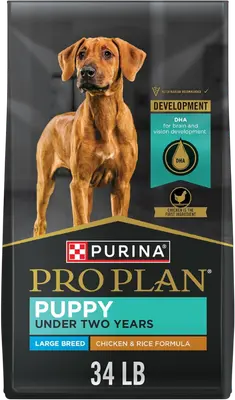
Purina Pro Plan Development Large Breed Chicken & Rice — Best Overall
Best for: Owners wanting a broadly suitable, well-documented large-breed puppy formula.
Avoid if: Your veterinarian has recommended avoiding chicken, egg, fish, wheat, corn, or using a controlled elimination diet.
Honest buying note: This is our Best Overall because of its balance, not because it will suit every puppy. Individual tolerance still matters.
Purina Pro Plan Development earns our top position because it does a lot well without depending on a narrow use case. Purina describes it as a formula intended to support an appropriate growth rate in large-breed puppies, with chicken first, DHA from fish oil, and calcium and phosphorus among its bone-supporting minerals. The manufacturer currently offers 18-, 34-, and 47-pound bags. (Purina)
The current guaranteed analysis lists 28% minimum protein, 13% minimum fat, 1.1% minimum calcium, 0.9% minimum phosphorus, 0.1% minimum DHA, and 419 kcal per cup.
Customer feedback is strong overall. Across the Amazon and Chewy reviews we checked, owners frequently mentioned good acceptance and digestive tolerance. A smaller number reported loose stools, other individual digestive problems, or bag-quality concerns.
This is not a simple formula for a puppy on an elimination diet. The current ingredient list includes chicken, chicken by-product meal, wheat, corn, soy, and beef fat, so this is not a simple or limited-ingredient formula.
Pros
- Dedicated large-breed puppy formula
- Chicken is first
- Calcium and phosphorus clearly disclosed
- DHA included
- Three useful large bag sizes
- Extensive customer-feedback history
Cons
- Multiple animal protein sources
- Contains wheat and corn
- Not appropriate for every food-sensitive puppy

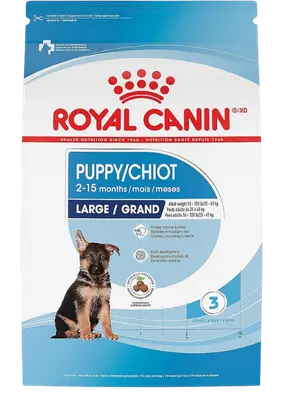
Royal Canin Large Puppy — Best for Puppies Expected to Reach 56–100 lb
Best for: Puppies expected to mature between roughly 56 and 100 pounds.
Avoid if: Your puppy is likely to exceed 100 pounds or needs to avoid chicken, wheat, or corn.
Honest buying note: The biggest reason to choose this food is the precise size targeting—not a vague idea that Royal Canin is automatically “more premium.”
Royal Canin makes this choice unusually straightforward: its Large Puppy formula is intended for puppies with an expected adult weight of 56–100 pounds, up to 15 months old. The current manufacturer information lists 349 kcal per cup and describes it as complete and balanced nutrition for this size range. (Royal Canin)
That precise weight target is the main reason it earns a place near the top. If your puppy is expected to mature around 70, 80, or 90 pounds, you do not have to guess whether the product’s size classification matches.
The current guaranteed analysis lists 28% minimum protein and 14% minimum fat.
Customer feedback was strongly positive overall for acceptance and digestive tolerance. The clearest recurring drawback was price.
Pros
- Extremely clear 56–100 lb adult-size target
- Dedicated large-breed growth formula
- 349 kcal/cup
- Several bag sizes available
- Straightforward feeding guide based on adult target weight
Cons
- One of the more expensive options
- Contains chicken, wheat, and corn
- Current calcium and phosphorus percentages are not as easy to compare from the supplied retailer analysis

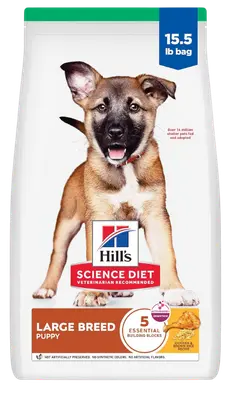
Hill's Science Diet Puppy Large Breed Chicken & Brown Rice — Best for Clear Calcium Guidance
Best for: Owners who want a large-breed puppy food with particularly clear calcium guidance.
Avoid if: Your puppy needs a chicken-free or simpler ingredient profile.
Honest buying note: We would not compare Hill’s guaranteed-analysis figures directly with dry-matter numbers from another source without explaining the different reporting basis.
Hill’s specifically emphasizes an optimal calcium level for the controlled bone growth needs of large-breed puppies, and its current manufacturer page states that feeding tests using AAFCO procedures support complete and balanced nutrition for growing puppies. (Hill’s Pet Nutrition)
The current guaranteed analysis lists 24% minimum protein, 11% minimum fat, 0.8% minimum calcium, and 0.1% minimum DHA, with about 391 kcal per cup.
Chicken is the first ingredient, followed by brown rice and other ingredients including chicken meal, oats, barley, wheat, soy, and corn.
The customer-feedback pattern was positive overall, particularly for palatability and general tolerance. Individual reports of soft stools, digestive upset, or food refusal also appeared.
Pros
- Large-breed-specific formula
- Clear calcium-focused positioning
- Chicken first
- DHA included
- Strong retailer feedback
Cons
- More expensive than IAMS or Diamond
- Chicken-based
- Contains several grains and soy

Purina Pro Plan Sensitive Skin & Stomach Large Breed Salmon & Rice — Best for Sensitive Stomachs
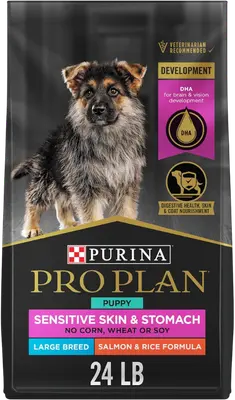
Best for: Owners specifically seeking a salmon-first large-breed puppy food designed with digestive sensitivity in mind.
Avoid if: Your puppy needs to avoid fish or beef-derived ingredients, or requires a veterinarian-directed elimination diet.
Honest buying note: Persistent diarrhea, vomiting, itching, or suspected food allergy deserves veterinary attention rather than repeated trial-and-error food switching.
This formula gives owners a genuinely different option from the chicken-first foods above. Purina currently describes it as a complete and balanced large-breed puppy food for puppies weighing more than 50 pounds at maturity, with salmon as the first ingredient, rice, prebiotic fiber, DHA, and a formula aimed at sensitive digestive systems. (Purina)
The current nutrition information lists 28% minimum protein, 13% minimum fat, and about 418 kcal per cup.
No chicken ingredient appeared in the current ingredient list supplied during research, but that does not make this hypoallergenic. It contains multiple fish ingredients and beef fat.
Retailer reviews include many owners reporting good digestive tolerance, but others reported loose stools, vomiting, food refusal, or a strong fish smell. A “sensitive stomach” label is not a guarantee that every sensitive puppy will tolerate it.
Pros
- Salmon is first
- Dedicated large-breed puppy formula
- Prebiotic fiber and probiotics
- DHA included
- Useful alternative to chicken-first formulas
Cons
- More expensive
- Only 16- and 24-pound bags in the current research
- Strong fish smell reported by some owners
- Contains beef fat and several fish ingredients

Royal Canin Giant Puppy — Best for Giant Breeds
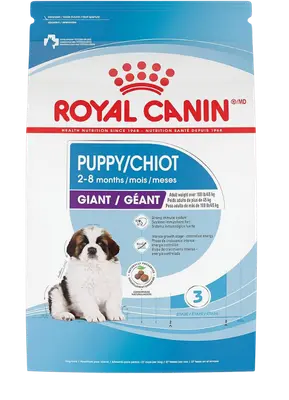
Best for: Giant-breed puppies expected to mature above 100 pounds.
Avoid if: Your puppy falls comfortably below the giant-breed range or you want one formula throughout puppyhood.
Honest buying note: For a genuinely giant puppy, this may be more relevant than our overall #1 pick because the adult-size targeting is much more specific.
A giant-breed puppy deserves more than being treated as an extra-large version of every other puppy. Royal Canin Giant Puppy is specifically intended for puppies expected to exceed 100 pounds as adults, through about eight months of age. Its current nutritional adequacy statement covers growth including large-size dogs. (Royal Canin)
The current formula provides 32% minimum protein, 12% minimum fat, 1.1% minimum calcium, 0.92% minimum phosphorus, and 338 kcal per cup. (Royal Canin)
At around eight months, Royal Canin directs owners toward Giant Junior for the next growth stage. That staged system is useful, but it also means this is not a single bag-to-adulthood solution.
Pros
- Specifically designed for >100-lb adult size
- Clear calcium and phosphorus figures
- Lower calorie density than several other picks
- Defined giant-breed growth-stage system
Cons
- Expensive
- 30-pound bag
- Mainly intended for the first eight months
- Requires a later formula change

Diamond Naturals Large Breed Puppy Lamb & Rice — Best Lamb-Based Option
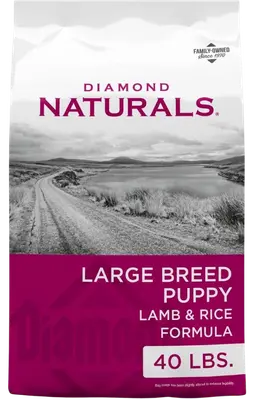
Best for: Owners wanting a lamb-centered, grain-inclusive large-breed puppy food at a more approachable cost.
Avoid if: Your puppy must strictly avoid chicken-derived ingredients, egg, or fish.
Honest buying note: Choose this for its lamb-first formula and value—not because you assume “lamb” means single-protein or chicken-free.
Diamond Naturals stands out because lamb and lamb meal lead the ingredient list while the formula is explicitly intended for large-breed growth. Diamond’s current manufacturer information says it meets AAFCO nutrient profiles for all life stages including growth of large-size dogs at 70 pounds or more as adults. (Diamond Pet Foods)
The current guaranteed analysis lists 27% minimum protein, 15% minimum fat, 1.2% minimum calcium, 1.0% minimum phosphorus, and 0.05% minimum DHA, with about 414 kcal per cup.
The 40-pound bag is also practical for larger puppies, and its price was competitive at the time of our check.
One important correction: this is not chicken-free. The current recipe contains chicken fat, along with egg product and fish meal. (Diamond Pet Foods)
Pros
- Lamb and lamb meal first
- Calcium and phosphorus disclosed
- DHA included
- 40-pound bag
- Probiotics
- Strong value relative to several premium-priced picks
Cons
- Contains chicken fat
- Contains egg and fish
- Some owners report gas or soft stool
- Kibble may be smaller than expected for a large-breed food

IAMS Proactive Health Large Breed Puppy — Best Budget Pick

Best for: Owners who need to manage the ongoing cost of feeding a fast-growing large puppy without moving to a generic adult food.
Avoid if: Your puppy needs a chicken-, egg-, corn-, or soy-free diet.
Honest buying note: Budget does not have to mean nutritionally irrelevant. Its large-breed positioning and disclosed mineral levels are why IAMS made the list.
IAMS is the budget choice, but it still needs to qualify as a real large-breed puppy food rather than simply being the cheapest bag. IAMS currently describes this formula as complete and balanced for growth of large-breed puppies, with chicken first and omega-3 DHA. The manufacturer also provides separate transition guidance for large and giant dogs based on expected adult size. (IAMS)
The current guaranteed analysis lists 27% minimum protein, 14% minimum fat, 1.2% minimum calcium, 0.8% minimum phosphorus, and 0.1% minimum DHA, with about 378 kcal per cup.
At the time of our price check, the larger bag cost substantially less per pound than several other foods in this roundup. Prices change, but the difference was large enough to support the budget position.
Customer feedback was broadly positive for price and palatability. A minority of owners reported gas, diarrhea, or puppies losing interest in the food over time.
Pros
- Dedicated large-breed puppy formula
- Chicken first
- Calcium, phosphorus, and DHA disclosed
- Strong value
- Large customer-review base
Cons
- Contains chicken, corn, soy, and egg
- Includes caramel color
- Some digestive-intolerance reports
What Makes a Good Large Breed Puppy Food?
The best food for a large-breed puppy is not necessarily the formula with the most protein, the longest ingredient list, or the highest price. The more useful question is whether the food is appropriate for the puppy’s growth stage and expected adult size.
Check the Nutritional Adequacy Statement
Start with the nutritional adequacy statement rather than the marketing claims on the front of the bag.
A puppy food should be a complete and balanced diet for growth, not a topper, mixer, treat, or supplemental product. For puppies expected to become large adults, look for wording showing that the formula is appropriate for the growth of large-size dogs when that distinction applies.
This matters because a retailer may place a food in a “large breed puppy” category even when the exact formula is designed more broadly. The label and manufacturer information are more useful than the store filter alone.
Also avoid phrases such as “AAFCO approved.” AAFCO does not individually approve pet foods. What matters is how the food’s nutritional adequacy is stated.
Look at Calcium and Phosphorus Together
Calcium gets a lot of attention in discussions about puppy growth, but it should not be considered by itself.
Phosphorus, calorie intake, the overall formula, and how much the puppy actually eats all matter too. That is one reason we included calcium and phosphorus figures when they were clearly available on the same reporting basis.
More calcium is not automatically better.
If a complete-and-balanced large-breed puppy food already provides appropriate mineral levels, adding a calcium supplement without veterinary guidance can disrupt the balance of the diet. Owners of fast-growing large or giant puppies should be especially cautious about adding supplements simply because they sound beneficial.
Pay Attention to Calories, Not Just Cups
The foods in this roundup range from roughly the mid-300s to more than 400 calories per cup.
That makes a universal “feed X cups per day” recommendation unreliable.
For example, Royal Canin Giant Puppy provides about 338 kcal per cup, while Purina Pro Plan Development Large Breed provides about 419 kcal per cup. Feeding the same number of cups would not provide the same amount of energy.
Use the manufacturer’s feeding guide as a starting point, then pay attention to your puppy’s body condition, growth, activity level, and veterinary guidance.
The goal is not to make a large puppy grow as fast as possible.
Protein Matters, but the Highest Percentage Does Not Automatically Win
Protein supports growth, but choosing a large-breed puppy food should not become a contest to find the highest protein percentage. If you want to compare protein levels more closely, our guide to high-protein puppy food explains what those percentages can and cannot tell you.
Our selected foods range from about 24% to 32% minimum crude protein. Royal Canin Giant Puppy has the highest percentage among these picks, but that does not make it the best food for every large puppy.
It is specifically designed for giant puppies expected to exceed 100 pounds as adults.
The complete formula and its intended use matter more than one number.
Check the Main Proteins and Relevant Ingredients
Ingredient lists become particularly useful when a puppy has known or suspected food sensitivities.
For example:
- Purina Pro Plan Development Large Breed is chicken-first and also contains several other animal ingredients.
- Purina Pro Plan Sensitive Skin & Stomach is salmon-first and does not show chicken in the current ingredient list we reviewed, but it still contains beef fat and several fish ingredients.
- Diamond Naturals Large Breed Puppy is lamb-first but contains chicken fat, along with egg and fish.
That is why terms such as “lamb formula” or “salmon formula” should not be interpreted as single-protein or hypoallergenic without checking the complete ingredient list.
Persistent itching, vomiting, diarrhea, poor appetite, or suspected food allergy is a better reason to speak with a veterinarian than to keep switching foods based on the protein named on the front of the bag.
Consider the Manufacturer, Not Just the Ingredient List
An attractive ingredient list does not tell you everything about a food.
Formulation expertise, nutritional research, quality-control procedures, feeding guidance, calorie information, and the manufacturer’s ability to answer nutrition questions also matter.
Likewise, ingredients such as corn, wheat, or animal by-products should not automatically be treated as proof of low quality.
For this roundup, we looked at the formula as a whole rather than ranking foods according to which bag sounded the most “natural” or “premium.”
What Counts as a Large Breed Puppy?
There is no single weight cutoff used in every context.
In everyday veterinary and consumer discussions, dogs expected to reach around 50 pounds or more are often described as large breeds. Pet-food nutritional adequacy language uses a more specific large-size-growth framework, which is why owners may also see 70 pounds mentioned.
The practical takeaway is simple: use the puppy’s expected adult weight, not its current puppy weight, when choosing the most suitable food.
A three-month-old puppy may still be small enough to carry, but that does not mean it should be fed like a small-breed puppy if it is expected to become a 75-pound adult.
What About Giant-Breed Puppies?
Giant breeds deserve an extra level of attention because their growth period and expected adult weight can be substantially greater.
In this roundup, Royal Canin Large Puppy is designed for puppies expected to reach 56–100 pounds, while Royal Canin Giant Puppy targets puppies expected to exceed 100 pounds.
That difference is more meaningful than simply buying the biggest bag available.
Royal Canin Giant Puppy is intended mainly for the earlier growth stage, from about two to eight months, followed by Giant Junior. That staged approach will not suit every household, but it illustrates why giant-breed puppy food should not automatically be treated as interchangeable with ordinary large-breed food.
Large Breed Puppy Food vs. Regular Puppy Food
Large-breed puppy foods are generally designed with the growth pattern of bigger dogs in mind, but the words “large breed” on the bag are not the only thing that matters.
Some regular puppy foods may have a nutritional adequacy statement that includes growth of large-size dogs. Others may specifically exclude it.
That means a large-breed puppy does not necessarily need a product whose marketing name contains “Large Breed,” but the exact formula should still be appropriate for that puppy’s growth stage and adult size.
Large-breed formulas may also differ in calorie density, mineral formulation, kibble size, and feeding guidance.
The safest approach is to check:
- Growth-stage nutritional adequacy
- Large-size-growth suitability when relevant
- Calories per cup
- Calcium and phosphorus information when available
- Expected adult-size guidance
- The puppy’s current body condition and growth
For a broader comparison of food types and puppy nutrition, our complete puppy food guide covers puppies of different sizes and feeding needs.
Is Grain-Free Large Breed Puppy Food Better?
A grain free large breed puppy food is not automatically healthier or more appropriate simply because it excludes grains.
We did not include a “Best Grain-Free” winner in this roundup because none of the evidence we reviewed justified treating grain-free as an advantage by itself.
Grains such as rice, oats, barley, corn, or wheat can provide nutrients and energy. Their presence does not automatically make a puppy food low quality.
If a veterinarian has identified a reason for your puppy to avoid a particular ingredient, that is different. In that situation, the choice should be based on the puppy’s actual dietary needs rather than a general preference for grain-free food.
For most owners, large-size-growth suitability, calorie intake, nutritional adequacy, and individual tolerance deserve more attention than whether the recipe contains grains. Our grain-free puppy food guide explains when the label may matter and when it does not.
Large Breed Puppy Food Checklist
Before settling on a food, run through these basic checks:
- Confirm it is a complete meal. Do not use a topper, mixer, or treat as the puppy’s main diet.
- Read the nutritional adequacy statement. Make sure the formula is appropriate for growth and, when applicable, large-size growth.
- Use expected adult weight. A puppy’s current size does not tell you what nutritional category it will ultimately fit.
- Start with the manufacturer’s feeding guide. Different foods have different calories per cup.
- Watch body condition, not just the number on the scale. Growth should be monitored over time.
- Do not add calcium casually. A complete puppy diet is already formulated around mineral balance.
- Transition gradually. Sudden food changes can cause digestive upset.
- Check the complete ingredient list if sensitivities matter. A lamb- or salmon-named food may contain other animal ingredients.
- Speak with your veterinarian when something looks wrong. Persistent vomiting, diarrhea, itching, poor growth, unusual weight changes, or loss of appetite deserves professional attention.
Common Mistakes When Feeding a Large Breed Puppy
Trying to Make a Puppy Grow Faster
A bigger puppy is not automatically a healthier puppy.
Feeding extra food to accelerate growth can also increase calorie intake far beyond the manufacturer’s intended feeding range. A large puppy should grow appropriately for its body and breed rather than be pushed toward maximum possible growth.
Adding Calcium to a Complete Puppy Food
Calcium supplements may sound sensible for a big puppy with growing bones, but more is not automatically better.
If the puppy is already eating a complete-and-balanced growth diet, do not add calcium unless your veterinarian has specifically recommended it.
Choosing Food From the Front of the Bag Alone
Marketing terms can be useful shortcuts, but they are not enough.
“Large breed,” “premium,” “natural,” “high protein,” and “real meat” do not replace the nutritional adequacy statement or calorie and mineral information.
Assuming More Protein Always Means Better
The highest-protein formula in this roundup is Royal Canin Giant Puppy at 32% minimum, but it is intended for a narrow group of puppies expected to exceed 100 pounds.
The best formula for a 65-pound adult-size Labrador-type puppy could be completely different.
Switching Foods Too Quickly
Several foods in this roundup recommend gradual transitions of around seven days, while some suggest longer for sensitive dogs.
Moving too quickly can make it difficult to tell whether loose stool or stomach upset is caused by the new formula, the abrupt transition, or something unrelated.
Copying Another Brand’s Cup Measurement
One cup of one food is not nutritionally identical to one cup of another.
Our researched foods range considerably in calories per cup. Use the feeding instructions for the specific product you are feeding, not the portion from the previous bag.
Frequently Asked Questions
What Is the Best Large Breed Puppy Food?
For most large-breed puppies, our Best Overall pick is Purina Pro Plan Development Large Breed Chicken & Rice because it combines explicit large-breed positioning with disclosed calcium, phosphorus, DHA, calorie information, multiple bag sizes, and strong availability.
The right choice can change if your puppy is expected to exceed 100 pounds, needs a salmon-first formula, or has ingredient sensitivities.
Can a Large Breed Puppy Eat Regular Puppy Food?
Possibly, but check the exact formula rather than assuming all regular puppy foods are suitable.
The nutritional adequacy statement should show whether the food supports the puppy’s growth stage and, when relevant, growth of large-size dogs. A product does not necessarily have to say “Large Breed” on the front to qualify, but its nutritional suitability still needs to be appropriate.
When Should You Stop Feeding Large Breed Puppy Food?
There is no single age that applies to every large puppy. Large and giant dogs can mature later than smaller dogs, and timing depends on breed, expected adult size, body condition, and the specific food. Our guide to when to switch a puppy to adult food explains the transition in more detail. Ask your veterinarian if you are unsure when your puppy is ready.
What Is the Best Food for a Giant Breed Puppy?
For puppies expected to exceed 100 pounds as adults, our most targeted pick is Royal Canin Giant Puppy.
It is specifically designed around giant-breed growth and provides 1.1% minimum calcium, 0.92% minimum phosphorus, and about 338 kcal per cup in the current formula we reviewed.
It is not intended to be used unchanged throughout the entire growth period, so follow the manufacturer’s age guidance.
Is Grain-Free Large Breed Puppy Food Better?
Not automatically.
A grain-free label does not prove superior nutrition, and we did not select a grain-free winner simply to fill a category. Focus instead on growth-stage nutritional adequacy, expected adult size, calories, mineral formulation, manufacturer evidence, and how well your puppy tolerates the diet.
How Much Should I Feed My Large Breed Puppy?
Start with the feeding chart for the exact product you buy. Because these foods vary substantially in calories per cup, a universal cup recommendation would be misleading. For age-based meal frequency and portioning principles, see our puppy feeding schedule. Your veterinarian can help if your puppy is gaining too quickly, staying unusually thin, or not following the expected growth pattern.
Final Verdict
For most owners looking for the best large breed puppy food, Purina Pro Plan Development Large Breed Chicken & Rice is our Best Overall pick because it combines broad large-breed relevance, clear calcium and phosphorus data, useful bag sizes, and strong availability.
Royal Canin Large Puppy is especially useful when the expected adult weight falls between 56 and 100 pounds, while Royal Canin Giant Puppy is the more targeted choice for puppies expected to exceed 100 pounds. If price is the main constraint, IAMS Proactive Health Large Breed Puppy provides a more affordable large-breed-specific option with disclosed calcium, phosphorus, and DHA.
Whichever formula you choose, use expected adult size and nutritional suitability as the starting point—not just the brand name, ingredient marketing, or review score.