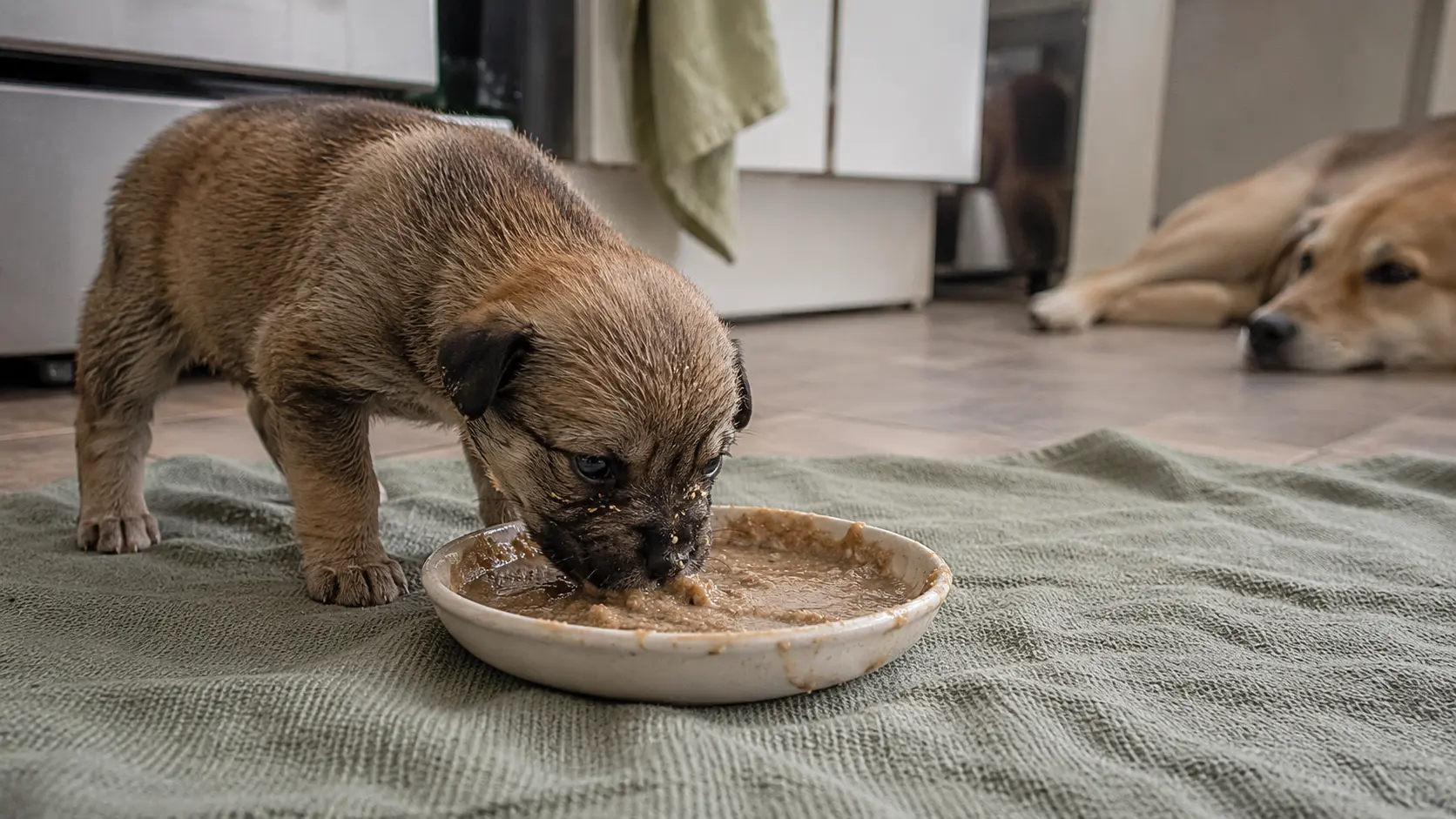
Most puppies can begin trying softened puppy food at around 3–4 weeks old. At this stage, “solid food” usually does not mean a bowl of hard, dry kibble. The first meals are normally soft enough for a young puppy to lap or chew while nursing continues.
Over the following weeks, the food can gradually become thicker and less moistened as the puppy becomes a more capable eater. Many puppies can handle dry puppy food by roughly 5–6 weeks, although there is no single age that applies to every puppy.
The key is to think of weaning as a gradual process rather than a one-day switch from milk to kibble.
When Can Puppies Start Eating Solid Food?
For most healthy puppies, the first introduction to solid food happens at about 3–4 weeks of age.
That does not mean the puppy suddenly stops drinking its mother’s milk. Early weaning usually involves both: puppies continue nursing while they learn to eat softened puppy food.
It also helps to separate several milestones that are often treated as though they happen at the same time.
Stage |
General timing |
What usually changes |
|---|---|---|
First softened puppy food |
Around 3–4 weeks |
Puppy begins licking and eating food |
Increasing solid-food intake |
Around 4–5 weeks |
Puppy food supplies progressively more nutrition |
Firmer or dry-food ability |
Often around 5–6 weeks |
Many puppies can handle less-moistened food |
Full weaning |
Variable, usually later |
Puppy no longer depends nutritionally on milk |
Sources differ slightly on the exact endpoint because nutritional independence and the end of all nursing are not necessarily the same milestone. Some puppies are nutritionally weaned closer to six weeks, while nursing or other mother-puppy interactions may continue longer.
These are approximate ranges, not deadlines.
A peer-reviewed review of canine nutrition describes puppies as becoming capable of consuming semi-solid food during the early weaning period and often being able to chew dry food by about 5–6 weeks. Other veterinary sources describe complete weaning later, which is one reason owners may see different ages quoted online.
The difference is usually about which milestone is being discussed.
What Does Weaning Actually Mean for a Puppy?
Weaning is the gradual transition from a mother’s milk, or canine milk replacer when needed, to independently eating puppy food.
A puppy might begin tasting food at three or four weeks without being close to fully weaned.
Over time:
- the puppy eats larger amounts of food
- food provides more of its daily nutrition
- nursing becomes less important nutritionally
- the puppy becomes able to manage firmer food
- milk is eventually no longer required as its main source of nutrition
There is another distinction worth making: eating solid food does not mean a puppy is ready to leave its mother and littermates.
Nutritional independence and social development are different things. Cornell University’s College of Veterinary Medicine notes that remaining with the mother and littermates during early development provides opportunities for puppies to learn normal canine social behavior.
How to Introduce Solid Food to Puppies Step by Step
Most puppies do not need a complicated weaning routine. The goal is simply to introduce appropriate puppy food in a texture they can handle, then make it gradually more solid as their eating skills develop.
Step 1: Start With Softened Puppy Food
The first food should be suitable for a growing puppy, not simply whichever food happens to be soft.
Look for a food that is complete and balanced for growth or otherwise appropriate for the puppy’s growth life stage. The FDA explains that “complete and balanced” pet foods must meet an applicable nutritional standard or feeding-test requirement.
Early options can include:
- wet puppy food
- dry puppy food softened with warm water
- puppy food mixed with properly prepared canine milk replacer when milk replacement is appropriate
A very young puppy may find a soft, porridge-like texture easier to manage than intact kibble.
There is no need to use one universal food-to-liquid ratio for every puppy and every food. The practical goal is a consistency the puppies can lap and begin chewing comfortably.
Step 2: Give Puppies Time to Learn
Eating from a dish is new behavior.
Use a shallow, stable bowl or dish and allow the puppies to investigate the food. Some may start eating quickly, while others initially lick, step in or play with it.
A messy first meal does not automatically mean something is wrong.
Avoid forcing food into a puppy’s mouth simply because it does not immediately understand the dish.
For puppies nursing normally from their mother, nursing can continue during this early stage.
Step 3: Make the Food Gradually Thicker
Once puppies are eating the softened food reliably, begin decreasing the added liquid gradually.
Think of the transition as:
very soft food → thicker food → lightly moistened food → normal puppy-food texture
The puppy’s ability matters more than reaching an exact date on the calendar.
If one puppy is eating a thicker consistency comfortably while another littermate is still struggling with it, there is no benefit in forcing both puppies to progress at exactly the same speed.
Step 4: Let Puppy Food Supply More of the Diet
As puppies become better at eating, puppy food gradually supplies a larger share of their nutrition.
At the same time, dependence on milk decreases.
This is why weaning is more accurately described as a transition than a switch.
Watch how the puppy responds as the amount and texture of food change. Appetite, stools, energy and growth are more useful than simply assuming everything is fine because the puppy has reached a particular age.
Step 5: Move Toward the Normal Food Texture
During the following weeks, many puppies become capable of managing firmer food.
By roughly 5–6 weeks, many can chew dry puppy food as their baby teeth emerge and their eating ability improves. Some may still do better with lightly moistened kibble for longer.
There is no rule requiring every puppy to be eating completely dry food on the same day.
When Can Puppies Eat Dry Food?
Puppies can begin eating softened dry puppy food during early weaning, often from around 3–4 weeks old.
Eating intact, unsoaked kibble usually comes later.
A scientific review of nutrition during canine reproduction and weaning notes that deciduous teeth emerge during this period and that puppies are generally capable of chewing and consuming dry food by around 5–6 weeks.
That makes two different questions important:
When can puppies start eating dry puppy food?
Often around 3–4 weeks if the food is appropriately softened.
When can puppies eat dry kibble without softening?
Many can manage it around 5–6 weeks, but readiness varies.
Do not rush the texture simply because a puppy has reached a particular age. Reduce the amount of added moisture progressively and watch whether the puppy can chew and swallow the food comfortably.
When Can Puppies Eat Hard Food?
Pet owners often use “hard food” to mean unsoaked dry kibble.
Many puppies can handle that texture around 5–6 weeks, but it is not a universal deadline. A puppy that still manages softened kibble better can continue progressing gradually.
Moistening kibble can make the texture easier for a young puppy to eat, but it should not be described as a guaranteed way to prevent choking.
What Should Puppies Eat During Weaning?
The texture matters during weaning, but nutrition matters just as much.
A food should be appropriate for puppy growth, rather than an adult-maintenance food chosen simply because it is convenient to soften.
If you are deciding what type of diet to use beyond the weaning process, LumaPaw’s guide to choosing an appropriate puppy food covers the broader food-selection questions.
For puppies expected to become large dogs, the growth formulation also deserves attention. Large and giant breeds have particular nutritional considerations during growth, including avoiding excessive calcium intake and overly rapid growth. Our large-breed puppy food guide covers that topic separately.
Wet Puppy Food vs Softened Dry Puppy Food
Either wet puppy food or appropriately softened dry puppy food can be used during weaning.
Wet food is not automatically nutritionally superior because it is softer, and dry food is not automatically better because it is kibble.
The more useful questions are:
- Is the food appropriate for puppy growth?
- Can the puppy comfortably eat its current texture?
- Is the puppy tolerating it well?
- Is the puppy continuing to grow normally?
Owners specifically interested in canned or moist diets can compare wet puppy food options separately without turning the weaning process into a product decision.
Do Puppies Still Need Milk or Puppy Formula?
Starting puppy food does not mean milk should disappear immediately.
Puppies Nursing From Their Mother
For a healthy litter nursing normally, early weaning overlaps with continued nursing.
Puppies begin experimenting with food while mother’s milk continues to contribute to their nutrition. Over time, their reliance on food increases and their dependence on milk decreases.
That gradual overlap is normal.
Orphaned Puppies and Puppy Milk Replacer
Orphaned puppies are a different situation and deserve more caution.
For puppies that cannot receive adequate milk from their mother, commercially prepared canine milk replacer is generally preferred. The Merck Veterinary Manual notes that commercial milk replacers are superior to homemade substitutes, although no replacement exactly duplicates the dam’s milk.
Very young orphaned puppies also have less room for feeding mistakes. Poor intake can quickly become serious, and improper liquid-feeding techniques can create risks such as aspiration.
For that reason, a general weaning guide should not provide casual syringe-feeding or tube-feeding instructions.
If you are caring for a newborn orphan, use a veterinarian-guided feeding plan rather than relying on a generic puppy bottle-feeding chart. Bottle-feeding a neonate and weaning a healthy three- or four-week-old puppy are not the same task.
What Kind of Milk Can Puppies Drink?
A nursing puppy’s natural milk source is its mother.
When replacement feeding is genuinely necessary, a commercial canine milk replacer is generally the appropriate substitute.
Ordinary cow’s or goat’s milk should not be used as the routine replacement for a mother dog’s milk because its nutrient composition does not adequately match the needs of a growing puppy.
That is different from saying cow’s milk is “toxic.” The concern is nutritional suitability, not that ordinary milk is a canine poison.
What Should You Feed a Six-Week-Old Puppy Without Its Mother?
At six weeks, many puppies are already eating puppy food and may be capable of eating increasingly firm food.
A six-week-old puppy without its mother should generally be eating a nutritionally appropriate puppy diet rather than adult-maintenance food. Whether milk replacer is still needed depends on the puppy’s individual development and how successfully it has progressed through weaning.
This is a situation where age alone is not enough.
A six-week-old puppy that is eating well, maintaining normal energy and growing appropriately is very different from one that is weak, underweight, refusing food or having persistent digestive problems.
If a motherless puppy is not progressing normally through weaning, veterinary guidance is safer than trying to compensate with homemade formula or unverified feeding techniques.
How Much and How Often Should Weaning Puppies Eat?
Weaning puppies generally do better with several small meals rather than trying to consume their food in one or two large meals.
There is no useful universal portion chart for this stage because the correct amount depends on factors such as:
- the puppy's age
- body weight
- the food's calorie density
- how much the puppy is still nursing
- individual growth and condition
Feeding directions on the food package provide a starting point, but they may need adjustment for the individual puppy.
For meal frequency and portion planning beyond the weaning process, see LumaPaw’s puppy feeding schedule by age.
The same applies to searches such as “how often do newborn puppies eat.” A newborn orphan requires a different feeding plan from a puppy learning to eat solids, so neonatal bottle-feeding schedules should be determined with appropriate veterinary guidance rather than folded into a general weaning chart.
What Should You Monitor During Weaning?
A calendar can tell you when weaning usually begins. It cannot tell you whether an individual puppy is progressing normally.
Pay attention to:
- whether the puppy is actually eating
- appetite
- body-weight trend
- energy and activity
- stool quality
- vomiting or regurgitation
- ability to chew and swallow comfortably
- whether one puppy consistently falls behind its littermates
Weight is particularly useful in young puppies.
Veterinary sources including VCA and Merck identify poor weight gain or weight loss as signs that deserve attention in neonatal and very young puppies.
Imagine two littermates that are both five weeks old. One eats lightly moistened kibble without difficulty. The other eats enthusiastically only when the food remains softer.
There is little value in forcing the second puppy onto dry kibble simply because the first is ready.
Age gives you a starting range. Eating ability, growth and overall health tell you whether the transition is actually going well.
Common Puppy-Weaning Mistakes to Avoid
Moving to Hard Food Too Quickly
A gradual texture change is easier to manage than abruptly replacing very soft food with intact kibble.
Let the puppy’s eating ability guide the pace.
Stopping Nursing as Soon as Puppies Taste Food
Trying solid food is the beginning of weaning, not the end.
Puppies normally increase their food intake progressively while dependence on milk decreases.
Using Cow's or Goat's Milk as the Regular Replacement
If a puppy genuinely needs milk replacement, use an appropriate canine milk replacer rather than assuming ordinary household milk provides equivalent nutrition.
Feeding Adult-Maintenance Food Because It Is Soft
Texture alone does not make a food suitable for a growing puppy.
Choose food intended to meet growth needs.
Following the Calendar but Ignoring the Puppy
A puppy can technically be old enough to try firmer food and still be struggling with the transition.
Watch appetite, stools, weight and eating ability.
Expecting Every Littermate to Progress Identically
Small differences in readiness are normal.
A range is more realistic than forcing every puppy onto the same texture on the same day.
Assuming Solid Food Means the Puppy Can Leave Its Mother
Eating puppy food and being ready to leave the mother and littermates are separate developmental questions.
Trying Advanced Feeding Techniques Without Training
Bottle, syringe and especially tube feeding of very young puppies can carry real risks if performed incorrectly.
If a neonate cannot nurse or take replacement milk normally, that is a veterinary-care issue rather than something to solve by improvising a new feeding technique.
When to Contact a Veterinarian
Routine weaning in a healthy litter is usually a normal part of puppy development.
Some signs, however, should not be treated as ordinary reluctance to try a new food.
Contact a veterinarian promptly if a young puppy:
- loses weight
- repeatedly fails to gain weight
- cannot nurse or eat normally
- becomes unusually weak or lethargic
- has persistent vomiting or diarrhea
- repeatedly regurgitates food or milk
- has difficulty swallowing
- develops breathing difficulty
- has noticeable abdominal distention
- appears abnormally cold or distressed
Veterinary guidance is also appropriate if you are caring for an orphaned newborn and are unsure about milk replacement or feeding technique.
Very young puppies have smaller energy reserves than healthy older dogs, so persistent feeding problems deserve more attention than simple pickiness in an adult dog.
Does Eating Solid Food Mean a Puppy Is Ready to Leave Its Mother?
No.
Starting solid food is mainly a nutritional milestone. Leaving the mother and litter is a broader developmental issue.
A puppy may be able to eat food independently while still benefiting from interactions with its mother and littermates.
Cornell University’s College of Veterinary Medicine notes that puppies learn important canine social behavior during this period and advises keeping puppies with their mother and litter until at least around eight weeks in typical circumstances.
That does not mean every behavioral outcome can be traced to one exact separation age. It simply means that the ability to eat kibble should not be used as the sole test of whether a puppy is ready to leave its litter.
Frequently Asked Questions
Can 4-Week-Old Puppies Eat Solid Food?
Many puppies can begin trying softened puppy food at around four weeks while continuing to nurse.
At this age, “solid” food is usually served soft enough to lap or chew easily rather than as intact dry kibble.
Can 5-Week-Old Puppies Eat Dry Food?
Some five-week-old puppies can handle increasingly firm food, but dry kibble may still be easier to eat when moistened.
Progress based on the puppy’s eating ability rather than assuming every five-week-old should eat the same texture.
Can 6-Week-Old Puppies Eat Hard Food?
Many puppies can chew unsoaked puppy kibble by around six weeks.
That does not make six weeks a strict deadline. A puppy that still does better with lightly softened food can continue transitioning gradually.
When Should You Stop Soaking Puppy Food?
Begin reducing the added liquid as the puppy consistently handles firmer food comfortably.
There is no single age at which every puppy must stop eating moistened kibble.
When Can Puppies Start Drinking Water?
Fresh water should be available as puppies begin eating more solid food and progress through weaning.
Use a stable, accessible dish and make sure very young puppies can reach it easily.
What If a Puppy Will Not Eat Solid Food?
Some hesitation during the first introductions can happen because eating from a dish is new.
Persistent refusal is different.
If the puppy is not eating adequately, is losing or failing to gain weight, becomes weak, or develops vomiting, diarrhea or other signs of illness, contact a veterinarian rather than repeatedly changing foods or forcing feeding.
What Kind of Milk Can Puppies Drink Without Their Mother?
When replacement milk is necessary, a commercially prepared canine milk replacer is generally preferred.
Cow’s or goat’s milk should not be treated as an equivalent long-term substitute for canine milk.
Do I Need a Puppy Bottle-Feeding Chart for Weaning?
Not for a healthy puppy that is already beginning the transition to solid food.
Bottle feeding mainly applies to puppies that cannot receive adequate maternal milk. Newborn orphan feeding requires more individualized guidance than a general weaning schedule because feeding amount and technique carry greater safety considerations.
A Gradual Transition Matters More Than One Exact Age
So, when can puppies eat solid food? For most puppies, the first softened meals can begin at around 3–4 weeks old.
From there, the goal is gradual progress: milk and very soft food first, then increasingly substantial puppy meals, followed by firmer and eventually dry food as the puppy becomes capable of handling it.
Do not judge progress by age alone. Watch whether the puppy is eating comfortably, maintaining normal energy and continuing to grow.
Once the puppy is eating independently, you can use LumaPaw’s puppy feeding schedule to plan age-appropriate meal frequency and portions as the next stage of feeding begins.