
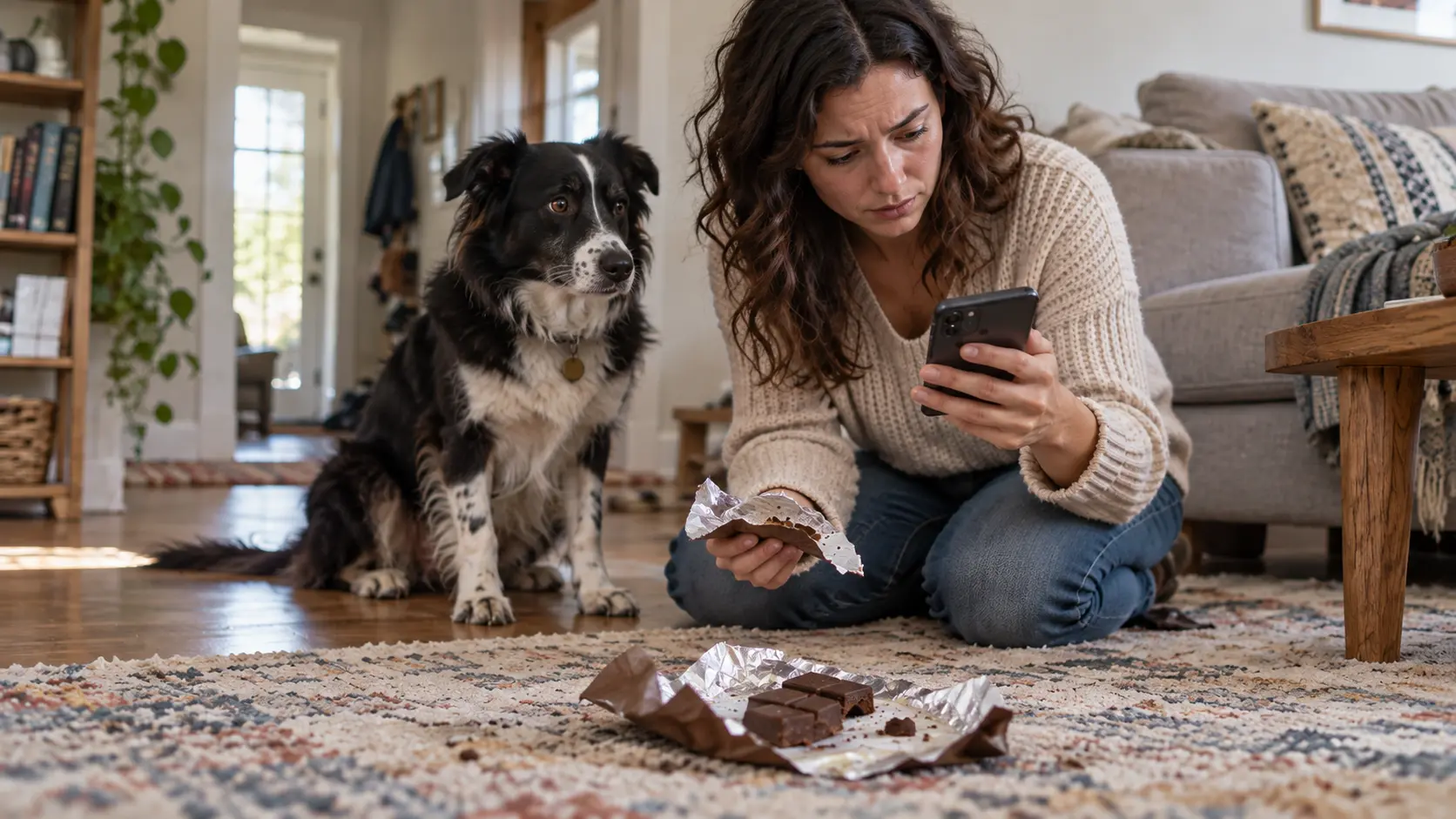
Chocolate can cause poisoning in dogs, but what happens if a dog eats chocolate depends on the type of chocolate, how much was eaten, the dog’s weight, when it happened, and whether other ingredients or packaging were swallowed. Cocoa powder, baking chocolate, and dark chocolate generally pose more risk than milk chocolate because they contain more of the stimulants theobromine and caffeine.
If your dog has just eaten chocolate, don’t wait for symptoms before deciding whether it matters. Keep the package or ingredient label, estimate how much is missing, note when it happened, and contact a veterinarian, emergency veterinary clinic, or veterinary poison service for case-specific advice.
My Dog Ate Chocolate — What Should I Do Right Now?
If you have just discovered that your dog ate chocolate, focus first on gathering useful information rather than trying to calculate the risk yourself.
- Move any remaining chocolate out of reach.
- Keep the wrapper, box, ingredient label, or recipe information.
- Identify the type of chocolate if possible—such as cocoa powder, baking chocolate, dark chocolate, milk chocolate, or white chocolate.
- Estimate how much is missing. A rough estimate is more useful than pretending you know an exact amount.
- Note when the ingestion probably happened.
- Have your dog's current or approximate weight available.
- Check whether anything else was swallowed, including raisins, xylitol-containing products, macadamia nuts, caffeine sources, foil, plastic, or wrappers.
- Contact your veterinarian, an emergency veterinary clinic, or a veterinary poison service promptly.
- Do not induce vomiting or give home remedies unless a veterinary professional specifically instructs you to do so.
These are the details veterinary professionals use to assess a chocolate exposure.
Do not wait for vomiting, tremors, or other symptoms before asking for professional advice. Chocolate-poisoning signs can be delayed.
For example, if your dog got into a partially eaten dark chocolate bar, keep the wrapper. Note the bar size and cocoa percentage if listed, estimate how much appears missing, record your dog’s approximate weight, and think about when you last saw the chocolate untouched.
What Happens to a Dog After Eating Chocolate?
Chocolate contains theobromine and caffeine, two compounds known as methylxanthines. Both can stimulate the nervous system and cardiovascular system.
Dogs can metabolize these compounds, but they clear them more slowly than people do. That gives the stimulants more time to affect the body.
Depending on the exposure, a dog might show no obvious signs, develop digestive upset, or progress to more serious cardiovascular or neurological problems. Severe chocolate poisoning can be life-threatening.
Why chocolate is toxic to dogs
Theobromine is generally the main concern in chocolate, although caffeine contributes too.
Possible effects include vomiting, diarrhea, restlessness, increased thirst and urination, a fast or abnormal heartbeat, tremors, seizures, and other neurological signs.
This is different from simply saying that chocolate is “bad for dogs.” The concern is a dose-related poisoning risk.
For a broader look at foods dogs should and should not share with people, see our guide to human foods dogs can eat.
How Dangerous Is the Chocolate Your Dog Ate?
Not all chocolate contains the same amount of methylxanthines.
As a general rule, the more concentrated the cocoa product, the greater the concern.
Chocolate type |
General relative concern |
What to know |
|---|---|---|
Cocoa powder |
Very high |
Highly concentrated source of methylxanthines |
Unsweetened or baking chocolate |
Very high |
Much more concentrated than milk chocolate |
Dark or semisweet chocolate |
High |
Cocoa concentration varies between products |
Milk chocolate |
Lower, but not harmless |
Larger amounts can still cause poisoning |
White chocolate |
Very low methylxanthine risk |
Other ingredients, fat, or sugar may still cause problems |
Current Merck veterinary data show large differences in methylxanthine concentration between these categories, while also warning that concentrations vary naturally between products and brands.
Your dog's size matters
A smaller dog receives a larger dose per kilogram from the same piece of chocolate.
That is why a quantity that may represent a relatively low exposure for a large dog could be much more significant for a small dog.
Weight is therefore one of the main details a veterinarian or poison specialist will ask for.
Amount and timing matter too
The quantity eaten and the time since ingestion also affect risk assessment and what a veterinarian may recommend.
If you do not know exactly how much was eaten, don’t assume that uncertainty means the exposure was minor. Tell the veterinary professional what you do know—for example, how much was originally in the package and how much appears to remain.
How Much Chocolate Is Dangerous to a Dog?
There is no single amount of chocolate that can reliably be described as “safe” or “fatal” for every dog.
Veterinary toxicology uses methylxanthine dose, usually expressed relative to body weight, to estimate risk. Current Merck guidance reports that:
- around 20 mg/kg of methylxanthines may produce mild signs;
- around 40–50 mg/kg is associated with cardiovascular effects;
- around 60 mg/kg or more is associated with seizures.
These are risk ranges, not guaranteed cutoffs. Chocolate products differ in methylxanthine concentration, and individual dogs do not all respond identically.
How much chocolate can kill a dog?
There is no reliable ounce-based amount that predicts death in every dog.
Veterinary references report population-level lethal-dose data, but those numbers should not be used as an individual dog’s “death threshold.” Severe signs and death can occur below generalized lethal-dose figures, while other dogs may respond differently.
That is why an online chart should not be used to decide that a dog is “below the dangerous amount.”
Symptoms of Chocolate Poisoning in Dogs
Symptoms vary with the exposure and may become more serious as the methylxanthine dose increases.
Early signs
Possible early signs include:
- vomiting
- diarrhea
- restlessness
- increased thirst
- increased urination
More serious signs
More significant poisoning can cause:
- marked agitation or hyperactivity
- rapid breathing
- a fast heart rate
- an abnormal heart rhythm
- poor coordination
- muscle rigidity
- tremors
- seizures
- collapse or coma in severe cases
Current veterinary guidance and clinical case data support gastrointestinal, cardiovascular, and neurological signs as important features of chocolate toxicosis.
If your dog is trembling, having a seizure, collapsing, breathing abnormally, showing marked agitation, or appears to have a very fast or irregular heartbeat, seek urgent veterinary care.
But do not wait for those signs before calling about a known chocolate exposure.
My Dog Ate Chocolate but Is Acting Fine — Should I Still Worry?
A dog acting normally soon after eating chocolate is not proof that the exposure is harmless.
Chocolate-poisoning symptoms are often delayed.
Merck reports that signs usually appear within about 6–12 hours, while Cornell gives a broader 2–12-hour range. Clinical cases have occasionally developed signs earlier. The safest way to describe the timing is that symptoms often develop within several hours, but there is no exact symptom-free window that guarantees safety.
That matters because waiting until a dog becomes obviously sick may also delay options a veterinarian might consider earlier after ingestion.
How long can symptoms last?
Many signs last for hours. More serious cases may continue considerably longer.
Cornell notes that clinical signs often last 12–36 hours and sometimes longer, while Merck reports that severe cases can persist for up to about 72 hours.
Those time ranges should not be used as a home-monitoring schedule. If the exposure was potentially significant, professional assessment is more useful than waiting for a particular number of hours.
Chocolate Cake, Brownies, Candy and Other Mixed Foods
When a dog eats a brownie, chocolate cake, candy, cookie, or another mixed product, the chocolate may not be the only concern.
Check the full ingredient list
Additional hazards may include:
- xylitol, which can be present in some sugar-free products;
- raisins;
- macadamia nuts;
- additional caffeine sources.
ASPCA guidance specifically advises checking chocolate products for other potentially toxic ingredients.
For example, a sugar-free chocolate-covered raisin cannot be assessed as “just chocolate.” The coating, sweetener, and raisin may all matter.
Rich chocolate products can also contain substantial fat. Fatty foods may contribute to gastrointestinal upset and, in susceptible dogs, may trigger pancreatitis. That is a separate issue from methylxanthine poisoning.
Did your dog swallow the wrapper too?
Foil, plastic, candy wrappers, bags, or other packaging do not make theobromine more toxic, but they introduce a different problem.
Swallowed nondigestible material can sometimes become lodged in the digestive tract and cause a foreign-body obstruction.
Not every swallowed wrapper causes a blockage, but tell the veterinarian if packaging is missing.
What If My Dog Ate White Chocolate?
White chocolate contains very little methylxanthine compared with cocoa powder, baking chocolate, dark chocolate, or milk chocolate. Classic theobromine/caffeine poisoning is therefore much less likely from white chocolate.
That does not make white chocolate an appropriate food for dogs.
Large amounts can still cause digestive upset, and fatty foods may pose an additional concern for susceptible dogs. A white-chocolate product may also contain other ingredients that change the risk.
If your dog ate a large amount, is showing symptoms, or the ingredients are uncertain, contact your veterinarian.
What Not to Do After Your Dog Eats Chocolate
A known chocolate exposure is not a good time to experiment with internet home remedies.
Do not induce vomiting unless specifically instructed
Veterinarians may recommend induced vomiting in certain recent exposures, depending on factors such as timing and the dog’s current condition.
That does not mean every owner should make a dog vomit at home.
Do not give hydrogen peroxide or another vomiting agent unless a veterinarian or veterinary poison specialist has specifically told you to do so for your dog.
Do not give activated charcoal yourself
Activated charcoal is also a veterinary treatment decision, not a routine home remedy.
Current Merck guidance is more cautious than some older chocolate-poisoning advice because charcoal can contribute to dehydration and electrolyte problems in some situations.
Other mistakes to avoid include:
- waiting for symptoms before calling;
- assuming milk chocolate is harmless;
- relying on an online calculator as the final decision;
- throwing away the package;
- ignoring other ingredients or swallowed wrappers.
How Veterinarians Treat Chocolate Poisoning
Treatment depends on what was eaten, the estimated dose, how recently it happened, and whether the dog is already showing signs.
Veterinary management may include:
- gastrointestinal decontamination when appropriate;
- IV fluids;
- monitoring heart rhythm and body temperature;
- correcting electrolyte abnormalities;
- controlling tremors or seizures;
- treating abnormal heart rhythms;
- hospital monitoring in more serious cases.
Not every dog needs all of these measures. The exact plan depends on the individual exposure and clinical condition.
This is also why medication doses, charcoal protocols, or vomiting instructions do not belong in a general home-care guide.
Can Dogs Recover After Eating Chocolate?
Yes. Many dogs recover with timely veterinary care.
A peer-reviewed case series involving 156 chocolate-ingestion events found generally good outcomes among dogs that received veterinary assessment and treatment. However, those results should not be interpreted as proof that untreated exposures are usually harmless because many dogs in the study received early decontamination or supportive care.
Severe chocolate poisoning can still be life-threatening.
The most useful takeaway is not to predict the outcome from symptoms alone, but to have the exposure assessed early.
Why Chocolate Toxicity Calculators Are Only Estimates
Chocolate-toxicity calculators can be useful for estimating exposure, but they cannot tell you exactly what will happen to an individual dog.
There are several reasons:
- methylxanthine concentrations vary between chocolate products;
- cocoa percentages and recipes differ;
- the amount actually eaten may be uncertain;
- individual susceptibility varies.
A calculator can estimate risk from the information entered, but it cannot replace veterinary assessment when the exposure may be significant.
How to Prevent Another Chocolate Exposure
Keep chocolate, cocoa powder, baking chocolate, chocolate chips, and candy where your dog cannot reach them.
Holiday candy bowls and baking supplies are especially easy to overlook. Cocoa powder and unsweetened baking chocolate deserve extra care because they can contain far more methylxanthines than ordinary milk chocolate.
Dispose of wrappers and bags in a secure bin, and make sure family members and visitors know not to offer chocolate to the dog.
Frequently Asked Questions
Can one small piece of chocolate hurt a dog?
It depends on the dog’s size, the type of chocolate, and how much was eaten. A small piece of milk chocolate and the same-sized piece of baking chocolate do not represent the same exposure. There is no universal “one piece is safe” rule.
What if I don't know how much chocolate my dog ate?
Keep the package if you have it and estimate what is missing. Tell the veterinarian or poison specialist that the quantity is uncertain rather than assuming the exposure was small.
Is milk chocolate less dangerous than dark chocolate?
Generally, yes. Milk chocolate contains less methylxanthine than dark, baking, or cocoa products. That does not mean milk chocolate is harmless, especially when a larger amount is eaten or the dog is small.
Can chocolate kill a dog?
Yes. Severe chocolate poisoning can be fatal. However, there is no single amount that reliably predicts death in every dog because product concentration, body weight, dose, and individual susceptibility vary.
What if my dog ate chocolate yesterday and seems normal?
A dog remaining normal is reassuring, but it does not let a general article determine whether a particular exposure was safe. Chocolate type, amount, dog size, timing, and any symptoms all matter. If the amount was significant, uncertain, or involved concentrated chocolate, contact a veterinarian for case-specific advice.
The Bottom Line
What happens if a dog eats chocolate can range from no obvious illness to severe poisoning. The biggest factors are the type and amount of chocolate, your dog’s weight, when the ingestion occurred, and whether other hazardous ingredients or packaging were involved.
Cocoa powder, baking chocolate, and dark chocolate generally present greater methylxanthine risk than milk chocolate, but no generic chart can tell you exactly how an individual dog will respond.
If your dog has eaten chocolate, gather the package and exposure details and contact a veterinarian or veterinary poison service rather than waiting for symptoms or relying on a calculator alone.