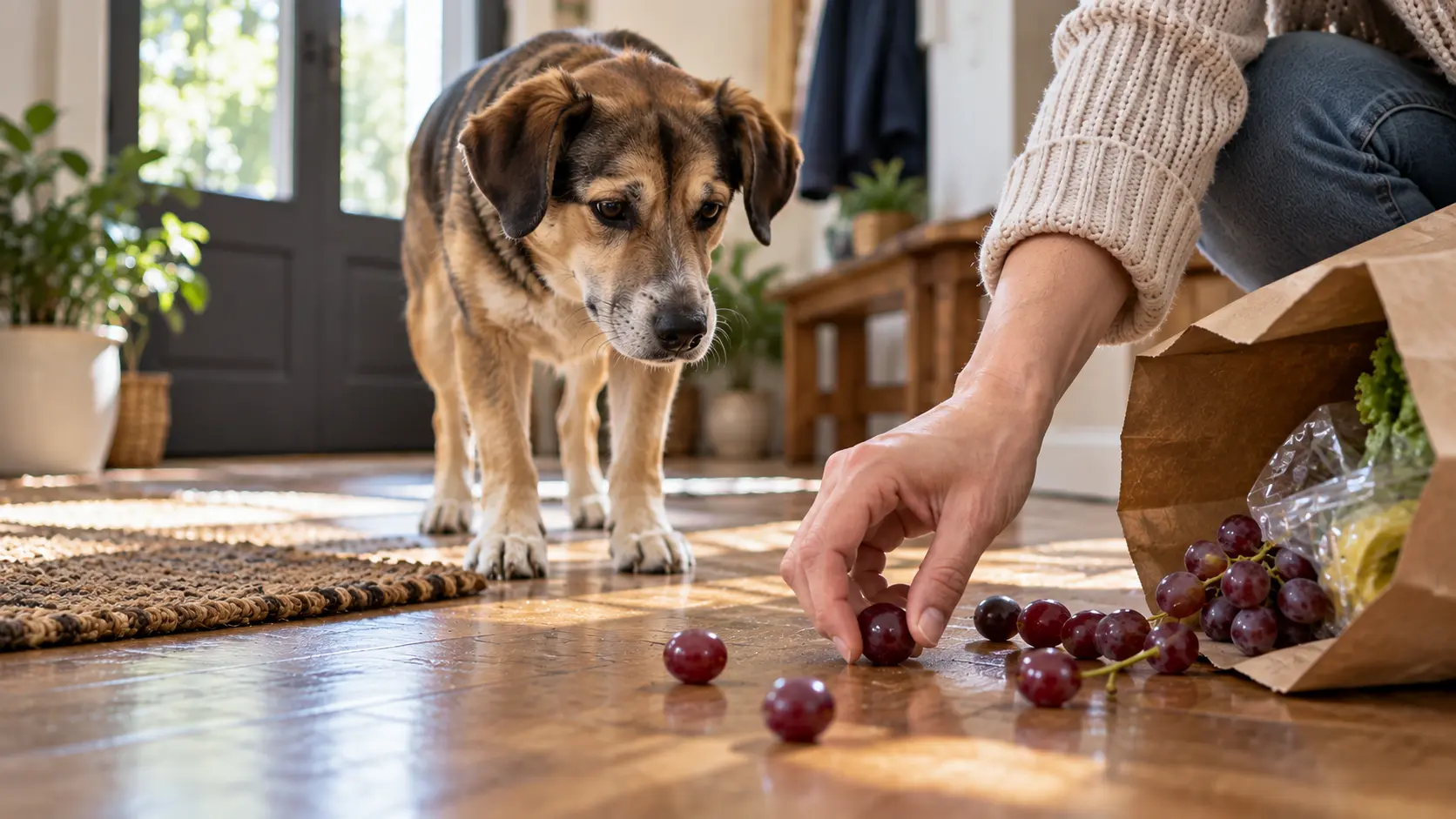
There is no scientifically established safe number of grapes a dog can eat. A single grape does not mean a dog will inevitably develop kidney injury, but it also cannot be guaranteed safe.
If your dog has eaten grapes, raisins, sultanas, or Zante currants, contact your veterinarian, an emergency veterinary hospital, or a qualified animal poison service promptly. Do not wait for symptoms to appear.
Grape and raisin toxicity is unusually difficult to predict because dogs do not all respond the same way and the amount of the suspected toxic compounds in the fruit can vary.
How Many Grapes Are Toxic to Dogs?
There is no dependable grape count that separates a safe exposure from a toxic one.
The Merck Veterinary Manual notes that more than one grape or raisin per 10 pounds (4.5 kg) of body weight may contain enough tartaric acid to pose a kidney risk. But that figure is a risk reference, not a safe-dose threshold.
In other words, it would be a mistake to assume that a 40-pound dog can safely eat three grapes simply because that number falls below a rough weight-based reference.
A 2024 review of the veterinary evidence found that the toxic dose remains difficult to establish. Dogs can also differ in susceptibility, and tartaric-acid levels are not identical in every grape or raisin.
For that reason, a grape-count chart or online toxicity calculator can provide more certainty than the evidence actually supports.
My Dog Ate Grapes—What Should I Do Now?
If you know or suspect your dog ate grapes or raisins, focus on getting useful information together quickly rather than trying to calculate whether the dose was “safe.”
1. Prevent your dog from eating any more
Move the grapes, raisins, food container, cake, trail mix, or other food out of reach.
2. Work out what may have been eaten
Try to gather:
- What your dog ate
- Approximately how much may be missing
- When the ingestion happened
- Your dog's approximate weight
- The package or ingredient list if it was a mixed food
The exact amount may be impossible to determine. Do not delay contacting a veterinary professional while trying to count every missing grape.
3. Contact veterinary help promptly
Call your regular veterinarian, an emergency veterinary hospital, or a qualified animal poison-control service.
A dog does not need to be vomiting or acting sick before you make the call. Early professional advice is particularly useful because treatment decisions can depend on how recently the ingestion occurred and the dog’s individual circumstances.
4. Do not make your dog vomit unless a professional tells you to
Veterinary decontamination can be useful after some grape or raisin exposures, but inducing vomiting is not appropriate for every dog.
Do not give hydrogen peroxide, salt, mustard, cooking oil, or other home remedies unless a veterinarian or qualified poison specialist specifically directs you to do so.
There also is not a reliable homeowner rule such as “vomiting is useless after two hours.” Clinical research has documented grape material being recovered several hours after ingestion, so the decision should be made by the veterinary professional handling the case.
Will One Grape Kill a Dog?
One grape does not inevitably kill or poison every dog.
But it is equally inaccurate to say that one grape is automatically safe.
Veterinary sources do not have a reliable way to predict exactly how one particular dog will respond to one particular grape. Individual susceptibility differs, grape composition varies, and body weight is only one part of the risk assessment.
There is also some variation in veterinary guidance. Cornell University advises treating known grape or raisin ingestion as potentially serious, while the UK’s Veterinary Poisons Information Service has described a single grape or piece of dried fruit as a lower-risk exposure. Both positions recognize that a dependable toxic dose has not been established.
So if your dog ate one grape, the useful response is neither panic nor automatic reassurance. Contact a veterinary professional and give them the dog’s weight, the estimated amount eaten, and when it happened.
My Dog Ate Grapes but Seems Fine—Should I Still Worry?
Yes. A dog can look completely normal soon after eating grapes or raisins.
According to Cornell University College of Veterinary Medicine, early signs often develop within about 6–24 hours. Kidney injury can become apparent later, over the following one to three days.
Early kidney blood values may also be normal shortly after exposure. Depending on the case, a veterinarian may recommend repeat blood or urine testing rather than relying on a single early result.
That is why “my dog seems fine” should not be used as a reason to wait.
The exposure itself is enough reason to get professional advice.
What Happens If a Dog Eats a Grape?
The course varies. Some dogs exposed to grapes or raisins never develop significant kidney injury, while others can become seriously ill.
Early signs
Commonly reported early signs include:
- Vomiting
- Diarrhea
- Loss of appetite
- Lethargy
- Abdominal discomfort
- Dehydration
Vomiting is often one of the first signs, but symptoms do not always start immediately.
Signs of possible kidney involvement
As toxicity progresses, a dog may develop changes in thirst or urination, increasing weakness, abnormal kidney-test results, or other systemic signs.
Serious cases can involve:
- Markedly reduced urine production
- No urine production
- Severe weakness
- Tremors or poor coordination
Reduced or absent urine production is particularly concerning because it can indicate severe acute kidney injury and is associated with a poorer prognosis.
Do not wait for these signs before seeking help.
How long after eating grapes can a dog get sick?
Gastrointestinal signs often develop within roughly 6–24 hours, although the timing varies.
Kidney injury may become evident over approximately 24–72 hours. Those ranges describe typical clinical patterns, not a countdown that can tell you when a dog is definitely safe.
Are Raisins Poisonous to Dogs Too?
Yes. Raisins and sultanas are dried grapes and are included in the same Vitis toxicity concern.
Are raisins more toxic than grapes?
It is tempting to say that raisins are simply “more toxic” because they are dried and concentrated, but the veterinary evidence does not support a dependable grape-to-raisin conversion.
Older clinical reports have documented kidney injury after comparatively small amounts of raisins. However, a 2024 review found no clear evidence that toxicity could reliably be predicted from the type of Vitis fruit involved.
For owners, the practical answer is simpler: treat both grapes and raisins as potentially dangerous rather than trying to rank one against the other.
What about currants?
The name “currant” can be confusing.
Zante currants are dried Vitis grapes and are relevant to grape and raisin toxicity.
True currants from the Ribes genus are botanically different and have not been associated with the same grape-related kidney injury in the Merck Veterinary Manual.
If your dog ate a food labeled “currants,” check the packaging or recipe and give that information to your veterinarian rather than trying to identify the fruit yourself.
For broader guidance on which produce is appropriate to share, see our guide to fruits and vegetables dogs can safely eat.
Does a Dog's Size Change the Risk?
Body weight matters when a veterinarian evaluates an exposure, but it does not provide a reliable safe grape allowance.
That means searches such as “how many grapes can a 40-pound dog eat?” or “how many grapes can a 100-pound dog eat?” cannot be answered responsibly with a fixed number.
A large dog should not be assumed safe simply because the same number of grapes represents a smaller amount per pound of body weight. Likewise, there is no evidence-based chart that can reliably predict an individual dog’s outcome from weight alone.
Veterinary professionals use weight alongside the estimated exposure, timing, symptoms, medical history, and other clinical information.
Why Are Grapes Toxic to Dogs?
Grape and raisin poisoning can cause acute kidney injury, meaning a sudden decline in kidney function.
For years, the specific cause was uncertain. Current research increasingly points toward tartaric acid and potassium bitartrate as the leading suspected toxic compounds.
Experimental studies have shown damaging effects of tartaric acid on canine kidney cells and have provided a plausible mechanism for why dogs may be unusually susceptible.
But the science is not complete enough to say that tartaric acid concentration alone can predict whether an individual dog will become sick after eating a specific grape.
So “tartaric acid is the leading suspected cause” is more accurate than saying the mechanism has been completely proven.
What Will the Vet Do After a Dog Eats Grapes?
There is no single treatment plan for every grape or raisin exposure.
The veterinarian will consider factors such as what was eaten, the estimated amount, how long ago it happened, the dog’s condition, and the results of any testing.
Decontamination
If appropriate, a veterinarian may recommend gastrointestinal decontamination, which can include professionally directed vomiting.
This is one reason prompt contact matters, but there is no universal time cutoff that owners should use at home to decide that treatment is no longer useful.
Blood and urine monitoring
Veterinary assessment may include blood and urine tests to monitor kidney function, such as:
- Creatinine
- Blood urea nitrogen (BUN)
- Electrolytes
- Urinalysis
- Urine-output monitoring
A normal early blood test does not always settle the issue. Repeat testing may be recommended because kidney abnormalities can take time to appear.
Supportive treatment
Depending on the dog and the exposure, treatment may involve IV fluids, kidney monitoring, anti-nausea or other supportive care.
There is no specific antidote for grape or raisin toxicity.
Severe cases involving serious kidney injury may require intensive treatment, and dialysis can be considered in some dogs at specialist veterinary centers.
Treatment should not be reduced to a universal rule such as “every dog needs aggressive IV fluids for 72 hours.” More recent evidence suggests care can be individualized, particularly in dogs that remain asymptomatic and normally hydrated.
Can Dogs Recover From Grape or Raisin Poisoning?
Yes. Many dogs evaluated after grape or raisin ingestion recover well, particularly when serious kidney injury does not develop.
Published veterinary studies include many dogs that survived after exposure, but those results should not be turned into a simple percentage for an individual dog. The dogs in those studies were veterinary patients receiving different types of assessment and treatment.
The outlook becomes more concerning once significant acute kidney injury develops, especially if the dog produces very little urine or stops producing urine altogether.
Prompt assessment gives the veterinarian the best opportunity to decide what monitoring or treatment is appropriate before severe abnormalities develop.
Common Mistakes After a Dog Eats Grapes
A few responses can create unnecessary risk:
- Waiting for symptoms. Dogs may look normal during the early period after ingestion.
- Assuming one grape is harmless. One grape does not guarantee toxicity, but it cannot be declared universally safe.
- Assuming a large dog can handle several grapes. Weight does not produce a reliable safe allowance.
- Using an online grape-count calculator. Current evidence is not precise enough to support one.
- Inducing vomiting without professional guidance. Home methods can cause complications and are not appropriate in every situation.
- Assuming one normal early blood test means the dog is clear. Kidney changes can be delayed.
- Ignoring the rest of the ingredients. Raisin bread, trail mix, cake, and chocolate-covered raisins may contain additional hazards.
For example, if your dog ate chocolate-covered raisins, both ingredients matter. Our guide to what happens if a dog eats chocolate explains the separate chocolate risk.
Frequently Asked Questions
Are green or seedless grapes safer for dogs?
No grape variety has been established as reliably safe for dogs. Red, green, seeded, and seedless grapes have all been associated with poisoning, so color and seed status should not be used to judge risk.
What if I don't know how many grapes my dog ate?
Estimate how many may be missing if you reasonably can, but do not delay contacting a veterinarian while trying to get an exact count. Have your dog’s approximate weight, the type of fruit or food, and the likely time of ingestion ready.
What if my dog ate grapes several hours ago?
Still contact a veterinary professional. Do not assume that evaluation or decontamination is pointless simply because several hours have passed. Clinical reports have documented grape material being recovered from the stomach well after ingestion.
What if my dog ate raisin bread or chocolate-covered raisins?
Save the package or ingredient list if possible. Mixed foods may introduce hazards beyond raisins—for example, chocolate or certain sweeteners—so the veterinarian needs to know the complete product, not just the amount of dried fruit.
How Many Grapes Can a Dog Eat? The Bottom Line
There is no dependable safe number of grapes a dog can eat. A small exposure does not mean kidney failure is inevitable, but current evidence is not precise enough to guarantee that one grape—or any other fixed number—is safe for an individual dog.
If your dog has eaten grapes, raisins, sultanas, or Zante currants, contact a veterinarian or qualified animal poison service promptly rather than waiting to see whether symptoms develop.
For broader everyday feeding guidance, see our guide to human foods dogs can and can’t eat.