
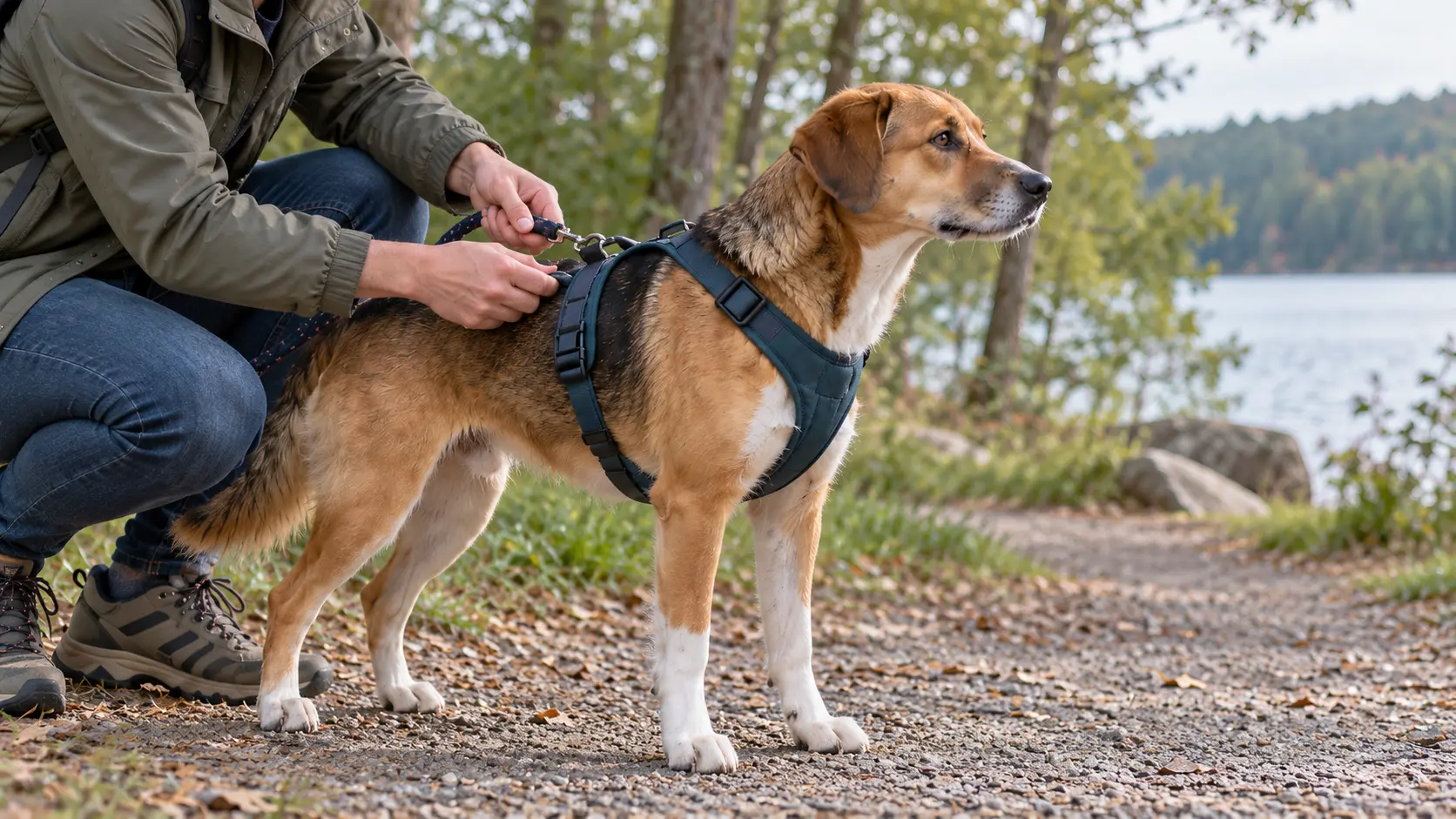
Finding the best dog harness is less about choosing the product with the most reviews and more about finding a design that works with your dog’s body, walking habits, and tolerance for different harness styles.
A padded everyday harness may suit one dog perfectly but feel bulky on another. Some owners need more control when their dog pulls. Others mainly want something simple to put on, lightweight for warm walks, or adjustable enough for an unusual chest-to-neck ratio.
For this guide, we compared current product details, sizing and adjustment systems, leash attachment options, retailer availability, and recurring owner feedback. We also looked closely at common complaints, because a harness that works well for most dogs can still be a poor match for a particular body shape.
We did not personally test every product in this guide.
Our strongest all-around choice is the Ruffwear Front Range Harness, but it is not automatically the right harness for every dog.
Affiliate disclosure: LumaPaw may earn a commission if you buy through links on this page, at no extra cost to you. Our product choices are based on relevance, product details, customer feedback, limitations, and comparison with other suitable options.
The Best Dog Harnesses at a Glance
Product |
Our Pick For |
Entry style |
Leash attachments |
Main advantage |
Main limitation |
|---|---|---|---|---|---|
Ruffwear Front Range |
Best Overall |
Over the head |
Front + back |
Balanced everyday design |
No neck buckle or top handle |
rabbitgoo Classic Fit |
Best Value |
Over the head |
Front + back |
Strong feature-to-price balance |
Fit can vary by body shape |
Blue-9 Balance |
Best for Adjustable Fit |
Buckle neck |
Front + back |
Six adjustment points |
Takes more time to fit |
2 Hounds Freedom |
Best for Pulling Management |
Strap-style harness |
Front + back |
Dual-point control |
More complicated than a basic harness |
Voyager Step-In Air |
Best Step-In Harness |
Step-in |
Back |
Very easy to put on |
Limited fine adjustment |
PetSafe Easy Walk |
Best Lightweight Front-Clip Harness |
Strap-style |
Front |
Minimal coverage |
No back clip or padding |
AUROTH Tactical |
Best Heavy-Duty Harness |
Over the head |
Front + back |
Substantial build and control handle |
Bulky for ordinary walks |
The right choice depends on what you actually need. A dog that dislikes anything going over its head has a different problem from a powerful puller or a dog that never seems to fit standard harness proportions.
How We Researched These Dog Harnesses
We started with products that were relevant to the broad best dog harness search rather than filling the list with seven nearly identical padded vests.
For each candidate, we compared factors that affect day-to-day use:
- Harness style and how it goes on
- Adjustment range and sizing
- Front, back, or dual leash attachments
- Padding and materials
- Handles and reflective details where relevant
- Cleaning requirements
- Ease of use
- Current retailer availability
- Repeated positive customer-feedback patterns
- Repeated complaints about fit, rubbing, slipping, hardware, or durability
- Value compared with similar harnesses
- Whether the product added a genuinely different reason to buy
We did not rank harnesses just because they had a bestseller badge, a high star rating, or a large review count.
Customer reviews are useful for identifying patterns, but they are not controlled tests. A complaint about rubbing, for example, may reflect the product design, incorrect sizing, the individual dog’s body shape, or some combination of those factors.
That is why the most useful question is not simply, “Is this a good harness?”
It is:
“Is this a good harness for this dog and this type of walk?”
The 7 Best Dog Harnesses

Ruffwear Front Range Harness — Best Overall
Best for: Owners who want one versatile harness for normal everyday walking.
Avoid if: Your dog hates equipment going over its head, or previous padded harnesses consistently rub around the armpits or neck.
Who should buy it: Someone who wants a well-rounded everyday harness rather than a highly specialized training, tactical, or step-in design.
Who may want to avoid it: Owners specifically looking for maximum adjustability, a lift/control handle, or an easy buckle-neck entry.
Common complaints: Fit around the front legs, over-the-head removal, and occasional reports of wear or fraying.
Honest buying note: The Front Range is our strongest all-around choice, not a universal winner. Measure carefully and check where the panels and straps sit once your dog starts moving.
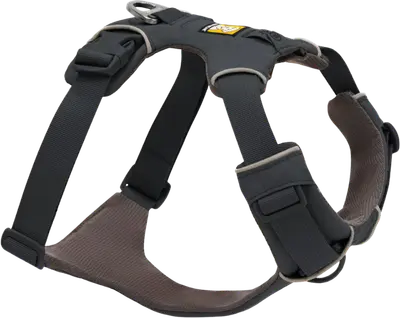
The Ruffwear Front Range earns our top spot because it covers the everyday basics particularly well without leaning too far into one specialist use.
It is a padded harness with front and rear leash attachment options and multiple adjustment points. That makes it flexible enough for ordinary neighborhood walks while still giving owners the option of a front attachment when they want more directional control.
The design also includes reflective detailing and an ID pocket. Those features are useful, but the main reason we prefer the Front Range is simpler: its overall combination of padding, adjustment, construction, and dual attachment points makes sense for a wide range of everyday dogs.
Owner feedback repeatedly favors its comfort and solid construction. It also has a much longer track record than some newer harness designs.
The Front Range is not perfect, though.
It has to pass over the dog’s head. There is no neck buckle, so dogs that strongly dislike over-the-head gear may be happier in something like the Blue-9 Balance or Voyager Step-In Air.
Fit also varies by body shape. Some owners report rubbing near the front legs or the harness sitting higher around the neck than expected on slimmer dogs. A padded harness is only comfortable when the shape and adjustment actually suit the dog wearing it.
Pros
- Good balance of padding and everyday practicality
- Front and rear leash attachment options
- Multiple adjustment points
- Reflective details
- Broad everyday usefulness
- Stronger evidence base than many newer competitors
Cons
- Must go over the dog’s head
- No top control handle
- May rub or sit awkwardly on some body shapes
- Costs more than value-focused options such as rabbitgoo

rabbitgoo Classic Fit No Pull Dog Harness — Best Value
Best for: Owners who want a practical padded harness with useful features at a more accessible price.
Avoid if: Your dog has repeatedly struggled with overhead harnesses or develops rubbing behind the front legs.
Who should buy it: Value-focused owners who still want dual leash attachments, padding, adjustability, and a handle.
Who may want to avoid it: Owners whose main concern is precision fit rather than price.
Common complaints: Neck-to-chest fit mismatch, difficulty removing it over larger heads, and occasional chafing.
Honest buying note: “No pull” is part of the product name, but a front attachment should be viewed as a management tool. It may make redirection easier; it does not teach loose-leash walking by itself.
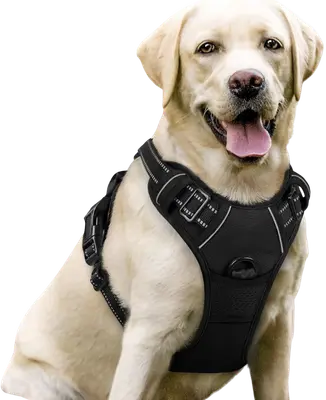
The rabbitgoo Classic Fit makes a strong case for owners who want many of the features found on more expensive harnesses without moving into premium pricing.
It combines padding, front and rear leash attachments, four adjustment straps, reflective detailing, and a top handle. That is a useful feature set for an everyday walking harness.
The front ring gives you an alternative attachment point when you need more directional control, while the back attachment works well for more relaxed walks. The handle is also useful when you need to keep a dog close for a moment, although it should not be treated as a substitute for a purpose-built lifting harness.
Its biggest advantage is value rather than one standout technology.
Based on product details and owner feedback, rabbitgoo offers a lot for the money. The tradeoff is that its fit does not seem as adaptable as the Blue-9 Balance.
Some owners have trouble getting the neck and chest areas equally snug, particularly when the dog has a large head, narrow neck, or unusual chest proportions. Because the harness goes over the head, tightening it enough for walking can also make removal less convenient.
Reports of rubbing behind the front legs are another reason to check fit rather than assuming the padding solves every comfort problem.
Pros
- Good feature-to-price balance
- Front and back leash attachments
- Four-point adjustment
- Padded construction
- Top handle
- Reflective details
- Wide size and color selection
Cons
- Over-the-head entry
- Fit can be awkward on unusual proportions
- Some reports of underarm rubbing
- Not as precisely adjustable as the Blue-9 Balance

Blue-9 Balance Harness — Best for Adjustable Fit
Best for: Dogs that are difficult to fit with standard harness proportions.
Avoid if: You want thick padding or a very quick, uncomplicated setup.
Who should buy it: Owners who have already tried ordinary harnesses and keep ending up with a loose neck, tight chest, or poor overall balance.
Who may want to avoid it: Someone who mainly wants a soft, padded harness that can be adjusted once and forgotten.
Common complaints: Initial adjustment complexity and side-to-side movement on some body shapes.
Honest buying note: We prefer the Balance for its fit flexibility, not because we think it will automatically stop a dog from pulling. Front attachment can help with management, but leash training still matters.
Some dogs simply do not fit conventional padded harnesses well.
That is where the Blue-9 Balance becomes interesting.
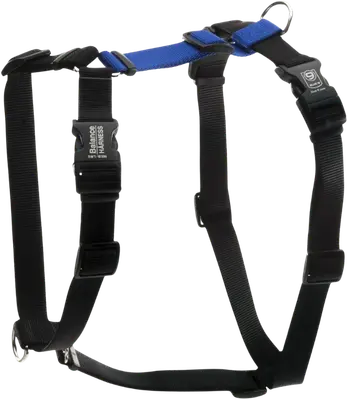
Instead of relying on large padded panels, the Balance uses a lighter webbing-style construction with six adjustment points. The goal is to let you change more dimensions independently rather than choosing a harness largely by chest size and hoping the neck proportions also work.
It also has a buckle at the neck.
That small design difference can matter a lot if your dog dislikes having a harness pulled over its head or has a relatively large head compared with its neck.
There are leash attachment rings at both the front and back, so the Balance can work as an everyday rear-clip harness or provide a front attachment when more directional control is useful.
The main compromise is setup.
Six adjustment points provide flexibility, but they also mean you may spend more time getting the harness right. Several owners report that the harness can rotate or shift sideways on some dogs, especially when the leash is attached at the front or the fit is not dialed in carefully.
It is also much less padded than Ruffwear or rabbitgoo. Some owners will see that as a benefit; others will prefer the cushioned feel of a vest-style design.
Pros
- Six adjustment points
- Buckle-neck design avoids pulling the harness over the head
- Front and rear leash attachments
- Lightweight, low-bulk construction
- Useful for dogs with difficult proportions
Cons
- Takes longer to adjust
- Less padding than vest-style harnesses
- Can shift or rotate on some dogs
- Not the simplest harness for a first-time owner

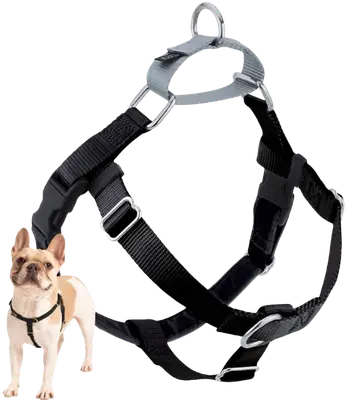
2 Hounds Design Freedom No-Pull Harness — Best for Pulling Management
Best for: Owners who want more control while working on loose-leash walking.
Avoid if: Your dog already walks calmly and you mainly want a simple everyday harness.
Who should buy it: Someone dealing with regular pulling who wants a more purpose-built management system than a standard padded front-clip vest.
Who may want to avoid it: Owners who prioritize speed and simplicity over training versatility.
Common complaints: Continued pulling in some dogs, fiddly setup, and fit close to the front legs.
Honest buying note: We would pair the Freedom with consistent leash training rather than expect the harness itself to change behavior.
The Freedom No-Pull Harness is the most control-focused option in this general roundup.
It uses front and rear connection points, plus a rear action loop that changes how pressure is distributed when a dog pulls. The system can also be used with a double-ended training leash, giving the handler two points of contact instead of relying on a single front or rear ring.
That makes the Freedom a better fit for owners who are actively working on leash manners and want more steering options.
The straps that sit behind the front legs are lined with soft material, which is intended to reduce rubbing in an area where narrow webbing can otherwise become uncomfortable.
Customer feedback often mentions improved control, but the important word is control, not cure.
Some dogs continue to pull while wearing it. A harness can change leverage and make redirection easier, but it cannot teach the behavior you want in place of training.
Fit also deserves attention. On some dogs, the straps or hardware can sit too close to the armpits. Getting the correct size and adjustment matters more here than simply tightening everything until it feels secure.
Another retailer detail is worth knowing: the Amazon product we researched was the harness by itself, while the Chewy version included a double-connection leash. Those packages should not be compared as though they contain exactly the same items.
Pros
- Front and rear control points
- Optional two-point leash setup
- Rear action loop designed for pulling management
- Soft lining behind the front legs
- Wide size range
- Clear training-focused purpose
Cons
- More complicated than a basic walking harness
- Does not stop every dog from pulling
- Fit can interfere near the armpits on some dogs
- Two-point leash setup has a learning curve

Best Pet Supplies Voyager Step-In Air — Best Step-In Harness
Best for: Smaller dogs and dogs that resist over-the-head harnesses.
Avoid if: You need a high level of adjustability or control for a powerful puller.
Who should buy it: Owners who value simple, quick dressing more than advanced leash-management features.
Who may want to avoid it: Owners whose dog falls awkwardly between sizes or regularly backs out of harnesses.
Common complaints: Sizing sensitivity and limited adjustment.
Honest buying note: Do not choose by breed label alone. Measure the actual chest and compare it with the current size chart.
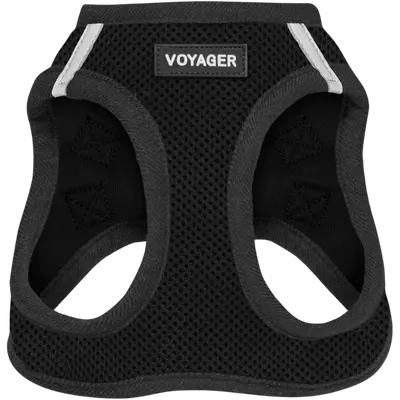
The Voyager Step-In Air solves a very specific problem well: some dogs and owners simply do not want an over-the-head harness.
The dog places its front legs into the openings, the vest wraps around the body, and the closure secures across the back. That can be much easier for small dogs that dislike having gear pushed over their ears or face.
The mesh construction is lightweight and breathable, and reflective bands add some visibility in lower light.
It is also one of the simpler harnesses in this list.
That simplicity comes with a major tradeoff: limited fine adjustment.
The Voyager is much more dependent on choosing the correct size than a harness such as the six-point Blue-9 Balance. If your dog sits between measurements, you have less ability to compensate by independently changing several straps.
A loose step-in vest can also be easier for some dogs to back out of, so check the fit carefully before relying on it outdoors.
This product is particularly relevant for smaller dogs. If that is your main priority, our guide to the best harnesses for small dogs goes deeper into small-body fit and lightweight harness choices.
Pros
- Easy step-in entry
- No need to pull it over the dog’s head
- Lightweight mesh
- Simple closure
- Reflective bands
- - Good option for many smaller dogs
Cons
- Less adjustable than strap-style harnesses
- Fit ranges can be narrow
- Not intended as a strong pulling-management harness
- - A loose fit may make backing out easier

PetSafe Easy Walk Harness — Best Lightweight Front-Clip Harness
Best for: Owners who specifically want a lightweight front-clip walking harness.
Avoid if: Your dog has sensitive skin around the armpits, needs padding, or you also want a back leash attachment.
Who should buy it: Someone who wants minimal coverage and front-control functionality without a padded vest.
Who may want to avoid it: Owners looking for one harness for several activities and attachment styles.
Common complaints: Chafing, slipping adjustment, and inconsistent fit on certain body shapes.
Honest buying note: A front clip can make a pulling dog easier to redirect, but it should not be described as a guaranteed way to stop pulling.
The original PetSafe Easy Walk takes almost the opposite approach from a padded vest harness.
It is intentionally minimal.
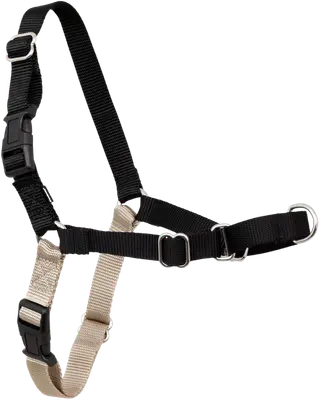
Rather than wrapping a large padded panel around the chest and back, it uses adjustable straps with a front leash attachment and a martingale-style front loop designed to help redirect a dog that pulls forward.
That low-coverage construction is the main reason it remains useful.
For dogs that get warm easily or owners who dislike bulky harnesses, the Easy Walk offers front-clip control without a large amount of material around the torso.
It also has a broad size range.
But the minimalist design is less forgiving when the fit is wrong.
Owners repeatedly report issues with straps loosening, the front section sitting incorrectly, or rubbing around the front legs. Some dogs also fall between sizes or have body proportions that make the harness difficult to stabilize.
There is no rear leash attachment, either. If you want to switch freely between rear-clip casual walks and front-clip control, Ruffwear, Blue-9, rabbitgoo, or 2 Hounds are more versatile.
Pros
- Lightweight and low-bulk
- Front attachment helps with directional control
- Broad size range
- Less body coverage than padded vest harnesses
- Long-established design
Cons
- Front attachment only
- No padding
- Fit needs careful adjustment
- Reports of rubbing and straps loosening
- - Less versatile than dual-clip harnesses

AUROTH Tactical Dog Harness — Best Heavy-Duty Harness
Best for: Owners who genuinely want a more substantial harness with a handle and accessory webbing.
Avoid if: Your dog is small, gets hot easily, or only needs a simple everyday walking harness.
Who should buy it: Someone who values heavier construction and direct handle control more than minimal weight.
Who may want to avoid it: Most owners of calm dogs who do not need tactical-style features.
Common complaints: Bulk, warmth, fit between sizes, and straps that may need readjustment.
Honest buying note: We like AUROTH because it fills a distinct heavy-duty role. We would not choose it over Ruffwear simply because it looks tougher.
AUROTH is the most specialized choice in this list.
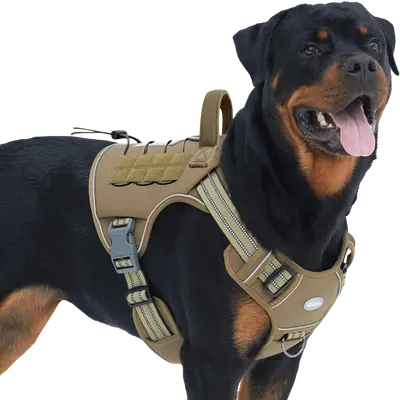
Its tactical-style construction includes front and rear leash attachment points, a top control handle, padding, reflective details, and MOLLE webbing that can accept compatible accessories.
That makes it substantially different from the thin PetSafe Easy Walk or lightweight Blue-9 Balance.
For a larger or stronger dog, the extra structure and handle may be useful. The handle can help keep a dog close for short periods when more direct control is needed, while the rear and front leash points offer different walking setups.
The downside is obvious once you compare it with the rest of this list: there is simply more harness.
The extra material can feel bulky and warmer, particularly in hot weather or on dogs that do not need heavy-duty equipment. MOLLE panels are useful if you actually plan to attach compatible gear, but they add little value to an ordinary twenty-minute neighborhood walk.
Sizing also needs attention. Some owner feedback describes awkward jumps between sizes or straps loosening during use.
And despite the tactical appearance, we would not call it escape-proof. No harness should get that label simply because it looks substantial.
Pros
- More substantial construction
- Front and rear leash attachments
- Top control handle
- MOLLE accessory webbing
- Reflective details
- - Useful option for larger or stronger dogs
Cons
- Bulkier than normal walking harnesses
- Can feel warm
- Tactical features are unnecessary for many owners
- Some reports of loosening and difficult sizing
- Not automatically escape-proof
Which Type of Dog Harness Is Best for Your Dog?
Harness labels can make shopping sound more complicated than it needs to be. Start with how the harness attaches, how your dog gets into it, and what you need from it during a walk.
There is no single design that is automatically best for every dog. Fit, body shape, movement, pulling behavior, and correct adjustment matter more than choosing a harness because of one shape or marketing term.
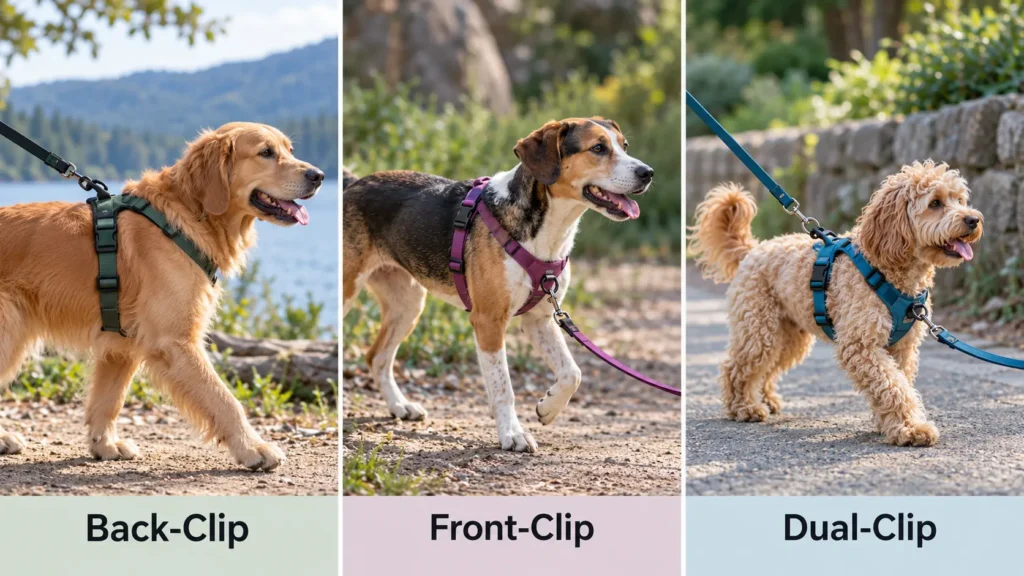
Back-Clip Harnesses
A back-clip harness attaches the leash between or behind the shoulder blades.
This is usually the simplest setup for dogs that already walk reasonably well on leash. The leash stays away from the front legs, and many owners find a rear attachment convenient for relaxed everyday walks.
The downside is control. If a dog pulls hard, attaching the leash at the back may give you less ability to redirect the front of the body.
For calm everyday walkers, though, there is nothing inherently wrong with choosing the rear clip.
Front-Clip Harnesses
A front-clip harness places the leash attachment on the chest.
When the dog pulls forward, the attachment position can make it easier to redirect the dog sideways rather than simply allowing the dog to continue leaning straight into the leash.
That can improve handling, but it is important not to oversell what the equipment does.
A front clip may help you manage pulling. It does not teach loose-leash walking by itself.
Products such as the PetSafe Easy Walk are built mainly around this idea, while harnesses such as Ruffwear Front Range and rabbitgoo give you both front and rear options.
If pulling is your main concern, a dedicated guide to front-clip and no-pull harnesses will be more useful than relying only on this broad roundup.
Dual-Clip Harnesses
Dual-clip harnesses have leash attachment points at both the chest and back.
For many owners, this is the most flexible setup.
You can use the rear attachment for ordinary walking and switch to the front when you want more directional control. Some products, such as the 2 Hounds Freedom, can also be used with a double-ended leash so both points are connected at once.
The extra versatility is useful, but more attachment points do not automatically make a harness better. Fit and hardware placement still matter.
Step-In Harnesses
With a step-in harness, the dog places its front legs through the openings and the harness fastens over the back.
This can be much easier for a dog that dislikes having a harness pulled over its head.
The tradeoff is that many soft step-in models offer less fine adjustment than strap-style harnesses. Choosing the correct size becomes especially important.
The Voyager Step-In Air is a good example: simple and convenient, but much more dependent on the dog falling comfortably within the intended measurement range.
Y-Shaped and Chest-Panel Harnesses
You will often see harnesses described as Y-shaped because the front straps form a Y when viewed from the front.
You may also see terms such as chest harness, vest harness, or chest-panel harness.
These descriptions can help explain how a harness is built, but they should not be treated as proof that one design is universally more comfortable or less restrictive than another.
A well-fitted harness should let the dog move comfortably, stay away from the throat, avoid persistent rubbing, and remain stable while walking.
The individual fit matters more than the label printed on the product page.
How to Choose the Best Dog Harness for Your Dog
Once you know the main harness styles, the next step is matching them to your dog rather than shopping by appearance alone.
Start With Chest and Neck Measurements
Do not buy a harness based only on your dog’s breed or weight.
Two dogs of the same weight can have very different chest depth, neck size, shoulder width, and overall proportions.
Most manufacturers use chest girth as the main measurement. This is usually taken around the widest part of the rib cage behind the front legs.
Some harnesses also require neck measurements.
Use the manufacturer’s current size chart rather than assuming a “Medium” from one brand will fit like a “Medium” from another.
If your dog sits near the edge between sizes, look carefully at how much adjustment the harness provides before choosing.
Check Body Shape, Not Just Breed
Body proportions can explain why a popular harness works beautifully for one dog and poorly for another.
A deep-chested dog may need a different adjustment range from a stockier dog with the same body weight.
A broad chest combined with a narrow waist may cause some harnesses to rotate.
A dog with a relatively large head and narrow neck may be difficult to fit in an overhead harness because the neck opening must be large enough to pass over the head without becoming too loose once it is on.
Long-bodied dogs can also need extra attention to strap position.
Breed can be a useful starting clue, but the individual dog’s measurements are more useful.
Think About How the Harness Goes On
This is easy to overlook until you own a dog that refuses to put its head through a harness.
Over-the-head harnesses are common and often simple once adjusted, but some dogs dislike the movement around their face and ears.
A buckle-neck harness such as the Blue-9 Balance lets you fasten the neck section much like a collar.
A step-in harness avoids the head entirely but requires the dog to lift or place its front feet into the openings.
There is no universally easiest style. Choose the one your dog tolerates and you can put on correctly every time.
Choose the Right Leash Attachment
Think about how you expect to use the harness most often.
A rear attachment usually works well for dogs that walk calmly.
A front attachment can give you more steering influence when pulling is an issue.
A dual-clip harness gives you the option to switch between the two.
If you use the front attachment, watch how the harness behaves during actual movement. A harness that twists dramatically or slides far to one side may need adjustment or may simply not suit your dog’s proportions.
Consider Walking Style and Activity
An ordinary neighborhood walk and a day on the trail do not place exactly the same demands on a harness.
For normal everyday walking, comfort, fit, easy adjustment, and reliable leash hardware matter most.
For dogs that pull strongly, you may want more control-oriented attachment options.
For running or hiking, weight, freedom of movement, visibility, durability, drying time, and handle design may become more important.
Dogs that regularly reverse out of harnesses need a more security-focused design rather than simply a tighter everyday harness.
Vehicle restraint is another separate category. A walking harness should not be assumed to function as a crash-tested car restraint just because it has a strong-looking D-ring.
Check Materials, Hardware, and Cleaning
Small construction details affect how pleasant a harness is to live with.
Look at:
- Webbing and stitching
- Buckle quality
- Leash attachment hardware
- Padding around pressure areas
- Breathability
- Reflective details if you walk after dark
- Whether adjustment sliders stay in place
- Cleaning instructions
A heavily padded harness may feel comfortable but can also hold more heat and take longer to dry.
A minimalist webbing harness can be cooler and easier to clean but offers less cushioning.
Neither approach is automatically better.
How Should a Dog Harness Fit?
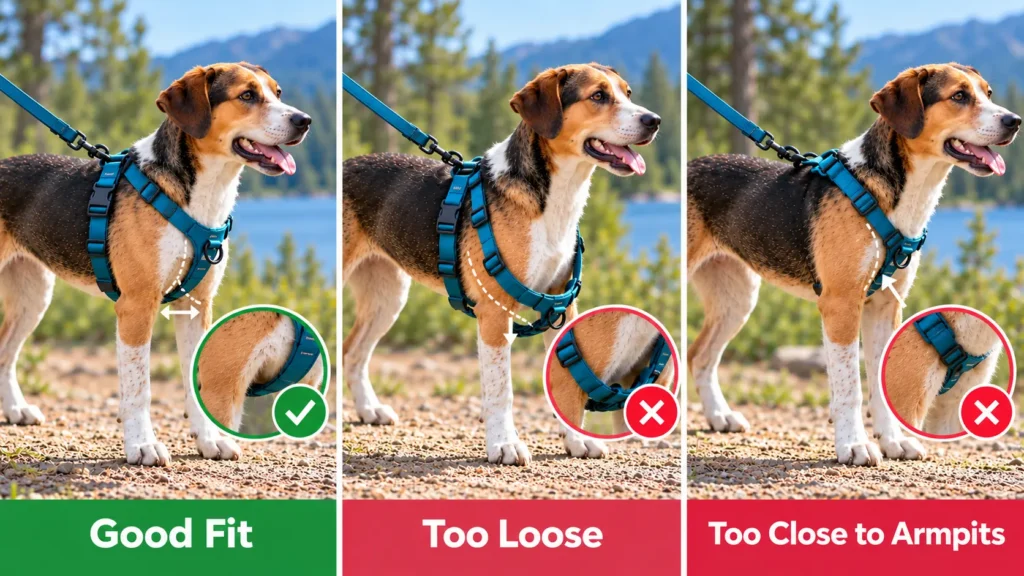
A new harness should be checked while your dog is standing and again once your dog starts walking.
A good fit should remain reasonably centered on the body. The straps should not gape dramatically, slide into the throat, or repeatedly rub the armpits.
You should also watch your dog’s movement rather than judging the fit only while the dog is standing still.
During the first few walks, check for:
- Redness or irritated skin
- Hair rubbing away
- Straps moving into the armpits
- The harness rotating heavily to one side
- Adjustment sliders creeping loose
- Pressure near the throat
- Noticeable changes in stride
- The dog being able to reverse out of the harness
A small amount of movement does not necessarily mean the harness is unusable. Some designs shift slightly depending on where the leash is attached.
Persistent rotation, rubbing, gaping, or slipping is different.
Do not keep tightening a poorly shaped harness indefinitely. If you cannot get secure chest and neck fit at the same time, another design may suit your dog’s proportions better.
Recheck the fit after weight changes, grooming changes that remove a lot of coat, or growth in puppies.
If a dog develops persistent soreness, skin irritation, pain, or an unusual gait, stop using the harness and talk with your veterinarian rather than assuming the equipment is harmless.
Dog Harness Safety and Quality Checklist
A harness should be inspected periodically, not just on the day you buy it.
Before regular use, check that:
- All buckles close completely
- Stitching around leash attachment points is intact
- D-rings and other hardware are not bent or badly worn
- Adjustment sliders stay where you set them
- Webbing is not frayed or partially chewed
- Padding is not folded into a rubbing point
- Straps stay away from the throat
- The harness is not rubbing behind the front legs
- Your dog cannot easily back out of it
Replace damaged equipment rather than waiting for a buckle, strap, or attachment point to fail during a walk.
If your dog chews harnesses, store the harness out of reach when it is not being worn. A strap that looks normal from a distance may already have been weakened.
Follow the manufacturer’s washing instructions as well. Heat, strong cleaners, or repeated machine washing can affect some materials and hardware.
And keep vehicle safety separate from walking convenience.
An ordinary dog walking harness should not automatically be treated as a crash-tested car restraint. Use a product specifically designed and documented for vehicle restraint when car safety is the goal.
Harness vs. Collar: Which Should You Use?
A harness and a collar do not have to be competing pieces of equipment.
Many dogs wear a collar for identification while the leash attaches to a harness during walks.
That setup lets the collar carry ID information while the harness distributes leash forces across a larger area of the body.
A collar is still useful for many dogs, especially for tags and everyday identification. You can compare everyday collar styles in our guide to the best dog collars.
Which piece of equipment should take the leash depends on the individual dog.
A dog that walks calmly may do well with either, depending on fit and owner preference. A dog that pulls strongly, coughs when leash pressure reaches the neck, or has a medical condition may need a more individualized recommendation.
If your dog has neck, airway, orthopedic, neurologic, or other health problems, ask your veterinarian what type of restraint is appropriate rather than relying only on general product advice.
Quick Guide: Which Harness Should You Choose?
If you want the shortest possible answer:
- Most everyday dogs: Ruffwear Front Range
- Better value: rabbitgoo Classic Fit
- Difficult body proportions: Blue-9 Balance
- Pulling-management priority: 2 Hounds Freedom
- Dog dislikes over-the-head harnesses: Voyager Step-In Air
- Minimal front-clip design: PetSafe Easy Walk
- Heavier-duty construction: AUROTH Tactical
Some needs deserve their own product research rather than being squeezed into a broad roundup.
If you have a very small dog, use a small-dog-specific guide.
For a large or powerful dog, look at products and sizing intended for larger bodies.
Dogs that routinely back out of ordinary harnesses need a security-focused design.
Running and hiking place different demands on the harness than neighborhood walking.
And for vehicle restraint, use a dedicated car-harness guide rather than assuming your everyday walking harness is suitable.
Frequently Asked Questions
What type of harness is best for a dog?
There is no single harness type that is best for every dog.
For everyday walking, a well-fitted back-clip or dual-clip harness works well for many dogs. A front attachment may be useful when pulling is difficult to manage. Step-in and buckle-neck designs can be easier for dogs that dislike over-the-head equipment.
Body shape and fit matter as much as harness style.
How tight should a dog harness be?
A harness should be snug enough that it stays stable and the dog cannot easily slip out, but not so tight that straps dig into the skin or restrict comfortable movement.
Check the manufacturer’s fitting instructions because harness shapes differ.
The best test is not only how the harness feels while the dog is standing. Watch it during an actual walk for rubbing, rotation, gaping, or movement toward the throat.
Are front-clip harnesses better for dogs that pull?
They can be useful.
Attaching the leash at the chest can make it easier to redirect a dog that pulls forward. That often gives the handler more control than a rear-only attachment.
But a front-clip harness does not teach loose-leash walking on its own.
For persistent pulling, combine suitable equipment with consistent training. A qualified trainer can help if pulling is difficult to manage safely.
Are Y-shaped harnesses better for dogs?
Not automatically.
A Y-shaped front can work very well when the harness fits the individual dog properly, but shape alone does not prove that a harness will be comfortable or unrestricted.
Strap placement, sizing, adjustment, body proportions, and how the harness behaves in motion all matter.
Instead of buying only because a product is advertised as Y-shaped, watch where the straps sit and how your dog actually moves in it.
Can a regular dog harness be used in the car?
Do not assume so.
A harness designed for walking may have strong-looking straps and leash rings without being designed or tested for crash restraint.
For car travel, look specifically for a vehicle-restraint product with clear current documentation about how it is intended to be used.
Choosing the Best Dog Harness Comes Down to Fit
The Ruffwear Front Range is our strongest all-around pick for the best dog harness because it balances everyday comfort, front and rear leash attachments, useful adjustment, and a practical design without becoming overly specialized.
But it will not be the right choice for every dog.
A Blue-9 Balance may make more sense when ordinary harness proportions never fit correctly. The 2 Hounds Freedom offers more control options for owners working on pulling. Voyager is easier for dogs that dislike over-the-head designs, while rabbitgoo delivers a strong feature set for the money.
Start with your dog’s measurements, body shape, walking behavior, and preferred entry style.
Then check the fit again once your dog is actually moving.
The best harness is not the one with the most reviews. It is the one that stays secure, fits comfortably, suits the way you walk your dog, and does not create new problems while trying to solve another.