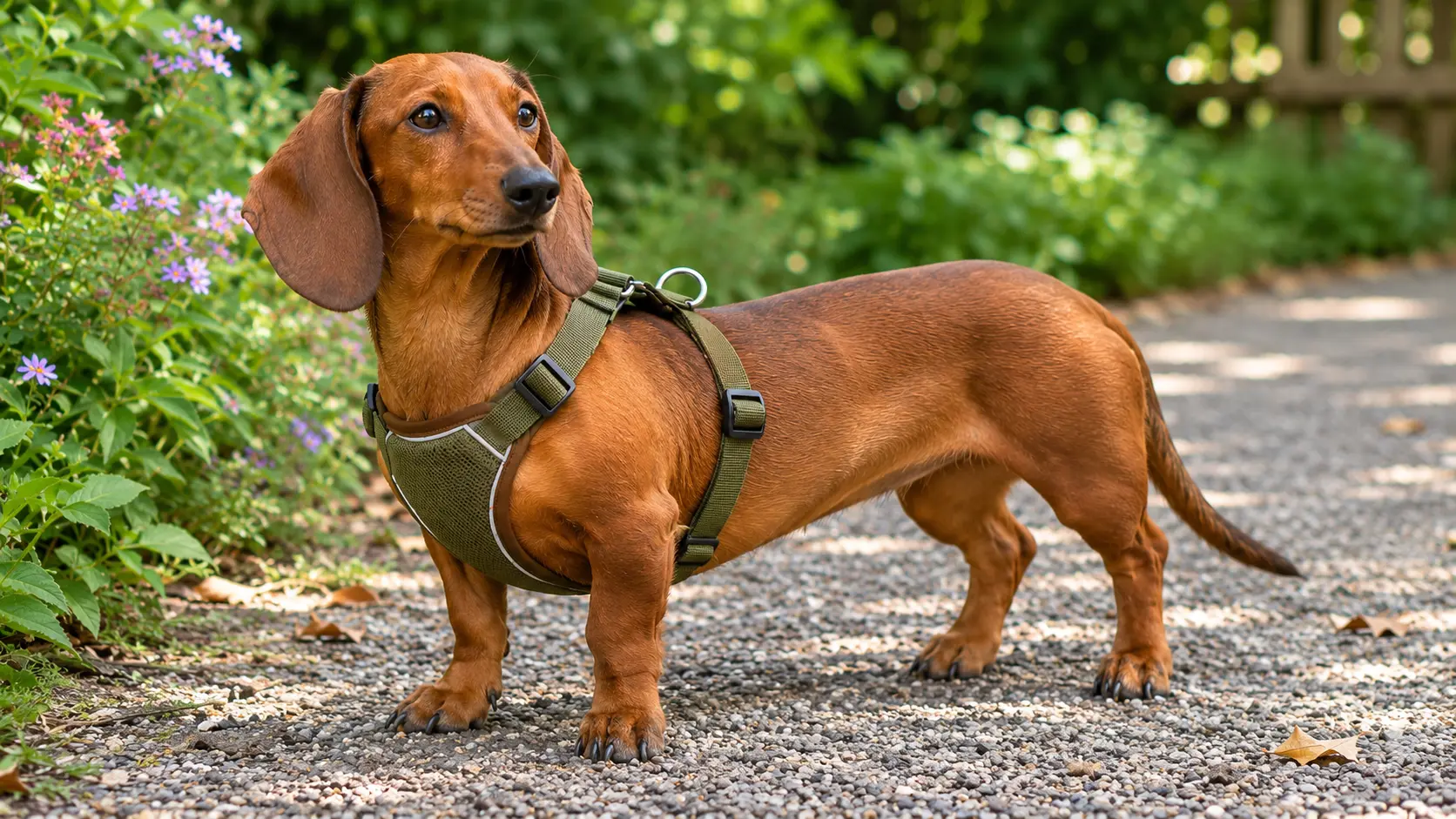
Finding a harness that fits a Dachshund can be surprisingly difficult. Their long bodies, deep chests, and short legs mean a harness that fits around the ribs may still rub behind the front legs, shift during walks, or leave too much room around the neck.
The best Dachshund harness isn't necessarily the one labeled “small” or advertised as escape-proof. It's the one that fits your dog's measurements, stays in position, and allows comfortable movement.
For everyday walks, the DJANGO Adventure is a strong starting point because of its adjustable, padded design and Dachshund-specific owner feedback. The Ruffwear Flagline offers more body coverage for dogs that need extra security, while the Blue-9 Balance gives owners greater control over individual strap adjustments.
We've compared six different designs, including lightweight options for miniature Dachshunds and harnesses for dogs that are harder to fit.
Affiliate disclosure: LumaPaw may earn a commission from qualifying purchases through links in this article, at no additional cost to you. Our recommendations are based on product information, customer feedback, and practical suitability—not hands-on product testing.
Best Dachshund Harnesses at a Glance
| Harness | Our recommendation | Main consideration |
|---|---|---|
| DJANGO Adventure | Best for Everyday Dachshund Walks | Adjustable and padded, but may rub some dogs |
| Ruffwear Flagline | Best Extended-Coverage Harness | Additional security strap; higher price |
| Blue-9 Buckle-Neck Balance | Best for Fine-Tuning the Fit | Extensive adjustment; minimal padding |
| Voyager Step-in Air | Best Budget Step-In Harness | Lightweight and simple; limited adjustment |
| Gooby Escape Free Easy Fit X | Best for Very Small Chests | Small sizing range; security depends on fit |
| Puppia RiteFit | Best Soft-Mesh Harness with an Adjustable Neck | Soft mesh and adjustable neck; sizing requires care |
These are different approaches to fitting a Dachshund, not interchangeable recommendations. A miniature Dachshund with a narrow chest may need a very different harness from a broader-chested standard Dachshund.
Measure your dog before choosing a size. The variations reviewed below are reference examples, not universal size recommendations.
How We Researched These Dachshund Harnesses
We compared manufacturer specifications, size charts, construction details, and Amazon and Chewy product listings. We also examined customer experiences involving fit, rubbing, escape attempts, everyday use, and durability.
Particular attention was given to feedback from Dachshund owners and people with similarly proportioned dogs. Their experiences are useful, but individual reviews cannot establish how reliably a harness will fit or perform for every dog.
We did not physically test these harnesses. Our recommendations reflect the available product evidence, practical design differences, and the limitations reported by owners.
The 6 Best Dachshund Harnesses Reviewed
1. DJANGO Adventure — Best for Everyday Dachshund Walks
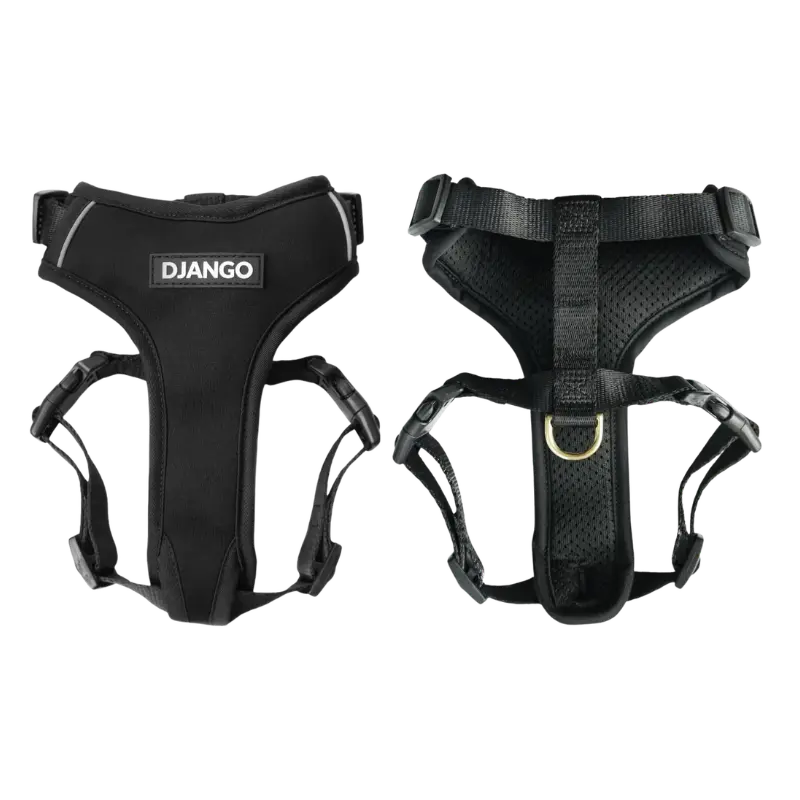
The DJANGO Adventure Dog Harness is one of the more relevant everyday options for Dachshund owners because the manufacturer specifically markets it for small, long-bodied dogs.
Instead of relying on a fixed neck opening and a single chest adjustment, the Adventure has four adjustment points. Its weather-resistant neoprene exterior, soft mesh lining, and padded front panel are intended to provide comfortable coverage without the bulk of an extended-body harness.
The selected Black, Small variation has a rear leash attachment and reflective details. It slips over the dog's head, then fastens around the torso.
What makes DJANGO worth considering is the combination of its design and customer feedback. Several Dachshund owners describe finding a better fit than with previously purchased harnesses. Others appreciate the padding, adjustability, and construction.
However, not every Dachshund has the same experience.
Some owners report rubbing behind the front legs or difficulty finding the right balance between a snug chest and a comfortable neckline. The head-over design can also be inconvenient for dogs that dislike having equipment passed over their ears.
Pros
- Four adjustment points for neck and chest fitting
- Padded neoprene and mesh construction
- Particularly relevant Dachshund-owner feedback
- Lightweight alternative to larger security harnesses
Cons
- Some reports of underarm rubbing
- No front leash attachment
- Must pass over the dog's head
- No additional rear security strap
Who should consider it? Owners seeking a padded, adjustable harness for ordinary walks, especially when conventional small-dog harnesses haven't fitted their Dachshund's chest properly.
Who should look elsewhere? Owners who need front-clip leash control, additional rear-body security, or a harness that opens fully around the neck.
2. Ruffwear Flagline — Best Extended-Coverage Harness
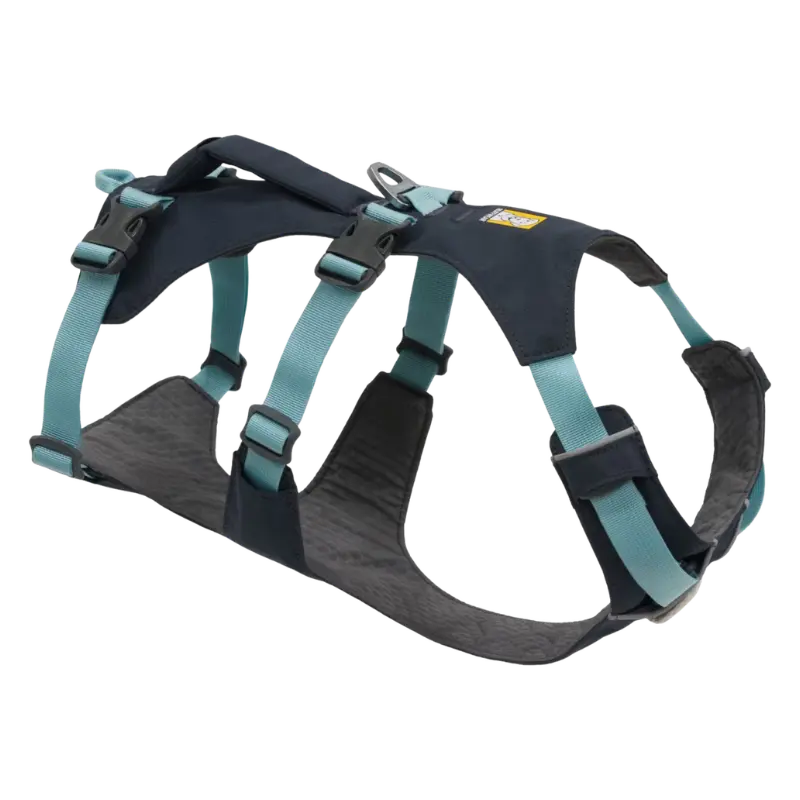
Some Dachshunds are remarkably good at reversing out of ordinary harnesses. For these dogs, additional body coverage may be worth considering.
The Ruffwear Flagline takes a different approach from the DJANGO Adventure. It uses an extended chest-and-belly design with an additional strap positioned farther back along the body.
Its six adjustment points help accommodate different proportions, while three leash attachment points provide flexibility for everyday walking. There's also a padded handle and a load-dispersing panel that Ruffwear designs for lift assistance.
The selected Basalt Gray, XX-Small variation is listed for a 13–17-inch chest.
For Dachshunds, the extra rear strap is the main reason to consider this model. It gives the harness another point of contact that may make backing out more difficult when correctly fitted.
Customer feedback includes positive experiences with long-bodied dogs and owners who appreciate the adjustment range and handle. Complaints are less consistent but include fit difficulties, occasional hardware problems, and fabric wear.
The biggest concern is the length of the underside. On a low-set dog, the harness must leave enough room for natural movement and urination. A harness can have excellent adjustment options and still be the wrong shape for an individual Dachshund.
Pros
- Six adjustment points
- Additional rear belly strap
- Front and rear leash attachment options
- Lightweight extended-body construction
- Padded control and assistance handle
Cons
- More expensive than the other selected harnesses
- Requires careful adjustment of multiple straps
- Underside coverage may not suit every dog
Who should consider it? Dachshund owners wanting more rear-body coverage than a conventional walking harness provides, particularly when their dog has previously slipped out of shorter designs.
Who should look elsewhere? Owners who want a simple step-in harness or whose dog's body proportions prevent the rear strap from sitting comfortably.
Ruffwear describes the handle as suitable for assisted lifting, but that doesn't make it a medical support device. If your Dachshund has a back injury or a history of IVDD, ask your veterinarian about appropriate handling and support.
For more alternatives, see our guide to harnesses for dogs that slip out.
3. Blue-9 Buckle-Neck Balance — Best for Fine-Tuning the Fit
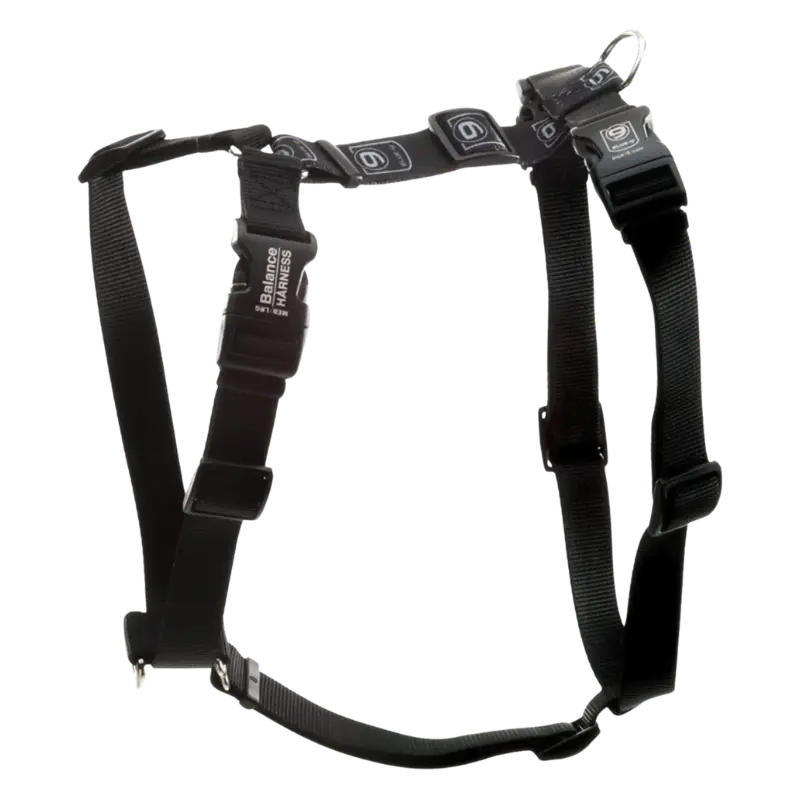
A padded vest isn't always the answer to an awkward harness fit. Sometimes, what matters most is being able to adjust where individual straps sit.
That's the strongest reason to consider the Blue-9 Buckle-Neck Balance Harness.
Its minimalist nylon-webbing construction has six adjustment points, allowing owners to change the fit around the neck, chest, and connecting sections. The selected Black, X-Small variation fits a listed chest range of 13.5–18 inches.
Unlike harnesses that must be pulled over the head, this version includes a neck buckle. That can be useful for a dog that resists head-over equipment.
Blue-9 also provides front and rear leash attachments. The front connection may help with leash handling when a dog pulls, although it isn't a replacement for teaching loose-leash walking.
The adjustment system is the product's biggest advantage—and one of its drawbacks.
Owners frequently praise the flexibility, but others find the straps confusing initially. There are also reports of twisting, movement during walks, and rubbing when the harness isn't positioned correctly.
Because it has relatively little padding, Blue-9 won't appeal to every owner. A dog that is sensitive to narrow straps may do better with broader fabric coverage.
Pros
- Six separate adjustment points
- Front and back leash attachments
- Neck buckle avoids head-over entry
- Lightweight, relatively open design
Cons
- Takes more effort to fit correctly
- Limited padding
- Some reports of shifting and rubbing
- Selected retailer variation has experienced stock interruptions
Who should consider it? Owners who have struggled to find a harness that fits their Dachshund's neck and chest proportions at the same time.
Who should look elsewhere? Owners who prefer a cushioned vest or need an additional security strap behind the rib cage.
Blue-9's official fitting guidance is particularly useful: it explains why the girth strap should rest around the rib cage rather than pressing into the armpits or sitting too far back on the soft abdomen.
If controlling pulling is your primary concern, our comparison of front-clip dog harnesses explains the differences between common attachment designs.
4. Voyager Step-in Air — Best Budget Step-In Harness
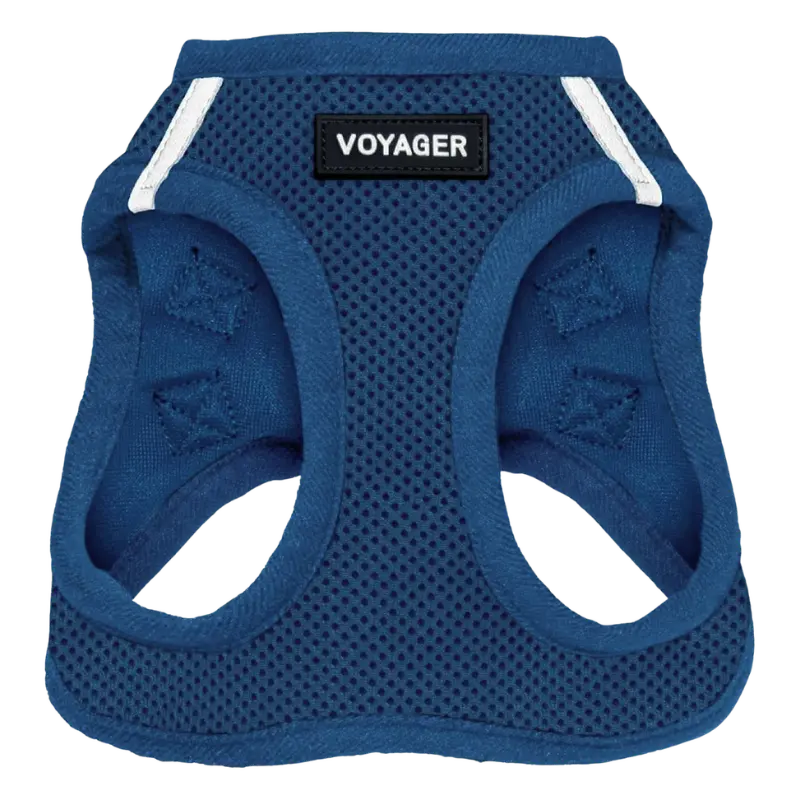
Not every Dachshund needs an elaborate harness. For a small dog that walks calmly and fits the measurements, the Voyager Step-in Air offers a much simpler option.
The selected Royal Blue with Matching Trim, X-Small harness uses lightweight polyester mesh, a hook-and-loop closure, a fastening buckle, and two rear D-rings for attaching the leash.
The dog steps into the leg openings, and the vest fastens across the back. There's no need to pull it over the head.
According to Voyager's sizing information, this XS variation is intended for a 13–14.5-inch chest and 10–11-inch neck, with a listed maximum weight of 9 pounds.
That narrow range matters. A miniature Dachshund may be small in weight but still have a chest that's too broad for this particular size.
Customer reviews frequently mention easy application, comfortable mesh, and good value. Some Dachshund owners report satisfactory fits.
However, there are also reports of dogs slipping out, including accounts involving Dachshunds. The vest doesn't offer the same independent adjustment as Blue-9 or the additional rear strap of Ruffwear Flagline.
It's also worth noting that the product is sometimes advertised using “no-pull” wording. The selected Step-in Air has rear leash attachments, not a dedicated front-clip control system.
Pros
- Lightweight mesh
- Straightforward step-in design
- No head-over entry
- Comparatively affordable
- Available through both Amazon and Chewy
Cons
- Narrow sizing range
- Limited independent adjustment
- No front leash attachment
- Some customer reports of backing-out escapes
Who should consider it? Owners of very small, calm Dachshunds whose measurements closely match the manufacturer's chart.
Who should look elsewhere? Owners of determined escape artists, strong pullers, or dogs whose chest and neck measurements don't fit the same size.
For puppies or very small adults, be especially careful not to choose XS based on weight alone. Measure both the chest and neck, and check the fit as the dog grows.
5. Gooby Escape Free Easy Fit X — Best for Very Small Chests
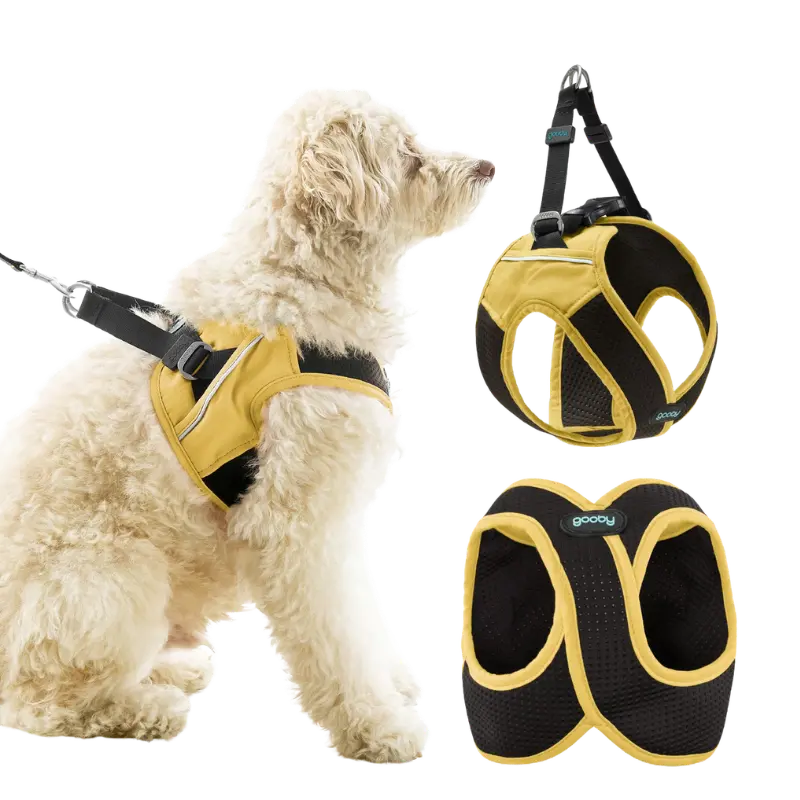
The Gooby Escape Free Easy Fit X deserves attention for a different reason: its extra-small sizing begins below the chest measurements of several other harnesses in this roundup.
The selected Miami Yellow, X-Small variation is listed for an 11.25–14.25-inch chest.
Gooby uses an X-frame design that is intended to tighten around the dog's body when tension is applied through the leash. Unlike the Ruffwear Flagline, it doesn't depend on a separate rear belly strap to provide its escape-resistant design.
The harness also features a deep V-shaped neckline, adjustable straps, reflective trim, and step-in entry.
This makes it an interesting option for some very small Dachshunds, particularly when larger vest designs leave excess room around the chest.
But the name Escape Free needs a qualification.
The tightening mechanism depends on how the harness fits and how tension is applied. Customer experiences are mixed: some owners report that their dogs stopped escaping, while others—including Dachshund owners—describe slipping out when the leash became slack or when the dog reversed.
That doesn't mean the design has no value. It means a properly measured, closely checked fit is essential.
Pros
- Smaller chest range than several alternatives
- Distinctive adjustable X-frame design
- Step-in entry
- Lightweight construction with reflective details
Cons
- Not guaranteed to prevent escapes
- Security can change with leash tension
- No additional rear security strap
- Sizing can be difficult near size boundaries
Who should consider it? Owners of very small Dachshunds needing a compact step-in harness with more adjustment than a basic mesh vest.
Who should look elsewhere? Owners whose dogs regularly back out of harnesses, especially when a leash is slack, or whose chest measurements fall outside the selected size range.
Before using this harness outdoors, check the adjustment carefully and observe how it sits when your dog turns, walks, and gently moves backward.
6. Puppia RiteFit — Best Soft-Mesh Harness with an Adjustable Neck
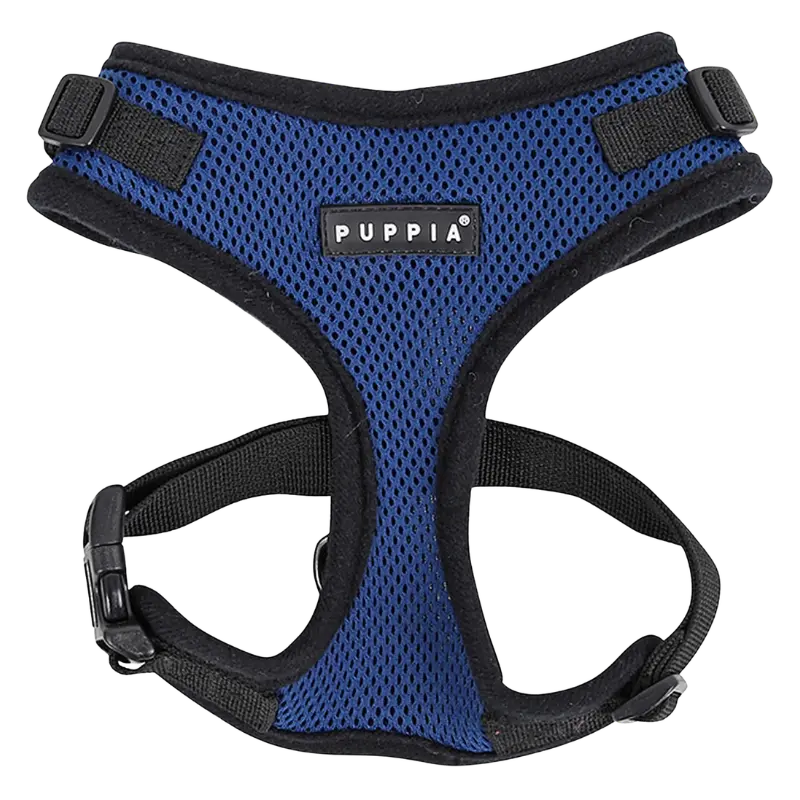
Puppia's RiteFit addresses a common frustration with small-dog mesh harnesses: a vest can fit around the chest while leaving the neck opening too loose or too tight.
The Puppia Authentic RiteFit combines soft polyester mesh with adjustable neck fastening and an adjustable chest belt.
The selected variation is Royal Blue, Medium.
Unlike Puppia's simpler Soft Harness, the RiteFit uses hook-and-loop adjustments and buckles around the neckline. This gives owners more control over the fit without relying entirely on a fixed neck opening.
Several customers appreciate that flexibility, along with the soft mesh construction. Positive feedback includes everyday walking comfort and successful fits for dogs whose neck and chest proportions differ from standard sizing expectations.
Other owners report that the harness can still rub, sit awkwardly around the throat, or require more adjustment than anticipated. Hook-and-loop fasteners may also collect hair and become less convenient over time.
It's a useful alternative to Voyager, but not simply an upgraded version of the same product. Voyager prioritizes step-in simplicity; RiteFit prioritizes additional neckline adjustment.
Pros
- Adjustable neck and chest
- Soft polyester mesh
- More fitting flexibility than fixed-neck mesh designs
- Rear leash attachment for everyday walking
Cons
- Size-chart differences require attention
- No front leash attachment
- No extra rear security strap
- Some complaints about rubbing and fastener usability
Who should consider it? Dachshund owners wanting soft mesh coverage but needing more control over the neck opening than a conventional vest provides.
Who should look elsewhere? Owners primarily seeking escape resistance, substantial body coverage, or front-clip leash control.
Medium is the variation reviewed here, not a recommendation for every miniature Dachshund. Check the current Puppia size guide and your dog's actual measurements before ordering.
How to Choose a Harness That Fits Your Dachshund
Dachshund Harness Fit and Safety Checks
Frequently Asked Questions About Dachshund Harnesses
Are Harnesses Better Than Collars for Dachshunds?
It depends on the dog and what you're trying to achieve.
A properly fitted harness can be useful for leash handling, especially when you want to avoid applying walking tension directly through a collar. However, a harness is not automatically more comfortable or secure, and there's no established evidence that it prevents Dachshund back disease.
The fit and your dog's walking behavior matter more than choosing one type of equipment based on a blanket rule.
For dogs with a history of cervical IVDD or other neck problems, seek individual veterinary guidance.
What if My Miniature Dachshund Falls Between Harness Sizes?
Start by checking both neck and chest measurements rather than choosing based on weight or breed label.
If your dog's chest matches one size but the neck matches another, look for a model with more independent adjustment. Blue-9, for example, provides multiple strap adjustments, while Puppia RiteFit offers an adjustable neckline.
Don't automatically choose the larger size. Excess space can make it easier for a dog to slip out, while a smaller size may cause rubbing or pressure.
When the size chart doesn't provide a clear answer, contact the manufacturer with your dog's measurements.
How Do I Help My Dachshund Get Used to Wearing a Harness?
Introduce the harness gradually, especially if your dog dislikes having equipment put over the head or around the legs.
Begin by allowing your dog to investigate it, offering treats or praise for calm behavior. Then practice putting it on briefly indoors without immediately starting a walk.
Reward relaxed movement and remove the harness before your dog becomes distressed. Gradually increase the time worn as your dog becomes comfortable.
If your Dachshund suddenly resists a previously tolerated harness, check for rubbing, poor adjustment, or signs of pain rather than assuming the behavior is simply stubbornness.
Which Dachshund Harness Should You Choose?
For many owners looking for an adjustable everyday walking harness, DJANGO Adventure is a sensible place to start. Its padded design and Dachshund-specific customer feedback make it especially relevant to this roundup.
If your dog needs additional body coverage, consider Ruffwear Flagline. If fitting the neck and chest independently has been difficult, Blue-9 Balance offers more adjustment.
For smaller dogs, Voyager Step-in Air provides an affordable, straightforward option, while Gooby Easy Fit X accommodates a particularly small chest range. Puppia RiteFit is worth considering when a soft mesh harness with an adjustable neckline is the priority.
None is the right choice for every Dachshund.
Measure carefully, check how the harness sits behind the front legs, and make sure your dog can walk comfortably without the equipment shifting or rubbing. A well-fitting harness is more valuable than an impressive product label—and it's the detail that matters most once the walk begins.