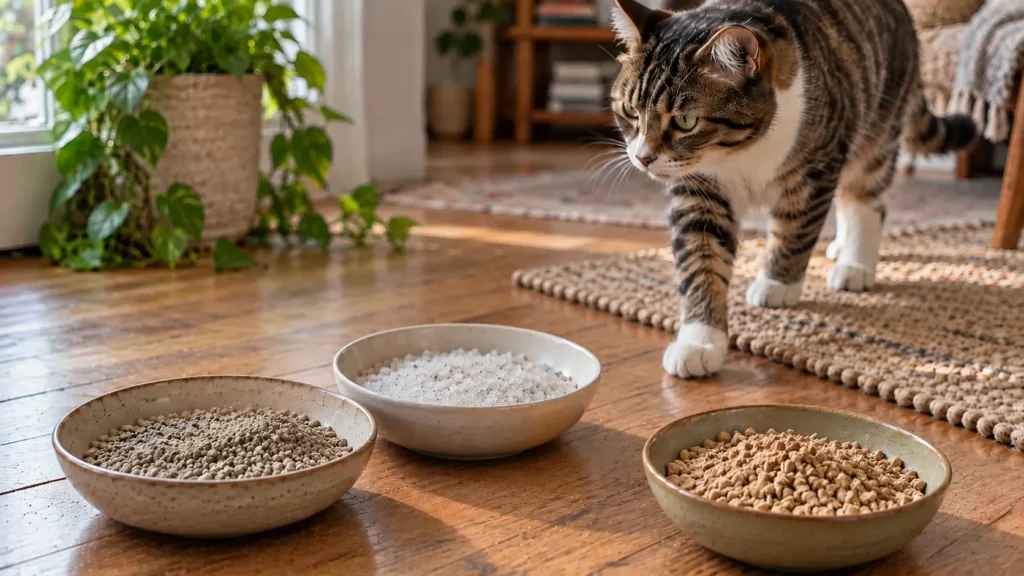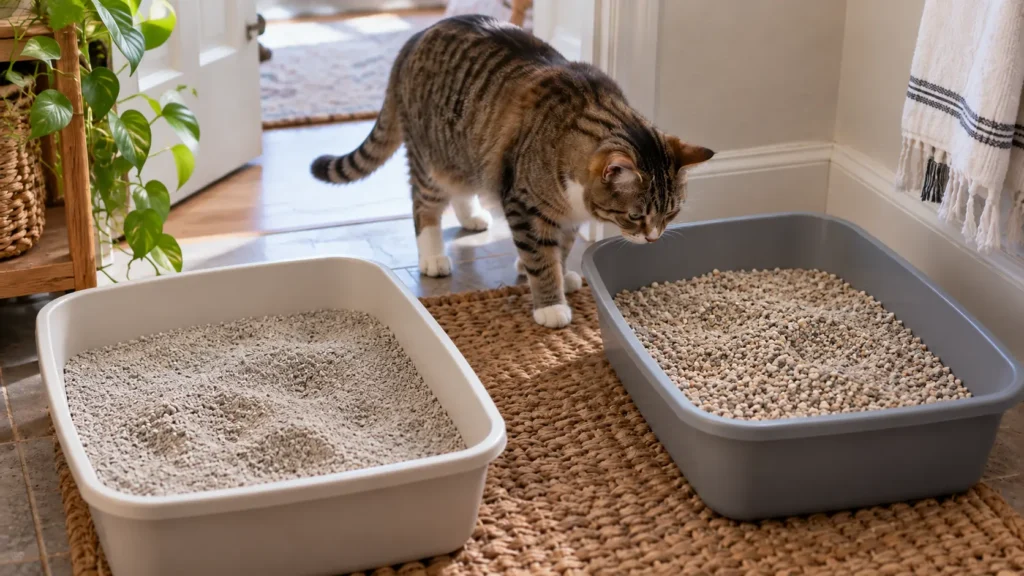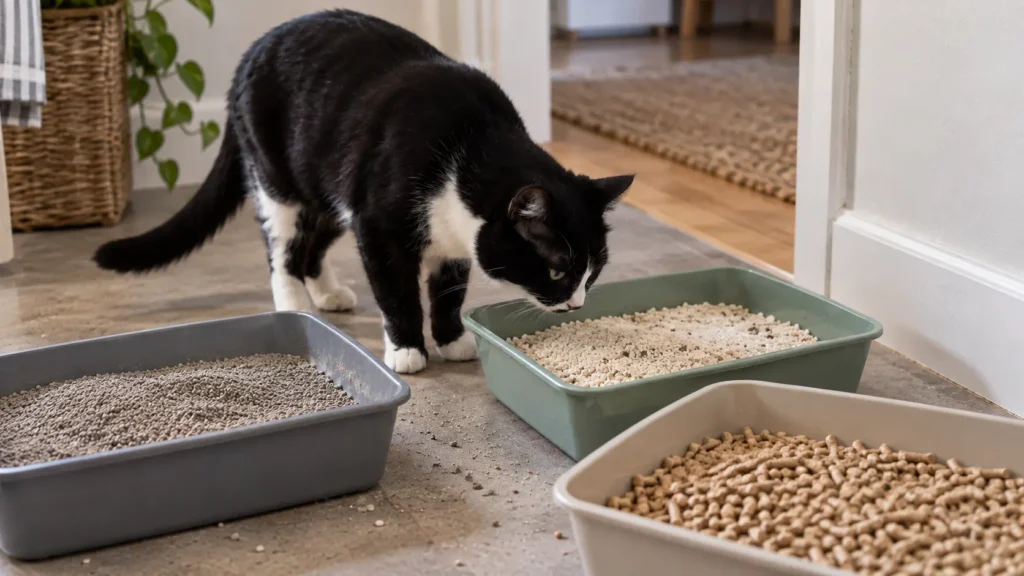
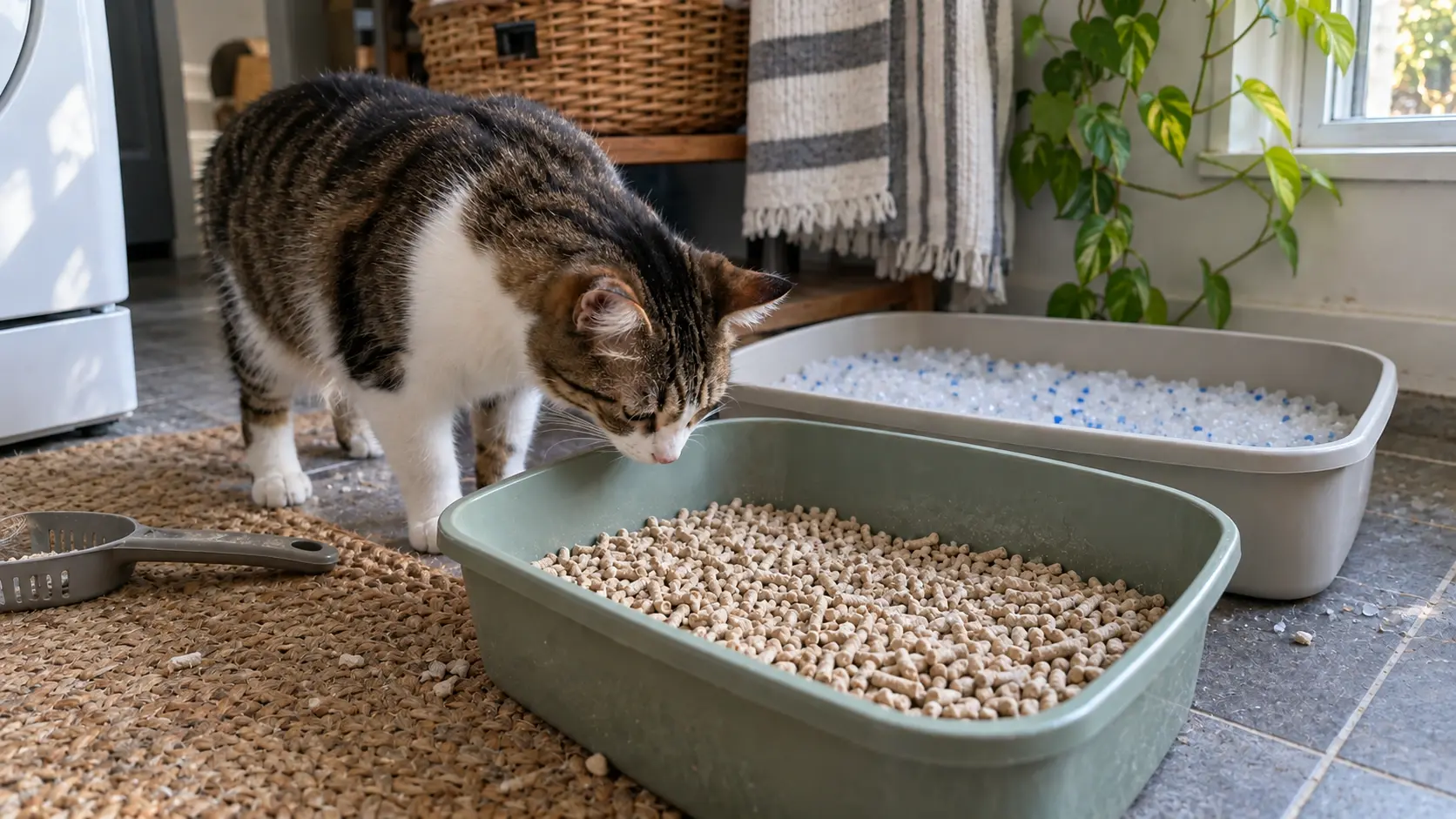
Non clumping cat litter is not one single type of litter. Traditional clay, pine pellets, recycled paper, silica crystals, and dedicated pellet-and-pad systems can all be non-clumping, but they handle urine in very different ways.
For most households willing to try pellet litter, Feline Pine Original is our strongest all-around starting point. It is relatively affordable, has no added fragrance, works in a standard litter box, and has a long track record of positive feedback for urine odor, dust, and tracking. Its main catch is texture: some cats simply do not like large pine pellets.
If you are still comparing litter formats in general, our guide to the best cat litter types overall covers clumping, crystal, natural, low-dust, and other options.
Affiliate disclosure: LumaPaw may earn a commission if you buy through links on this page, at no extra cost to you. We do not choose products based on commission rates.
Best Non-Clumping Cat Litter at a Glance
| Product | Our Pick For | Material | Scent | What Happens to Urine | Main Limitation |
|---|---|---|---|---|---|
| Feline Pine Original | Best Overall | Pine pellets | No added fragrance | Wet pellets break down toward sawdust | Some cats dislike coarse pellets |
| Tidy Cats 24/7 Performance | Best Budget | Clay | Scented | Urine is absorbed throughout the clay | Heavy and fragranced |
| Fresh Step Non-Clumping | Best for Odor Control | Clay | Scented | Urine is absorbed throughout the clay | Febreze scent may be too strong |
| Fresh News Original | Best Paper Litter | Recycled paper pellets | Unscented | Wet pellets absorb moisture, swell, and darken | Wet pellets can be awkward to remove |
| Tidy Care Alert | Best Health-Monitoring Crystal | Silica crystals | Unscented | Moisture is absorbed into crystals | Color changes are not a diagnosis |
| Tidy Cats Breeze Pellets | Best Non-Clumping Litter System | Zeolite pellets | Unscented pellets | Urine passes through to a pad below | Requires Breeze box and pads |
The biggest difference is not the bag material or marketing label. It is how you want to deal with urine. With some products, urine stays in the litter until a full change. Pine turns wet material toward sawdust. Silica is stirred to redistribute moisture. Breeze sends urine through the pellets into a separate pad.
That difference affects cleaning, odor, cost, and whether the litter will fit your routine.
How We Researched and Chose These Non-Clumping Litters
We compared current manufacturer information, Amazon and Chewy listings, exact formulas and package versions, maintenance instructions, materials, scent, litter-box compatibility, recurring customer feedback, and repeated complaints.
We also looked at how each product handles urine rather than treating all non-clumping litter as interchangeable.
Ratings and review counts helped us identify recurring patterns, but they were not enough to earn a recommendation on their own. The same applies to badges such as Amazon’s Choice or bestseller labels.
We also treated claims such as “99.9% dust-free” as manufacturer claims unless there was independent evidence behind them. Customer comments about dust, tracking, odor, or cat acceptance were used as patterns of reported experience, not as proof that every household will have the same result.
Most importantly, each product below has a different reason for being here. We did not add extra pine or crystal litters just to make the roundup longer.
The 6 Best Non-Clumping Cat Litters
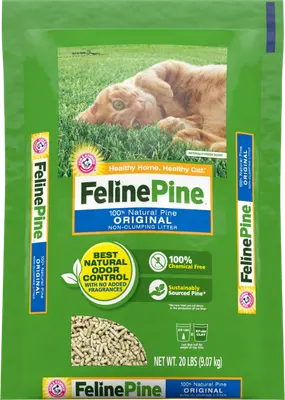
Feline Pine Original Non-Clumping Wood Cat Litter — Best Overall
Best for: Owners who want an affordable, fragrance-free pellet litter for a standard box.
Avoid if: Your cat strongly prefers fine litter or you want urine removed as a scoopable clump.
Common complaints: Cats refusing the pellet texture, awkward scooping with some litter scoops, and a learning curve around managing sawdust.
Maintenance note: A regular litter box works, but some owners find a suitable sifting setup easier for separating used sawdust from intact pellets.
Honest buying note: Feline Pine is not the best choice because pine is automatically healthier or “more natural.” It earns the top spot because it offers a strong balance of value, availability, standard-box compatibility, and practical performance if your cat accepts the pellets.
Feline Pine Original is the non-clumping litter we would start with for most people who are open to pellet litter.
It is made from pine and has no added synthetic fragrance. Instead of forming a urine clump, the pellets absorb moisture and gradually break down toward sawdust. Solid waste still needs to be removed daily.
Its biggest advantages are simplicity and value. There is no special litter box to buy, the litter is relatively lightweight compared with traditional clay, and the large pellets tend to create less fine-grain mess around the box.
Customer feedback also gives Feline Pine a deep evidence base. Urine odor control, lower tracking, and reduced fine dust are recurring positives.
The trade-off is texture. Large pine pellets feel very different from fine clay or sand-like litter, and some cats refuse them. Feline Pine provides gradual transition instructions for exactly that reason.
Although the product is sold as unscented, that does not mean odorless. Pine itself has a noticeable woody smell.
If you want to compare pine with walnut, paper, corn, grass, and other materials, see our guide to natural cat litter options.
Pros
- 100% pine
- No added fragrance
- Relatively low fine-grain tracking
- Lightweight compared with clay
- Good value in larger bags
- Strong long-term customer-feedback base
Cons
- Coarse pellets can be rejected by some cats
- Requires a different cleaning routine from clumping litter
- Stool odor may remain noticeable until scooped
- Natural pine smell may bother people who dislike wood scents
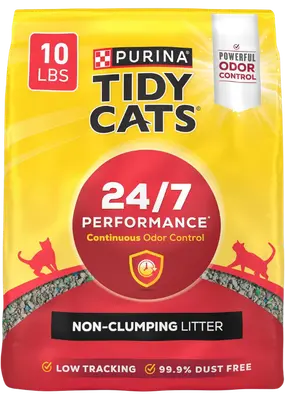
Tidy Cats 24/7 Performance Non-Clumping Cat Litter — Best Budget
Best for: Buyers who want low-cost, conventional non-clumping clay.
Avoid if: You prefer unscented litter, lightweight bags, or a litter that lets you remove urine daily.
Common complaints: Strong fragrance, urine smell appearing before a full box change, heavy bags, and dust during pouring.
Maintenance note: Remove solid waste daily, maintain the recommended litter depth, and replace saturated litter as needed rather than expecting urine clumps to appear.
Honest buying note: Tidy Cats 24/7 makes the most sense when keeping purchase cost down matters more than fragrance-free ingredients or specialty urine management.
Tidy Cats 24/7 is a straightforward choice for someone who wants traditional non-clumping clay without paying specialty-litter prices.
Unlike pine or paper pellets, this feels closer to conventional mineral litter. Urine is absorbed into the clay instead of forming removable clumps, while solids are scooped daily.
Its strongest advantage is cost. In the sizes we researched, it was one of the least expensive serious non-clumping options per pound. Large bags also make it practical for homes that go through litter quickly.
The downside is that cheap clay has its own compromises. This formula is scented, heavy in larger bags, and customer feedback on urine odor control was more mixed than for Fresh Step.
Purina also promotes the formula as low tracking and 99.9% dust-free. We would treat the dust percentage as a manufacturer claim rather than independent proof, especially because some customers still report dust while pouring.
Pros
- Very low cost
- Multiple bag sizes
- Familiar clay format
- Easy to find
- Suitable for standard litter boxes
Cons
- Scented
- Heavy in large bags
- Urine remains distributed through the litter
- Odor-control feedback is inconsistent
- Some customers still report dust and tracking
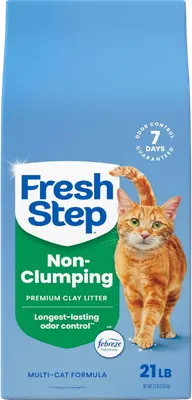
Fresh Step Premium Non-Clumping Clay Cat Litter — Best for Odor Control
Best for: Owners who want traditional non-clumping clay and prioritize odor management.
Avoid if: You specifically need unscented litter or dislike strong fragrance.
Common complaints: Fragrance that feels too strong, dusty bags, and odor returning as the litter becomes saturated.
Maintenance note: Fresh Step recommends maintaining roughly 2–3 inches of litter, removing solid waste daily, topping up as needed, and periodically dumping and replacing the full box.
Honest buying note: We did not independently measure odor performance. This pick is based on the current formula, manufacturer guidance, and stronger recurring odor-control feedback than the other conventional clay finalist.
Fresh Step is the stronger clay choice when odor performance matters more than getting the lowest possible price.
This is a scented non-clumping clay formula with odor-eliminating carbon and paw-activated Febreze freshness. Fresh Step currently claims up to seven days of odor control when the litter is used as directed.
Customer feedback on odor control and absorbency was also more consistently positive than it was for Tidy Cats 24/7, which is why Fresh Step gets the odor-control position among our clay picks.
That does not mean it will be the right choice for fragrance-sensitive cats or people. The Febreze scent is one of the most common reasons some buyers avoid or stop using it.
Dust is another mixed area. Many users report manageable dust, while others describe noticeable clouds during pouring or cleaning.
Pros
- Strong recurring odor-control feedback
- High-absorbing clay
- Multiple package sizes
- Familiar litter texture
- Clear manufacturer cleaning guidance
Cons
- Scented with Febreze freshness
- Dust complaints are not unusual
- Heavier than pine, paper, or silica
- Urine is not removed as a clump
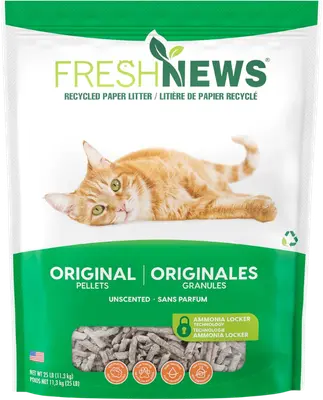
Fresh News Original Unscented Non-Clumping Paper Cat Litter — Best Paper Litter
Best for: Owners who want an unscented paper litter with little fine-grain tracking.
Avoid if: Your cat strongly prefers sand-like litter or you want precise urine scooping.
Common complaints: Difficulty telling which pellets are wet after they begin drying, throwing away clean pellets during scooping, and occasional cat refusal.
Maintenance note: Remove solids daily and remove obviously wet pellets where practical. Full replacement frequency depends on how quickly the litter becomes saturated.
Honest buying note: Paper litter is not automatically cleaner or safer than every other material. Fresh News stands out because it gives readers a genuinely different low-fine-particle option without requiring a special litter system.
Fresh News is the strongest paper option we researched for readers who want to avoid both clay and pine.
Its pellets are based on recycled paper and use an odor-control system that includes baking soda. The Original version is unscented.
Paper pellets behave differently from pine. Instead of quickly turning into sawdust, wet Fresh News pellets tend to absorb moisture, swell or darken, and remain more pellet-like.
That can make the litter noticeably less messy around the box because there are fewer fine particles to scatter through the house. Low dust and lower tracking are recurring positives in customer feedback.
The weak point is urine cleanup. Wet pellets do not form neat clumps, and separating damp material from clean pellets can be imprecise. Some owners end up discarding clean pellets along with used ones.
Large paper pellets can also be a difficult transition for cats accustomed to fine litter.
Pros
- Recycled-paper pellet format
- Unscented
- Generally low fine-grain tracking
- Low-dust feedback is strong
- Works in standard litter boxes
- Different feel from both clay and pine
Cons
- Wet pellets can be awkward to separate
- Large pellet texture may reduce cat acceptance
- Odor performance depends heavily on removing wet areas before saturation
- Some customer reviews report occasional non-paper debris
Tidy Cats Tidy Care Alert Health Monitoring Litter — Best Health-Monitoring Crystal
Best for: Owners who want non-clumping crystal litter with an added urine-monitoring signal.
Avoid if: You want a diagnostic product, dislike crystal tracking, or have several cats sharing one box and cannot tell who produced a color change.
Common complaints: Crystals around the box, dust while stirring, color readings that are difficult to interpret, and shorter-than-expected lifespan in multi-cat homes.
Maintenance note: Scoop solids daily, stir the crystals frequently, and follow Purina’s replacement schedule. Do not add products such as baking-soda deodorizer if the manufacturer warns they may interfere with color readings.
Honest buying note: Think of the color system as an extra observation tool, not a substitute for watching your cat’s behavior or getting veterinary care.
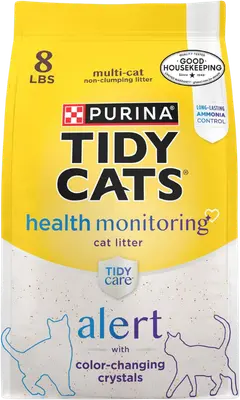
Tidy Care Alert is a non-clumping silica crystal litter with an extra feature: its crystals respond to characteristics of a cat’s urine and can change color when urine moves outside the cat’s usual range.
The important part is what that feature does not do. It does not diagnose a urinary tract infection, kidney disease, bladder stones, or any other condition.
Purina instructs owners to establish a baseline for their individual cat and monitor persistent changes. If a color remains outside the usual range, or the cat is showing symptoms such as straining or visible blood, the next step is a veterinarian—not relying on the litter to identify the cause.
As litter, Alert is lightweight, unscented, and absorbs urine into the crystals rather than creating clumps. Solids are scooped daily and the crystals need regular stirring.
It earned this position over PrettyLitter because the core monitoring concept is similar while Alert offered better value in the retailer versions we compared.
For a deeper comparison of silica formulas, see our guide to crystal cat litter options.
Pros
- Unscented
- Lightweight silica crystals
- pH-related color monitoring
- No urine clumps to scoop
- Good retailer availability
- Better value than the premium monitoring alternative we researched
Cons
- Health-monitoring colors can be ambiguous
- Not a diagnostic tool
- Dust and tracking complaints occur
- Monitoring is harder to interpret in multi-cat homes
- More expensive than clay or pine
Tidy Cats Breeze Zeolite Pellets — Best Non-Clumping Litter System
Best for: Owners willing to switch to a dedicated pellet-and-pad system to separate urine from the litter surface.
Avoid if: You want litter for your current standard box or do not want recurring pad purchases.
Common complaints: Cats refusing the pellets, ongoing pad cost, unpleasant stray pellets under bare feet, and stool odor when waste is not removed quickly.
Maintenance note: Scoop solids daily, replace the urine pad on the schedule appropriate for your household, and replace the pellets according to Purina’s guidance.
Honest buying note: Breeze is a strong system, but it should not be compared as though it were just another bag of litter. It requires the largest change in both equipment and routine of anything in this roundup.
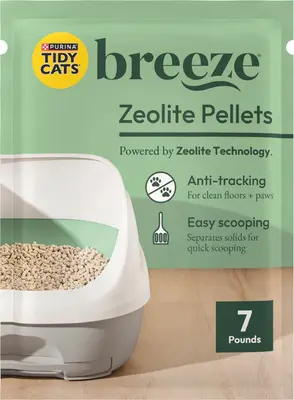
The zeolite pellets are designed for the Tidy Cats Breeze litter box system, not as a normal litter that you pour into any standard pan.
Instead of absorbing urine and keeping it in the litter bed, the pellets allow liquid to pass through the grate into an absorbent pad underneath. Solid waste stays on top and is scooped daily.
That separation is the main reason to buy the system. It can keep wet urine away from the surface where the cat stands, and the large pellets produce much less fine litter scatter than clay or sand-like crystals.
But there is a real cost to that convenience. You need the Breeze box, the pellets, and replacement pads. Some cats also dislike walking on the hard pellets.
Fresh feces can remain exposed because the pellets do not bury stool the way fine litter does, so solid-waste odor still depends on prompt scooping.
Pros
- Urine passes into a separate pad
- Very little fine-grain tracking
- Low-dust system
- Straightforward daily solid-waste cleanup
- Pellets usually need replacement less often than traditional litter
Cons
- Requires the Breeze litter box
- Pads add recurring cost
- Hard pellets may be rejected by some cats
- Fresh stool odor can remain noticeable
- Loose stool can make the grate harder to clean
How Does Non-Clumping Cat Litter Work?
The easiest way to understand non-clumping litter is to look at what each material does with urine.
| Material | What Happens to Urine | Typical Daily Task |
|---|---|---|
| Clay | Absorbed into the litter | Scoop solids and monitor saturation |
| Pine pellets | Wet pellets gradually break down | Scoop solids and manage sawdust |
| Paper pellets | Pellets absorb moisture, swell, or darken | Scoop solids and remove wet material where practical |
| Silica crystals | Moisture is absorbed into crystals | Scoop solids and stir crystals |
| Breeze system | Urine passes through pellets to a pad | Scoop solids and replace pad as needed |
Non-Clumping Clay
Traditional non-clumping clay absorbs urine instead of surrounding it with a removable clump.
You scoop feces each day, top up the litter when necessary, and replace the litter once it becomes too saturated or loses odor control.
This is simple, but it means urine generally remains in the litter until you refresh the box. If you are specifically comparing traditional mineral formulas, our clay cat litter guide explains the differences between clumping and non-clumping clay in more detail.
Pine Pellets
Pine pellets absorb urine and gradually soften and break down into a sawdust-like material.
That changes the cleaning routine. Instead of looking for a urine clump, you remove solids and manage the used sawdust.
Some owners use a suitable sifting setup to separate broken-down material from intact pellets, although the right setup depends on pellet size and box design.
Paper Pellets
Paper pellets absorb liquid without forming a hard clump.
Depending on the product and how wet the pellets become, they may swell, soften, or darken while largely retaining their pellet shape.
This can keep fine litter from spreading through the house, but removing only the wet material can be less precise than scooping a firm clump.
Silica Crystals
Non-clumping silica litter absorbs moisture into the crystals.
You remove feces and stir the crystals regularly so moisture is distributed rather than remaining concentrated in one part of the box.
Once the litter becomes saturated, odor control and absorbency decline and the box needs a complete change.
Pass-Through Pellet Systems
Tidy Cats Breeze works differently from ordinary absorbent litter.
Its pellets are designed to let urine pass through the upper grate and into an absorbent pad below. Solid waste stays above the grate for scooping.
That keeps urine physically separated from the pellet bed, but it also means you need the Breeze litter box and replacement pads.
Clumping vs Non-Clumping Litter: The Short Answer
The main difference is what happens to urine.
| Clumping Litter | Non-Clumping Litter |
|---|---|
| Forms removable urine clumps | Does not form firm urine clumps |
| Makes urine spot-cleaning straightforward | May require stirring, sifting, wet-pellet removal, pad replacement, or full changes |
| Common in bentonite and plant-based formulas | Available in clay, pine, paper, silica, and pellet systems |
| Often has fine granular texture | Texture ranges from clay grains to large pellets |
Neither format is automatically better.
Clumping litter is convenient when you want to remove urine daily. Non-clumping litter offers materials and maintenance styles that some cats and owners prefer.
If you are still deciding between the two formats, our full clumping vs non-clumping litter comparison explains the differences in cleaning, texture, odor, cost, and everyday use.
FAQs About Non-Clumping Cat Litter
Do You Scoop Pee Out of Non-Clumping Cat Litter?
Usually not as a firm urine clump, because that is what distinguishes non-clumping litter.
What you do instead depends on the material.
With clay, urine is absorbed and the litter is periodically replaced. Pine turns wet pellets toward sawdust. Paper pellets may swell or darken and can sometimes be removed. Silica crystals absorb moisture and are stirred. Breeze sends urine into a pad underneath.
Always follow the instructions for the specific litter.
How Often Should You Change Non-Clumping Cat Litter?
There is no single replacement schedule for all non-clumping litter.
Some clay formulas need relatively frequent full changes, while silica crystals or pellet systems may have longer manufacturer-recommended intervals.
The number of cats, box size, urine volume, litter depth, and cleaning routine all affect lifespan.
Replace litter sooner if odor persists, absorbency drops, or the material becomes heavily saturated.
Why Use Non-Clumping Cat Litter?
People choose non-clumping litter for different reasons.
Some want inexpensive conventional clay. Others prefer pine or paper pellets because they create less fine-grain tracking. Silica buyers may want lightweight litter or health-monitoring features, while Breeze users may prefer separating urine into a pad.
Those are specific advantages of individual materials and systems—not proof that non-clumping litter as a category is better than clumping litter.
Can You Mix Clumping and Non-Clumping Cat Litter?
Sometimes, but usually only as part of a transition and only when the product instructions allow it.
Mixing can change the way a litter absorbs moisture or behaves during cleaning.
It can be especially problematic with health-monitoring crystals because another litter may interfere with color interpretation.
If you are transitioning a cat, follow the manufacturer’s recommended method rather than creating your own permanent mixture.
Is Non-Clumping Cat Litter Good for Kittens?
Some non-clumping products are marketed for kittens or all life stages, but that does not make every non-clumping litter appropriate for every kitten.
Consider the kitten’s age, pellet or granule size, tendency to investigate or eat litter, and the manufacturer’s instructions.
If a very young kitten repeatedly eats litter, has digestive problems, or needs a specific litter after a medical procedure, ask your veterinarian what substrate is appropriate.
Can You Use Non-Clumping Litter in an Automatic Litter Box?
Only if the automatic box is designed to use it.
Many self-cleaning boxes depend on firm clumps and will not work correctly with ordinary non-clumping litter.
Some crystal litters work with selected automatic boxes, while Breeze is a dedicated non-clumping system of its own.
Check the machine manufacturer’s compatibility requirements before purchasing litter.
Does Non-Clumping Cat Litter Control Odor?
It can.
Odor performance depends more on the material, formula, maintenance routine, number of cats, and saturation level than on whether the litter clumps.
Fresh Step uses a scented clay and odor-control system. Pine absorbs urine differently. Silica traps moisture inside crystals. Breeze moves urine to a pad.
Even a good odor-control litter will perform poorly if the box is allowed to become saturated.
Final Verdict: Which Non-Clumping Cat Litter Should You Choose?
The best non clumping cat litter depends on how your cat responds to the texture and how you want to handle urine.
Feline Pine Original is our broadest all-around choice if your cat accepts pine pellets. Tidy Cats 24/7 is the straightforward budget option, while Fresh Step makes more sense when odor control matters more than avoiding fragrance.
Choose Fresh News if you specifically want paper pellets, or Tidy Care Alert if the added urine-monitoring feature is useful to you. Tidy Cats Breeze is the most different option, separating urine into a pad but requiring its dedicated system.
Whichever format you choose, a litter that your cat reliably uses and that you can maintain properly is more valuable than a product that looks better only on paper.