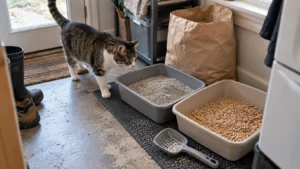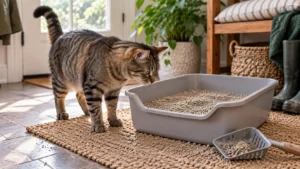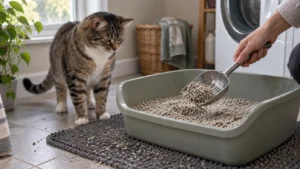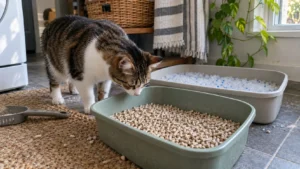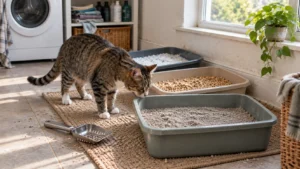
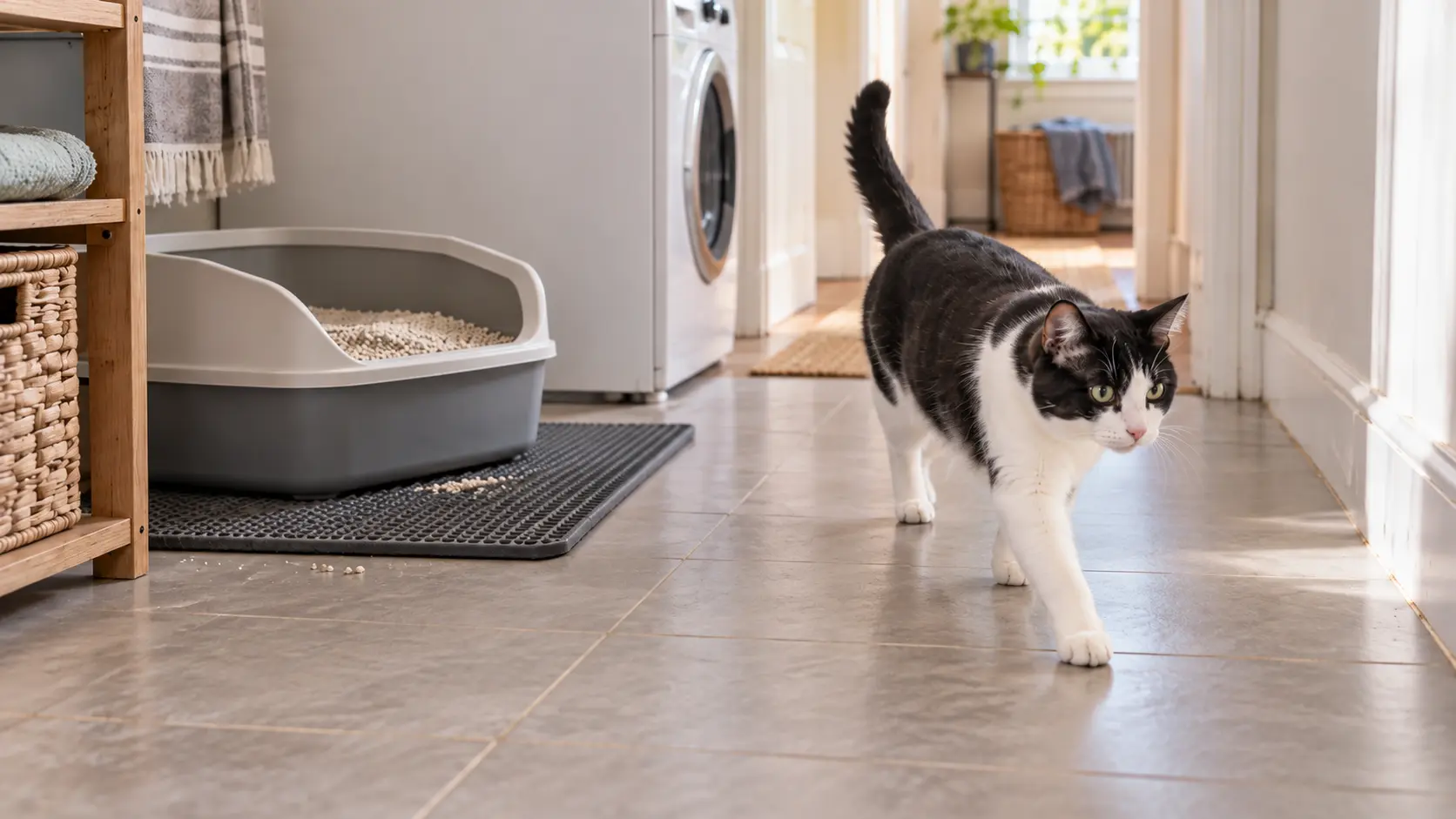
Low tracking cat litter can reduce the trail of granules that follows your cat away from the box, but no loose litter is guaranteed to stay completely contained. Particle size, shape, weight, and pellet structure all matter, and the designs that track less often come with trade-offs in clumping, texture, price, or litter-box compatibility.
For most households that want to keep using familiar clumping clay, Purina Tidy Cats Performance+ Tidy Feet Unscented offers the strongest overall balance. But it is not the right answer for everyone. Long-haired cats, automatic litter boxes, and owners who prefer plant-based litter all have better-targeted options below.
If tracking is only one part of your decision, our broader cat litter guide compares litter by odor control, dust, clumping, materials, weight, and maintenance.
Disclosure: LumaPaw may earn a commission from qualifying purchases made through links on this page, at no extra cost to you.
Best Low-Tracking Cat Litter at a Glance
Product |
Our Pick For |
Material |
Clumping |
Why It May Track Less |
Automatic Box? |
Main Limitation |
|---|---|---|---|---|---|---|
Purina Tidy Cats Performance+ Tidy Feet Unscented |
Best Overall |
Clay |
Yes |
Larger, specially shaped granules |
Depends on machine |
Heavy; clumping can be inconsistent |
Dr. Elsey’s Clean Tracks |
Best Value Clay |
Clay |
Yes |
Medium-grain low-tracking formula |
Depends on machine |
Very hard clumps can stick |
Tuft & Paw Really Great Cat Litter Unscented |
Best Tofu Litter |
Tofu-based pellets |
Yes |
Slim pellet shape |
Usually no |
Expensive; mixed odor control |
ökocat Low Tracking, Less Mess Mini-Pellets |
Best for Long-Haired Cats |
Wood |
Yes |
Dense wood mini-pellets |
No |
Pellet texture and slower sifting |
Sustainably Yours Large-Grain Formula |
Best for Automatic Litter Boxes |
Corn + cassava |
Yes |
Larger plant-based granules |
Yes, where specifically compatible |
Expensive; very hard clumps |
World’s Best Low Tracking & Dust Control |
Best Natural Value |
Corn |
Yes |
Larger corn granules |
Machine-dependent |
Granules can break into fines |
How We Researched These Low-Tracking Cat Litters
Tracking was the first filter, not an extra feature added after choosing otherwise popular cat litters.
We compared the exact formulas sold by manufacturers and major retailers, then looked at particle or pellet design, clumping, dust, odor control, texture, package weight, automatic-box compatibility, availability, and recurring customer complaints.
We also looked closely at what happens after the litter has been used for a while. A large granule may start out difficult for a cat to carry, but if it breaks into smaller pieces or powder, its tracking advantage may shrink.
Customer ratings helped us identify patterns, but we did not choose products simply because they had the highest stars or most reviews. A repeated complaint about tracking, crumbling, sticking, odor, or texture mattered more than an isolated comment.
LumaPaw did not conduct controlled home or laboratory tracking tests on these products. Manufacturer performance claims remain manufacturer claims, and customer feedback represents individual experiences rather than guaranteed results.
We also treated similarly named formulas separately. Scented and unscented versions, different grain sizes, and newer formula variants should not automatically share the same specifications or review conclusions.
The 6 Best Low-Tracking Cat Litters

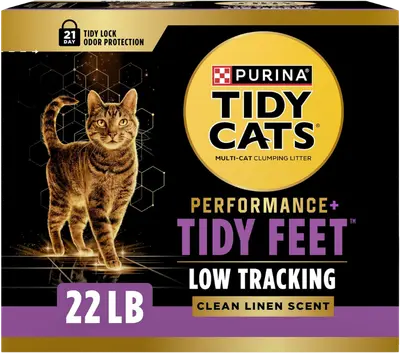
Purina Tidy Cats Performance+ Tidy Feet Low Tracking Unscented — Best Overall
Best for: households that want to reduce tracking without leaving conventional clumping clay.
Avoid if: lifting heavy litter is difficult or your cat strongly prefers fine, sand-like particles.
Honest buying note: This is the most balanced choice here, not a promise of zero tracking. Its main appeal is reducing mess without asking the cat or owner to adopt a completely different litter format.
Tidy Feet has one of the clearest tracking-focused designs in this group. Purina uses larger, specially shaped particles intended to roll less outside the box and stick less readily to paws. The company also reports 64% less tracking than the leading clumping litter in its comparison.
That does not mean it will leave every floor spotless. Current customer feedback still includes households that find granules outside the box. But many owners report a noticeable reduction compared with finer clay litters, which supports the basic design rather than relying on the product name alone.
Its biggest advantage is familiarity. Cats that already use clumping clay do not have to make the same jump in texture they would with wood or tofu pellets. It is also priced more like mainstream litter than the premium plant-based options in this guide.
The trade-off is weight. Larger clay particles make the box and package heavy, and some owners find the coarse texture less pleasant to sift. Clump quality is also not universally strong; recurring complaints include clumps breaking apart or sticking to the bottom.
Product snapshot
- Material: Clay
- Clumping: Yes
- Scent: Unscented
- Formula: Multi-cat
Pros
- Purpose-built low-tracking particle design
- Familiar clumping-clay format
- Unscented option
- Widely available
- More affordable than most premium pellet litters
Cons
- Heavy
- Clumps can crumble or stick
- Coarse particles may not suit every cat
- Still tracks for some households

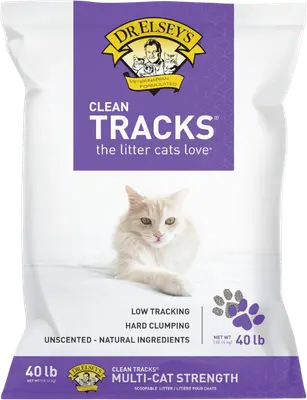
Dr. Elsey’s Clean Tracks — Best Value Clay
Best for: budget-conscious households that want unscented, low-tracking clumping clay.
Avoid if: you dislike hard clumps that may need scraping or need a lightweight package.
Common complaint: The most consistent issue is not weak clumping but clumps becoming almost too hard.
Honest buying note: Clean Tracks makes the most sense when price and firm clumps matter almost as much as tracking control.
Dr. Elsey’s Clean Tracks is the practical choice for owners who want a tracking-focused clay litter without paying premium plant-based prices.
The medium-grain clay is specifically intended to stay in the box better than finer litter while still producing firm clumps. Many owners report good clumping and less litter spread than with previous clay products, although tracking results are not consistent for everyone.
Where Clean Tracks stands out most is value. The larger bags have been considerably less expensive per pound than the tofu, corn-and-cassava, and wood alternatives we researched. Price per pound is not a perfect comparison across different litter densities, but the difference is large enough to matter for households that go through a lot of litter.
The main drawback is almost the opposite of weak clumping: urine clumps can become extremely hard. Repeated customer complaints describe clumps sticking to the bottom or sides of the litter box and requiring more scraping than expected.
The bags are also heavy, particularly at the larger sizes.
If you are deciding between different clay formats, our clay cat litter guide explains the broader material trade-offs.
Product snapshot
- Material: Clay
- Clumping: Yes
- Scent: Unscented
- Grain: Medium-grain
Pros
- Strong value among specialist low-tracking litters
- Firm clumping
- Unscented
- Widely available
- Designed specifically for reduced tracking
Cons
- Heavy bags
- Clumps can become very hard and stick
- Dust and tracking still vary between households

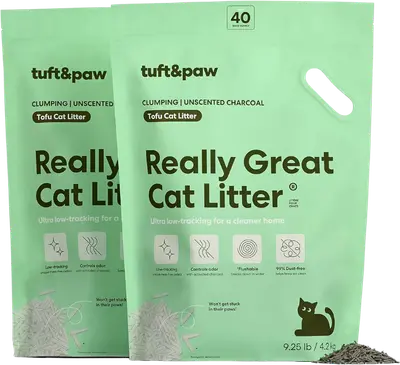
Tuft & Paw Really Great Cat Litter Unscented — Best Tofu Litter
Best for: owners willing to pay more to prioritize low tracking and low dust.
Avoid if: budget or automatic-box compatibility is a major priority.
Honest buying note: The premium price is easier to justify if floor mess is your main frustration. It is harder to justify if odor control or low cost matters more.
Tuft & Paw uses slim cylindrical pellets rather than fine clay-like granules. That shape is the main reason it belongs in a low-tracking roundup.
Tracking feedback is one of its strongest areas. Many owners report finding only a few pellets near the box rather than fine grit spread through multiple rooms, and the larger pieces are easier to see and pick up when they do escape.
Dust is another advantage. The pellets generate far less fine material than many conventional litters, and there is less evidence of them quickly breaking down into powder than we found with some corn formulas.
Clumping is also better than many people expect from a pellet litter. The main cleaning inconvenience is sifting: a normal scoop with narrow slots can trap unused pellets, so a wider-slot scoop is much easier to work with.
The biggest barrier is cost. Really Great Cat Litter was the most expensive serious contender in our research. Odor control is also more mixed than its tracking performance, with recurring complaints about urine or ammonia smell.
It is generally a poor match for most automatic litter boxes because the pellets are larger than the fine clumping litter those machines are designed to sift.
For a broader look at the material itself, see our tofu litter guide.
Product snapshot
- Material: Tofu-based pellets
- Clumping: Yes
- Scent: Unscented
- Feature: Activated carbon
Pros
- Very strong tracking feedback
- Very low dust
- Good clumping for a tofu pellet
- Lightweight
- Larger particles are easier to clean from the floor
Cons
- Expensive
- Odor control is inconsistent
- Wide-slot scoop works better
- Poor fit for most automatic boxes

ökocat Low Tracking, Less Mess Mini-Pellets — Best for Long-Haired Cats

Best for: long-haired cats that carry fine litter in their fur.
Avoid if: you use an automatic sifting litter box or your cat strongly prefers fine litter.
Honest buying note: If fur carryout is the problem, ökocat has one of the clearest reasons to choose it. If you use a self-cleaning box, choose something else.
Fine litter can be especially frustrating with long-haired cats because particles may catch in fur around the paws and travel well beyond the box.
ökocat’s Less Mess formula tackles that problem with dense wood mini-pellets. The manufacturer specifically recommends this version for long-haired cats, and customer feedback includes repeated reports of less litter becoming caught in fur compared with finer clay or corn products.
The pellets still clump, which separates this product from traditional non-clumping pine litter. Clumps are generally softer than clay, however, and the large pellet size makes sifting slower. A scoop with wider openings helps.
Another limitation is texture acceptance. Some cats transition easily; others dislike walking or digging in pellets. A gradual change is especially sensible if your cat has used fine clay for years.
Pellet condition also matters. Shipping damage or normal breakdown can produce smaller wood pieces and sawdust, reducing some of the tracking advantage.
Most importantly, the manufacturer says this Low Tracking Less Mess formula is not suitable for automatic litter machines because its pellets are too large.
Product snapshot
- Material: Wood mini-pellets
- Clumping: Yes
- Scent: Unscented
Pros
- Strong tracking-control design
- Especially useful for long fur
- Clumps unlike traditional loose pine pellets
- Low dust while pellets remain intact
- Natural wood-fiber format
Cons
- Some cats dislike pellet texture
- Softer clumps than clay
- Slower to sift
- Broken pellets can create fines
- Not for automatic litter machines

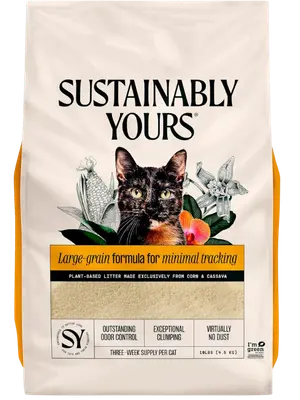
Sustainably Yours Large-Grain Formula — Best for Automatic Litter Boxes
Best for: owners using a compatible automatic sifting litter box who still want to reduce tracking.
Avoid if: you want a budget litter or dislike very hard clumps.
Honest buying note: This is the specialist choice for automatic-box users, not the cheapest or least-tracking litter overall.
Sustainably Yours is unusual because it combines a larger-grain design with very firm clumping and compatibility with Litter-Robot-style use where the exact machine supports it.
Make sure you are buying Large Grain. Sustainably Yours also sells Small Grain and Mixed Grain formulas, and reviews for those versions should not be treated as though they describe the same tracking performance.
The larger particles are designed to reduce carryout compared with finer versions, while the corn-and-cassava formula forms exceptionally firm clumps. That clumping behavior is a major advantage in a sifting automatic box because waste needs to separate cleanly from unused litter.
It can also become a drawback. Some owners report large, hard urine clumps sticking to the bottom of the box and requiring more effort to remove.
Tracking itself remains variable. Larger grains help many households, but this is not a pellet litter, and some cats still carry it well beyond the box.
The other major drawback is price. It costs substantially more than mainstream clay.
If you are choosing both the litter and the machine, our guide to automatic self-cleaning litter boxes can help with the other half of that decision.
Product snapshot
- Material: Corn and cassava
- Clumping: Yes
- Scent: Unscented
- Formula: Large-Grain
Pros
- Strong automatic-box case
- Large-grain low-tracking design
- Excellent clumping
- Very low dust for many users
- Plant-based corn and cassava
Cons
- Premium price
- Clumps can become very hard
- Tracking is still possible
- Compatibility must be checked for the exact machine

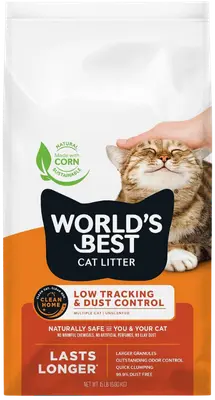
World’s Best Low Tracking & Dust Control — Best Natural Value
Best for: owners wanting a lower-cost plant-based clumping option.
Avoid if: you want tracking and dust performance to remain especially consistent as the litter ages.
Honest buying note: The price makes this an appealing natural option, but the granule-breakdown complaint is directly relevant to a low-tracking article and should not be overlooked.
World’s Best offers a more affordable route into plant-based low-tracking litter than Tuft & Paw or Sustainably Yours.
The exact orange-bag Low Tracking & Dust Control formula uses larger corn granules intended to stay in the box better than finer litter. Many owners report lower initial tracking and little visible dust when the litter is fresh.
The main concern appears later.
Repeated customer feedback describes the larger granules gradually breaking into smaller corn particles or powder during use. Once that happens, the litter can become easier to carry on paws and may produce more dust—the opposite of what someone buying a low-tracking formula wants.
Clumping also gets mixed reviews. Some owners find it easy to scoop, while others report fragments breaking away and leaving damp smaller particles behind.
Still, it earns a place because it is widely available, purpose-built for tracking control, and costs considerably less than the premium plant-based products in this lineup.
For a broader comparison of wood, corn, tofu, walnut, and other materials, see our natural cat litter guide.
Product snapshot
- Material: Corn
- Clumping: Yes
- Scent: Unscented
- Granule size: Larger granules
Pros
- Plant-based corn litter
- Purpose-built larger granules
- Lower purchase price than premium natural options
- Clumping
- Widely available
Cons
- Granules may break down into fines
- Dust can increase with use
- Clumping is less consistent than some competitors
- Automatic-box suitability varies by machine
What Actually Makes Cat Litter Track Less?
A “low-tracking” label on the bag is not enough. The physical litter and the way it changes in the box matter more.
Particle Size, Shape, and Weight
Fine, lightweight particles have more opportunities to settle between toes, stick to damp paws, or become caught in fur.
Larger or heavier pieces can be harder to carry away, while differently shaped granules may roll or scatter less easily. That is the basic idea behind products such as Tidy Feet and larger-grain plant litters.
Bigger is not automatically better, though. A cat that dislikes large particles may dig differently, avoid covering waste, or reject the box entirely.
Pellets vs. Granules
Tofu and wood pellets attack tracking in a different way. Instead of hundreds of tiny particles around the paws, they use larger individual pieces that are less likely to lodge in fur or toe spaces.
That is why Tuft & Paw and ökocat perform well for many tracking-focused buyers.
The compromise is cleanup. Larger pellets can be slower to sift through an ordinary scoop, and some cats simply prefer fine litter.
What Happens When Large Granules Break Down?
Low tracking can change over the life of the litter.
A fresh bag may contain large particles that mostly stay near the box. Digging, moisture, and normal use can gradually break some materials into smaller fragments.
Those fines can behave more like the litter you were trying to avoid: they are easier to stick to paws, spread across hard floors, and create dust.
This is why recurring reports about particle breakdown matter as much as how a litter looks when first poured.
Tracking, Scatter, and Dust Are Different Problems
They often look like the same mess, but the solution can be different.
Tracking is litter carried away on paws or fur.
Scatter is litter kicked directly over the edge while a cat digs or jumps out.
Dust is fine material that becomes airborne or settles around the box.
A low-tracking formula will not fix a box that is too small for an enthusiastic digger, and a low-dust formula can still leave plenty of granules on the floor.
If fine dust is the main issue rather than litter trails, compare our low-dust cat litter options instead.
How to Choose Low-Tracking Cat Litter
The best low-tracking cat litter is not necessarily the one with the biggest pellets or the strongest marketing claim. It has to reduce floor mess without creating a new problem your cat refuses to tolerate.
Start With the Texture Your Cat Is Most Likely to Accept
A cat that has used fine clay for years may not immediately accept wood or tofu pellets.
Larger granules and pellets can help reduce paw carryout, but the texture feels different underfoot. If you are making a major change, transition gradually rather than replacing the entire box overnight.
A common approach is to mix a small amount of the new litter into the old litter, then increase the proportion over several changes. Follow the transition instructions for the exact product when they are available.
If your cat starts avoiding the box, repeatedly eliminating elsewhere, or showing unusual litter-box behavior after a change, stop and reassess the transition rather than forcing the new texture.
Decide How Much Clumping Performance You Are Willing to Trade
Low tracking and strong clumping do not always come together.
Dr. Elsey’s Clean Tracks and Tidy Feet stay close to the familiar clay experience. They generally form firmer clumps than larger wood pellets.
Tuft & Paw’s tofu pellets also clump well for a pellet-style litter, while ökocat’s wood mini-pellets tend to form softer clumps.
Sustainably Yours sits at the other extreme. Its corn-and-cassava formula can form very firm clumps, but that can mean large, hard pieces that stick to the bottom in some boxes.
If clump firmness, sticking, and scoopability matter as much as tracking, our clumping cat litter comparison goes deeper into those differences.
Consider Long Fur and Paw Carryout
Long-haired cats can carry fine litter farther because small particles may lodge in fur around the paws.
Larger pellets can help because there are fewer tiny particles available to become trapped in the coat.
That is one reason ökocat Less Mess stood out in this roundup. Its wood mini-pellets are specifically positioned for long-haired cats, and current customer feedback repeatedly mentions less material caught in fur.
That does not mean every long-haired cat will prefer pellets. Texture acceptance still matters more than theory.
Check Automatic-Litter-Box Compatibility Before Buying
Do not assume that every clumping litter works in every automatic box.
Large pellets may not pass through a machine’s screen properly. Some rotating boxes also work better with fast-clumping, finer granular litter.
Sustainably Yours Large Grain has the strongest automatic-box case among the products in this guide because it combines larger granules with firm clumping and documented compatibility with Litter-Robot-style use.
By contrast, ökocat says its Low Tracking Less Mess pellets are too large for automatic litter machines, and Tuft & Paw’s tofu pellets are also a poor fit for most self-cleaning systems.
Always check the litter requirements for your exact machine before switching.
Compare Cost With the Trade-Off You Actually Care About
Price per pound is useful, but it is not a perfect comparison across clay, tofu, corn, and wood.
A lighter plant-based litter may require fewer pounds to fill a box, while a dense clay litter can look cheaper by weight but be much heavier to lift and pour.
The more useful question is what you are paying for.
Dr. Elsey’s is attractive if you want low-tracking clay at a relatively low purchase cost.
Tuft & Paw costs much more, but its strong tracking and dust performance may justify that premium for some homes.
World’s Best sits between those extremes as a more affordable plant-based option.
If price is your first priority, our more affordable cat litter options may be more useful than choosing by tracking alone.
How to Reduce Litter Tracking Even Further
Changing litter can help, but the product itself is only one part of the problem.
Use a Litter Mat and a Useful Exit Path
A textured litter mat gives loose particles another chance to fall from the paws before your cat reaches the rest of the room.
Placement matters. A small mat pushed beside the box will not help much if your cat jumps out in another direction.
Try to create an exit path that your cat naturally walks across rather than forcing an awkward route.
Use a Box Large Enough for Comfortable Digging
Some “tracking” is actually scatter.
If your cat digs energetically and throws litter over the edge, changing to a low-tracking formula may not solve the whole mess.
A larger box or higher sides can help contain particles that are being kicked out rather than carried out.
Make sure the box is still easy for your cat to enter and use comfortably.
Maintain the Recommended Litter Depth
Too little litter may encourage digging against the bottom of the box, while overfilling can make it easier for loose material to spill over the edge.
There is no single correct depth for every formula.
Follow the manufacturer’s instructions for the exact litter you are using, especially when switching between dense clay and lighter plant-based products.
Transition Slowly to Larger Granules or Pellets
A litter that tracks less is not useful if your cat refuses to use it.
This matters most with products such as ökocat and Tuft & Paw, where the change in texture is obvious.
A gradual transition gives the cat time to adjust while also letting you watch for changes in digging, covering, clumping, or box avoidance.
Watch Long Fur Around the Paws
If litter is repeatedly getting caught in long fur, the problem may not be solved by changing litter alone.
Regular grooming can help keep the fur around the paws clean and free of compacted litter.
Avoid aggressive trimming unless you know how to do it safely. If mats, skin irritation, or persistent litter buildup are a problem, ask a groomer or veterinarian for advice.
Low-Tracking Cat Litter Safety and Quality Checklist
Before switching, check the exact formula rather than relying only on the brand name.
A few practical rules make comparison easier:
- Buy the same formula and scent reviewed here. Similar packaging does not always mean the same product.
- Transition gradually when moving from fine clay to larger granules or pellets.
- Follow the manufacturer’s recommended litter depth.
- Scoop regularly so broken particles and contaminated fines do not build up.
- Check automatic-box compatibility for the exact machine you own.
- Store wood, corn, and tofu litter somewhere dry.
- Wash your hands after handling used litter.
- Do not assume “flushable” means suitable for every plumbing system or local wastewater rule.
- If a cat repeatedly eats litter or consumes a significant amount, stop access and contact a veterinarian for advice.
Dust deserves its own attention too. Low tracking does not automatically mean low dust.
If a new litter seems associated with persistent coughing, breathing difficulty, significant irritation, or litter-box avoidance, stop using it and speak with your veterinarian.
Frequently Asked Questions About Low-Tracking Cat Litter
Is There a Completely Non-Tracking Cat Litter?
No loose cat litter can realistically be guaranteed to stay entirely inside the box.
Even large pellets can be kicked out, and some cats are much more effective at carrying litter than others.
The realistic goal is less tracking, not zero tracking.
Products with larger granules, heavier particles, or pellet shapes may reduce how much litter leaves on paws, but box design, fur length, digging style, and litter mats also affect the result.
What Type of Cat Litter Usually Tracks the Least?
Larger pellets and coarse granules often have an advantage because they are less likely to lodge between toes or cling to fur than very fine particles.
Wood and tofu pellets can work especially well for floor mess, while some larger-grain clay and plant-based formulas also perform well.
There is no single material that tracks least for every cat.
A litter that performs well physically can still be a poor choice if your cat dislikes the texture.
Do Pellet Litters Track Less Than Clay?
They often can, but not always.
Large wood or tofu pellets are harder to carry on the paws than fine clay particles, and escaped pieces are easier to spot and clean up.
The trade-off is that some cats do not like pellet texture, and larger pellets can be slower to sift with a standard scoop.
Clay can also track relatively little when the granules are specifically designed to be larger or heavier.
Is Low-Dust Litter the Same as Low-Tracking Litter?
No.
Low dust refers to fine airborne or settled particles.
Low tracking refers to litter carried away from the box on paws or fur.
A litter can produce very little dust but still leave granules all over the floor.
It can also track relatively little while creating fine dust during pouring or scooping.
If dust is your main concern, see our low-dust cat litter guide.
What Low-Tracking Litter Works Well for Long-Haired Cats?
Among the products researched for this guide, ökocat Low Tracking, Less Mess Mini-Pellets has the strongest long-haired-cat case.
Its larger wood mini-pellets are less likely than fine litter to become caught in fur, and the manufacturer specifically identifies long-haired cats as a good use case.
Tuft & Paw’s tofu pellets are another option worth considering if you prefer tofu over wood.
Can Low-Tracking Cat Litter Be Used in a Litter-Robot?
Some can, but compatibility depends on the exact litter.
The litter needs to clump and sift properly through the machine.
Sustainably Yours Large Grain is one of the stronger options in this guide for compatible automatic boxes because its larger granules still form very firm clumps.
ökocat Low Tracking Less Mess should not be used in automatic litter machines according to the manufacturer because its pellets are too large.
Tuft & Paw’s pellets are also unsuitable for most automatic boxes.
Always check the machine manufacturer’s current litter requirements before changing formulas.
Why Is My Cat Still Tracking a Low-Tracking Litter?
The litter may not be the only source of the mess.
Possible reasons include:
- litter being kicked over the side rather than carried on paws
- long fur trapping particles
- granules breaking into finer pieces during use
- an undersized or overfilled box
- a short or poorly positioned litter mat
- a cat that jumps directly out of the box
- particles sticking to damp paws
Watch where the litter appears and how your cat exits the box. That can tell you whether changing litter, changing the setup, or both is more likely to help.
Which Low-Tracking Cat Litter Should You Choose?
For most owners who want familiar clumping clay with a stronger focus on floor mess, Tidy Cats Performance+ Tidy Feet Unscented is the most balanced starting point.
Choose Dr. Elsey’s Clean Tracks if value and firm clay clumps matter more. Tuft & Paw Really Great makes more sense if you want tofu pellets and very low dust. ökocat Less Mess is particularly useful for long-haired cats, while Sustainably Yours Large Grain is the stronger specialist option for compatible automatic litter boxes.
World’s Best Low Tracking & Dust Control is the lower-cost plant-based choice, but its tendency to break into finer particles over time is worth considering.
The best low tracking cat litter is not simply the one with the largest pieces. It is the one that reduces floor mess while giving your cat a texture they will reliably use and giving you a cleaning routine you can maintain.