
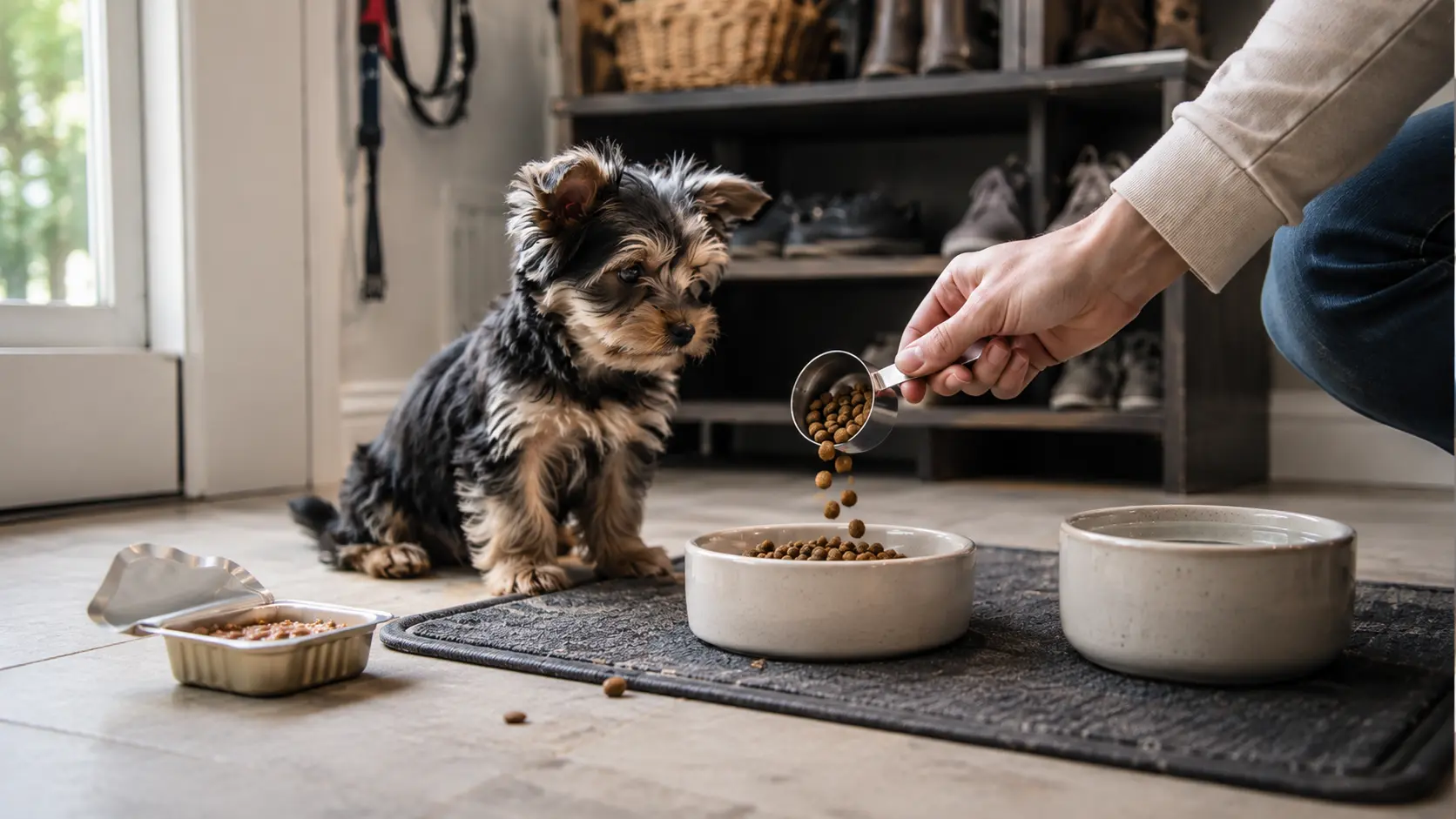
Choosing small breed puppy food is about more than finding a bag with a tiny dog on the front. The food first needs to work as a complete diet for puppy growth. After that, expected adult size, calorie density, kibble size, feeding amount, texture, ingredients, and your puppy’s individual tolerance all matter.
For this guide, we compared formulas specifically designed for small or toy-breed puppies and looked at current manufacturer information, nutritional profiles, retailer availability, and recurring customer feedback. We also considered what each food does differently rather than ranking products by star ratings alone.
Our Best Overall pick is Purina Pro Plan Puppy Small Breed Chicken & Rice, but it will not be the right fit for every puppy. If you want a broader look at puppy diets across sizes and food types, see our complete puppy food guide.
Affiliate disclosure: LumaPaw may earn a commission from qualifying purchases made through links on this page, at no extra cost to you. Our product choices are based on research and comparison, not commission rate.
Best Small Breed Puppy Food: Our Top Picks
Purina Pro Plan Puppy Small Breed Chicken & Rice — Best Overall
A strong all-around dry option for puppies expected to stay under about 20 pounds as adults. It combines bite-size kibble, 482 kcal per cup, DHA, and guaranteed probiotics.
Best for: Most small-breed puppies that tolerate the formula well.
Royal Canin Small Puppy — Best for Picky Puppies
Designed for puppies from about 2 to 10 months that are expected to mature between 9 and 22 pounds. Its small kibble and strong palatability feedback make it particularly interesting for selective eaters.
IAMS Proactive Health Smart Small Breed Puppy — Best Budget
One of the clearest value options we found that still has genuine small-breed puppy positioning, DHA, small kibble, and a solid 30% protein and 18% fat profile.
Hill’s Science Diet Puppy Small & Mini — Best Digestive-Support Formula
A small-and-mini puppy formula built around Hill’s prebiotic-fiber approach, with DHA and small kibble. We prefer the careful label “digestive-support formula” rather than claiming it treats sensitive stomachs.
Purina Pro Plan Puppy Toy Breed — Best for Toy Breeds
A more specialized option for puppies expected to remain under 10 pounds. It has exceptionally small kibble and a high energy density of 533 kcal per cup.
Eukanuba Puppy Small Breed — Best Higher-Fat Dry Formula
With 32% protein, 21% fat, and 465 kcal per cup, Eukanuba has the highest declared fat level among our main standard small-breed dry picks.
Purina Pro Plan Small Breed Puppy Chicken & Brown Rice Entrée — Best Wet Food
A complete wet puppy food formulated specifically for smaller breeds. Each 5.5-ounce can provides about 200 calories and offers a softer alternative to kibble.
How We Researched and Chose These Small Breed Puppy Foods
Puppy Growth Suitability Came First
A food did not make the list simply because it was marketed for small dogs. We first looked for formulas intended as complete diets for puppy growth.
That distinction matters. An adult small-breed food may have tiny kibble and excellent reviews, but it is still the wrong type of product for a young puppy roundup.
We also avoided wording such as “AAFCO approved.” AAFCO does not individually approve pet foods. What matters is the nutritional adequacy information associated with the formula.
We Checked Expected Adult Size
There is no single universal weight cutoff used by every manufacturer.
Royal Canin Small Puppy, for example, is aimed at puppies expected to reach roughly 9 to 22 pounds as adults, while Purina Pro Plan Toy Breed focuses on puppies expected to remain under 10 pounds.
That is why expected adult weight is more useful than simply looking at how small your puppy is today.
Calories, Protein and Fat Were Compared in Context
Higher numbers are not automatically better.
A calorie-dense food may be useful when a tiny puppy needs substantial energy from a small volume of food, but feeding directions, age, activity, body condition, and the puppy’s actual needs still matter.
The same applies to protein and fat. We compared them rather than automatically rewarding whichever bag had the highest percentage.
Customer Feedback Was Used Carefully
Reviews helped identify practical patterns such as:
- kibble being too large or very small
- selective puppies refusing or readily eating a formula
- packaging complaints
- price concerns
- reports of loose stool or poor tolerance
Customer reviews are useful signals, but they do not prove that a food causes or treats a medical problem.
The 7 Best Small Breed Puppy Foods Reviewed

Purina Pro Plan Puppy Small Breed Chicken & Rice — Best Overall
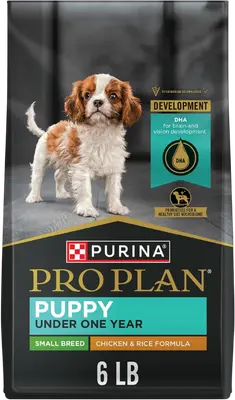
Best for: Most small-breed puppies within the manufacturer’s size guidance.
Avoid if: Your veterinarian has recommended avoiding one of its animal proteins or other ingredients.
Honest buying note: It is our first choice for balance, not because every small puppy needs Purina Pro Plan.
Purina Pro Plan earns our Best Overall position because it has no major weakness in the areas that matter most for this article.
The formula is intended for puppies expected to remain under about 20 pounds and provides 482 kcal per cup, 33% protein, and 20% fat. It also contains DHA and guaranteed Bacillus coagulans probiotics.
The kibble is sized for smaller dogs, and the 6- and 18-pound bags give owners some flexibility without forcing them to buy an oversized package.
Its ingredient list includes chicken along with several other animal proteins and grains. That is not inherently a problem, but it makes this a poor choice if a veterinarian has already identified one of those ingredients as unsuitable for your puppy.
Pros
- Excellent small-breed relevance
- DHA and guaranteed probiotics
- Energy-dense formula
- Useful bag-size options
- Broad retailer availability
Cons
- Complex ingredient profile
- Some buyers report confusion when packaging or formula naming changes
- May not be ideal for exceptionally tiny toy puppies

Royal Canin Small Puppy — Best for Picky Puppies
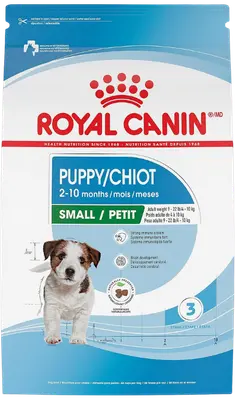
Best for: Selective puppies within the 9–22-pound expected adult range.
Avoid if: Cost per pound is a major concern.
Royal Canin has one of the clearest size and age targets in this group: puppies roughly 2 to 10 months old that are expected to mature between 9 and 22 pounds.
The formula provides about 349 kcal per cup, 29% protein, and 18% fat. That calorie figure is lower than several competitors, which is a good example of why we do not use a universal “higher calories is better” rule.
Its strongest case is palatability. Royal Canin specifically pays attention to kibble design and food acceptance, and customer feedback repeatedly includes puppies eating it willingly when owners had struggled with other foods.
Pros
- Precise adult-weight range
- Small puppy-focused kibble
- Strong palatability feedback
- Prebiotic and digestive-support components
Cons
- Expensive compared with IAMS or Purina
- Not designed for puppies expected to remain below Royal Canin’s stated Small range
- No food can guarantee success with a picky eater

IAMS Proactive Health Smart Small Breed Puppy — Best Budget
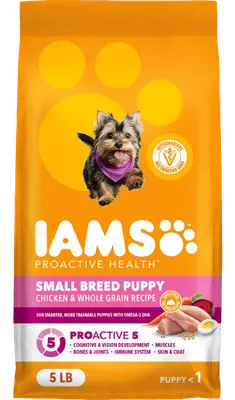
Best for: Owners looking for a lower-cost small-breed puppy kibble.
Honest buying note: It earns the budget position because of value, not because it is simply the cheapest bag we found.
IAMS stood out because its lower price did not require moving to a generic adult or all-breed product.
It remains a genuine small-breed puppy food with 454 kcal per cup, 30% protein, 18% fat, and DHA.
Its ingredient list includes chicken, chicken by-product meal, corn, rice, sorghum, soybean meal, egg, and other ingredients. We would not label those ingredients “bad,” but owners who need a simpler or more restricted formula should look elsewhere.
Pros
- Strong value
- Small-breed puppy formulation
- DHA
- Small kibble
- Solid calorie and macronutrient profile
Cons
- Less specialized than some premium options
- Not suitable for every known ingredient intolerance
- Some individual reports of gas or loose stool

Hill’s Science Diet Puppy Small & Mini — Best Digestive-Support Formula
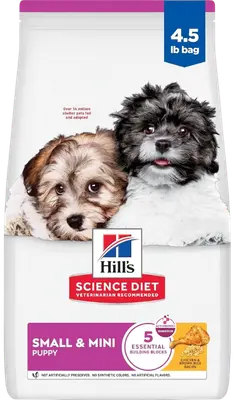
Best for: Owners who prioritize a prebiotic-fiber approach and small kibble.
Hill’s offers a noticeably different profile from the richer Purina and Eukanuba formulas.
It provides about 418 kcal per cup, 24% protein, and 15% fat, along with DHA and Hill’s current prebiotic-fiber approach.
That makes it a reasonable choice for an owner who values digestive-support features without assuming that the highest protein or fat number must be superior.
Customer feedback commonly mentions the very small kibble and good tolerance, but persistent diarrhea, vomiting, poor appetite, or suspected food allergy needs veterinary attention rather than repeated food switching.
Pros
- Small & Mini puppy formulation
- Prebiotic-fiber digestive support
- Small kibble
- DHA
- Strong retailer availability
Cons
- Lower protein and fat than several finalists
- Not a budget formula
- “Digestive support” should not be confused with treatment for gastrointestinal disease

Purina Pro Plan Puppy Toy Breed — Best for Toy Breeds
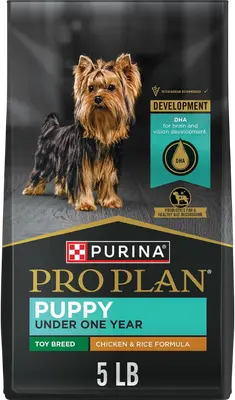
Best for: Chihuahuas and other puppies expected to remain toy-sized.
This is the most specialized dry food in our final lineup.
Purina targets it to puppies expected to remain under 10 pounds, with extremely small kibble and 533 kcal per cup. It also provides 34% protein, 20% fat, DHA, and guaranteed probiotics.
That higher calorie density can make sense for tiny puppies that need substantial energy without eating a large volume, but portions still need to follow the puppy’s actual needs.
One limitation is also part of its main selling point: the pieces are very small. A fast gulper may swallow them quickly rather than chew.
Pros
- Clear under-10-pound target
- Very small kibble
- High energy density
- DHA and probiotics
- Strong protein/fat profile
Cons
- Tiny pieces may not suit fast gulpers
- Narrower use case than general small-breed formulas
- Only useful if the puppy truly fits the toy-size target

Eukanuba Puppy Small Breed — Best Higher-Fat Dry Formula
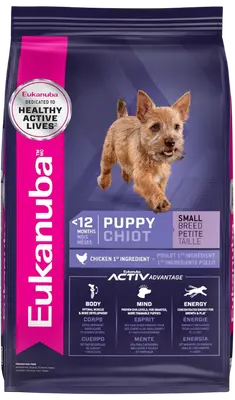
Best for: Owners specifically comparing richer small-breed dry formulas.
Eukanuba provides 32% protein, 21% fat, and about 465 kcal per cup for puppies expected to mature under roughly 23 pounds.
The 21% fat level is the highest among our main standard small-breed dry foods, which is why we use the factual label “Best Higher-Fat Dry Formula.”
We would not call it the healthiest formula or automatically recommend it for every active puppy. A richer food is not necessarily a better one if the puppy does not need that energy intake.
Pros
- Exact small-breed puppy target
- 32% protein
- Highest declared fat among our standard dry picks
- DHA
- Multiple bag sizes
Cons
- Richer formulation is unnecessary for some puppies
- Some owners consider it expensive
- Kibble may feel relatively thick for extremely tiny puppies

Purina Pro Plan Small Breed Puppy Chicken & Brown Rice Entrée — Best Wet Food
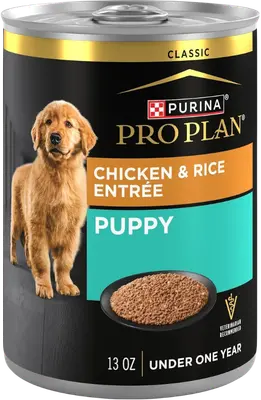
Best for: Owners who want a complete wet option for a small puppy.
For a broader comparison of canned, soft, and moist formulas, see our wet puppy food comparison.
This Purina formula gives small-puppy owners a genuine wet-food option rather than forcing an all-breed puppy can into the list.
It is a complete puppy food, and each 5.5-ounce can provides about 200 calories. Its guaranteed analysis includes 10% protein and 7.5% fat as fed, plus DHA.
Those percentages should not be compared directly with dry-food protein and fat because wet food contains far more moisture.
Wet feeding can also become more expensive on a daily basis, especially as calorie needs rise.
Pros
- Small-breed puppy-specific
- Complete wet meal
- Soft texture
- 200 kcal per can
- DHA
- Useful for wet or mixed feeding
Cons
- More expensive than dry feeding for many owners
- Open cans require proper refrigeration
- Current customer-feedback evidence is less extensive than for several dry finalists
What Makes Small Breed Puppy Food Different?
Expected Adult Size Matters
A five-pound puppy today could mature into a toy dog, a small dog, or something larger. Food selection should therefore consider expected adult size rather than current weight alone.
If your puppy is expected to become a much larger dog, our guide to food for puppies expected to become large dogs covers that different growth situation.
Small Kibble Can Be More Practical
Tiny kibble can be easier for small mouths to handle. That is a practical advantage, not proof that a food is nutritionally superior.
For especially small toy puppies, the difference can be meaningful. Purina’s Toy Breed formula, for example, is much more specialized than a standard small-breed kibble.
“Small Breed” Does Not Replace Growth Suitability
This is the most important distinction.
A bag can say “small breed” and still be designed for adult dogs. For a puppy, growth-stage suitability comes first. Size-specific features such as kibble dimensions, calorie density, and expected adult-weight ranges come after that.
Small Breed Puppy Food vs Regular Puppy Food
A small puppy does not automatically require a food carrying the words “small breed.”
A general puppy formula can still be appropriate if it is complete for growth and works for the puppy’s size, feeding needs, and ability to manage the food.
Small-breed formulas can be more practical because manufacturers may adjust:
- kibble size
- calorie concentration
- feeding portions
- adult-weight targeting
For broader comparisons across puppy food types, see our guide to puppy foods for dogs of different sizes.
Small Breed vs Toy Breed Puppy Food
“Small” and “toy” are not standardized into one universal cutoff across every brand.
Instead, check the manufacturer’s adult-weight range.
Purina Pro Plan Small Breed is aimed at puppies expected to remain under roughly 20 pounds, while its Toy Breed formula narrows that target to under 10 pounds and uses exceptionally small kibble.
For a Chihuahua-sized puppy, that difference can be more useful than a generic “small dog” label.
Dry vs Wet Food for Small Breed Puppies
Dry food usually gives owners more choices, easier storage, simple measuring, and a lower cost per day.
Wet food adds moisture and a softer texture, which some puppies prefer. The tradeoff is usually cost and more careful storage after opening.
You can also mix wet and dry puppy food if both products are appropriate and you adjust the total amount rather than simply adding a full wet portion on top of a full dry ration.
How to Choose the Best Puppy Food for a Small Breed
Start with the label, not the marketing language.
Check that the exact food is intended as a complete diet for puppy growth. Then compare the manufacturer’s expected adult-weight range with your puppy.
Look at calories alongside feeding directions. A more calorie-dense food is not automatically superior if it results in overfeeding.
Protein and fat deserve the same treatment. They are useful comparison points, but chasing the highest percentages is not a reliable way to choose food.
Ingredient lists can help identify relevant proteins or ingredients your puppy has been advised to avoid. They should not be turned into a simple ranking based on whichever food lists meat first or uses words such as “natural” or “premium.”
Finally, look at practical details:
- kibble size
- package size
- how quickly one small puppy will finish the bag
- current price
- availability
- recurring customer complaints
- how well your puppy actually tolerates the food
Small Breed Puppy Food Safety and Quality Checklist
Before changing foods:
- Confirm the exact formula is intended as a complete diet for puppy growth.
- Match the manufacturer’s size guidance to expected adult weight.
- Follow the feeding instructions and monitor body condition.
- Change foods gradually rather than switching abruptly.
- Keep dry food sealed and store opened wet food as directed.
- Recheck the ingredient list if packaging or formula information changes.
- Watch for persistent vomiting, diarrhea, poor appetite, itching, or abnormal growth.
Contact your veterinarian if your puppy has ongoing digestive problems, suspected allergies, poor growth, a health condition, or difficulty maintaining an appropriate body condition.
Feeding and Switching Small Breed Puppy Food
Young puppies generally need multiple meals during the day because they cannot eat a large amount at one sitting. The exact number and portion size depend on age, body weight, the specific food, and the manufacturer’s feeding instructions. Our puppy feeding schedule explains how meal frequency typically changes as puppies grow.
When changing formulas, transition gradually unless your veterinarian advises otherwise. Mixing increasing amounts of the new food with decreasing amounts of the previous food can help reduce abrupt dietary changes.
Small dogs often mature sooner than large breeds, but there is no single switch-to-adult-food age that fits every dog. Adult size, breed, growth, and veterinary guidance all matter. Our guide to when to switch a puppy to adult food covers the timing and gradual transition in more detail.
Frequently Asked Questions About Small Breed Puppy Food
What is the best small breed puppy food?
There is no single best food for every puppy. Look for a complete growth diet that fits your puppy’s expected adult size, calorie needs, feeding amount, and food tolerance. Among our researched options, Purina Pro Plan Small Breed provides the strongest overall balance.
Can a puppy eat small breed food?
Yes, if the exact small-breed formula is intended for puppy growth. Do not assume an adult small-breed food is appropriate simply because the kibble size looks suitable.
Can an 8-week-old puppy eat small breed puppy food?
An 8-week-old puppy can usually eat an age-appropriate complete puppy food, including a small-breed formula when it fits the puppy’s expected adult size. Follow the feeding instructions and ask your veterinarian if the puppy has recently been weaned, is underweight, or has feeding difficulties.
Can a small breed puppy eat large breed puppy food?
It is better to choose a food designed for the puppy’s expected adult size. Large-breed puppy formulas are created around a different growth situation, so they should not be chosen just because another puppy in the household eats them.
Can I substitute small breed adult food for puppy food?
Not as a routine substitute. Adult-maintenance food and puppy-growth food are designed for different life stages. Check the nutritional adequacy statement rather than relying on kibble size or brand family.
How long do small breed puppies need puppy food?
Small breeds often reach maturity earlier than large breeds, but the right transition point depends on breed, expected adult size, individual growth, and the formula being fed. Use manufacturer guidance and ask your veterinarian when the timing is uncertain.
Is wet or dry food better for small breed puppies?
Neither format is automatically better. Dry food is usually more economical and convenient, while wet food provides a softer texture and more moisture. Both can work when they are complete for growth and fed in appropriate amounts.
Final Verdict: Which Small Breed Puppy Food Should You Choose?
The best small breed puppy food is the one that fits your puppy’s growth stage, expected adult size, feeding needs, and tolerance—not simply the product with the highest protein level or most reviews.
Purina Pro Plan Small Breed Puppy is our Best Overall pick. Royal Canin Small Puppy stands out for selective eaters, IAMS offers the strongest budget case, Purina Toy Breed is more specialized for puppies expected to remain under 10 pounds, and Purina Pro Plan Small Breed Puppy Entrée is our preferred wet option.
Whichever formula you choose, check the exact label, feed to body condition rather than blindly following a cup amount, and involve your veterinarian if growth, appetite, digestion, or food tolerance becomes a concern.