

Wet puppy food can be a full daily diet, part of a mixed-feeding routine, or simply a softer option for puppies that do not take easily to kibble. The format can range from pâté and chopped canned food to stew, slices in gravy, trays, and ultra-soft mousse.
What matters most is not whether a recipe looks expensive or has an appealing ingredient list. A growing puppy needs food that is nutritionally appropriate for growth, provides enough calories for its size and age, and works in real life for your budget and feeding routine.
After comparing puppy-specific formulas, calorie content, ingredients, texture, package size, retailer availability, and customer feedback, these are the seven wet dog foods for puppies that stand out for different needs. For a broader look at dry, wet, and other formats, see our complete puppy food guide.
Disclosure: LumaPaw may earn a commission from qualifying purchases made through links on this page, at no additional cost to you.
Our Top Wet Puppy Food Picks
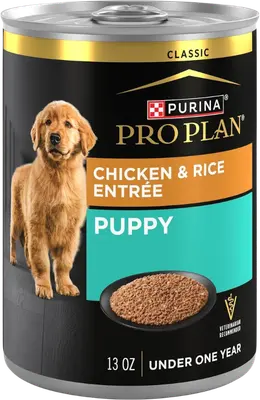
Best Overall: Purina Pro Plan Development Puppy Chicken & Rice Entrée
Best for: Most puppies when you want a conventional complete canned food
Texture: Pâté
Size: 13-oz can
Calories: 437 kcal per can
Main limitation: Contains several animal proteins rather than a restricted protein list
Purina Pro Plan offers the strongest overall balance in this group. It is puppy-specific, calorie-dense enough to be practical as a main food, includes DHA, and has broad suitability rather than solving only one narrow need.
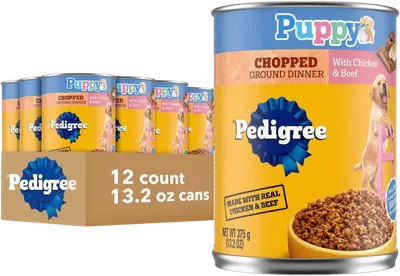
Best Budget: Pedigree Puppy Chopped Ground Chicken & Beef
Best for: Owners trying to keep the cost of an all-wet or mixed diet manageable
Texture: Chopped/minced
Size: 13.2-oz can
Calories: 421 kcal per can
Main limitation: Not our choice as a sole diet for puppies expected to reach 70 pounds or more
The main advantage here is straightforward: it offers puppy-specific canned food at a lower ongoing cost than most of the premium alternatives.
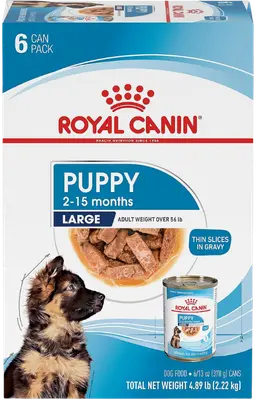
Best for Large-Breed Puppies: Royal Canin Large Puppy Thin Slices in Gravy
Best for: Puppies expected to weigh about 56–100 pounds as adults
Texture: Thin slices in gravy
Size: 13-oz can
Calories: 320 kcal per can
Main limitation: Expensive for exclusive wet feeding
This one earns its place because the large-breed positioning is genuine rather than just a retailer filter.
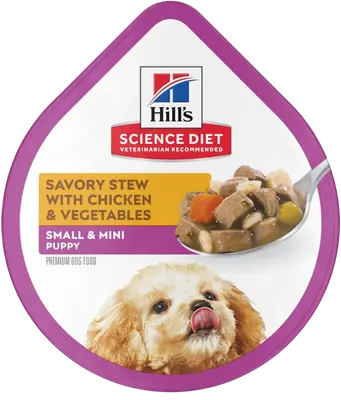
Best for Small Puppies: Hill’s Science Diet Puppy Small & Mini Savory Stew
Best for: Toy and small puppies that do not need a large opened can
Texture: Stew
Size: 3.5-oz tray
Calories: 90 kcal per tray
Main limitation: High cost per calorie
The small tray and small food pieces make this one particularly practical for little puppies.
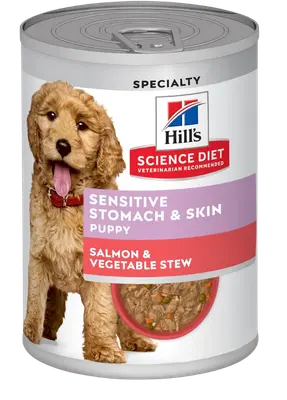
Best for Sensitive Stomachs: Hill’s Science Diet Puppy Sensitive Stomach & Skin
Best for: Puppies needing a formula specifically positioned around digestive and skin sensitivity
Texture: Chunks/stew in gravy
Size: 12.5-oz can
Calories: 309 kcal per can
Main limitation: Contains chicken, pork, salmon, and egg
This is not a chicken-free, limited-ingredient, or hypoallergenic food despite the salmon recipe name.
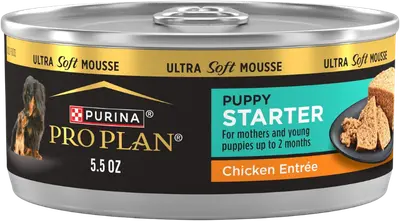
Best for Weaning Puppies: Purina Pro Plan Puppy Starter Mousse
Best for: Very young puppies transitioning from nursing toward solid food
Texture: Ultra-soft mousse
Size: 5.5-oz can
Calories: 188 kcal per can
Main limitation: A specialist early-life formula rather than the obvious choice for an older puppy
Its genuinely different texture and early-life purpose separate it from conventional canned puppy foods.
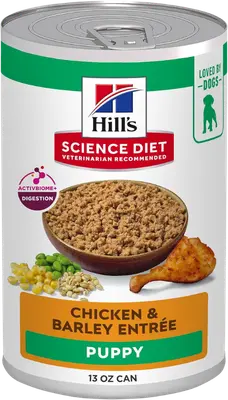
Best Loaf-Style Option: Hill’s Science Diet Puppy Chicken & Barley Entrée
Best for: Puppies and owners who prefer a firm traditional loaf instead of stew or gravy
Texture: Loaf/minced entrée
Size: 13-oz can
Main limitation: Less differentiated from the Best Overall choice
This is primarily a texture alternative rather than a food with a completely different nutritional use case.
How We Chose the Best Wet Puppy Foods
We did not rank these foods by star ratings alone. The selections and positions are based on the product information, nutritional details, retailer listings, customer feedback, limitations, and comparisons supplied during our product research.
Growth Suitability Came First
A food intended to be the puppy’s main diet needs to provide appropriate nutrition for growth. That is more important than claims such as “premium,” “natural,” or “high protein.”
We also looked more closely at large-breed suitability because a generic puppy label does not automatically mean a formula is appropriate for every expected adult size.
For toppers, mixers, and treats, the standards are different because those products are not intended to provide the entire diet.
We Compared Calories and Portion Practicality
Can size alone tells you very little.
A small tray can look cheaper until you calculate how many trays a growing puppy needs each day. On the other hand, a 13-oz can may create unnecessary leftovers when feeding a tiny puppy.
Calories per container, feeding volume, puppy size, and package size all matter.
Ingredients Were Considered in Context
We looked at the main animal proteins, common allergens, DHA, and other relevant ingredients without treating the ingredient list as a simple ranking system.
A recipe with several animal proteins may work perfectly well for many puppies but be inconvenient if you are trying to identify a suspected food sensitivity. Likewise, a salmon recipe is not automatically chicken-free.
Texture Matters More Than It Seems
Pâté, chopped food, stew, slices in gravy, loaf, and mousse feel very different in the bowl.
Texture can matter for a puppy transitioning from milk, a small puppy handling bigger pieces, or a picky eater that accepts one consistency more readily than another.
That does not make one texture nutritionally superior.
We Looked at Value, Availability, and Complaints
A food that is difficult to buy consistently is less useful as an everyday diet.
We considered Amazon and Chewy availability along with package sizes, customer feedback, price positioning, acceptance, and recurring complaints. Reviews were treated as practical evidence about issues such as palatability, packaging, and individual tolerance—not as proof that one food is nutritionally better than another.
The 7 Best Wet Puppy Foods

Purina Pro Plan Development Puppy Chicken & Rice Entrée — Best Overall
Best for: Puppies without known dietary restrictions that need a mainstream wet food for daily feeding or mixing with kibble.
Avoid if: You are trying to isolate a particular animal protein because of a suspected food reaction.
Common complaints: As with many canned foods, some customer feedback mentions damaged or dented cans. Individual puppies can also reject the texture or experience digestive upset when a food does not agree with them.
Buying note: This is the most sensible starting point in the roundup when you do not need a breed-size, sensitivity, or weaning-specific formula.
Purina Pro Plan Development Chicken & Rice is our Best Overall because it does not depend on a narrow use case. It works as a conventional canned puppy food for a broad range of growing dogs while still providing substantial calories in each 13-oz can.
Chicken is the first listed ingredient, followed by other animal ingredients including liver and salmon. The formula provides DHA and is sold as complete and balanced nutrition for puppies.
At 437 calories per can, it is considerably more practical for feeding larger or fast-growing puppies than some lower-calorie wet foods. Purina also provides instructions for replacing part of its dry puppy food with canned food, which is useful for mixed feeding.
The tradeoff is the relatively broad protein mix. This is not the product we would choose when an owner needs a restricted-protein diet.
Pros
- Puppy-specific complete nutrition
- 437 kcal per 13-oz can
- Chicken listed first
- Includes DHA
- Useful for wet-only or mixed feeding
Cons
- Multiple animal protein sources
- Large cans may be inconvenient for very small puppies

Pedigree Puppy Chopped Ground Chicken & Beef — Best Budget
Best for: Small and medium puppies when ongoing food cost is an important consideration.
Avoid if: Your puppy is expected to become a large or giant adult and the current label does not cover that growth category.
Common complaints: Dented cans appear in some retailer feedback. Palatability is generally well represented in the supplied reviews, but acceptance still varies by puppy.
Buying note: Its reason for inclusion is value, not because we consider a cheaper food automatically equivalent for every puppy.
Feeding wet food exclusively can become expensive quickly, especially once a puppy starts eating several hundred calories a day. Pedigree Puppy Chopped Ground Chicken & Beef is the value-focused option in this list.
The recipe provides complete puppy nutrition, uses chicken and beef, includes fish oil as a source of DHA, and supplies about 421 calories per 13.2-oz can.
The chopped texture is softer than kibble but less uniform than a smooth pâté, and it can also be mixed into dry food.
Where this food needs more caution is large-size growth. Based on the nutritional adequacy information reviewed for this product, we would not choose it as the sole diet for a puppy expected to reach 70 pounds or more as an adult.
Owners of large and giant puppies should use a formula whose adequacy statement clearly covers their growth needs and can also read our large-breed puppy nutrition guide.
Pros
- Lower-cost option
- Approximately 421 kcal per can
- DHA from fish oil
- Can be fed alone or mixed with kibble
- Widely available
Cons
- Not our all-size recommendation
- Contains multiple animal ingredients
- Includes added color

Royal Canin Large Puppy Thin Slices in Gravy — Best for Large-Breed Puppies
Best for: Large puppies whose owners specifically want a wet formula intended for large-size growth.
Avoid if: You need the lowest-cost way to provide most of a large puppy’s calories.
Common complaints: Price is the clearest recurring drawback. Individual reviewers also report occasional dislike of the smell or digestive intolerance, which can happen with any formula.
Buying note: This is a much stronger choice for the “large-breed” position than forcing a generic puppy food into the category.
Royal Canin Large Puppy earns one of the strongest specialist positions in this roundup.
It is formulated for puppies from roughly 2 to 15 months with an expected adult weight of 56–100 pounds. That makes it more useful for a large puppy than simply choosing a generic canned food from a retailer’s “large breed” filter.
The food comes as soft slices in gravy and provides about 320 calories per 13-oz can. The formula includes DHA and is specifically designed around large-puppy growth.
The main drawback is cost. At only 320 calories in a full-size can, feeding a growing large dog exclusively with this product can require several cans per day. That makes it much more expensive than using it as part of a mixed feeding plan.
Pros
- Specifically formulated for large puppies
- Large-size growth suitability
- Soft slices in gravy
- DHA included
Cons
- Premium cost
- Only about 320 kcal per 13-oz can
- Multiple animal ingredients

Hill’s Science Diet Puppy Small & Mini Savory Stew — Best for Small Puppies
Best for: Toy and small puppies that benefit from smaller portions and small food pieces.
Avoid if: You are feeding a larger puppy or trying to minimize food cost per calorie.
Common complaints: Price is an obvious limitation. As with other stew-style foods, individual puppies may prefer a smoother pâté or firmer loaf.
Buying note: The small package is the real differentiator here. Owners of tiny puppies should not have to buy an oversized can simply because it looks cheaper on the shelf. If you’re comparing wet and dry options for a puppy expected to stay small, our small-breed puppy food guide covers the broader size-specific choices.
A 13-oz can makes sense for a growing Labrador. It can be awkward for a four-pound puppy.
Hill’s Small & Mini Savory Stew solves that practical problem with a 3.5-oz tray containing about 90 calories. The smaller package makes it easier to portion meals without keeping a large opened can in the refrigerator.
The texture is a soft chicken-and-vegetable stew rather than a dense pâté. Hill’s also includes DHA from fish oil and positions the formula specifically for small and miniature puppies.
That convenience costs more. On a calorie-for-calorie basis, the trays are expensive compared with large canned foods.
Pros
- 3.5-oz portion
- About 90 kcal per tray
- Small/mini puppy formulation
- Soft stew texture
- DHA from fish oil
Cons
- Expensive per calorie
- Small trays become impractical for bigger puppies
- Contains several animal ingredients including chicken and pork

Hill’s Science Diet Puppy Sensitive Stomach & Skin — Best for Sensitive Stomachs
Best for: Puppies whose owners want a non-prescription formula specifically positioned for digestive and skin sensitivity.
Avoid if: You are avoiding chicken, pork, egg, or using a veterinary elimination-diet plan.
Common complaints: Some owners report that their puppies dislike the smell or texture, while others report diarrhea or other digestive problems. Those experiences are individual and should not be treated as proof that the food is universally good or bad for sensitive dogs.
Buying note: Persistent diarrhea, vomiting, itching, poor growth, or suspected food allergy warrants veterinary guidance rather than repeatedly switching foods.
Hill’s Sensitive Stomach & Skin is the specialist option for puppies whose owners are looking for digestive and skin-support positioning rather than a standard chicken pâté.
The Salmon & Vegetable Stew provides around 309 calories per 12.5-oz can. Hill’s describes the formula around digestibility, prebiotic fiber, skin support, and antioxidants.
There is an important limitation hidden behind the recipe name: this is not a chicken-free salmon food.
The ingredient list includes chicken broth, pork liver, salmon, chicken fat, egg, and chicken-derived flavor ingredients. It should therefore not be treated as a limited-ingredient, hypoallergenic, or elimination diet.
That distinction matters because a puppy with recurring digestive or skin problems needs a veterinary assessment rather than guesswork based on the name on a can.
Pros
- Sensitivity-specific formulation
- 309 kcal per can
- Salmon included
- Stew texture
Cons
- Not chicken-free
- Multiple animal proteins
- More expensive than basic canned puppy food
- Individual sensitive puppies may still not tolerate it

Purina Pro Plan Puppy Starter Mousse — Best for Weaning Puppies
Best for: Young puppies starting the transition from nursing to solid food.
Avoid if: Your puppy is fully weaned and comfortable with ordinary pâté, stew, or kibble.
Common complaints: The available feedback base is much smaller than for long-established products such as Purina’s regular Puppy Chicken & Rice or Pedigree Puppy.
Buying note: Very young or poorly thriving puppies should not be managed by food choice alone. Weaning problems, failure to gain weight, vomiting, diarrhea, or poor appetite should be discussed with a veterinarian.
Most canned puppy foods are designed for puppies already eating solid meals. Purina Pro Plan Starter Mousse addresses an earlier stage.
The food has an ultra-soft mousse texture and is formulated for puppies transitioning through weaning, as well as the high energy needs of nursing mothers. Purina’s feeding instructions begin offering the food at around three to four weeks of age and continue through weaning.
Each 5.5-oz can provides about 188 calories. Chicken is the first ingredient, and the recipe includes fish oil and DHA.
Its narrow purpose is also its biggest limitation. There is little reason to choose a specialist starter mousse over a good conventional puppy food for an older puppy that already eats solid meals comfortably.
Pros
- Ultra-soft mousse texture
- Specific weaning use case
- 188 kcal per can
- Chicken first
- DHA included
- Can also support nursing mothers according to the feeding directions
Cons
- Specialist rather than general-purpose food
- Smaller retailer-review history
- More expensive than basic canned foods

Hill’s Science Diet Puppy Chicken & Barley Entrée — Best Loaf-Style Wet Puppy Food
Best for: Puppies that prefer a dense traditional loaf rather than chunky or gravy-heavy wet food.
Avoid if: Texture does not matter to you and you want the most broadly useful option; Purina Pro Plan is the stronger general pick.
Common complaints: Some owners find dense loaf-style foods drier or firmer than expected. Packaging damage can also occur with shipped canned food.
Buying note: Choose this for the format, not because loaf-style food is nutritionally superior.
Hill’s Chicken & Barley overlaps more with our Best Overall choice than any other food here, which is why we would not invent a premium or “healthiest” award for it.
Its reason for inclusion is simpler: texture.
This is a traditional, firm canned entrée rather than stew, gravy, or mousse. Some puppies and owners prefer that denser consistency, particularly when spooning small amounts into kibble or portioning food from a large can.
The recipe uses chicken with whole-grain corn, barley, pork liver, fish oil, and other ingredients. Hill’s positions it as puppy nutrition and provides feeding directions across puppy growth stages.
Pros
- Traditional loaf-style texture
- 13-oz can
- Puppy-specific feeding directions
- Established product and retailer presence
- Suitable as an alternative to stew or gravy textures
Cons
- Less distinctive nutritionally than the other specialist picks
- Firm texture will not appeal to every puppy
- Large can may be inconvenient for small puppies
What Counts as Wet, Canned, Soft, and Moist Puppy Food?
The wording around puppy food gets messy because shoppers often use several terms for similar products.
Wet and Canned Puppy Food
Canned puppy food is one type of wet puppy food, but not every wet product comes in a can.
Wet foods can also come in trays or pouches, and textures range from smooth pâté to stew, minced food, mousse, and chunks or slices in gravy.
That is why this guide keeps wet puppy food, canned puppy food, and closely related moist formats together instead of creating several nearly identical roundups.
What Does “Soft Puppy Food” Mean?
Soft puppy food often means canned or wet food, especially when an owner wants something easier to eat than dry kibble.
But the phrase can also describe kibble that has been softened with water or another appropriate liquid.
A soft texture does not tell you whether the food is nutritionally complete. Check the label rather than assuming any soft product can replace a puppy’s regular meals.
What About Moist Puppy Food?
“Moist” is often used casually as another way of describing food with much more water than kibble.
For this article, pâté, stew, gravy, mousse, canned food, and wet trays all fall under the same practical shopping intent.
Fresh refrigerated and subscription foods are a separate format and are not included simply to make this product list longer.
How to Choose Wet Puppy Food
The front of a can can tell you the flavor, texture, and a long list of benefits. For a growing puppy, the more useful information is usually on the back.
Start With the Nutritional Adequacy Statement
If wet food will make up most or all of your puppy’s diet, look for a nutritional adequacy statement showing that it is complete and balanced for growth.
That distinction separates a full meal from products intended only as toppers, treats, or supplemental foods.
Large-breed owners need to read the statement even more carefully. Some puppy foods are appropriate for growth but specifically exclude dogs expected to reach 70 pounds or more as adults.
Also avoid treating phrases such as “AAFCO approved” as a quality badge. AAFCO does not approve, certify, or endorse individual pet foods.
Check Your Puppy’s Expected Adult Size
A five-pound toy puppy and a growing Great Dane do not have identical nutritional or practical needs.
For small puppies, portion size can matter. A 3.5-ounce tray may create less waste than opening a 13-ounce can for every meal.
For larger puppies, nutritional suitability matters more than package convenience. Look for a diet whose adequacy statement covers large-size growth when that applies.
If your puppy is likely to become a large adult, our guide to choosing food for a large-breed puppy goes into that issue in more detail.
Compare Calories, Not Just Can Size
A larger can is not automatically better value.
For example, the products in this guide range from around 90 calories in a small tray to more than 400 calories in a full-size can. That changes how many containers you may need each day.
When comparing price, consider:
- calories per container
- how much your puppy actually needs
- whether you feed wet food alone or with kibble
- how much opened food is likely to be wasted
Cost per 100 calories is often more useful than simply comparing the shelf price of two differently sized packages.
Consider Protein Sources and Allergens
Ingredient lists are useful, but they need context.
A puppy without food sensitivities does not automatically need a single-protein or grain-free food. On the other hand, owners investigating a suspected reaction should pay attention to every animal ingredient, not just the recipe name.
Hill’s Sensitive Stomach & Skin Salmon & Vegetable, for example, still contains chicken and pork ingredients. The word “salmon” on the front does not make it a chicken-free food.
If your puppy has persistent itching, vomiting, diarrhea, or another suspected food reaction, work with a veterinarian instead of trying random ingredient exclusions.
Match the Texture and Package Size to Your Puppy
Wet puppy food can vary more in texture than dry food.
Mousse is especially soft and can be useful during weaning.
Pâté or loaf is dense and easy to portion.
Stew or gravy contains softer pieces and more visible liquid.
Chopped or minced food falls somewhere between a smooth pâté and chunky stew.
There is no universally better texture. The practical choice is the one your puppy can eat comfortably and that fits your feeding routine.
Is Wet Food Good for Puppies?
Yes. Puppies can eat wet food as their main diet when the product is complete, balanced, and appropriate for puppy growth.
Wet food has several practical advantages. The soft texture can be easier for young puppies to eat, the higher moisture content adds water to the diet, and some puppies find wet food more appealing than dry kibble.
There are tradeoffs.
Wet food usually costs more per calorie, opened containers require refrigeration, and larger puppies may need several cans per day if fed exclusively on lower-calorie formulas.
It is also important not to assume that wet food is inherently healthier than dry food. Both formats can provide suitable puppy nutrition when the formula is appropriate.
The better question is whether a particular food meets your puppy’s nutritional needs and works for its size, appetite, tolerance, and your budget.
Wet Puppy Food vs Dry Puppy Food
Wet and dry puppy foods solve different practical problems. Neither format automatically wins.
When Wet Food Makes Sense
Wet food can be useful for puppies that:
- prefer softer textures
- are transitioning through weaning
- are reluctant to eat dry kibble
- benefit from extra dietary moisture
- need wet food mixed into kibble to improve acceptance
It can also make portioning medications or creating enrichment meals easier.
When Dry Food May Be More Practical
Dry food is typically easier to store, stays usable longer after opening, and usually provides more calories in a smaller volume.
That can make it more practical for large puppies or households trying to control feeding costs.
Dry food is also easier to measure consistently for mixed feeding.
Do Puppies Need Both?
No.
A puppy does not need both wet and dry food simply because both formats exist. A suitable complete diet can be fed on its own.
Mixed feeding is mainly a practical choice.
For a broader comparison of feeding formats and puppy-food types, see our guide to compare puppy food types.
How Much Wet Food Should You Feed a Puppy?
There is no reliable universal answer in “cans per day.”
One puppy might need less than one large can daily, while another growing puppy could require several. The number depends heavily on the calories in the specific food.
Start with the manufacturer’s feeding guide for the exact formula, then adjust according to:
- your puppy’s current weight
- age
- expected adult size
- activity level
- body condition
- calorie content of the food
- treats and other foods
- whether you are mixing wet and dry food
A 13-ounce can containing more than 400 calories is very different from a 3.5-ounce tray containing around 90 calories.
Young puppies also generally eat their daily allowance across several meals rather than one large serving. Our puppy feeding schedule explains how meal frequency typically changes as puppies grow, while the exact amount still depends on the calorie content of the food and the individual puppy.
Monitor growth and body condition rather than trying to hit an arbitrary number of cans. Your veterinarian can help establish a calorie target if your puppy is underweight, gaining too quickly, has a medical condition, or belongs to a large or giant breed where controlled growth deserves extra attention.
Can You Mix Wet and Dry Puppy Food?
Yes. Wet and dry puppy food can be mixed, provided both fit the puppy’s nutritional needs and the total amount of food is adjusted appropriately.
The main mistake is adding wet food without reducing anything else.
Adjust the Total Calories
Suppose a puppy is already eating its full daily amount of kibble. Adding half a can of wet food on top can significantly increase daily calories.
Instead, treat the wet food as a replacement for part of the dry food, not an automatic bonus meal.
The exact substitution depends on the calorie content of both products.
Don’t Add a Full Wet Portion to a Full Dry Portion
This is especially easy to do when wet food is used to encourage a picky puppy to eat.
A spoonful used mainly for flavor may have a modest calorie impact. A full can can be very different.
Check the calories on both packages and keep treats in the same daily calorie picture.
Transition Gradually
When introducing a new wet food, gradually increase the new food while decreasing the old diet over several days.
Many manufacturers recommend around a week, although some puppies with sensitive digestion may benefit from a slower change.
If diarrhea, vomiting, or poor appetite persists rather than settling during a transition, contact your veterinarian.
When Can Puppies Start Eating Wet Food?
Puppies can begin exploring soft food during the weaning period, when they are gradually moving from their mother’s milk toward solid food. This often starts at roughly three to four weeks of age, but weaning is a gradual process rather than a single day when milk suddenly stops. For a fuller explanation of softened meals, weaning, and the move toward firmer food, see our guide to when puppies can eat solid food.
This often starts at roughly three to four weeks of age, but weaning is a gradual process rather than a single day when milk suddenly stops.
Very young puppies may begin with a soft starter food, mousse, or appropriately prepared puppy food that is easy to lap and swallow. Purina Pro Plan Puppy Starter Mousse is the specialist option in our roundup for this stage.
By the time most puppies go to new homes, they are already eating solid puppy food.
If a very young puppy is orphaned, failing to gain weight, refusing food, or having difficulty weaning, veterinary guidance is important. Feeding a neonatal or poorly thriving puppy is different from choosing wet food for a healthy eight- or ten-week-old puppy.
Wet Puppy Food Safety and Quality Checklist
A good wet puppy food should do more than look appetizing in the bowl.
Before making a food part of your puppy’s regular diet, check these points:
- Confirm it is appropriate for growth. A topper or supplemental food should not silently replace a complete puppy diet.
- Check large-size growth suitability when needed. This matters for puppies expected to become large adults.
- Read the actual label. Retailer categories and search filters can be wrong or overly broad.
- Check every relevant protein source. Recipe names do not always reveal all animal ingredients.
- Transition gradually. Sudden food changes can cause digestive upset.
- Account for calories when mixing foods. Wet food still contributes significant energy.
- Inspect cans and trays before feeding. Avoid swollen, leaking, punctured, badly damaged, or otherwise compromised packaging.
- Follow current storage directions. Refrigerate opened food when required.
- Recheck the label after packaging or formula changes. Ingredients and feeding instructions can change over time.
Occasional food refusal does not automatically indicate a medical problem. Persistent vomiting, diarrhea, poor appetite, weight loss, abnormal growth, significant itching, or repeated digestive problems deserve veterinary attention.
How to Store Opened Wet Puppy Food
Once a can or tray is opened, cover the unused portion and refrigerate it according to the manufacturer’s instructions.
Do not leave an opened container sitting at room temperature for long periods simply because your puppy may return to it later.
Smaller packages can be convenient for toy breeds because there is less leftover food to store. With large cans, a reusable can cover or sealed food-safe container can make refrigeration easier.
Before serving leftovers, check their smell, appearance, and the storage instructions on the package. If food has been left out too long or you are unsure whether it is still safe, throwing it away is the safer choice.
Frequently Asked Questions
What Is the Best Wet Food for Puppies?
For most puppies without special dietary needs, our Best Overall choice is Purina Pro Plan Development Puppy Chicken & Rice Entrée.
It combines complete puppy nutrition, substantial calorie density, DHA, broad growth suitability, and wide retailer availability.
That does not mean it is best for every puppy. Large breeds, very small puppies, weaning puppies, and dogs with dietary sensitivities may be better matched to one of the more specialized options.
How Much Wet Food Should I Feed a Puppy?
Use the feeding directions for the exact product rather than a generic cans-per-day rule.
Calories vary substantially between wet foods. Your puppy’s age, weight, expected adult size, activity, body condition, treats, and any dry food being fed all change the amount required.
Can Puppies Eat Canned Dog Food?
Yes, but look for canned food specifically suitable for puppy growth or all life stages where the adequacy statement covers your puppy.
An adult-only canned food should not replace a complete puppy diet simply because the texture is soft.
Can Puppies Eat Adult Wet Dog Food?
Not as a default everyday diet. Adult-maintenance food is designed for adult dogs rather than growth, so check the nutritional adequacy statement before using an adult-labeled wet food as a meaningful part of a puppy’s diet. As your puppy approaches maturity, our guide to when to switch puppy to adult food explains how the timing changes with size and development.
Can Puppies Eat Wet Food Every Day?
Yes. A puppy can eat wet food every day when it is a complete, balanced diet appropriate for growth and fed in an appropriate amount.
Daily wet feeding is mainly limited by practical issues such as cost, storage, portion size, and how well the puppy tolerates the formula.
Can Large-Breed Puppies Eat Wet Food?
Yes, but the formula should be appropriate for large-size growth.
Do not assume every food labeled “puppy” meets that requirement. Check the nutritional adequacy statement and discuss growth with your veterinarian if you have a large or giant-breed puppy.
Does Wet Puppy Food Need to Be Refrigerated After Opening?
Usually, yes.
Cover unused food and refrigerate it according to the manufacturer’s instructions. Different brands may give slightly different storage guidance, so the current package should be your reference.
Final Verdict: Which Wet Puppy Food Should You Choose?
The best wet puppy food is not necessarily the most expensive can or the formula with the longest ingredient list.
For a broad everyday choice, Purina Pro Plan Development Puppy Chicken & Rice Entrée is our Best Overall. Pedigree Puppy Chicken & Beef is the stronger budget option when its growth suitability fits the puppy, while Royal Canin Large Puppy Thin Slices in Gravy has the clearest specialist role for large-breed growth.
For other puppies, package size, texture, sensitivities, and weaning stage can matter just as much.
Whichever canned puppy food you choose, check the nutritional adequacy statement, feed according to calories rather than can count alone, and adjust the plan as your puppy grows. For help comparing wet food with the rest of the available formats, our complete guide to choosing puppy food covers the broader picture.