
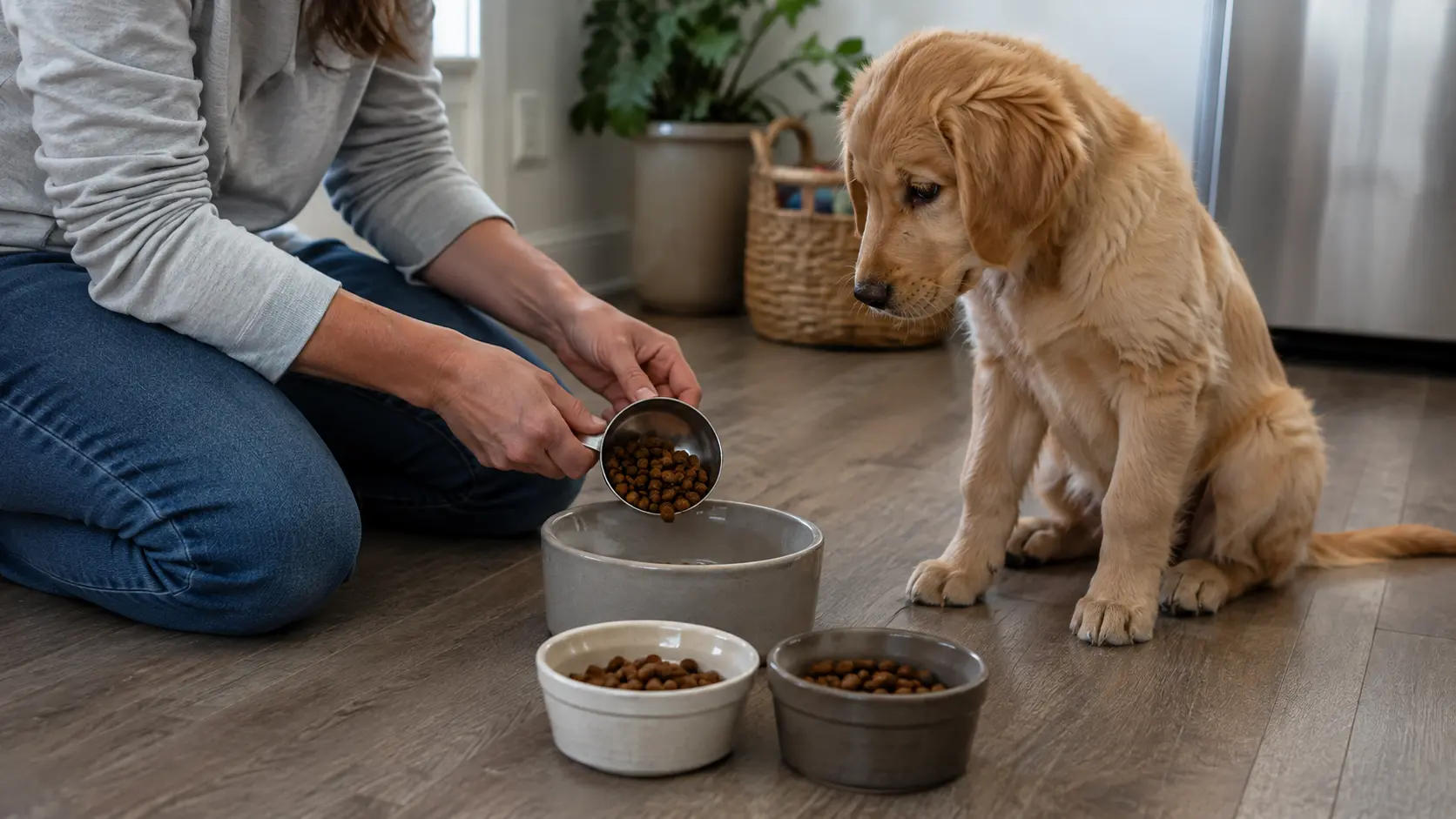
A good puppy feeding schedule answers two different questions: how often your puppy should eat and how much food they should get over the whole day.
Young puppies commonly eat three to four smaller meals a day. Many move toward three meals as they grow, then around two meals a day later in puppyhood. The exact timing varies with age, size, health, and individual needs.
The amount of food is different. There is no universal cups-per-day number that works for every puppy because foods vary in calorie density and puppies grow at different rates.
The practical approach is simple: find the daily amount for your puppy’s specific food, divide it between the appropriate number of meals, then monitor growth and body condition and adjust when needed.
Puppy Feeding Schedule at a Glance
Meal frequency usually decreases as a puppy gets older.
Around 8–12 weeks
- Usually 3–4 meals per day
- Small, regularly spaced meals are easier for young puppies
- Some very small puppies may need more frequent feeding
About 3–6 months
- Often around 3 meals per day
- Continue checking the puppy’s growth and daily food amount
About 6–12 months
- Often around 2 meals per day
- Breed size and maturity can affect when this change makes sense
Many puppies move toward two meals per day during this stage, although breed size and maturity can affect the timing. Reducing meal frequency is separate from changing from puppy food to adult food. If your puppy is approaching maturity, our guide to when to switch a puppy to adult food explains when that transition usually makes sense and how to make it gradually.
Toy and very small puppies
- May need smaller, more frequent meals
- Young toy breeds can be more vulnerable to low blood sugar, so their schedule may need veterinary guidance
This is a meal-frequency guide, not a universal puppy food chart for quantity.
Two puppies of the same age and weight can need different amounts of food if they eat diets with different calorie densities or have different energy needs.
How Much Should I Feed My Puppy?
Start with the daily feeding recommendation for the exact food you are using rather than copying a cup amount from another puppy or another brand.
Pet-food feeding directions are meant to provide a starting amount. They are not a guarantee that every puppy of a certain weight needs exactly that amount.
A puppy’s actual needs can change with growth, expected adult size, activity, body condition, and the calorie density of the food.
Step 1: Start With Food Appropriate for Growth
A puppy’s main diet should be complete and balanced for the appropriate growth life stage.
Check the nutritional adequacy statement on the package rather than relying only on words such as “puppy recipe” on the front of the bag or can.
If you are still deciding what type of diet is appropriate, our guide to choosing puppy food covers food types and formula selection in more detail.
For this feeding schedule, the important part is that the food is suitable for your puppy and that you know its feeding directions.
Step 2: Find the Daily Amount for That Specific Food
Read the feeding chart carefully.
Check whether the amount shown is the total for the entire day. Owners sometimes mistake a daily recommendation for a per-meal amount and unintentionally feed several times more than intended.
Also check what information the manufacturer uses to determine the portion. Depending on the food, the feeding guide may consider:
- current body weight
- puppy age
- expected adult size
- activity or growth stage
Use the recommendation as your starting point, not a permanent rule.
A puppy that is becoming too lean, gaining excessive body fat, or growing differently than expected may need an adjustment.
Step 3: Divide the Daily Total Between Meals
Once you know the starting daily amount, divide that amount between the puppy’s scheduled meals.
For example, imagine the directions for a particular food recommend 300 grams for the whole day.
If the puppy eats three meals:
300 g ÷ 3 = about 100 g per meal
If a particular food recommends 1½ cups per day and the puppy eats three meals:
1½ cups ÷ 3 = about ½ cup per meal
These numbers are only examples showing how to divide a daily ration. They do not mean that 300 grams or 1½ cups is the correct amount for your puppy.
Step 4: Measure Consistently
Try to measure food the same way every day.
A kitchen scale that measures grams can make dry-food portions more consistent than estimating with an unmarked scoop. Measuring cups can work, but small errors repeated across several meals can add up.
Consistency matters more than trying to make every meal mathematically perfect.
How Much Should an 8-Week-Old Puppy Eat?
At around eight weeks, many puppies are fully or nearly fully weaned and are eating solid puppy food independently.
If your puppy is still moving from nursing or softened meals toward normal puppy food, our guide to when puppies can eat solid food covers the weaning process separately.
A reasonable general schedule at this age is three to four small meals per day.
The exact amount at each meal depends on the food and the puppy. There is no reliable rule such as “an 8-week-old puppy should eat one cup per day” that applies across diets.
Instead:
- Find the total daily amount recommended for the specific puppy food.
- Decide whether the puppy is eating three or four meals.
- Divide the daily amount evenly between those meals.
- Watch how the puppy grows and responds.
For a four-meal schedule:
Daily ration → divide into 4 meals
For a three-meal schedule:
Daily ration → divide into 3 meals
At this age, keep an eye on appetite, stool quality, weight trend, body condition, and general energy.
A young puppy that repeatedly refuses meals, seems weak, or develops vomiting or significant diarrhea should not simply be assumed to be a picky eater.
How to Get a Puppy on a Feeding Schedule
A useful schedule does not need to follow one exact clock. Consistency matters more than feeding at the same times used by someone else.
Choose Regular Meal Times
Space meals across the puppy’s waking day in a way that fits your household.
For a puppy eating four meals, one example could be:
- 7:00 a.m.
- 11:00 a.m.
- 3:00 p.m.
- 7:00 p.m.
For three meals:
- 7:00 a.m.
- 1:00 p.m.
- 7:00 p.m.
For an older puppy eating twice daily:
- morning
- evening
These are examples, not medical requirements.
A household that starts the day at 9 a.m. does not need to wake at 7 a.m. simply because an online puppy feeding schedule uses that time.
If you work evenings, nights, or a second shift, the same principle applies. Move the meal times to fit the household routine while keeping the appropriate number of meals reasonably distributed through the puppy’s waking period.
Measure the Day’s Food First
One easy way to avoid accidental overfeeding is to measure the puppy’s full daily ration at the start of the day.
Then divide that amount between meals.
If some of the food will be used for training, take it from the measured daily ration rather than repeatedly adding extra handfuls.
This approach gives you a clearer idea of how much the puppy actually ate.
Keep the Routine Predictable
Puppies generally adapt more easily when meals happen on a reasonably predictable schedule.
You do not need to panic if lunch happens 30 minutes late one day. The goal is a usable routine, not a rigid timetable that makes normal life difficult.
How to Tell Whether Your Puppy Is Getting the Right Amount
A feeding chart gives you somewhere to start. Your puppy’s growth and body condition tell you whether that starting amount is working.
Watch the Growth Trend, Not One Number
There is no single correct weight that every puppy should reach at a particular age.
A Chihuahua puppy and a Labrador puppy obviously follow very different growth patterns, and even puppies expected to reach a similar adult size can develop at different rates.
Look for steady growth rather than trying to match a generic “puppy weight by age” number from the internet.
Regular weigh-ins can help you spot trends. If growth seems unusually slow or very rapid, discuss it with your veterinarian rather than making a large food adjustment based on one weigh-in.
Check Body Condition
Body Condition Score, or BCS, is a way of looking at body fat using both appearance and touch.
In a puppy at an appropriate body condition, you would generally expect:
- ribs that can be felt without pressing through a thick layer of fat
- a visible waist when viewed from above
- an abdominal tuck when viewed from the side
Veterinary body-condition systems commonly use a 9-point scale, with the middle range representing ideal condition.
Body condition is more useful than scale weight alone because a number on the scale cannot tell you whether the puppy is carrying too much or too little body fat.
If you are unsure how your puppy should look or feel at a healthy condition, your veterinarian can show you during a routine visit.
Adjust the Daily Total Rather Than Randomly Changing the Schedule
If the puppy appears to need a little more or less food, the amount to review first is usually the total daily ration.
Do not add another meal simply because the puppy seems hungry one afternoon, and do not drop a meal simply because the puppy appears to be gaining too quickly.
Meal frequency and total calories are related, but they are not the same thing.
There is also no universal rule such as “increase the bag amount by 20%.” Adjustments should reflect the individual puppy.
Treats, Training Rewards and the Daily Food Total
Training can add more food than owners realize.
A treat here, a few pieces of kibble there, and a chew later in the day can make the puppy’s real calorie intake noticeably higher than the amount measured into the bowl.
A commonly used veterinary guideline is to keep treats and extras to no more than about 10% of daily calories. That is a ceiling, not a goal.
Growing puppies should still receive the great majority of their nutrition from a complete-and-balanced growth diet.
One simple option is to use some of the puppy’s regular food as training rewards.
Measure the day’s ration first, set aside part of it for training, and feed the rest at mealtimes.
When a Puppy May Need a Different Feeding Schedule
Age provides a useful starting point, but some puppies deserve extra consideration.
Toy and Small-Breed Puppies
Very small puppies may need smaller meals more often than larger puppies of the same age.
Young toy-breed puppies also have a recognized risk of hypoglycemia, or low blood sugar. That does not mean every small puppy will have a problem, but it is one reason very young toy breeds should not automatically be placed on the same schedule as a much larger puppy.
If your puppy is exceptionally small, ask your veterinarian how frequently to feed.
For help with formula selection rather than meal timing, see our guide to food for small-breed puppies.
Large and Giant-Breed Puppies
Large and giant puppies should grow steadily rather than as fast as possible.
Excess energy intake can encourage overly rapid growth, so portion control deserves particular attention in these breeds.
They also need food appropriate for large-size growth. Extra calcium should not be added casually to a complete-and-balanced diet simply because the puppy is getting bigger.
Our guide to large-breed puppy nutrition covers suitable food choices in more detail.
Puppies With Medical or Growth Concerns
A standard online chart may not be appropriate for a puppy with:
- poor growth
- excessive weight gain
- recurring digestive problems
- a diagnosed medical condition
- a therapeutic diet
- unusual appetite changes
These situations are better handled with veterinary guidance rather than repeated trial-and-error changes at home.
Common Puppy Feeding Schedule Mistakes
Even a good feeding chart can go wrong if the numbers are interpreted incorrectly.
Treating the Bag Amount as Permanently Exact
The manufacturer’s recommendation is a starting point.
Your puppy may eventually need more or less depending on growth and body condition.
Confusing the Daily Amount With the Amount per Meal
If a feeding chart says two cups per day, feeding two cups at breakfast, lunch, and dinner would turn that into six cups.
Check the wording before dividing the ration.
Copying a Cup Amount From Another Food
One cup of one kibble can contain a different number of calories than one cup of another.
Use the feeding information for the exact food you are feeding.
Leaving Unlimited Food Available Without Tracking Intake
Free feeding is not automatically harmful for every dog, but it makes it harder to know exactly how much a growing puppy has eaten.
Measured meals make appetite, portion changes, and growth easier to track.
Forgetting About Training Treats
Treats still count toward the day’s intake.
If training is frequent, using part of the regular meal ration can help prevent extras from quietly adding up.
Trying to Make a Puppy Grow Faster
More food does not automatically mean healthier growth.
This matters especially for large and giant breeds, where controlled growth is preferable to pushing the puppy to become bigger as quickly as possible.
Adding Calcium or Vitamins Without a Reason
A complete-and-balanced puppy food is designed to provide nutrients in appropriate proportions.
Do not add calcium or other supplements simply because the puppy is growing unless your veterinarian has identified a specific reason.
When to Contact a Veterinarian About Your Puppy’s Eating
An occasional unfinished meal does not automatically mean something is wrong.
A persistent or sudden change in appetite deserves more attention, especially in a very young puppy.
Contact your veterinarian if your puppy repeatedly refuses food or appears to be losing weight or failing to grow normally.
Seek prompt veterinary advice when appetite problems occur with signs such as:
- repeated vomiting
- significant or persistent diarrhea
- blood in vomit or stool
- unusual weakness or lethargy
- signs of dehydration
- abdominal pain
- collapse
- tremors
- poor coordination
- seizures
Weakness, tremors, or abnormal coordination deserve particular caution in young toy-breed puppies because low blood sugar can be a concern.
Do not try to diagnose or treat suspected hypoglycemia from an online feeding guide. A veterinarian should assess a puppy showing those signs.
Frequently Asked Questions
Can I Leave Food Out All Day for My Puppy?
Measured meals are usually easier to manage during puppy growth than keeping an unlimited bowl available.
Scheduled portions let you see how much the puppy actually eats, notice appetite changes sooner, and adjust the daily ration more accurately.
Free feeding is not automatically dangerous in every situation, but it provides less control over intake.
What if My Puppy Doesn't Finish a Meal?
A puppy leaving part of one meal is different from repeatedly refusing food.
First check whether you may be offering more than the puppy actually needs and whether treats or training rewards have already contributed to the day’s intake.
If appetite loss is persistent, sudden, or accompanied by vomiting, diarrhea, weakness, weight loss, or unusual behavior, contact your veterinarian.
Very young puppies deserve particular caution because they have less room for prolonged poor intake than healthy adult dogs.
Do Wet and Dry Puppy Food Use the Same Feeding Amounts?
No.
Wet and dry diets can differ greatly in moisture content and calorie density. A cup of kibble cannot be converted directly into a certain number of cans or trays without checking the calorie information and feeding directions for the specific products.
If you use wet puppy food, follow the feeding information for that diet rather than borrowing the portion from a dry-food chart.
The same applies when combining wet and dry food: the total daily intake matters.
Should I Use Puppy Food as Training Treats?
You can use part of your puppy’s regular food as training rewards when practical.
Measure the daily ration first, put aside the amount you expect to use during training, and feed the remainder at scheduled meals.
This makes it easier to reward frequently without adding a separate stream of extra calories.
Use the Schedule as a Starting Point
A useful puppy feeding schedule does not depend on finding one perfect chart. Age helps you choose how many meals to offer, while the specific food provides the starting daily quantity.
Measure that total consistently, divide it between meals, and watch how your puppy grows rather than treating the first number on the bag as permanent.
If appetite, body condition, or growth starts moving in the wrong direction, adjust the plan with your veterinarian instead of relying on a generic cups-by-weight chart.