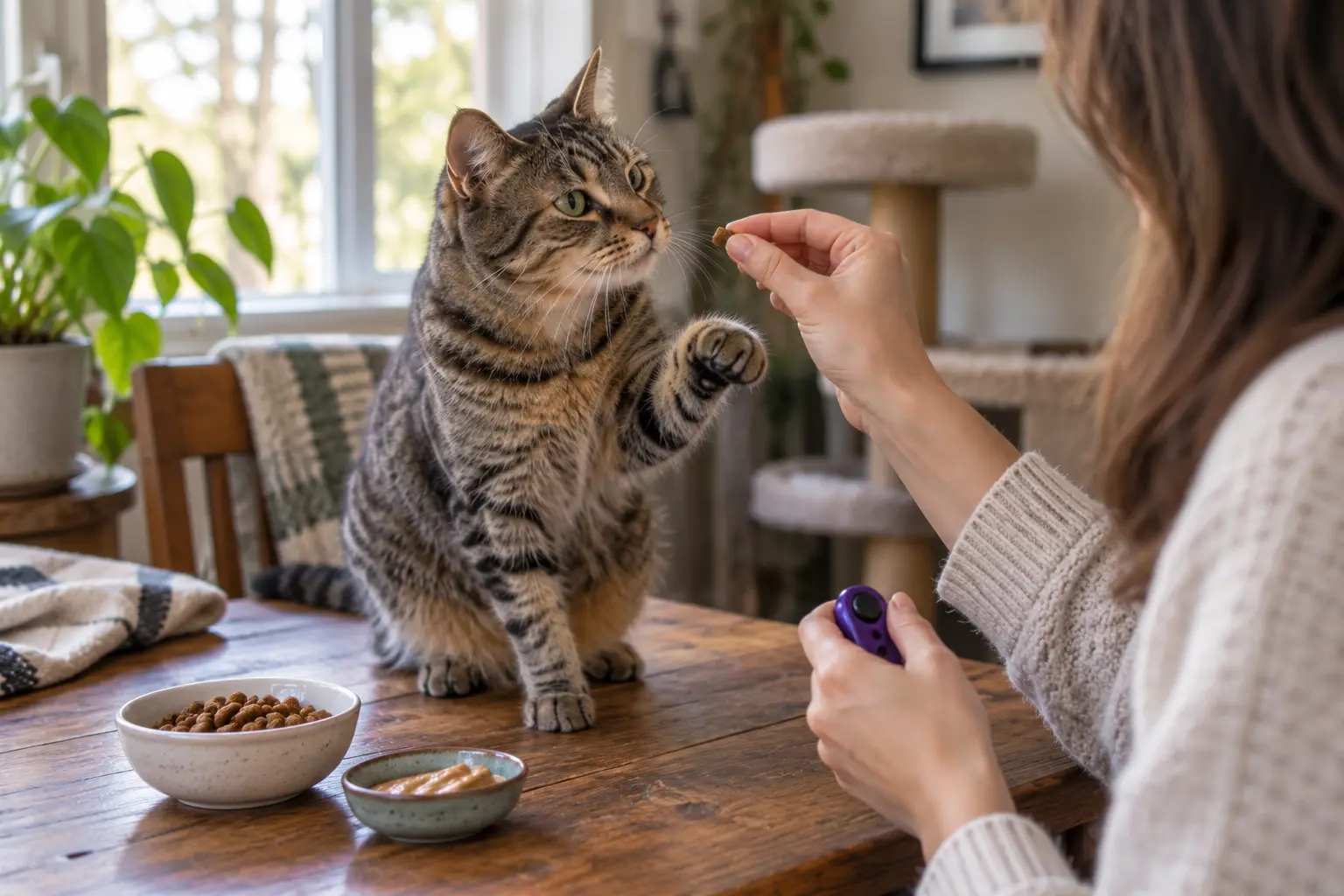
The best cat training treats are motivating enough to hold your cat’s attention, small enough for repeated rewards, and easy to deliver without slowing the session down. That does not mean one treat works best for every cat—or every type of training.
For everyday clicker work and recall, a small dry treat is often convenient. A lickable reward can make more sense when you are conditioning a carrier, touching paws, brushing, or working on nail handling. Soft and freeze-dried options fill other useful gaps.
Our five picks cover those different jobs rather than giving you five versions of the same crunchy treat.
Affiliate disclosure: LumaPaw may earn a commission from qualifying purchases made through links on this page, at no extra cost to you.
Best Cat Training Treats at a Glance
Product |
Best for |
Format |
Calories |
Main advantage |
Main limitation |
|---|---|---|---|---|---|
Wellness Kittles Chicken & Cranberries |
Best Overall |
Crunchy |
About 1.1 kcal/treat |
Small, clean, versatile reward |
Hard texture |
Temptations Classic Tasty Chicken |
Best Budget |
Crunchy with softer center |
Under 2 kcal/treat |
Low-cost frequent rewarding |
Calories can add up |
INABA Churu Chicken Variety |
Best for Cooperative Care |
Lickable purée |
6 kcal/tube |
Controlled lick-by-lick reward |
Messier and not tossable |
BLUE Wilderness Chicken & Salmon |
Best Soft Training Treat |
Soft-moist |
1.5 kcal/treat |
Easy to break into smaller rewards |
Can dry out after opening |
Stella & Chewy’s Meowfulls Chicken & Chicken Liver |
Best Freeze-Dried Training Treat |
Freeze-dried raw |
About 1 kcal/treat |
Small, portion-friendly freeze-dried bites |
Raw format and higher cost |
A full Churu tube is not the same thing as one training reward. You can squeeze out a small lick, pause, and use the rest across many repetitions. That is why calories should be considered based on the amount you actually feed during a session.
How We Chose These Cat Training Treats
We compared current manufacturer information, major retailer listings, formula details, calorie information, package formats, and recurring customer-feedback patterns. We did not personally test these products.
For training, we gave extra weight to factors that ordinary treat roundups often overlook.
Reward size and calorie control
Training can involve a lot of repetitions. A treat that looks low-calorie in isolation can still contribute a substantial amount if you hand out 20 or 30 whole pieces.
Smaller rewards, or treats that divide cleanly, give you more flexibility.
Speed and ease of delivery
A useful reward should not repeatedly interrupt the session. Small pieces that are quick to eat generally work better for fast clicker exercises than large chunks that require prolonged chewing.
The delivery method matters too. Dry pieces are convenient for tossing and moving exercises, while lickable treats can keep a cat engaged during handling.
Texture, crumbs, and mess
Crunchy, soft, freeze-dried, and lickable treats all have legitimate training uses. We looked at whether pieces are easy to break, whether they crumble excessively, and how practical they are to handle repeatedly.
Motivation
A popular treat is not automatically “high value” for your cat. Some cats work eagerly for an ordinary crunchy reward; others ignore it and become much more interested when a lickable or meat-based option appears.
Ingredients, safety, and availability
We also considered dietary restrictions, life-stage information, raw versus cooked formats, current retailer availability, and recurring complaints rather than treating star ratings as proof of quality.
The 5 Best Cat Training Treats

Wellness Kittles Chicken & Cranberries — Best Overall
Best for: Clicker training, tricks, recall, and general everyday reinforcement.
Avoid if: Your cat struggles with hard treats, strongly prefers moist food, or needs a strict limited-ingredient diet.
Common limitation: Hardness is the main practical drawback, particularly for cats that have difficulty chewing crunchy treats.
Honest buying note: Kittles has excellent training mechanics, but no ingredient list or calorie number matters if your cat does not find the reward motivating. Try a small bag before committing to a large supply.
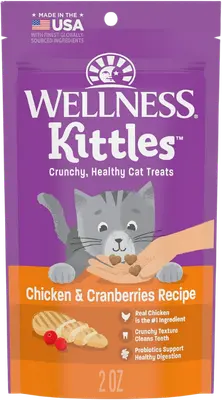
Wellness Kittles earns our Best Overall position because it combines several things that matter during ordinary training: small pieces, low calories, clean handling, and enough structure to toss or hand-deliver.
Chewy currently lists the Chicken & Cranberries recipe at about 1.1 calories per treat. The crunchy pieces require no preparation and work particularly well for clicker training, simple tricks, recall practice, and other sessions where you may reward many behaviors in quick succession.
They are also easier to count than irregular freeze-dried chunks, which helps when you are trying to keep track of how many rewards you have used.
Pros
- About 1.1 kcal per treat
- Small, ready-to-use pieces
- Easy to carry, count, hand-feed, or toss
Cons
- Crunchy texture will not suit every cat
- Not a single-ingredient treat
- Some cats simply prefer softer rewards

Temptations Classic Tasty Chicken — Best Budget
Best for: Frequent training, multi-cat households, and owners who want an inexpensive everyday reward.
Avoid if: Your cat needs a limited-ingredient, grain-free, or closely controlled elimination diet.
Common complaints: Most serious-looking negative retailer feedback we reviewed involved damaged containers during shipping rather than the treats themselves.
Honest buying note: Budget treats can be useful for routine behaviors, while a more valued reward can be saved for harder tasks. There is no need to use your cat’s favorite treat for every easy repetition.
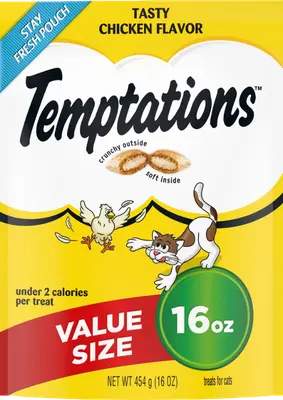
Training regularly can use a surprising number of individual rewards, and Temptations offers a practical advantage that premium treats cannot match: low cost in large package sizes.
The Tasty Chicken formula is sold in bags and tubs ranging from smaller trial-style sizes to large bulk options. Individual pieces are under 2 calories, uniform, easy to dispense, and widely accepted according to a very large body of customer feedback.
That makes Temptations particularly practical for routine exercises where your cat does not need the most exciting reward you own.
The tradeoff is the ingredient list. This is not a limited-ingredient product. The formula includes chicken by-product meal, corn, wheat, animal fat, rice, and other ingredients.
That does not automatically make it a poor training treat, but it makes it unsuitable for cats that require strict ingredient avoidance.
Pros
- Excellent value
- Large package options
- Uniform and easy to dispense
- Strong recurring palatability feedback
Cons
- More complex ingredient list
- Contains corn and wheat
- Under 2 calories each can still add up during long sessions

INABA Churu Chicken Variety — Best for Cooperative Care
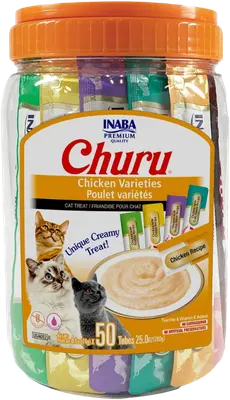
Best for: Grooming, carrier conditioning, paw handling, nail-trim practice, and sustained rewards.
Avoid if: You need a clean reward that can be thrown during recall exercises, or your cat has dietary restrictions that conflict with the assortment’s multiple recipes.
Common limitation: Enthusiastic cats may grab, bite, or paw at the tube, so control the opening carefully.
Churu solves a different training problem from every dry treat on this list.
Instead of handing your cat a piece and waiting for it to be eaten, you can offer a small lick, pause, continue the activity, and offer another lick. That makes it particularly useful for carrier conditioning, brushing, paw handling, nail-trim practice, and other cooperative-care exercises.
Each 0.5-ounce tube contains about 6 calories and 91% moisture, but the whole tube does not need to be fed at once.
Customer feedback repeatedly describes owners using Churu while handling cats, giving medication, introducing carriers, grooming, and building positive associations with close human interaction.
One important detail: the Chicken Variety assortment contains several recipes, including versions with ingredients or flavors such as scallop, cheese, shrimp, and crab. It should not be treated as a strict single-protein chicken product.
For more tube and purée options, see our guide to squeezable cat treats.
Pros
- Excellent control over reward amount and duration
- Very useful during handling
- High moisture
- Strong recurring customer enthusiasm
Cons
- Messier than dry treats
- Requires one hand to hold the tube
- Cannot be tossed
- Usually costs more than crunchy treats

BLUE Wilderness Chicken & Salmon — Best Soft Training Treat
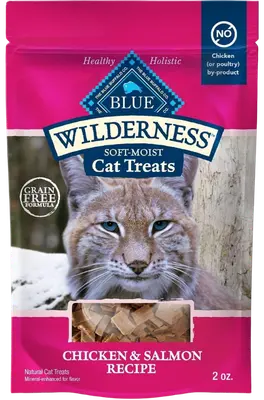
Best for: Cats that prefer softer rewards, hand-delivered training, and owners who want to divide treats into smaller pieces.
Avoid if: You want a reward that stays consistently soft after repeated opening or your cat strongly prefers crunchy treats.
Common complaint: Loss of softness after opening is the main recurring issue worth knowing about.
Honest buying note: Buy this for the texture rather than because it is grain-free. Grain-free alone does not make a training treat better.
BLUE Wilderness Chicken & Salmon is useful when a cat likes a chewable reward but does not do well with hard crunchy pieces.
If soft texture is your main priority rather than training use, our soft cat treat guide compares a wider range of tender and chewable options.
The soft-moist treats provide about 1.5 calories each, and the pieces can be broken into smaller portions when you want more repetitions from the same calorie allowance.
That combination makes them practical for hand-delivered training, especially when you want something faster to chew than a hard biscuit but cleaner than a purée.
The biggest limitation is also directly related to the product’s main strength. Some customers report that the treats become drier or harder after the bag has been opened.
Resealing the pouch carefully therefore matters.
Pros
- Soft-moist texture
- 1.5 kcal per piece
- Easy to divide
- Cleaner to handle than lickable treats
Cons
- Can dry or harden after opening
- Not every cat likes soft-moist texture
- Contains both chicken and salmon

Stella & Chewy’s Meowfulls Chicken & Chicken Liver — Best Freeze-Dried Training Treat
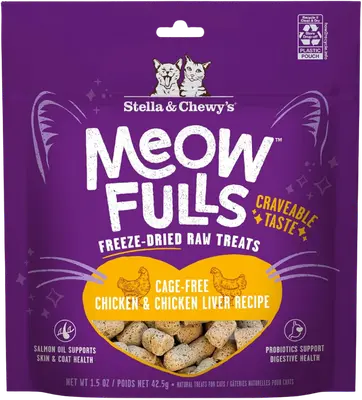
Best for: Owners who want a small freeze-dried reward for recall, tricks, or higher-value training.
Avoid if: You prefer cooked treats, want the cheapest option, or your cat dislikes freeze-dried texture.
Common limitation: Value is the main practical downside, especially if you train frequently.
Many freeze-dried meat treats come as irregular chunks that need breaking before they become practical training rewards. Stella & Chewy’s Meowfulls is easier to use because the pieces are relatively small and portion-friendly from the start.
The Chicken & Chicken Liver recipe provides about 1 calorie per treat and has a softer freeze-dried texture than many whole-meat chunks we compared.
That makes it useful for recall, tossed rewards, hand delivery, and training sessions where you want a meat-focused reward without constantly stopping to prepare large pieces.
It is still a freeze-dried raw product, so normal raw-pet-food hygiene precautions apply. Freeze-drying should not be treated as proof that a raw product is risk-free.
If you prefer this format, our freeze-dried cat treat guide compares more options.
Pros
- About 1 kcal per treat
- Small, training-friendly pieces
- Easy to toss or hand-feed
- Less preparation than many irregular freeze-dried treats
Cons
- Raw format
- Relatively small bag
- More expensive than everyday crunchy treats
- Some cats simply reject freeze-dried texture
What Makes a Good Cat Training Treat?
The best reward is one your cat actually values
“High value” is not a permanent property of a product.
Your cat decides what is valuable.
One simple way to find out is to offer two or three tiny options separately and see which reward your cat consistently chooses or works harder to obtain.
You may also discover that reward value changes with the situation. A normal crunchy treat may work perfectly in the kitchen but become irrelevant near an open carrier.
Small and quick to eat usually works better
For repeated clicker training, you generally want the cat to eat the reward quickly and return attention to the next repetition.
That is why small pieces are often more practical than a large treat that requires long chewing.
Preparing portions before training also helps. If a soft or freeze-dried treat is larger than you need, divide several pieces before the session rather than stopping after every click.
Crunchy vs soft vs freeze-dried vs lickable
There is no single best texture.
Crunchy treats are clean, portable, and easy to toss.
Soft treats are easier to divide and may suit cats that dislike harder pieces.
Freeze-dried treats can be highly motivating, but size and crumbling vary considerably between products.
Lickable treats are awkward for recall but excellent when you need sustained reinforcement during grooming or handling.
Match reward value to difficulty
You do not have to use the same treat for everything.
A familiar trick in a quiet room may only need an ordinary reward. A new behavior, carrier exercise, or high-distraction environment may justify something your cat values much more.
Saving a favorite reward for harder work can help preserve its usefulness.
Match the Treat to the Training Job
Clicker training and tricks
Small, quick-to-eat pieces are usually the easiest choice.
Kittles and Temptations both work well mechanically because you can deliver one piece and move on quickly.
Recall and tossed rewards
Choose something dry enough to throw without sticking to your hand or floor.
Crunchy treats and Meowfulls are more practical here than Churu.
Carrier training, grooming, and nail handling
These exercises often benefit from a reward that lasts longer than one bite.
Churu can be particularly useful because you control when licking starts and stops while gradually pairing the activity with something enjoyable.
Difficult or distracting exercises
Use the reward your cat values most.
The correct answer may be Churu for one cat, freeze-dried meat for another, and ordinary Temptations for a third.
How to Use Cat Training Treats Without Overfeeding
Training is unusual because a cat may receive many rewards in a short period.
A treat being “only one calorie” does not mean the total is insignificant after 20 repetitions.
Look at the amount actually fed during the session rather than the package serving alone.
A full Churu tube is 6 calories, but several training rewards can come from one tube. Similarly, one soft piece may be divided into several tiny rewards.
Preparing portions before training makes this easier.
For simple behaviors, part of your cat’s normal measured food ration may sometimes work as a reward if your cat finds it motivating. That can reduce the number of extra treat calories being added.
If calorie control is your main priority, see our guide to lower-calorie cat treat options.
Cats eating veterinary therapeutic diets, or those being managed for food allergies, diabetes, kidney disease, urinary disease, or weight problems, may need more careful treat choices. Ask your veterinarian before adding rewards that could interfere with the feeding plan.
Cat Training Treat Safety and Quality Checklist
A few practical checks make repeated treating safer and easier:
- Use pieces that are appropriately sized for your cat.
- Break oversized freeze-dried chunks before rapid feeding.
- Discard unusually hard, sharp, spoiled, or abnormal-looking pieces.
- Reseal soft treats carefully so they do not dry out.
- Follow storage directions for opened lickable products.
- Wash your hands and use appropriate hygiene with raw freeze-dried products.
- Check ingredient lists when your cat has known food sensitivities.
- Do not assume “natural,” “grain-free,” “raw,” or “single ingredient” automatically means healthier.
- Remember that treats should not crowd out a nutritionally appropriate main diet.
If your cat has a concerning reaction after eating a new treat, stop feeding it and contact your veterinarian.
What If Your Cat Doesn't Like Treats?
Some cats are simply less food-motivated than others, and others become selective about where or when they will eat.
Try changing one variable at a time.
A cat that ignores crunchy food may respond to a soft or lickable reward. Another may prefer freeze-dried meat. You can also test different flavors.
If your cat does not care about food rewards at all, training does not have to stop. Play, petting, access to a favorite spot, or another activity the cat enjoys can sometimes act as reinforcement.
The key is finding something your cat is willing to work for rather than repeatedly offering a treat it does not value.
Frequently Asked Questions
What are the best treats for training a cat?
Look for rewards your cat likes that are small, quick to eat, easy to portion, and practical for the task. Crunchy treats work well for rapid repetitions and recall, while lickable treats can be especially useful during grooming, handling, and carrier conditioning.
How do you train a cat with treats?
Reward the behavior you want soon after it happens so the cat can connect the action with the consequence. Start with easy behaviors and small rewards. Keep sessions short, and use something your cat genuinely values rather than assuming every commercial cat treat will be motivating.
Can I use regular kibble to train my cat?
Yes, if your cat considers it rewarding enough. Using part of the normal daily ration can be convenient for easy repetitions and can reduce extra treat calories. Kibble may be less effective for difficult tasks or distracting environments if your cat finds another food much more valuable.
Are Churu treats good for cat training?
Yes, particularly for handling and cooperative-care exercises. You can offer one or two licks at a time while touching paws, grooming, or encouraging the cat into a carrier. They are less convenient for tossed recall rewards or training while moving around.
How small should cat training treats be?
Small enough that your cat can eat the reward quickly and continue training without a long chewing break. There is no universal measurement because treat texture and cat size vary. Larger soft or freeze-dried pieces can often be divided before the session.
How many training treats can a cat have?
There is no useful universal number because training treats vary widely in calories and size. As a general guideline, treats and snacks should stay within about 10% of a cat’s total daily calories, and all rewards given during training count toward that amount. Cats on therapeutic diets or being managed for weight or medical conditions may need veterinarian-guided limits.
How do you train a cat that doesn't like treats?
First try different textures and flavors rather than assuming your cat dislikes all food rewards. If food still has little value, test non-food rewards such as play, affection, or access to a favorite activity. The reward needs to matter to the individual cat.
Are soft or crunchy treats better for cat training?
Neither format is universally better. Crunchy treats are convenient, clean, and easy to toss. Soft treats can be divided into very small portions and may be easier for some cats to eat. Choose based on your cat and the specific exercise.
Are freeze-dried treats good for cat training?
They can be, especially if your cat finds meat-based rewards highly motivating. Look for small, consistent pieces or break larger chunks before training. Remember that some freeze-dried products are raw and require appropriate handling.
Final Verdict
The best cat training treats depend on what you are teaching and what your cat actually wants to work for.
Wellness Kittles is our most versatile everyday choice, while Temptations makes frequent training more affordable. INABA Churu stands out for grooming, carrier work, and cooperative care. BLUE Wilderness provides a softer chewable option, and Stella & Chewy’s Meowfulls is the strongest freeze-dried training choice in this lineup.
Keep rewards small, match their value to the difficulty of the task, and pay attention to total calories across the full session.
If training is only one reason you are shopping, our broader guide to the best cat treats compares options by format, ingredients, calories, and everyday use.