Giving treats gets tricky when you are trying to keep a cat’s calories under control. A treat that contains only one or two calories sounds insignificant, but several rewards throughout the day can add up quickly.
The best low calorie cat treats make that easier by combining a modest calorie count with portions you can actually track. Texture, piece size, ingredients, and your cat’s preferences matter too—a one-calorie treat is not useful if your cat refuses it.
For this guide, we compared six different options, including tiny crunchy treats, an indoor-cat formula, a single-ingredient freeze-dried treat, an inexpensive everyday choice, and a lickable option. If calories are only one part of your decision, our broader guide to the best cat treats compares different textures, ingredients, and uses.
Affiliate disclosure: LumaPaw may earn a commission from qualifying purchases made through links on this page, at no extra cost to you.
Best Low-Calorie Cat Treats at a Glance
Product |
Our pick |
Calories |
Texture |
Best for |
Main limitation |
|---|---|---|---|---|---|
Fruitables Chicken & Blueberry |
Best Overall |
1.25 kcal/treat |
Crunchy |
Everyday portion control |
Contains rice and barley |
Wellness Kittles Chicken & Cranberries |
Best for Frequent Rewards |
About 1 kcal/treat |
Small crunchy pieces |
Training and repeated rewards |
Hard texture; contains herring meal and salmon oil |
Greenies SmartBites Healthy Indoor Chicken |
Best for Indoor Cats |
About 1.3 kcal/treat |
Crunchy outside, softer inside |
Adult indoor cats |
Grain-inclusive; relatively higher fat |
PureBites Chicken Breast |
Best Single-Ingredient |
2 kcal/average treat |
Freeze-dried chunks |
Ingredient simplicity |
Pieces vary in size and crumble |
Temptations Classic Tempting Tuna |
Best Budget |
About 2 kcal/treat |
Crunchy outside, soft center |
Affordable everyday treating |
More complex ingredient list |
Nulo Perfect Purées Chicken |
Best Lickable |
7 kcal/tube |
Purée |
Cats that prefer soft treats |
Costs more per serving; contains tuna extract |
A calorie number only tells part of the story. One Nulo tube is a complete lickable serving, for example, while one Kittles piece is a tiny crunchy reward. Compare realistic portions rather than assuming the smallest number automatically means the best product.
How We Chose These Low-Calorie Cat Treats
We did not rank treats based on star ratings, bestseller badges, or brand recognition.
Instead, we compared calories per treat or serving, portion consistency, ingredient information, guaranteed analysis where useful, life-stage suitability, texture, availability, and recurring customer feedback.
We also looked for products with genuinely different uses. There is little value in recommending six nearly identical crunchy treats just because all of them contain around two calories.
One other point matters: low calorie does not automatically mean low fat, grain-free, high protein, or nutritionally superior. A tiny treat can contain relatively little energy per piece simply because the portion is small.
Guaranteed-analysis percentages also need context. A dry crunchy treat and a 90%-moisture purée should not be compared solely by their as-fed protein or fat percentages.
The 6 Best Low-Calorie Cat Treats

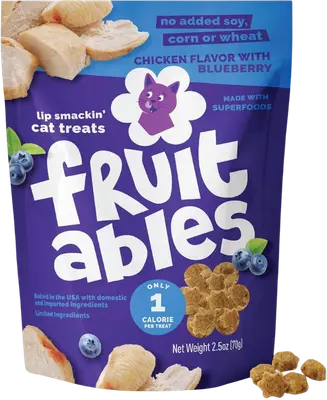
Fruitables Chicken & Blueberry Crunchy Cat Treats — Best Overall
Best for: Owners who want a small, conventional crunchy treat that is easy to count.
Avoid if: Your cat struggles with hard treats or needs a grain-free formula.
Honest buying note: Fruitables does not win every nutritional metric in this guide. It wins because it has relatively few compromises for the average owner trying to manage treat calories.
Fruitables earns our top position because it offers one of the best overall combinations of calorie control, predictable portions, availability, and straightforward everyday use.
Chewy’s nutrition information lists 1.25 calories per treat, with 28% minimum crude protein, 12% minimum crude fat, and 8% maximum crude fiber. Chicken meal is the first ingredient.
The pieces are small and consistently shaped, which matters more than it may seem. If you are tracking treats throughout the day, manufactured pieces are easier to count than irregular chunks of dried meat.
Fruitables is made without wheat, corn, or soy, but it is not grain-free. The current ingredient list includes rice flour and barley. That distinction is worth knowing if your cat has a specific dietary restriction.
Customer feedback is generally positive about taste and the small size, including reports from owners of selective cats. The more useful negative pattern is texture: some owners find the treats fairly hard, so they may be uncomfortable for cats with significant dental problems.
Pros
- 1.25 calories per piece
- Small, consistent portions
- Chicken meal first
- No wheat, corn, or soy
- Widely available
Cons
- Contains rice flour and barley
- Fairly hard texture
- Small bags can feel expensive for multi-cat homes

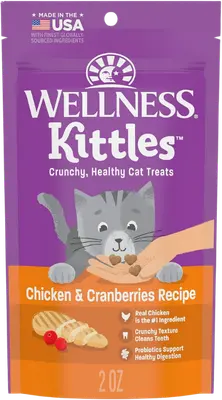
Wellness Kittles Chicken & Cranberries — Best for Frequent Rewards
Best for: Training, enrichment, and frequent tiny rewards.
Avoid if: Your cat needs soft treats or a fish-free formula.
Wellness Kittles makes the most sense when you want to give several tiny rewards rather than one larger treat.
Current product information puts each small piece at roughly one calorie, making Kittles one of the lowest-calorie options in this lineup. The formula lists 30% minimum protein and 12% minimum fat.
That makes these especially practical for clicker training, puzzle feeders, treat hunts, or any routine where your cat may earn several rewards in a short period.
If repeated reinforcement is your main goal, our cat training treat guide compares reward size, calories, texture, and handling in more detail.
The Chicken & Cranberries recipe is grain-free, but do not assume it contains chicken only. Current formula information includes fish ingredients as well, so this is not a suitable pick when fish needs to be avoided.
Feedback frequently praises the tiny size and palatability. The tradeoff is that Kittles are crunchy and can be hard. Cats with missing teeth, dental pain, or difficulty chewing may do better with something softer.
Pros
- Around one calorie per tiny piece
- Easy to spread rewards throughout the day
- Grain-free
- Chicken is a leading ingredient
- Useful for puzzle toys
Cons
- Hard texture
- Small standard bags
- Contains fish ingredients

Greenies Feline SmartBites Healthy Indoor Chicken — Best for Indoor Cats
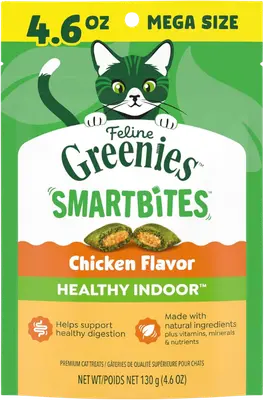
Best for: Adult indoor cats whose owners want small, portionable rewards.
Avoid if: You want a grain-free or especially simple ingredient list.
Greenies also sells products specifically designed around dental care. Those belong in a different comparison; see our guide to cat dental treats if dental function is your priority.
Greenies SmartBites Healthy Indoor has a clearer audience than most products here: adult indoor cats.
At roughly 1.3 calories per treat, the pieces are easy to incorporate into a controlled treat allowance. Greenies also uses a fiber-focused formula and a crunchy-outside, softer-inside texture.
The ingredient list is more complex than Fruitables or PureBites. Chicken meal comes first, but the formula also includes animal fat, brewers rice, whole wheat, wheat flour, animal plasma, cellulose, and beet pulp.
That does not automatically make it a poor treat. It simply means this is not the choice for someone prioritizing a limited-ingredient or grain-free formula.
Another useful distinction is fat. The listed minimum fat is around 19–20%, considerably higher than some other crunchy picks here even though each piece remains low in calories. It is a good example of why low calories per treat and low fat are not interchangeable terms.
Customer feedback strongly favors palatability. One recurring complaint concerns large plastic tubs cracking during shipping, which is primarily a packaging and fulfillment issue rather than a problem with the treats themselves.
Pros
- About 1.3 calories per treat
- Indoor-cat-specific positioning
- Small, easy-to-count pieces
- Fiber-focused formula
- Broad availability
Cons
- Contains wheat and rice
- Relatively high listed fat
- Large tubs receive repeated shipping-damage complaints

PureBites Chicken Breast Freeze-Dried Cat Treats — Best Single-Ingredient
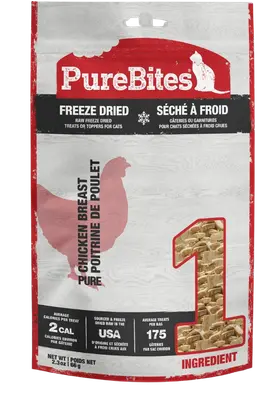
Best for: Owners who prioritize a single, recognizable ingredient.
Avoid if: You want uniform pieces for precise calorie counting or the best value per bag.
For more options in this format, see our guide to freeze-dried cat treats.
PureBites is the simplest product here:
The ingredient is chicken breast.
The current guaranteed analysis lists 74% minimum protein and just 3% minimum fat, with approximately 2 calories per average treat.
That makes PureBites useful for owners who want an uncomplicated meat-based reward rather than a biscuit made with several binders, grains, or flavoring ingredients.
There is an important catch for calorie counting, though. These are natural freeze-dried chicken chunks, not identically manufactured pieces. “Two calories per average treat” does not mean every piece is exactly two calories.
Customer reviews repeatedly mention another predictable characteristic of freeze-dried meat: crumbs and powder. Pieces can break during shipping or handling. The powder can be sprinkled over food, but that does not help owners who expected a bag full of intact rewards.
Because this is a raw freeze-dried product, sensible food hygiene also matters. The FDA recommends washing hands after handling pet food and treats and notes that raw pet foods have a higher potential for bacterial contamination than processed foods.
Pros
- One ingredient: chicken breast
- 74% minimum protein
- 3% minimum fat
- About 2 calories per average piece
- Strong ingredient simplicity
Cons
- Pieces vary in size
- Frequently crumbles into powder
- More expensive than mainstream crunchy treats
- Raw freeze-dried handling requires care

Temptations Classic Tempting Tuna — Best Budget
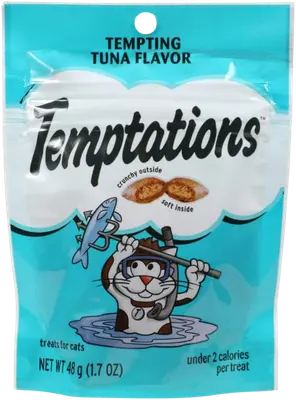
Best for: Owners who want an inexpensive, widely available treat with easy portion control.
Avoid if: Your priority is a limited-ingredient, grain-free, or meat-only formula.
Temptations is not here because it has the simplest ingredient list. It is here because it provides a practical combination of small portions, low cost, broad availability, and strong palatability.
Classic Tempting Tuna contains about 2 calories per treat, and its uniform pieces are easy to count.
The formula is more conventional than the premium options above. Current ingredient information includes chicken by-product meal, corn, animal fat, wheat flour, rice, and meat by-products.
For cats that tolerate those ingredients, that may be perfectly workable as an occasional reward. But owners specifically looking for grain-free or limited-ingredient treats have better options in this list.
Temptations has one of the strongest recurring palatability patterns in the customer feedback we reviewed. Larger bags and tubs also tend to offer better value than tiny specialty-treat packages.
The notable complaint is again packaging: some buyers report large plastic tubs arriving cracked when shipped with heavier items.
Pros
- About 2 calories per treat
- Affordable
- Uniform pieces
- Multiple package sizes
- Widely available
Cons
- Contains corn and wheat
- More complex ingredient list
- Higher listed fat than several alternatives
- Large tubs can be damaged during shipping

Nulo Freestyle Perfect Purées Chicken Recipe — Best Lickable
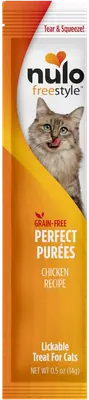
Best for: Cats that prefer lickable treats or dislike hard crunchy textures.
Avoid if:You need a confirmed fish-free option or want the greatest number of rewards for the fewest calories.
For a broader comparison of tubes and purées, see our guide to squeezable cat treats.
Not every cat wants a crunchy reward.
Nulo Perfect Purées gives this roundup a useful alternative: a 0.5-ounce lickable tube containing about 7 calories.
That is more calories than one Kittles or Fruitables piece, but it is not a fair one-to-one comparison. One Nulo tube is a complete lickable serving rather than a tiny biscuit.
The formula contains 90% maximum moisture and just 0.2% minimum fat on an as-fed basis. Nulo’s current manufacturer page does not list tuna extract, while Chewy’s current Chicken listing still does. If your cat must avoid fish, check the ingredient panel on the exact package before feeding.
That tuna extract is easy to miss. Despite the Chicken Recipe name, this is not a fish-free product.
Customer feedback commonly praises taste and topper use. A more consistent downside is texture: some tubes are described as thin or runny, making them messier to feed directly from the packet. Kneading the tube first or squeezing it into a shallow dish may be easier.
Pros
- 7 calories for a whole tube
- 90% moisture
- Soft, lickable format
- Can also be used as a topper
- Pre-portioned tubes
Cons
- More calories per serving than tiny crunchy treats
- Ingredient listings currently conflict on tuna extract
- Runny consistency complaints
- Relatively expensive per serving
How Many Treat Calories Can a Cat Have?
A practical low-calorie treat only helps if you also keep track of the total number given.
VCA Animal Hospitals advises that cat treats should generally make up no more than about 10% of daily caloric intake, noting that an even smaller share can be preferable. The rest of the diet should provide the nutrition your cat needs from appropriate complete-and-balanced food.
A simple calorie example
Suppose your veterinarian has determined that your cat should eat around 200 calories per day.
Using 10% as an upper treat guideline would give you about:
20 calories per day from treats.
That could mean roughly:
- 20 one-calorie pieces
- 10 two-calorie pieces
- or two 7-calorie lickable tubes with only a small amount left for other treats
That is only an example—not a feeding recommendation for your individual cat. Age, body condition, activity, neuter status, diet, and medical needs can all affect calorie requirements.
If your cat needs to lose weight, ask your veterinarian for an appropriate daily calorie target rather than guessing.
Why “per treat” can be misleading
Calories are easiest to track when every treat is roughly the same size.
Fruitables, Kittles, Greenies, and Temptations are manufactured pieces, so counting is relatively straightforward.
PureBites uses irregular chicken chunks, so two pieces may not weigh exactly the same.
A Nulo tube is different again: the entire tube is a serving. Comparing “one treat” across all three formats does not tell you much unless you consider the portion size.
How to Choose Low-Calorie Cat Treats
Compare realistic serving sizes
Do not choose a product because the front of the bag says “low calorie.”
Look for calories per piece, tube, or realistic serving. Then think about how you actually give treats.
A two-calorie treat you give twice may contribute fewer calories than a one-calorie treat you hand out 15 times.
Look at piece size and consistency
Small, uniform pieces are useful if you train your cat or give frequent rewards.
Larger or irregular treats may still work well, but portion tracking becomes less exact.
Check ingredients for your cat’s needs
There is no reason to reject every treat containing grains, nor does “grain-free” prove that a treat is better.
Instead, check ingredients for practical reasons:
- known food allergies or intolerances
- proteins your cat needs to avoid
- veterinary dietary restrictions
- ingredient simplicity when that matters to you
For example, PureBites is chicken-only, while Nulo’s Chicken Recipe also contains tuna extract.
Match the texture to your cat
Crunchy treats work well for many cats, but not every cat can comfortably chew hard pieces.
Freeze-dried treats are lighter and more fragile.
Lickable treats are useful for cats that prefer soft textures, but an entire tube may contain more calories than several tiny crunchy rewards.
Remember that a low-calorie treat is not a weight-loss plan
Changing treats alone may not solve weight gain if total food intake is still too high.
If your cat is overweight or losing or gaining weight unexpectedly, involve your veterinarian. Treats should fit into the larger feeding plan rather than becoming a separate calorie source nobody counts.
Practical Ways to Keep Treat Calories Under Control
A few simple habits make more difference than chasing the lowest possible calorie number:
- Measure out the day’s treats in the morning instead of feeding straight from the bag.
- Break larger treats into smaller pieces when the texture allows it.
- Use part of your cat’s normal food allowance as training rewards when practical.
- Put tiny treats into puzzle feeders or use them for short training sessions so a small portion lasts longer.
- Keep everyone in the household aware of how many treats have already been given.
- Use play, brushing, attention, or another activity your cat enjoys as some of the day’s rewards.
- Recalculate treat calories if you change your cat’s main food or feeding amount.
If calories are not your main concern, our broader guide to the best cat treats by type compares different textures and purposes.
Low-Calorie Cat Treat Safety Checklist
Treats are extras. Most should not replace the food your cat relies on for complete daily nutrition.
Check the label for life-stage and feeding instructions, and introduce unfamiliar treats sensibly rather than giving a large amount immediately.
For hard treats, consider your cat’s ability to chew. Cats with dental pain, missing teeth, or other oral problems may need a softer option.
Store treats according to the package instructions and discard anything with damaged packaging, an unusual odor, discoloration, or other signs that something is wrong. FDA similarly advises against buying damaged pet-food packages and recommends discarding spoiled products.
Wash your hands after handling pet food and treats, especially raw or freeze-dried raw products.
And if your cat has diabetes, kidney disease, urinary disease, food allergies, pancreatitis, or another condition requiring dietary management, ask your veterinarian whether a particular treat fits the treatment plan rather than relying on marketplace claims or customer reviews.
FAQs About Low-Calorie Cat Treats
What counts as a low-calorie cat treat?
There is no single universal calorie cutoff that makes a cat treat “low calorie.”
For everyday comparison, the most useful measure is calories per realistic piece or serving. Many products in this guide provide roughly one to two calories per small crunchy treat, while a whole lickable tube may contain several calories.
How many treats can I give my cat per day?
Count calories, not just pieces.
A common veterinary guideline is to keep treats at no more than about 10% of daily calorie intake. The appropriate number of treats therefore depends on your cat’s daily energy needs and the calories in each treat.
Are 2 calories per treat low?
Two calories is a modest amount for an individual cat treat, but quantity still matters.
Five two-calorie treats provide 10 calories. Ten provide 20 calories. Even small treats can become significant when handed out frequently.
Are freeze-dried cat treats low in calories?
Some are, but freeze-dried does not automatically mean low calorie.
PureBites Chicken Breast, for example, provides about two calories per average piece. Other recipes and brands can differ, and natural pieces may vary in size.
See our freeze-dried cat treats comparison if you want more options in that format.
Are lickable cat treats low in calories?
Some lickable treats are relatively modest in calories for an entire tube, but compare the whole tube rather than one squeeze.
Nulo Perfect Purées Chicken contains about seven calories per 0.5-ounce tube. That can fit into many cats’ treat allowances, but it is more than a single one-calorie crunchy piece.
You can compare more lickable and squeezable cat treats separately.
What treats are good for an overweight cat?
Small, easy-to-portion treats can make calorie control simpler, but there is no single treat that causes weight loss.
The more important question is how the treats fit into your cat’s total daily calories. If your cat is overweight, your veterinarian can help establish an appropriate feeding and weight-management plan.
Choosing Low-Calorie Cat Treats Without Overthinking It
The best low calorie cat treats are not necessarily the ones with the smallest number printed on the package.
Fruitables is our most balanced everyday choice, while Wellness Kittles makes sense when you want several tiny rewards. Greenies gives indoor-cat owners a more targeted option, PureBites keeps the ingredient list extremely simple, Temptations keeps costs down, and Nulo provides a soft lickable alternative.
Whichever format your cat prefers, count the calories across the whole day. A well-portioned treat your cat enjoys is more useful than a theoretically perfect option that does not fit your cat—or your feeding routine.