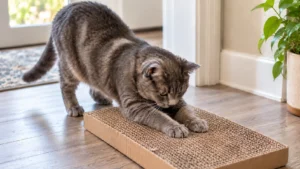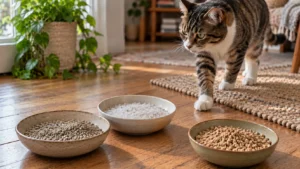
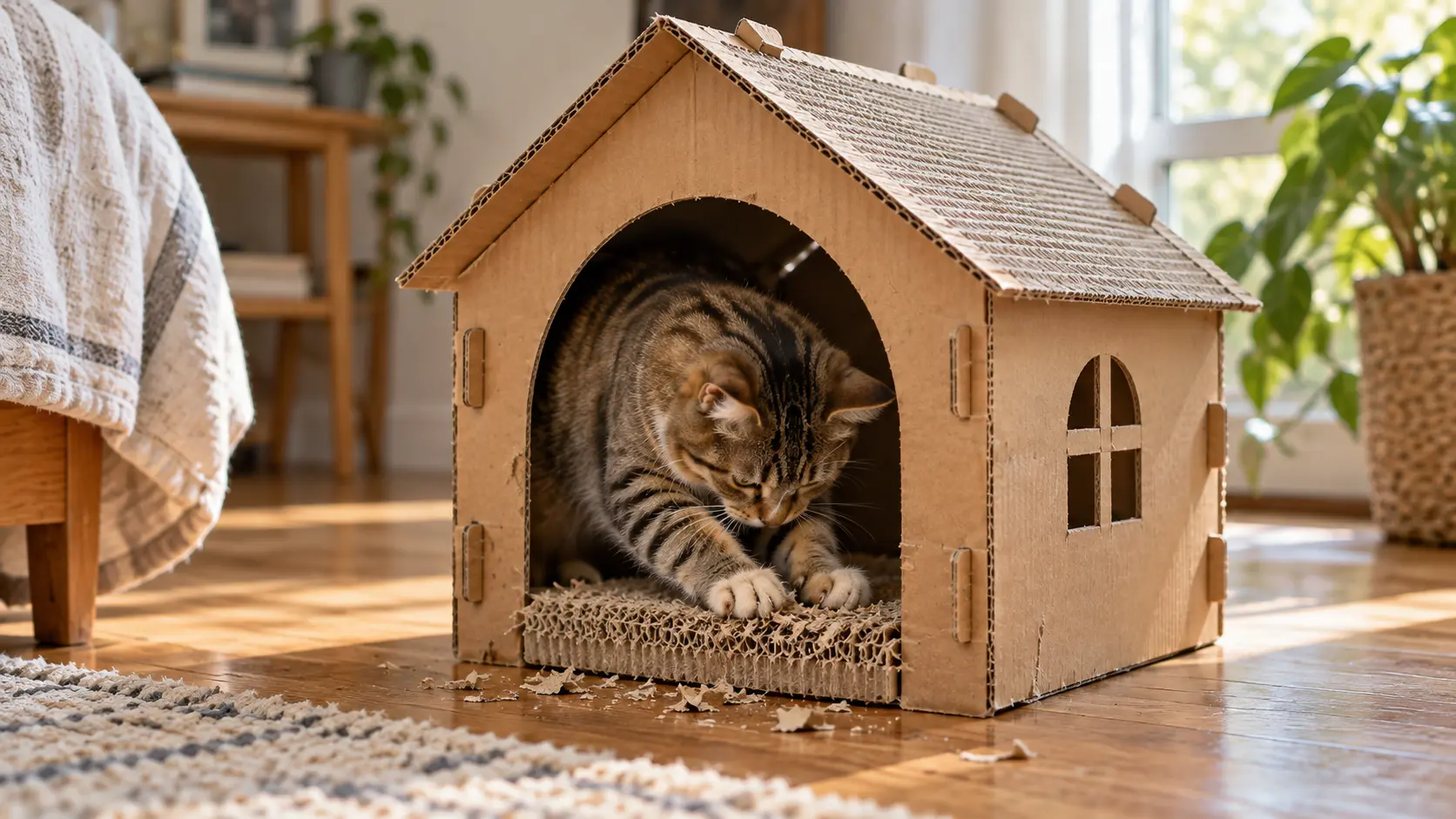
A cat scratcher house gives your cat two things in one spot: somewhere to hide or rest and a cardboard surface to scratch. Some are simple cottages with a scratching pad on the floor. Others have ramps, upper levels, and several places to dig in their claws.
The challenge is finding one that suits your cat. A house might look spacious in photographs but have a narrow entrance. Another may offer several scratching areas, yet its cardboard supports wear out before the pads do.
We compared five cat scratcher houses using product specifications, scratching layouts, replacement options, and customer feedback. The aim is to help you choose something your cat can comfortably use—not just a cardboard house that looks cute in the living room.
Affiliate disclosure: This article contains affiliate links. LumaPaw may earn a commission if you purchase through them, at no additional cost to you.
Cat Scratcher Houses at a Glance
These five options cover different scratching preferences, from enclosed floor pads to angled ramps and multi-level cardboard condos.
Cat Scratcher House |
Exterior Dimensions |
Scratching Design |
Replacement Pads |
|---|---|---|---|
Frisco Tudor House |
16.5 × 16.5 × 20.01 in |
Interior floor pad |
Yes |
FurHaven Tiger Tough Farmhouse |
27.5 × 16.5 × 31 in |
Multiple scratching areas and upper deck |
Not confirmed |
Tiger Tough Townhouse |
26 × 20 × 26 in |
Interior scratcher and angled ramp |
Not confirmed |
FUKUMARU SH02 |
16.93 × 11.81 × 14.57 in |
Angled and interior scratching surfaces |
Not confirmed |
ASPCA Cardboard Cottage |
19 × 13 × 17 in |
Interior floor pad |
Not confirmed |
Dimensions are based on the specified product listings and describe the outside of each structure, not the usable interior. The ASPCA measurements refer specifically to Amazon ASIN B07VGTY417.
The Frisco Tudor stands out for its confirmed replacement pads. FurHaven’s Farmhouse offers more levels and scratching areas, while the Townhouse adds an angled ramp. FUKUMARU takes a smaller, more open approach. ASPCA provides a traditional fold-flat cardboard cottage.
A larger house isn’t automatically a better one. Consider where your cat likes to scratch and whether there’s enough room to enter, turn around, and settle down.
How We Researched These Cat Scratcher Houses
We compared product details from Amazon, Chewy, and available manufacturer information, paying particular attention to dimensions, materials, scratching surfaces, assembly, and replacement parts.
Customer feedback helped identify problems that don’t always appear in product descriptions. These included cardboard tabs coming loose, scratch pads wearing out, difficult assembly, restricted entrances, and damage to elevated sections.
We also compared similar models rather than selecting several houses simply because they have different decorations. Products with a distinct scratching layout or practical ownership advantage received more consideration.
LumaPaw has not personally tested these houses. Our assessments are based on published product information, retailer listings, and customer experiences. Reports of long-lasting construction or early damage are treated as buyer experiences, not verified performance guarantees.
Prices and availability can change, so check the selected product version before purchasing.
Best Cat Scratcher Houses Reviewed

Frisco Tudor House Cardboard Cat House
Best for: Cats that enjoy horizontal scratching and enclosed resting spaces, especially when owners want replaceable pads.
Avoid if: Your cat destroys cardboard quickly, needs a particularly spacious hideaway, or frequently jumps onto lightweight furniture.
Buying note: If your cat tends to wear out scratching pads while leaving the surrounding structure intact, the Tudor’s replacement system is a meaningful reason to consider it over similarly priced cottages.
The strongest practical feature is the replacement option. Chewy lists the Frisco Cat House Cat Scratcher Toy Refill, item 2257870, as compatible with the Tudor House.
That’s important because the scratching surface may wear out long before the rest of the structure. Being able to purchase a fresh insert avoids automatically replacing the entire house.
Customer feedback is generally positive about cats using the Tudor for both scratching and sleeping. Some owners describe months of use, although others report faster wear from cats that chew or scratch aggressively.
Loose cardboard tabs and limited space for certain larger cats also appear in reviews. The exterior height shouldn’t be mistaken for unrestricted interior room beneath the sloped roof.
The Frisco Tudor is a sensible starting point for anyone who wants a traditional cat cardboard house without unnecessary extras.
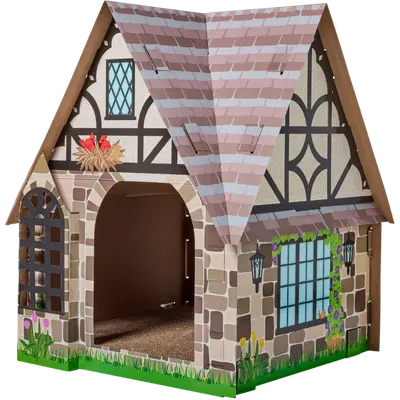
Its pitched roof and printed stone-and-timber exterior make it look like a small cottage, but the useful part is inside: a horizontal corrugated scratching pad where a cat can scratch, sit, or curl up.
The house measures 16.5 × 16.5 × 20.01 inches and has two entrances. That gives cats another way out instead of forcing them to use a single doorway.
Product snapshot
- Material: Cardboard and paper
- Design: Single-story enclosed house
- Scratching surface: Interior corrugated pad
- Assembly: Required
- Replacement: Compatible Frisco scratching inserts
Pros
- Confirmed replacement scratching pads
- Two entrances
- Combines scratching and enclosed resting space
- Straightforward design with relatively few levels to maintain
Cons
- Cardboard panels can loosen or deteriorate
- May feel cramped for long-bodied cats
- Not intended as a dependable elevated perch

FurHaven Tiger Tough Farmhouse Playground
Best for: Cats that enjoy cardboard play structures, exploring enclosed spaces, and using scratching surfaces at different levels.
Avoid if: Your cat makes forceful jumps onto furniture, frequently chews cardboard supports, or needs a reliably weight-rated climbing platform.
Buying note: The extra features make this appealing, but they’re only worthwhile if your cat will use them. For a cat that mostly sleeps in boxes and scratches the floor, a simpler house may be better value.
This model makes more sense for a cat that enjoys investigating different levels than one that simply wants a quiet box to sleep in.
Customer reviews describe cats scratching on different surfaces, lounging downstairs, and playing around the upper level. Some owners report extended use, even in multi-cat households.
The drawbacks deserve equal attention.
Several buyers describe confusing assembly instructions or cardboard tabs becoming damaged. Others report chewing-related deterioration and, in some cases, elevated sections collapsing after cats jumped onto them.
The opening between levels can also reduce usable upper-floor space. A large overall house doesn’t necessarily mean every compartment will comfortably accommodate a large cat.
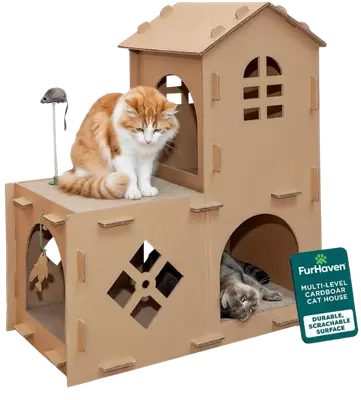
The FurHaven Tiger Tough Farmhouse offers more than a small cardboard hideaway. It’s a multi-level structure with different places to scratch, rest, and investigate.
Measuring approximately 27.5 × 16.5 × 31 inches, it has a larger overall footprint and considerably more height than the Tudor. Its layout combines a lower enclosed area with an upper house and deck.
The corrugated scratching sections are integrated into different parts of the structure. FurHaven also includes catnip and hanging toys, and the plain cardboard exterior can be decorated.
Product snapshot
- Material: Corrugated cardboard
- Design: Multi-level farmhouse with an upper deck
- Scratching surfaces: Multiple integrated areas
- Extras: Catnip and hanging toys
- Replacement scratchers: Not confirmed as separately available
Pros
- Several scratching positions
- Multiple hiding and resting areas
- Included toys and catnip
- More opportunities for exploratory play than a basic cottage
Cons
- More complicated assembly
- Cardboard supports require regular inspection
- No confirmed routine replacement scratch pads
- Upper sections are not a substitute for load-rated cat furniture

Tiger Tough Townhouse Playground Corrugated Cat Scratcher
Best for: Cats that prefer angled scratching and also enjoy exploring cardboard hideaways.
Avoid if: Your cat rapidly wears through cardboard ramps or needs a larger, reliably supported elevated resting area.
Buying note: Compared with FurHaven’s Farmhouse, choose the Townhouse for its angled ramp—not simply because it has two levels. That scratching surface is its most useful distinction.
The ramp is the main reason to consider this model.
Cats that already enjoy scratching angled cardboard may find the sloped surface appealing. It also provides an alternative to houses where scratching takes place only on a flat floor.
Customer feedback includes reports of regular scratching, sleeping inside, and cats moving between compartments. Some owners describe long periods of use.
However, replacement support is a notable limitation. Buyers have reported the ramp wearing out while the rest of the house remains usable. Chewy’s product-specific information does not confirm separately available replacement inserts.
Assembly experiences are mixed, too. Some owners find the pieces straightforward to connect, while others report loose flaps, confusing instructions, or damaged cardboard.
Because the upper level is part of a lightweight cardboard structure, it shouldn’t be treated as a proven heavy-duty perch.
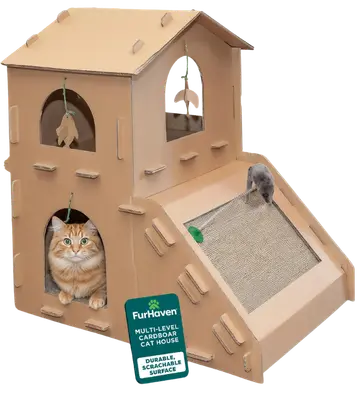
The Tiger Tough Townhouse looks similar in concept to the Farmhouse, but its scratching arrangement is quite different.
An angled corrugated ramp runs down the front of the structure, giving cats a sloping surface to scratch. There’s also scratching space in the lower compartment, with enclosed resting areas on two levels.
The entire structure measures approximately 26 × 20 × 26 inches. Its unfinished cardboard exterior can be customized, and the package includes catnip and hanging toys.
Product snapshot
- Material: Corrugated cardboard
- Design: Two-level townhouse with an exterior ramp
- Scratching surfaces: Angled ramp and lower interior
- Assembly: Required, without tools
- Replacement pads: Not confirmed as available
Pros
- Dedicated angled scratching ramp
- Two enclosed levels
- Additional scratching space downstairs
- Catnip and hanging toys included
Cons
- Worn ramp may be difficult to replace
- Scratching can create cardboard debris on the floor
- Some assembly and connection problems reported
- Upper compartments may be restrictive for bigger cats

FUKUMARU Cat Scratcher House SH02
Best for: Cats that like angled cardboard scratchers and low, partially sheltered resting spots.
Avoid if: You’re mainly shopping for a roomy enclosed house or your cat needs a larger resting area.
Buying note: The SH02 is worth considering for its scratching geometry. If your cat mainly wants privacy, a conventional cottage such as the Tudor or ASPCA house is a closer match.
This is more of a scratcher with a hideaway underneath than a full cardboard condo.
That distinction matters. A cat may enjoy scratching the sides and lying partially inside without having enough room to stretch out comfortably for a long nap.
Customer feedback repeatedly describes cats using the angled surfaces, relaxing around the opening, and returning to the scratcher throughout the day.
The most noticeable complaints involve cardboard debris, worn scratching sections, and the lack of confirmed replacement panels.
Some buyers also find the sheltered area smaller than expected.
FUKUMARU advertises a maximum load capacity of 22 pounds for this design. That is a manufacturer claim rather than an independently verified jumping or climbing safety rating. It shouldn’t be used as the sole basis for choosing the product for a heavier cat.
Not every cat wants to disappear inside a closed cardboard cottage. Some prefer a more open space where they can scratch, look around, and rest without feeling enclosed.
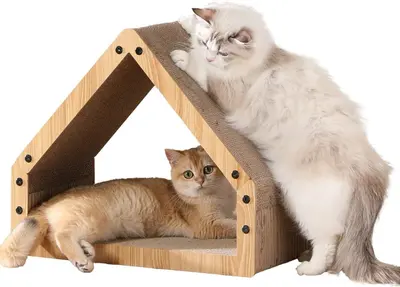
The FUKUMARU SH02 takes that approach with a triangular, house-shaped structure. Its sloping sides provide angled scratching surfaces, while the space underneath works as a small sheltered resting area or play tunnel.
The listed exterior dimensions are 16.93 × 11.81 × 14.57 inches.
Product snapshot
- Model: SH02
- Material: Cardboard
- Design: Compact triangular scratcher house
- Scratching style: Angled corrugated surfaces
- Intended use: Indoor scratching and resting
Pros
- Different scratching angle from ordinary floor pads
- Compact footprint
- Open sheltered area
- Useful combination of scratching and resting surfaces
Cons
- Limited enclosed sleeping space
- No confirmed replacement panels
- May shed noticeable cardboard debris
- Manufacturer load claim does not establish dynamic jumping safety

ASPCA Cardboard Cat House Hideaway Playhouse With Scratcher
Best for: Cats that enjoy a conventional cardboard hideaway and owners who appreciate easy storage.
Avoid if: Your cat is a heavy cardboard chewer, regularly jumps onto cardboard roofs, or requires verified replacement inserts.
Buying note: The ASPCA cottage is a reasonable alternative to Tudor, particularly if you prefer the folding design. Tudor has the clearer long-term advantage when replacement scratching pads matter.
There is considerable customer feedback for the Amazon-listed cottage. Owners frequently describe quick assembly, cats sleeping inside, and regular use of the scratching floor.
Some owners have kept their houses in use for months. Others describe much faster deterioration, particularly when cats chew the walls or put pressure on the roof.
Loose assembly tabs are another recurring complaint. Several customers mention needing to reinforce connections, and some report damage while assembling or adjusting the house.
Replacement support is less clear than with the Frisco Tudor. The interior scratching board may be removable, but that doesn’t establish that the manufacturer sells a compatible replacement.
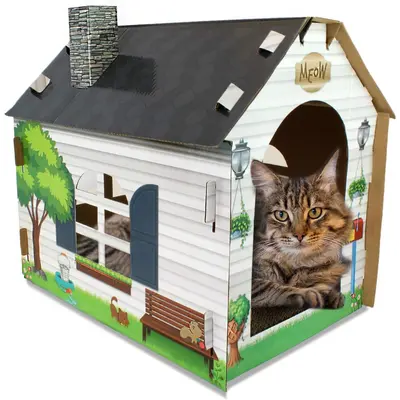
The ASPCA cardboard cottage keeps things simple: a printed house with an interior corrugated scratching board and enough shelter for a cat to investigate, rest, or nap.
It also folds flat for storage, which can be convenient if you don’t want a cardboard house permanently occupying part of the floor.
The Amazon cottage version, ASIN B07VGTY417, is listed at 19 × 13 × 17 inches. Chewy also carries an ASPCA Cat Cottage House, but confirm the exact measurements and product version before treating the two listings as interchangeable.
Product snapshot
- Selected product: Amazon ASIN B07VGTY417
- Material: Cardboard
- Design: Fold-flat cottage
- Scratching surface: Interior corrugated board
- Exterior dimensions: 19 × 13 × 17 inches
- Official replacement scratcher: Not confirmed
Pros
- Traditional enclosed cottage design
- Fold-flat storage
- Interior scratching board
- Straightforward assembly for many buyers
Cons
- Loose tabs reported by some owners
- No confirmed official replacement pads
- Durability varies with how cats use it
How to Choose a Cardboard Cat House With a Scratcher
A cardboard cat house with a scratcher shouldn’t be chosen by appearance alone. Two similarly sized products may feel quite different to a cat once you account for the doorway, floor space, and scratching surface.
Check the Entrance and Usable Interior Space
Start with your cat, not the product dimensions.
Measure your cat’s approximate body length while resting and consider shoulder width and normal sitting height. Then compare those measurements with the doorway and interior information available from the manufacturer.
A house that’s 20 inches tall on the outside may have considerably less usable height beneath a sloped roof.
Likewise, a cardboard cat condo with several levels may have smaller platforms than expected.
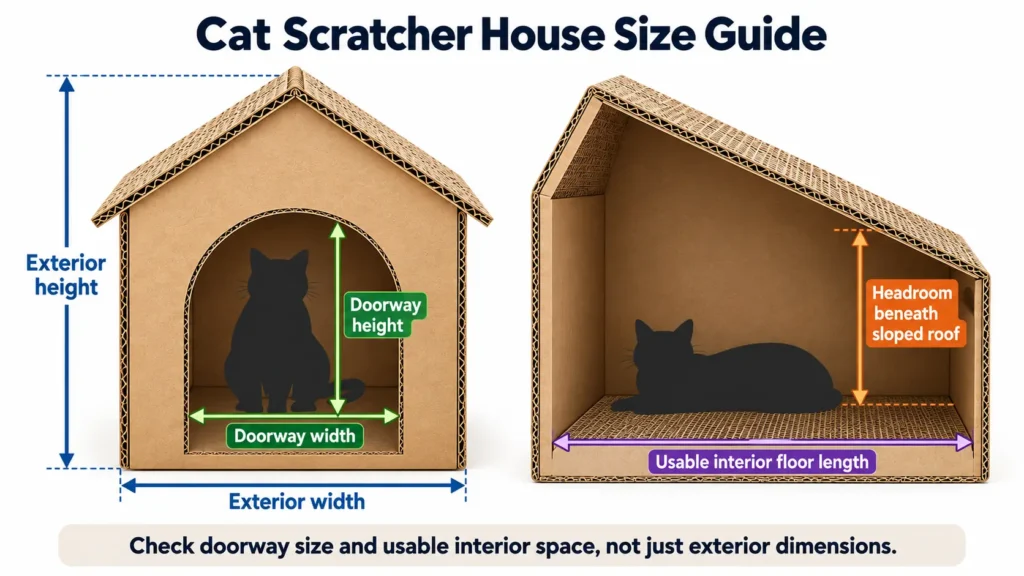
If you have a large or long-bodied cat, prioritize confirmed opening measurements and floor space over general labels such as “large cats” or “all sizes.”
For elevated structures, look for a clearly stated manufacturer capacity and remember that static weight support isn’t the same as safely absorbing a forceful jump.
Match the Scratching Surface to Your Cat
Watch what your cat already scratches.
A cat that regularly scratches carpets or flat cardboard pads may appreciate a house with an interior floor scratcher. A cat that likes sloped surfaces may get more use from the FUKUMARU or Tiger Tough Townhouse.
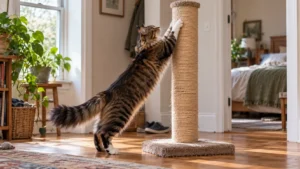
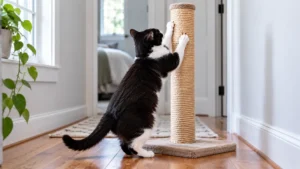
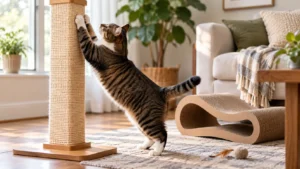
Cats that stretch upright against furniture may still need a separate vertical scratching post.
According to Cats Protection, matching scratching equipment to the cat’s preferred orientation can help encourage appropriate scratching.
If you’re unsure which format suits your cat, our guide to different types of cat scratchers compares vertical, horizontal, angled, and lounging designs.
A house can supplement an existing scratcher. It doesn’t necessarily need to replace it.
Single-Story Houses vs. Multi-Level Cardboard Cat Condos
A single-story cardboard house is usually easier to understand: your cat walks in, scratches the floor, and rests inside.
Multi-level houses provide more opportunities for investigation and play, but they also introduce extra joints, supports, openings, and elevated surfaces.
For kittens and smaller, relatively gentle cats, those additional features may be enjoyable. For a larger cat that jumps forcefully, cardboard construction requires more caution.
More levels do not automatically mean more comfortable sleeping space. Check where the scratch pads are located and whether the remaining platforms are large enough to use.
Look Beyond the Purchase Price
One of the easiest details to overlook is the scratcher’s replacement system.
Some cardboard houses use a separate insert that can be removed. Others have scratching surfaces integrated directly into the structure.
But removable does not always mean replaceable.
The Frisco Tudor has a compatible refill sold separately. That may extend the useful life of the house when only its scratching floor has worn out.
With other designs, a badly worn scratching panel could mean replacing the entire structure.
If you mainly need affordable surfaces for regular scratching rather than a hiding space, our comparison of cardboard cat scratch pads covers simpler alternatives.
Also consider the mess your cat creates. Some cats scratch cardboard neatly. Others shred it into small pieces that need frequent vacuuming.
Safety, Setup, and When to Replace a Cardboard Cat House
Cardboard is useful for scratching, but these houses are still lightweight furniture. Their condition matters, especially when they have upper levels or hanging toys.
Assemble and Place the House Carefully
Follow the product’s assembly instructions and check that every structural tab is properly connected before allowing your cat to use the house.
Place it on a flat, dry floor where it won’t slide or tip easily. Avoid positioning lightweight cardboard structures where cats might jump onto them from a much higher surface.
For houses with elevated floors, periodically inspect the supporting panels and connections.
In multi-cat homes, consider entrances and escape routes. A shy cat may be reluctant to use a house if another cat can block its only exit.
Start with the house near a resting place or an area your cat already likes to scratch.
Cleaning and Cardboard Maintenance
Remove loose cardboard with a vacuum or brush as needed. For ordinary surface dirt, follow the manufacturer’s cleaning instructions.
Some products recommend spot cleaning, while others advise dry cleaning only.
Avoid soaking corrugated cardboard. Moisture can soften panels, weaken connections, and make the house unsuitable for continued use.
Check scratch pads regularly, particularly where the pad meets the surrounding structure.
When Should You Replace the House?
A worn scratching surface isn’t automatically a problem. Fraying and shredded cardboard are expected with use.
Structural damage is different.
Stop using the house if you notice:
- Torn or missing load-bearing tabs
- Sagging upper floors or roof sections
- Damp or weakened cardboard
- Loose toy attachments that could be swallowed
- Large damaged sections that your cat is chewing or ingesting
No cardboard cat house is indestructible.
If your cat repeatedly eats cardboard rather than simply scratching it, remove the material and speak with your veterinarian. Seek prompt veterinary advice if your cat swallows pieces and develops vomiting, reduced appetite, or other signs of illness.
Frequently Asked Questions About Cat Scratcher Houses
Are cardboard cat houses good for scratching?
They can be, particularly for cats that enjoy corrugated cardboard.
The important detail is the scratching surface. A house with only a small floor pad might not satisfy a cat that prefers a tall vertical post.
Choose a scratching layout that resembles surfaces your cat already enjoys.
How long do cardboard cat scratcher houses last?
There isn’t one reliable lifespan for every cardboard house.
Some owners report months of use, while others describe rapid damage from chewing, scratching, or rough play.
The construction, your cat’s habits, and whether replacement pads are available all affect how long the house remains useful.
Inspect the structure rather than relying on a fixed replacement schedule.
Can large cats use cardboard cat condos?
Some can, but a large exterior doesn’t necessarily provide enough usable interior space.
Check the doorways, lower compartment, and any elevated platforms. Cat weight alone doesn’t establish fit or structural suitability.
For larger cats, pay particular attention to load-bearing parts and avoid relying on unverified customer weight anecdotes.
Can you replace the scratching pad inside a cardboard cat house?
It depends on the model.
The Frisco Tudor has a compatible replacement scratching insert sold separately through Chewy.
Other products may have removable pads without offering official refills. Check compatibility using the exact model or retailer item number before ordering replacement pieces.
What if my cat ignores the new scratcher house?
Try moving the house near a familiar resting or scratching area.
Allow your cat to investigate without forcing them inside. You can encourage interest through gentle play around the entrance or a small amount of catnip if your cat responds to it.
If your cat continues to ignore the house, the problem may be its location, entrance, scratching texture, or enclosed design.
Some cats simply prefer an open bed and a separate scratcher.
Which Cat Scratcher House Should You Choose?
The right cat scratcher house is the one that fits your cat’s body and scratching habits—not necessarily the largest or most decorative model.
For a straightforward hideaway with a replaceable scratch pad, the Frisco Tudor has a particularly practical advantage.
If your cat enjoys exploring cardboard structures with multiple scratching areas, consider the FurHaven Farmhouse or the Tiger Tough Townhouse, while paying close attention to their structural limitations.
The FUKUMARU SH02 makes more sense for angled scratching than spacious sleeping, while the ASPCA Cottage offers a traditional fold-flat alternative.
Before buying, check the exact version, entrance space, replacement options, and how your cat is likely to use the structure. Those details matter more than the design printed on the cardboard.