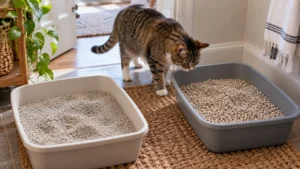
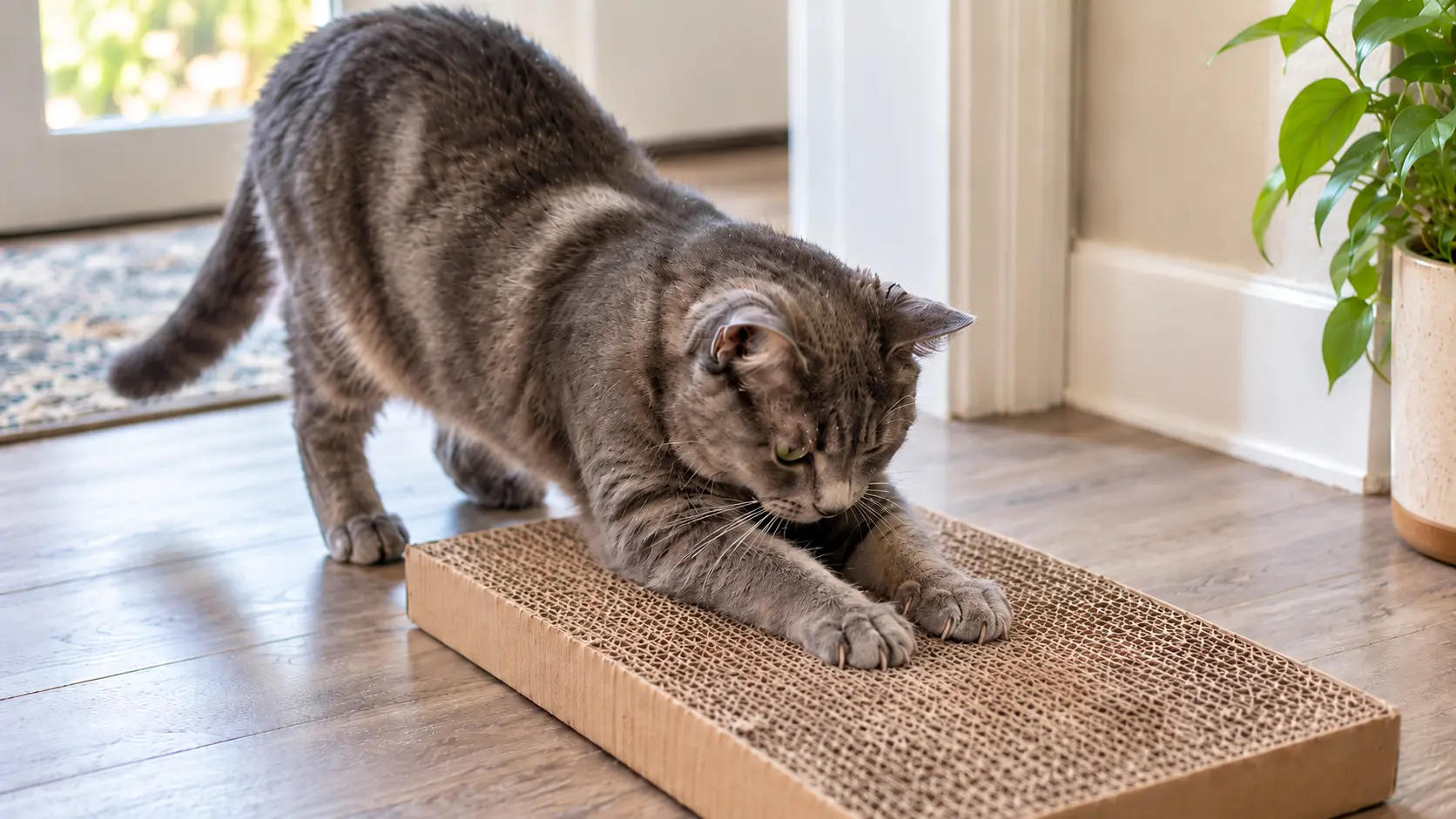
Some cats ignore a perfectly good scratching post but happily dig their claws into a rug, cardboard box, or doormat. For those cats, a horizontal scratcher may be a better fit.
A good cat scratch pad gives your cat a place to scratch without taking up much room. But not all cardboard scratchers work the same way. Some slide across the floor, some leave cardboard flakes everywhere, and others cost more to replace than you might expect.
We compared five options, from inexpensive multipacks to refillable scratchers and cardboard lounges. The right choice depends on how your cat likes to scratch, how much space you have, and how often you’re willing to replace worn cardboard.
Affiliate disclosure: LumaPaw may earn a commission when you purchase through links on this page, at no extra cost to you. Our recommendations are based on product research and customer feedback, not hands-on testing.
The 5 Best Cat Scratch Pads at a Glance
If your cat already scratches horizontally, a flat board is a sensible starting point. Curved and box-style scratchers are worth considering when your cat also likes resting on cardboard.
Cat Scratch Pad |
Best For |
Dimensions |
Replaceable Insert? |
Main Drawback |
|---|---|---|---|---|
Frisco Double-Wide |
Refillable flat scratching |
18 × 9.75 × 2 in. |
Yes |
Cardboard debris |
SIDAZON 2-Pack |
Low-cost scratching stations |
Approx. 16.5 × 8 in. each |
No separate refill |
Small boards can slide |
Kitty City XL 3-Pack |
Multiple cats or rooms |
18 × 10 × 1.5 in. each |
Pads are individually replaceable |
Lightweight boards may move |
Frisco Step-In |
Cats that like cardboard boxes |
15 × 13 × 4.5 in. exterior |
Yes |
Limited scratching length |
Original Scratch Lounge XL |
Scratching and lounging |
21.5 × 13.5 × 4.75 in. exterior |
Yes |
Higher purchase and refill costs |
Dimensions are from retailer or manufacturer listings. For box-style products, exterior measurements are larger than the usable interior space.
The 5 Best Cat Scratch Pads Compared

Frisco Double-Wide — Best Refillable Flat Cat Scratch Pad
Best for: Cats that already enjoy flat cardboard scratching and owners who prefer buying replacement inserts.
Avoid if: Your cat needs a much larger surface or regularly chews and swallows cardboard.
Honest buying note: The refill system is useful, but it doesn’t make the entire scratcher permanent. Check the condition of the cardboard holder before investing in more inserts.
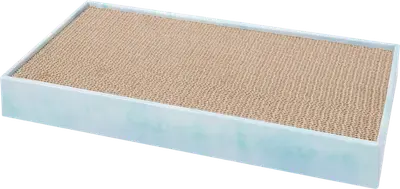
The Frisco Double-Wide is a straightforward choice for a cat that likes scratching on the floor.
Its corrugated cardboard surface sits inside a shallow tray measuring 18 × 9.75 × 2 inches. There’s enough room for a cat to stand over the pad and work its claws across the surface, although bigger cats may prefer something wider.
The main attraction is the replacement system. Once the cardboard wears down, you can purchase a compatible two-pack of Double-Wide inserts instead of replacing the whole scratcher.
The refills measure approximately 17.5 × 9 × 2 inches. They are made for this specific model, not Frisco’s Single-Wide or Step-In scratchers.
Customer feedback is generally favorable about cats taking to the pad for scratching and occasionally resting. Owners also appreciate being able to replace the insert. The recurring downside is cardboard debris, which can end up around the tray and require regular vacuuming.
Product snapshot
- Material: Corrugated cardboard
- Size: 18 × 9.75 × 2 inches
- Catnip: Included
- Replacement inserts: Available separately
- Design: Flat cardboard pad inside a tray
Pros
- Uncomplicated flat scratching surface
- Compatible replacement inserts available
- Catnip included
- Reasonable initial price compared with larger scratcher-loungers
Cons
- Shredded cardboard can make a mess
- The outer tray may eventually need replacing
- Not especially roomy for cats that stretch out fully

SIDAZON Reversible 2-Pack — Best Budget Two-Pack
Best for: Budget-conscious buyers who want to place inexpensive scratchers in two locations.
Avoid if: Your cat pulls hard while scratching or needs a wide, stable platform.
Honest buying note: This is a good budget candidate, not a durability champion. Two cheaper boards aren’t necessarily better value if your cat wears them out quickly.
Buying several scratchers can get expensive, especially when your cat tears through cardboard quickly.
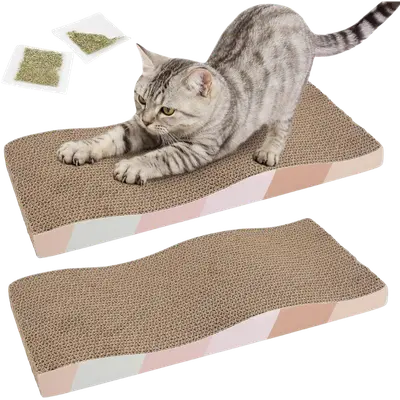
The SIDAZON two-pack offers two shallow-curved scratching boards rather than one larger scratcher. Each board is approximately 16.5 inches long and 8 inches wide, so they’re better suited to cats that don’t need an especially broad surface.
The boards are reversible, and the set includes catnip. Their shallow wave shape gives cats a slightly different scratching angle from a completely flat board.
At the price shown during our research, the two-pack was particularly inexpensive. That makes it worth considering if you want to try cardboard scratchers in different locations without spending much upfront.
Customer feedback supports its everyday usefulness, but durability is inconsistent. Some buyers report months of use, while others describe rapid shedding or worn edges.
Sliding is another common concern. The lightweight boards may move on hardwood or tile, and some owners report wobbling when the boards are flipped.
Product snapshot
- Material: Corrugated cardboard
- Quantity: Two scratching boards
- Size: Approximately 16.5 × 8 inches per board
- Catnip: Included
- Design: Shallow curve, reversible
Pros
- Two scratching stations in one purchase
- Low initial cost
- Reversible surfaces
- Compact enough for smaller spaces
Cons
- Smaller than several competing pads
- Can slide or wobble during scratching
- Cardboard shedding and loose edging are reported complaints

Kitty City XL 3-Pack — Best Multi-Pack for Multiple Scratching Spots
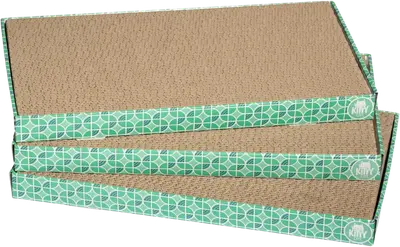
Best for: Households with several cats or multiple locations where scratching happens.
Avoid if: Your cat refuses to use scratching boards that move under its paws.
Honest buying note: Kitty City is attractive for its size and quantity. However, it isn’t automatically the cheapest option per board, and you should consider how the pads will stay in place.
One scratcher beside the sofa may not be enough if your cat also scratches near the bedroom door or in another favorite room.
The Kitty City XL set includes three separate cardboard pads, each measuring 18 × 10 × 1.5 inches. They’re reversible and can be used on their own or with compatible Kitty City furniture.
The larger rectangular surface is a meaningful advantage over smaller budget boards. Cats have more room to position themselves, and you can put the three pads wherever scratching is already happening.
Customer reviews frequently mention cats using these boards for scratching and sitting. Owners with multiple cats also appreciate having several pads available.
The trade-off is that the boards are lightweight. They can slide on smooth floors, particularly when a cat scratches from the edge without standing on the pad. Expect cardboard flakes as the surface wears, too.
Product snapshot
- Material: Corrugated cardboard
- Quantity: Three XL pads
- Size: 18 × 10 × 1.5 inches per pad
- Reversible: Yes
- Model: CM-0204-CS01, XL 3-Pack Geometric Mint
Pros
- Three generously sized scratching surfaces
- Useful for multi-cat households
- Reversible cardboard
- Easy to distribute around the home
Cons
- Pads may slide on hard floors
- Cardboard debris needs cleaning
- No rigid reusable tray included with this selected set

Frisco Step-In — Best Box-Style Cat Scratch Pad
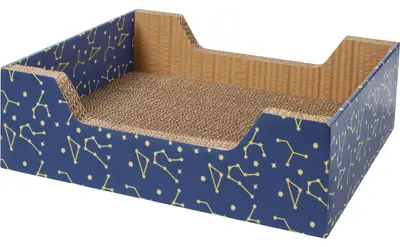
Best for: Cats that enjoy sitting in boxes and scratching flat cardboard surfaces.
Avoid if: Your cat prefers stretching its body out across a long, unobstructed board.
Honest buying note: Choose this over Frisco Double-Wide because your cat likes the box-style design, not because the two products have similar refill prices. They serve slightly different preferences, and their inserts are not interchangeable.
Some cats seem just as interested in the box around a scratcher as the scratching surface itself.
The Frisco Step-In combines a corrugated cardboard insert with a low-sided cardboard enclosure. The Constellations version measures 15 × 13 × 4.5 inches externally, making it more compact than a full-size cardboard lounge.
Its low walls create a contained spot where cats can scratch, sit, or curl up. Customer reviews include accounts of cats using it for both scratching and sleeping, sometimes prompting owners to buy additional boxes.
A separate two-pack of compatible Step-In replacement inserts is available, which is helpful when the bottom wears out.
The drawback is the limited interior length. Some owners report that their cats cannot stretch comfortably while scratching. There are also complaints about the cardboard walls or seams becoming damaged.
Product snapshot
- Material: Corrugated cardboard and paper
- Exterior size: 15 × 13 × 4.5 inches
- Catnip: Included
- Replacement inserts: Available separately
- Design: Low-sided step-in box
Pros
- Combines scratching with a contained resting spot
- Dedicated replacement inserts
- Compact footprint
- Suitable for cats that already enjoy cardboard boxes
Cons
- Shorter scratching area than an open flat pad
- Cardboard sides can wear or separate
- Some cats use it mainly for sleeping

Original Scratch Lounge Classic XL — Best Three-Sided Scratching Lounge
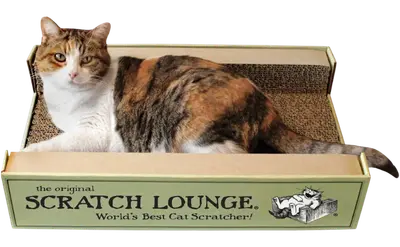
Best for: Cats that enjoy scratching and resting in cardboard spaces, particularly those that use both horizontal and side surfaces.
Avoid if: You want a low-cost scratcher that’s inexpensive to replace completely.
Honest buying note: Check the cost of a new lounge against the replacement panels before ordering several parts. Refillable construction is convenient, but it doesn’t always mean lower long-term spending.
The Original Scratch Lounge is a different proposition from a basic floor pad. It’s a shallow rectangular lounge with corrugated cardboard on the floor and both sides.
That gives cats several surfaces to scratch, along with a spot to rest between sessions.
The manufacturer lists exterior dimensions of 21.5 × 13.5 × 4.75 inches. The actual interior floor is approximately 21 × 9 inches, an important distinction if you’re buying it for a larger cat.
Its scratching panels can be reversed, and replacement floor and side pieces are sold separately. Customer feedback includes reports of cats scratching, lounging, and returning to the product over long periods.
There is a substantial price difference, though. This costs considerably more upfront than a simple cardboard pad. Replacement panels are also relatively expensive, so replacing every worn surface may not be economical.
Some owners report that their cats mainly sleep in the lounge rather than scratch it. That’s not necessarily a problem, but it matters when you’re specifically shopping for a scratching surface.
Product snapshot
- Material: Corrugated cardboard
- Exterior size: 21.5 × 13.5 × 4.75 inches
- Interior floor: Approximately 21 × 9 inches
- Scratching surfaces: Floor and two sides
- Replacement panels: Available separately
- Catnip: Included
Pros
- Three scratching surfaces
- Reversible and replaceable panels
- Room for scratching and resting
- Distinctive design for cats that enjoy cardboard lounges
Cons
- High upfront cost
- Replacement parts can be expensive
- Takes more floor space than ordinary pads
- Some cats treat it primarily as a bed
How We Researched These Cat Scratch Pads
We compared product specifications, dimensions, scratching styles, construction, replacement options, retailer availability, and customer feedback from Amazon and Chewy.
We also looked beyond average star ratings. Complaints about sliding, shedding, damaged cardboard frames, uncomfortable dimensions, and inconsistent durability are particularly important for products that cats physically pull against.
The shortlist was narrowed to five products with useful differences. Other candidates were left out because they duplicated stronger options, were less relevant to horizontal scratching, or had unresolved quality and availability concerns.
LumaPaw has not physically tested these scratchers. Our recommendations are based on available product information and reported customer experiences. Individual cats may respond differently, and customer reviews cannot establish a guaranteed product lifespan.
How to Choose a Cat Scratch Pad
Match the Pad to Your Cat's Scratching Style
Start with what your cat already scratches.
A cat that digs into rugs or doormats may prefer a flat cardboard scratcher. One that rests on cardboard boxes may enjoy a step-in design or scratching lounge.
Cats that scratch sofa arms or doorframes may want something upright instead. A flat pad won’t necessarily replace that preference.
You can compare different types of cat scratchers if you’re unsure which format makes sense.
Check the Usable Scratching Area
A large product isn’t always a large scratching surface.
Frisco Step-In measures 15 inches long externally, but the scratching insert is shorter. Scratch Lounge XL has a 13.5-inch exterior width, while the usable interior floor is approximately 9 inches wide.
For an active scratcher, consider whether your cat can stand comfortably and extend its front paws without running off the edge.
Body length and scratching posture are more useful here than relying on weight alone.
Stability Matters as Much as Cardboard Thickness
Cardboard density can influence wear, but it doesn’t tell you whether a scratcher will stay put.
A light board may slide across tile or hardwood. A curved design can rock when a cat puts pressure on one end.
Customer complaints about movement appeared across several products in our research.
Choose a stable location, check the scratcher’s movement before use, and consider whether your cat stands on the board while scratching. A surface that shifts unexpectedly may discourage repeat use.
Cardboard flakes are another realistic trade-off. Even well-made corrugated scratchers gradually shed material.
Reversible Pads, Catnip, and Refills
Reversible pads let you turn over a worn surface and use the other side. That can extend their usefulness, but it doesn’t guarantee twice the lifespan.
Replacement inserts are worthwhile when the surrounding holder is still in good condition and the new insert costs substantially less than another complete scratcher.
Always check compatibility. Frisco Double-Wide and Frisco Step-In use different replacement inserts.
Catnip can help attract some cats, but responses vary. An included packet should be treated as an extra, not a reason to choose an otherwise unsuitable scratcher.
How Much Do Cardboard Cat Scratch Pads Cost?
The purchase price tells only part of the story.
Some budget packs cost very little per board but may wear quickly. More expensive scratchers sometimes offer replaceable surfaces, although the replacement cost can be substantial.
Compare the Cost Per Pad
Here are examples from the US retailer prices observed during our October 2026 research.
Product |
Observed Purchase Price |
Approximate Cost Per Pad |
|---|---|---|
SIDAZON 2-Pack |
$9.99 |
$5.00 |
Kitty City XL 3-Pack |
$18.24 |
$6.08 |
Frisco Double-Wide |
$9.99 |
$9.99 for the complete scratcher |
Frisco Step-In |
$11.99 |
$11.99 for the complete scratcher |
Original Scratch Lounge XL |
$39.95 |
$39.95 for the complete lounge |
Prices exclude shipping and taxes and may change. Products differ in dimensions, construction, and scratching area, so cost per pad is not a direct measure of value.
When Are Refills Worth It?
During our research, the compatible Frisco Double-Wide and Step-In two-packs were each listed at $9.99, or approximately $5 per insert.
That’s a potentially economical replacement compared with buying another complete scratcher, assuming the cardboard holder remains usable.
The Original Scratch Lounge offers a different calculation. Its manufacturer listed a single XL floor replacement at $21.95 and a two-piece side replacement set at $21.95.
Replacing all three surfaces could cost more than purchasing another complete lounge.
Think About Replacement Frequency
A pad that lasts several months can be better value than a cheaper one worn out in weeks. But lifespan varies with scratching intensity, the number of cats using it, cardboard construction, and whether both sides remain usable.
Rather than relying on advertised durability, pay attention to how your cat actually uses the product and how quickly it wears.
Where to Place a Cat Scratch Pad and How to Encourage Use
Placement can make the difference between a scratcher that gets used and one that sits untouched.
According to Ohio State University’s Indoor Pet Initiative, cats may prefer scratching near resting spots, entrances, and regularly used areas of the home.
Try this approach:
- Place the pad near a rug, furniture corner, or other spot your cat already scratches.
- Check that it doesn't slide when your cat presses against it.
- Let your cat explore without forcing its paws onto the cardboard.
- Use a toy or a little catnip, if appropriate, to draw attention to the surface.
- Reward your cat when it chooses the scratcher.
If the cat consistently ignores flat pads but scratches upright furniture, consider a stable vertical scratching post instead.
Cat Scratch Pad Safety, Cleaning, and Replacement Signs
Cardboard scratchers are designed to wear down during use, but excessive damage shouldn’t be ignored.
Inspect the pad regularly, particularly if your cat scratches aggressively or likes chewing cardboard.
Replace it when you notice:
- Large loose cardboard pieces or exposed adhesive
- Decorative edging coming apart
- A damaged or unstable supporting frame
- Excessive wear that leaves little usable scratching surface
- Moisture damage, visible mold-like growth, or a strong unexplained odor
Vacuum or collect loose cardboard shreds as needed. Keep the product dry, and don’t soak or machine-wash cardboard inserts.
Supervise cats that tend to chew or swallow pieces. If your cat repeatedly eats cardboard or develops vomiting, loss of appetite, or other concerning symptoms after swallowing material, contact your veterinarian.
A scratch pad also doesn’t replace regular claw checks and trimming when needed. Scratching helps cats maintain their claws, but it may not keep every nail at a comfortable length.
Frequently Asked Questions About Cat Scratch Pads
How often should you replace a cat scratch pad?
There’s no reliable schedule that fits every cat.
Some scratchers last much longer than others, depending on cardboard quality and scratching habits. Replace the pad when the surface becomes excessively worn, loose pieces present a hazard, or the product no longer stays stable.
If the pad is reversible, check whether the unused side is still in good condition.
Why do cats sleep on scratch pads?
Some cats seem to enjoy the shape, texture, or location of cardboard scratching surfaces.
Box-style and lounge designs can be especially appealing because they provide a defined resting spot. Sleeping on a scratch pad is generally normal behavior, although it doesn’t necessarily mean the cat is using it for scratching.
Are cardboard scratch pads safe for cats?
Cardboard scratch pads are commonly used for scratching, but no product is completely risk-free.
Choose a well-constructed scratcher, remove damaged pieces, and supervise cats that chew cardboard. Manufacturer claims about non-toxic materials are not substitutes for checking the actual product’s condition.
What if my cat ignores a cardboard scratch pad?
Try changing the location first.
Place it near an existing scratching spot, and make sure it isn’t moving across the floor. You can also try a different texture or shape.
Some cats simply prefer upright surfaces, sisal, or carpet-like materials over corrugated cardboard.
Do cardboard scratch pads stop cats from scratching furniture?
They can provide an appropriate alternative, but they don’t guarantee that furniture scratching will stop.
Cats differ in their preferred materials, scratching angles, and locations. Offering a scratcher where your cat already likes to scratch is often more useful than placing one in an unused corner.
Which Cat Scratch Pad Should You Choose?
For a cat that already scratches horizontally, the Frisco Double-Wide is a practical starting option with a replaceable surface.
The SIDAZON 2-Pack keeps the initial cost low, while Kitty City XL makes more sense when you need several wider pads around the house.
If your cat enjoys sitting inside cardboard boxes, Frisco Step-In offers that familiar shape with replaceable inserts. The Original Scratch Lounge XL is worth considering when you want a larger, three-sided surface and don’t mind paying more.
The best cat scratch pad isn’t necessarily the thickest, most expensive, or highest-rated. It’s one that matches your cat’s scratching habits, stays stable during use, and makes sense for your replacement budget.