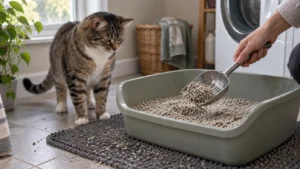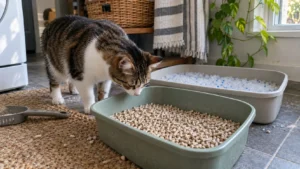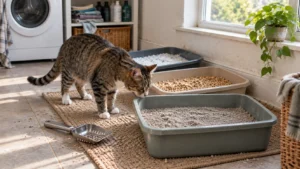
Clay cat litter is a mineral-based litter available in both clumping and non-clumping formulas. It remains one of the most common choices because it is widely available, usually easy to scoop or absorbent depending on the type, and comes in many price points, scents, granule sizes, and package sizes.
Its drawbacks are just as practical: clay can be heavy, some formulas create noticeable dust, fine particles may track through the house, and not every cat likes fragrance or the same texture.
This guide explains how clay litter works, the difference between clumping and non-clumping clay, the main safety questions, and five clay litters that stood out for different needs.
Disclosure: LumaPaw may earn a commission from qualifying purchases made through links on this page, at no extra cost to you.
What Is Clay Cat Litter?
Clay cat litter is made primarily from naturally occurring clay minerals that absorb moisture. The exact clay blend varies by product, so it is better to check the individual formula than assume every clay litter is made the same way.
If you are still deciding between materials, our broader cat litter guide compares clay with crystal, plant-based, and other options.
What Is Clay Litter Made From?
Traditional clay litter uses absorbent mineral clay. Some formulas use a single clay type, while others use blends designed to change clumping strength, weight, granule size, or odor control.
Manufacturers may also add ingredients such as activated charcoal, baking soda, or proprietary odor-control systems.
What Is Bentonite Clay Cat Litter?
Bentonite is a type of clay commonly used in clumping litter because it expands and binds together when wet.
That does not mean every clay litter is bentonite, and it also does not mean every clumping litter is clay. Corn, wheat, tofu, and other materials can clump too.
A useful distinction is:
Clay describes the material. Clumping describes what the litter does when it gets wet.
Clumping vs Non-Clumping Clay Litter
Both formats use clay, but they require noticeably different cleaning routines.
Feature |
Clumping clay |
Non-clumping clay |
|---|---|---|
Urine handling |
Forms removable clumps |
Absorbs urine into the litter |
Daily cleaning |
Scoop urine clumps and solids |
Remove solids and monitor saturation |
Full changes |
Usually less frequent |
More important |
Main advantage |
Targeted waste removal |
Simple format and often low upfront cost |
Main drawback |
Clumps may stick or break |
Urine remains in the litter |
How Clumping Clay Works
Clumping clay binds around moisture so urine can be removed along with solid waste.
Clump quality varies. Some litters form compact clumps that lift cleanly, while others can crumble or stick to the bottom of the pan if the litter is too shallow.
For a deeper product comparison, see our clumping cat litter recommendations.
How Non-Clumping Clay Works
Non-clumping clay absorbs urine rather than turning it into a scoopable mass.
That means a complaint that non-clumping litter “doesn’t clump” is not a product failure—it is the intended design. The tradeoff is that urine cannot be selectively removed, so full litter changes become more important.
Our non-clumping litter guide compares that format in more detail.
Is Clay Litter Bad for Cats?
Clay litter should not be reduced to a simple “safe” or “unsafe” answer. The exact formula, dust level, added fragrance, your cat’s behavior, and any existing health concerns all matter.
Clay Litter Dust and Respiratory Sensitivity
Clay formulas differ substantially in how much visible dust they produce.
Manufacturers often advertise figures such as “99% dust-free” or “99.9% dust-free,” but those are manufacturer measurements rather than guarantees that you will never see a dust cloud. Our product research repeatedly found owners reporting both very little dust and noticeably dusty bags from products carrying low-dust claims.
Cats with respiratory disease may need extra consideration when choosing litter. If your cat has asthma, chronic coughing, breathing problems, or is recovering from a procedure, ask your veterinarian what litter characteristics are appropriate.
You can also compare lower-dust cat litter options.
Scented vs Unscented Clay Litter
Added fragrance does not automatically mean better odor control.
Some scented litters manage odors well, but a strong perfume can be unpleasant for some cats or people. Unscented litter still has its own natural material smell; it simply means fragrance has not been intentionally added.
When you do not know a cat’s preference, an unscented option is usually a sensible starting point.
What If a Cat Eats Clay Litter?
A few particles picked up during normal grooming are different from a cat repeatedly eating litter.
If your cat deliberately eats litter, consumes a meaningful amount, vomits, becomes constipated, seems unwell, or keeps returning to the box to eat it, contact your veterinarian. Repeated litter eating can also warrant investigation for an underlying medical or behavioral cause.
What About Kittens?
Avoid applying one manufacturer’s kitten-age recommendation to every clay litter.
Age guidance varies between products, and veterinary advice should take priority for a very young kitten or one that is prone to tasting litter. Check the exact product directions rather than assuming every clumping clay formula has the same recommendation.
Clay Cat Litter Pros and Cons
Pros |
Cons |
|---|---|
Many formulas form firm, scoopable clumps |
Heavy compared with many alternatives |
Widely available |
Dust varies considerably |
Many price and package-size choices |
Fine particles can track |
Available scented or unscented |
Some clumps stick to the pan |
Familiar texture for many cats |
Some formulas contain strong fragrance |
Both clumping and non-clumping options |
Clay is a mined material |
Many cats readily use fine, granular litter, but individual preferences matter. If a cat avoids a new litter, the answer is not always that one material is objectively better—it may simply be a poor texture or scent match for that cat.
Clay also has an environmental tradeoff. It is mined rather than made from renewable plant material, and used clay litter is generally disposed of in household trash rather than flushed or composted.
How We Researched These Clay Cat Litters
We did not perform hands-on testing.
Our selections are based on current manufacturer information, exact Amazon and Chewy listings, formula and size verification, and repeated patterns in customer feedback.
We compared clumping style, scent, dust and tracking reports, pan sticking, package weight, odor-control approach, retailer availability, value, and recurring complaints.
Ratings, bestseller badges, and review counts were considered only as supporting context. We also treated manufacturer claims such as “99% dust-free” or extended odor-control periods as manufacturer claims rather than independent proof.
5 Clay Cat Litters Worth Considering
Product |
Our Pick For |
Type |
Scent |
Main advantage |
Main Limitation |
|---|---|---|---|---|---|
Dr. Elsey's Ultra |
Best Overall Clay Litter in This Guide |
Clumping |
Unscented |
Strong all-around balance |
Heavy; some sticking |
ARM & HAMMER Slide Platinum |
Best for Easy Cleanup |
Clumping |
Scented |
Easier pan release |
Added fragrance |
Fresh Step Advanced Simply Unscented |
Best for Odor Control Without Added Fragrance |
Clumping |
No added fragrance |
Carbon + ammonia-control system |
Tracking |
Cat's Pride Max Power |
Best Lightweight Clay |
Clumping |
Unscented |
Easier handling |
Fine particles can track |
Tidy Cats 24/7 Performance |
Best Traditional Non-Clumping Clay |
Non-clumping |
Scented |
Simple traditional format |
More full-box maintenance |

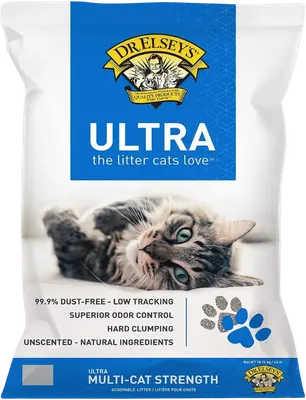
Dr. Elsey's Ultra Unscented — Best Overall Clay Litter in This Guide
Best for: Someone wanting a dependable, fragrance-free conventional clumping clay.
Avoid if: Carrying a 40-lb bag is difficult or pan sticking is your biggest frustration.
Common complaint: Keeping an adequate litter depth appears important because shallow litter can make bottom sticking worse.
Dr. Elsey’s Ultra is a straightforward unscented clumping clay with a strong balance of clump firmness, availability, and value. The manufacturer describes it as natural clay with medium-grain and heavier granules, and repeated owner feedback supports firm clumping and relatively easy scooping.
The tradeoffs are familiar clay-litter problems. The 40-lb bag is heavy, tracking still occurs, and some owners report dust or urine clumps sticking to the bottom of the box.
Pros
- Forms strong, firm clumps
- Unscented formula
- Broad availability on Amazon and Chewy
- Generally easy to scoop
Cons
- Heavy 40-lb package
- Tracking can occur
- Dust levels can vary
- Some urine clumps may stick to the bottom of the litter box

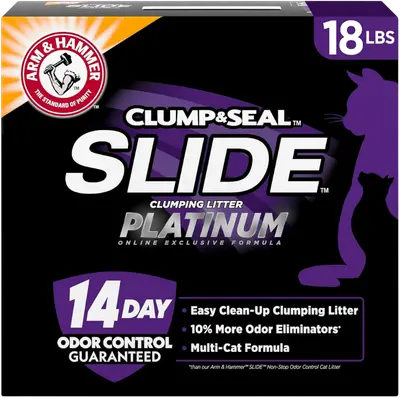
ARM & HAMMER Slide Platinum — Best for Easy Cleanup
Best for: Owners tired of scraping hardened clay from the box.
Avoid if: You or your cat strongly prefer fragrance-free litter.
Common complaint: A minority of users report softer or stickier clumps despite the product’s cleanup focus.
Slide Platinum earns its place for a specific reason: easier litter-box cleanup.
Its Slide/EZ Clean design is intended to reduce clay sticking to the pan, and repeated customer feedback supports easier release and less scraping compared with conventional clay formulas.
It also receives generally strong feedback for clumping and odor management, but this is a scented litter. Some owners like the fragrance; others find it too noticeable.
Pros
- Easier pan release
- Requires less scraping than many conventional clay litters
- Forms firm clumps
- Good recurring feedback for odor control
- Heavy package
Cons
- Contains added fragrance
- Tracking can still occur
- Dust levels can vary
- Some users report softer or stickier clumps

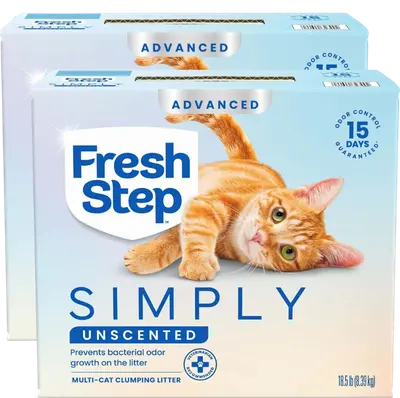
Fresh Step Advanced Simply Unscented — Best for Odor Control Without Added Fragrance
Best for: Households prioritizing odor control without perfume.
Avoid if: Tracking is your biggest concern or you need the exact Advanced formula from both major retailers.
Common complaint: Fine granules still migrate beyond the litter box.
Fresh Step Advanced Simply Unscented combines natural clay with odor-fighting carbon and additional Ammonia Block Technology while using no added fragrance or dyes.
Among the exact-version feedback we reviewed, odor management and clump strength were recurring positives. The two 18.5-lb boxes are also easier to handle individually than one 37- or 40-lb package.
Tracking is the main drawback. Some owners also notice a natural litter smell even though fragrance is not intentionally added.
Pros
- No added fragrance
- Strong odor-control positioning
- Forms firm clumps
- Uses carbon and an ammonia-control system
- Split packaging is easier to handle than one large 37- or 40-lb package
Cons
- Fine granules can track outside the litter box
- Some owners notice a natural litter smell despite the lack of added fragrance
- Exact Advanced formula availability is better on Amazon than Chewy

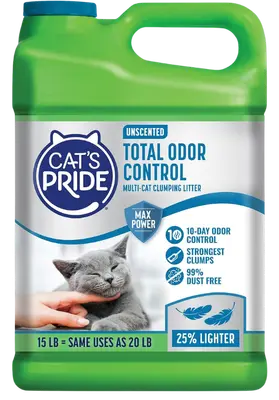
Cat's Pride Max Power Total Odor Control Unscented — Best Lightweight Clay
Best for: Someone who wants clumping clay without wrestling with a very heavy package.
Avoid if: You have a long-haired cat that carries fine litter through the home or tracking is your top concern.
Common complaint: The lightweight benefit does not eliminate tracking.
Clay’s weight is one of its most practical disadvantages, and Cat’s Pride addresses that directly.
The manufacturer says this dual-clay formula is 25% lighter than traditional scoopable clay litter. The 15-lb handled jug also makes pouring and storage easier than many 35- to 40-lb bags.
Clumping feedback is generally good, but the fine texture can travel on paws or get caught in longer fur.
Pros
- 25% lighter than traditional scoopable clay litter, according to the manufacturer
- Easier to lift and pour
- Unscented
- Generally good clumping
- Available in a handled jug
- Matching product available on Amazon and Chewy
Cons
- Fine particles can track
- Fine litter may get caught in longer fur
- Dust performance can vary
- Odor-control performance can vary by household

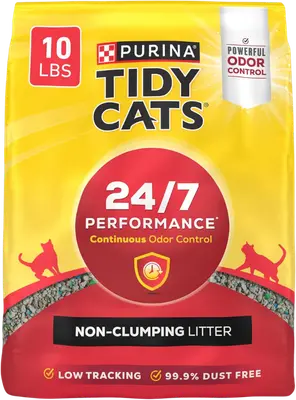
Tidy Cats 24/7 Performance — Best Traditional Non-Clumping Clay
Best for: Owners deliberately looking for traditional absorbent non-clumping clay.
Avoid if: You want unscented litter, scoopable urine clumps, or a lightweight package.
Common complaint: Some negative reviews say it does not clump, but that is the intended format rather than a defect.
Tidy Cats 24/7 Performance is included because not every clay owner wants clumping litter.
This traditional non-clumping formula absorbs urine instead of creating removable urine clumps. That can appeal to owners who dislike scraping clumps, and its upfront price per pound is often low.
The tradeoff is the cleaning routine. Because urine remains in the litter, regular full changes matter more than with a clumping formula.
It is also scented.
Pros
- Simple traditional non-clumping format
- Absorbs urine effectively
- Often has a low upfront cost
- Widely available on Chewy
- Suitable for owners specifically looking for non-clumping clay
Cons
- Scented
- Heavy
- Does not form scoopable urine clumps
- Requires more frequent full litter changes
- Odor can build as urine accumulates
- Dust reports are mixed
How to Choose a Clay Cat Litter
Clumping Strength and Scoopability
A hard clump is useful only if you can remove it cleanly.
Look beyond “strong clumping” marketing and pay attention to whether owners repeatedly mention crumbling, smearing, or cement-like sticking to the pan.
Maintaining the recommended litter depth can also improve performance.
Dust and Tracking
Dust and tracking are related but different problems.
A litter can pour with very little airborne dust and still travel through the house on paws. Fine particles tend to move more easily, while larger granules may reduce tracking for some cats but may feel different underfoot.
Scented vs Unscented
If you do not know your cat’s preference, unscented is the simpler starting point.
For odor control, look at how the product handles waste rather than assuming perfume is doing the work.
Granule Size and Cat Preference
Fine, sand-like litter is accepted readily by many cats, but there is no universal texture preference.
If your cat hesitates at the box after a litter change, texture can be just as important as odor or clumping performance.
Weight, Package Size, and Value
A cheap 40-lb bag is not a bargain if you struggle to lift it.
Check both price per pound and how the product is packaged. Two smaller boxes or a handled jug can be worth paying slightly more for.
Also avoid comparing clumping and non-clumping litter only by price per pound. Non-clumping litter may require more complete replacement.
Automatic Litter-Box Compatibility
Do not assume every clumping clay works in every automatic litter box.
Machines may have requirements for granule size, clump speed, litter weight, or material. Check the exact automatic-box manufacturer’s instructions before switching.
Clay Litter Safety and Quality Checklist
Before buying, check:
- whether the exact formula is clumping or non-clumping;
- whether fragrance is added;
- current package size and weight;
- manufacturer dust claims;
- litter-box or automatic-box compatibility;
- recommended litter depth;
- disposal directions;
- whether customer complaints involve the product itself or damaged shipping.
Wash your hands after handling used litter, and dispose of litter according to the product directions.
If your cat develops persistent coughing, breathing difficulty, repeated litter eating, or ongoing litter-box avoidance, contact your veterinarian rather than trying to solve the problem only by changing brands.
Clay vs Other Cat Litter Materials
Clay vs Crystal Litter
Clay is denser and usually uses absorption or clumping to manage urine. Crystal litter uses absorbent silica granules and can follow a different maintenance routine.
Crystal is often lighter, while clay usually offers a more familiar fine texture and, in clumping formulas, easy targeted urine removal.
See our crystal cat litter guide if you are comparing the two.
Clay vs Plant-Based Litter
Plant-based litters can use materials such as corn, wood, wheat, or tofu.
They may be lighter or made from renewable materials, but clumping strength, tracking, storage, texture, and cost vary just as much as they do with clay.
Our natural cat litter guide compares broader plant-based options, while our tofu litter guide goes deeper into that specific material.
How to Switch To or From Clay Litter
Change litter gradually rather than replacing everything overnight.
Start by mixing a smaller amount of the new litter with the existing material, then increase it over several days if your cat continues using the box normally.
Keep other variables stable when possible. Moving the box, changing its style, and changing the litter at the same time makes it difficult to tell what your cat dislikes.
Watch for hesitation, altered digging, accidents, or refusal to enter the box.
If a cat suddenly stops using the litter box altogether—especially with straining, frequent attempts to urinate, pain, or other signs of illness—contact a veterinarian promptly rather than assuming the new litter is the only cause.
Clay Cat Litter FAQs
Is bentonite litter the same as clay litter?
Bentonite is a type of clay commonly used in clumping cat litter. However, not every clay litter uses the same clay blend, so “clay litter” and “bentonite litter” are not always interchangeable terms.
Is all clay cat litter clumping?
No. Clay litter is available in both clumping and non-clumping forms. Clumping clay forms removable masses around urine, while traditional non-clumping clay absorbs moisture into the litter.
Can clay litter be used in an automatic litter box?
Some can, but compatibility depends on the machine. Automatic boxes may require a specific granule size, clumping speed, or litter weight. Always check the litter-box manufacturer’s requirements.
Is clay cat litter biodegradable?
Clay is a mineral rather than a plant-based biodegradable material. Used clay litter is generally disposed of in household trash rather than composted or flushed. Follow the product and local disposal guidance.
Do cats prefer clay litter?
Many cats readily accept fine, unscented granular litter, but individual preferences differ. If you are unsure, offering different litter types in separate boxes can help show which texture your cat prefers.
Is Clay Cat Litter Right for Your Cat?
Clay cat litter remains a practical choice because it is widely available and gives owners a choice between scoopable clumping formulas and traditional absorbent non-clumping litter.
The important part is choosing the right formula rather than treating every clay litter as interchangeable. Dust, scent, tracking, clump behavior, package weight, and your cat’s preferences can change the experience substantially.
If you are still deciding whether clay is the right material, our Best Cat Litter guide compares the broader options.