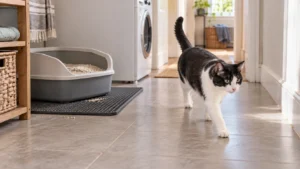
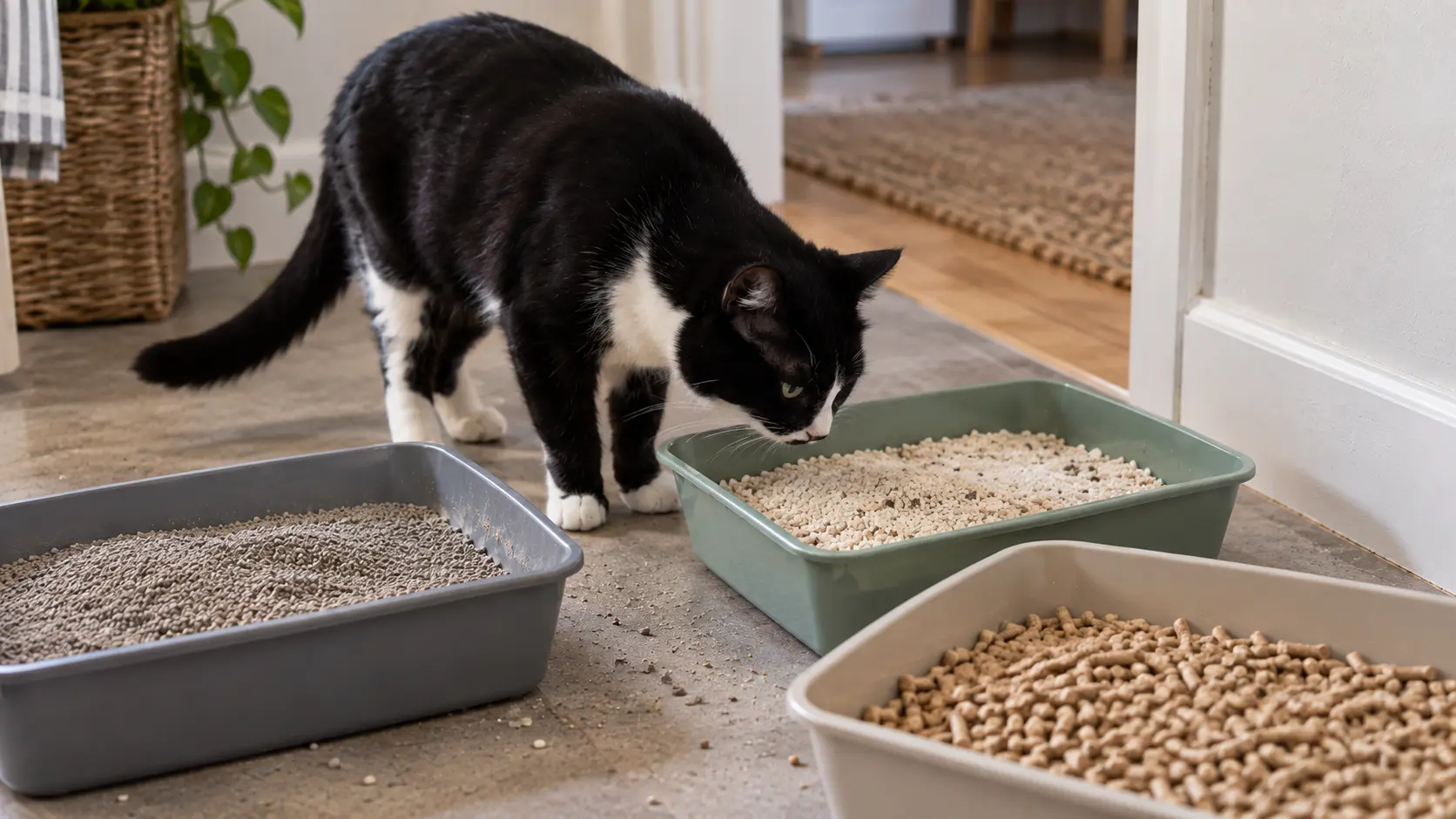
Clay, crystal, tofu, pellets, clumping, and low-dust are often described as different types of cat litter, but those labels do not all mean the same thing.
The main litter materials include clay, silica gel, wood, paper, and plant-based materials such as corn, wheat, walnut, and tofu. Separately, a litter may be clumping or non-clumping, come as fine granules, pellets, or crystals, and have features such as low dust, low tracking, or added fragrance.
There is no single type that is best for every cat. Many adult cats tend to favor a fine-textured, unscented, clumping substrate, but familiarity, paw comfort, age, health, box setup, and individual preference can all change what works best.
This guide explains what the labels actually mean, how the major litter materials differ, and what to consider before switching your cat to something new.
What Are the Main Types of Cat Litter?
The easiest way to understand cat litter is to separate four different characteristics.
Litter material
This is what the bulk of the litter is made from. Common examples include:
- Clay or mineral litter
- Silica gel or crystal litter
- Wood or pine litter
- Paper litter
- Corn, wheat, grass, and walnut litter
- Tofu or other plant-fiber litter
There is no scientific rule saying there are exactly eight, nine, or ten types. Products continue to use different materials and blends, so a fixed number can be misleading.
Clumping or non-clumping
Clumping describes what happens when the litter gets wet.
A clumping litter forms a removable mass around urine. Non-clumping litter handles moisture without making the same firm scoopable clump.
This is not a material category. Clay can be clumping or non-clumping, and plant-based litter can clump too.
Granules, pellets, and crystals
These describe the physical form or particle shape.
Wood and paper may come as pellets. Clay is often granular. Silica gel is commonly sold as crystals or granules.
That matters because the texture under a cat’s paws can affect whether the litter feels familiar and comfortable.
Features such as low dust or low tracking
“Low dust,” “low tracking,” “lightweight,” “unscented,” and “odor control” are performance features or marketing descriptions, not separate litter materials.
A useful way to decode a bag is:
- Material: clay
- Behavior: clumping
- Format: fine granules
- Feature: unscented and marketed as low dust
Keeping those categories separate makes different products much easier to compare.
Cat Litter Types at a Glance
Material |
Common format |
Can it clump? |
Main thing to know |
|---|---|---|---|
Clay |
Fine or coarse granules |
Yes or no |
Many formulations exist, including both clumping and non-clumping |
Silica gel |
Crystals or granules |
Depends on formula |
Porous silica gel absorbs moisture; do not confuse it with crystalline silica |
Wood/pine |
Pellets or granules |
Depends on formula |
Coarse texture may not suit every cat |
Paper |
Pellets or fibers |
Formula-dependent |
Texture differs noticeably from fine granular litter |
Corn/wheat/grass |
Granules or pellets |
Often can |
“Plant-based” does not describe one standardized performance profile |
Walnut |
Granules |
Formula-dependent |
Another plant-derived substrate |
Tofu/soy |
Pellets or granules |
Formula-dependent |
Formulas and ingredients differ among brands |
Material alone does not reliably tell you which product will create the least dust, track the least, control odor best, or suit every cat. Particle size, formula, manufacturing, maintenance, and the individual cat all matter.
The Main Cat Litter Materials Explained
Clay Cat Litter
Clay remains one of the most familiar litter materials, particularly in fine or medium-sized granules.
It is available in both clumping and non-clumping versions. Many clumping clay litters use swelling clay minerals such as bentonite or montmorillonite, which expand when exposed to moisture. But not every clay behaves the same way, so “clay” should not automatically be treated as another word for “clumping.”
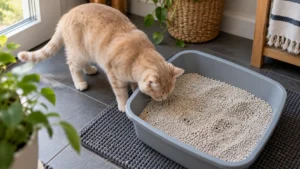
Fine-textured clay can also resemble the loose substrates many cats naturally find easy to dig in. That does not mean every cat will prefer clay or that every clay product performs equally well.
Dust is another area where broad claims cause confusion. Some clay products generate more airborne dust than others, but it is inaccurate to say clay itself causes feline asthma. Dusty litter is one possible environmental irritant for susceptible cats; the individual formulation matters.
For a deeper look at the category, see our guide to clay cat litter.
Silica Gel or Crystal Cat Litter
Crystal cat litter is generally made from porous silica gel, an amorphous form of silica that absorbs moisture.
One common source of confusion is the word “silica.” Silica gel is not the same thing as the respirable crystalline silica discussed in occupational silicosis research. Treating the two as identical creates an unnecessary and inaccurate safety claim.
Crystal litter also should not automatically be described as completely dust-free or non-tracking. Particle size and dust levels vary among products.
The texture is quite different from fine clay as well, which can matter if a cat strongly prefers a softer or sand-like substrate.
If you’re specifically considering this material, you can compare crystal cat litter options.
Wood and Pine Litter
Wood-based litter may come as coarse pellets or as smaller particles, and its behavior depends on the individual formulation.
Pellets have a practical advantage for some households, but their larger, firmer shape is very different from fine granular litter. Feline veterinary guidance notes that some cats, particularly those with painful joints, may find coarse wood or recycled-paper pellets uncomfortable to stand on.
That does not mean cats universally dislike wood litter. A cat already accustomed to pellets may use them without any problem.
The more useful question is whether the texture and scent suit that particular cat.
Paper Litter
Paper litter is usually sold as pellets or processed fibers.
Its texture can make it useful in certain situations, but the category is often given broader safety claims than the evidence supports.
Paper should not automatically be called the safest litter, completely dust-free, the best litter for every kitten, or universally appropriate after surgery. Individual products differ, and veterinary advice should guide litter choice when a cat has a medical or post-operative need.
As with wood pellets, some cats may simply dislike the feel of larger particles under their paws.
Plant-Based Cat Litter
Plant-based litter is an umbrella term rather than a single standardized type.
It may be made from:
- Corn
- Wheat
- Grass
- Walnut shells
- Soybean or tofu-related fibers
- Pea or other plant fibers
- Blends of several ingredients
Plant-based does not automatically mean non-clumping. Some plant-derived formulas form scoopable clumps, and a peer-reviewed transition study has even examined cats moving from clumping clay to a clumping corn-based litter.
It is also worth being careful with labels such as “natural.” The term alone does not prove that a litter creates less dust, controls odor better, is healthier, or has a lower overall environmental impact.
If plant-derived materials are your priority, our guide to plant-based and natural litter options goes deeper.
Tofu Cat Litter
Tofu litter sits within the broader plant-based category but has become recognizable enough to deserve its own explanation.
It is commonly sold as pellets or granules and is typically made with plant-derived ingredients. However, “tofu litter” is a commercial category, not one scientifically standardized formula.
Different products may use different proportions of soybean fiber, pea fiber, starches, binders, or other ingredients. That means you should not assume every tofu litter has the same composition or behaves in exactly the same way.
Our complete guide to tofu cat litter covers that category in more detail.
Clumping vs Non-Clumping, Pellets vs Granules: What Actually Changes?
Clumping vs non-clumping
Clumping litter forms a removable mass when urine wets the substrate. That can make daily scooping more targeted.
Non-clumping litter absorbs or handles the moisture without forming the same firm scoopable clump.
Neither term tells you what the litter is made from. Both clay and plant-based formulas can clump, while several materials are also sold in non-clumping versions.
If you already know which behavior you prefer, see our clumping cat litter options or non-clumping cat litter options.
Fine granules, coarse granules, pellets, and crystals
Particle size is easy to overlook, yet it can matter as much as the base material.
Veterinary guidance generally favors fine, easy-to-dig substrates for many adult cats, although individual preference still matters.
For example, a cat that has spent years using fine clay may hesitate when suddenly presented with large wood pellets. That does not prove wood is a poor material. The cat may simply dislike the unfamiliar texture.
This is why switching between physical formats can require more patience than moving between two similar granular litters.
What Type of Cat Litter Is Best for Your Cat?
There is no universally best litter material.
For many adult cats, fine-textured, unscented, clumping litter is a reasonable starting point based on feline veterinary guidance. But a litter that your cat consistently and comfortably uses is more useful than a theoretically “better” material the cat avoids.
Start with your cat's preference
If your cat reliably uses the current litter, digs normally, and shows no sign of discomfort, you do not need to switch simply because another material is fashionable or advertised as superior.
Pay attention to:
- Familiar texture
- Ease of digging
- Fragrance
- Paw comfort
- Consistent box use
A stable preference is useful information.
Then identify the problem you actually want to solve
Instead of asking which material is “best,” identify what is bothering you.
Too much dust? Compare the actual dust performance of individual formulas rather than assuming every product made from one material behaves alike. Our low-dust litter guide focuses specifically on that issue.
Litter scattered around the home? Particle size, shape, and formula can all influence tracking. See our guide to litter designed to reduce tracking.
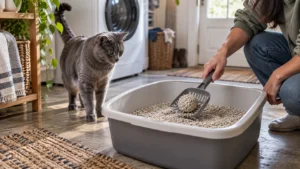
Odor problems? The litter formula matters, but so does routine scooping. No litter removes the need for regular cleaning. If odor is the main concern, compare odor-control litter options.
Heavy bags or difficult pouring? Look for lightweight formulas as a product feature rather than treating “lightweight” as its own litter material.
Consider life stage and health
Young kittens require extra care because they may investigate unfamiliar materials by mouthing or eating them. Some feline-welfare guidance recommends non-clumping litter while kittens are young and prone to doing this, but there is no well-established universal age cutoff that applies to every kitten.
For older cats and cats with joint discomfort, accessibility and paw comfort can matter as much as the material. A low-entry litter box and a softer, finer substrate may be easier for some cats than large hard pellets.
Cats with asthma or another respiratory condition may also benefit from minimizing airborne dust when a veterinarian recommends environmental control. Dusty litter can be an irritant, but that is not the same as saying clay itself causes asthma.
Check compatibility with automatic litter boxes
Automatic litter boxes do not all use the same mechanism.
Some require clumping, scoopable litter. Others are designed around crystal trays or another specific substrate. Always check the manufacturer’s compatibility requirements before changing litter in a self-cleaning box.
Scented vs Unscented Cat Litter
Unscented litter is the better default for many cats.
Feline veterinary guidelines commonly recommend non-scented litter, and strong fragrances may be unpleasant to some cats.
That does not mean every cat will reject a scented formula. Direct evidence that fragrance itself causes litter-box avoidance is not absolute, and individual tolerance varies.
If your cat is already happy with an unscented litter, adding perfume usually offers more benefit to the human nose than to the cat.
For odor management, frequent scooping and keeping the box clean remain important regardless of the scent printed on the package. Research has found that cats prefer clean boxes over boxes containing waste.
How to Change Cat Litter Without Making the Switch Too Abrupt
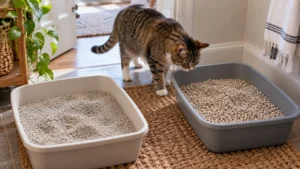
If your cat is comfortable with its current litter, avoid replacing it overnight unless there is a clear reason to do so.
Two approaches can make a change easier.
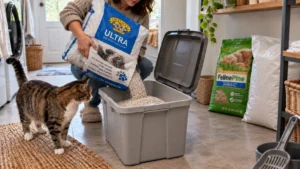
Option 1: Gradually mix the litters
- Keep the familiar litter as the main substrate at first.
- Introduce a smaller amount of the new litter.
- Increase the new material gradually while your cat continues using the box normally.
- Slow down or reconsider the change if you see clear signs of avoidance.
A controlled study successfully transitioned cats from one clumping clay litter to one clumping corn-based litter over six days, but that does not mean every cat or litter combination follows the same timetable.
Option 2: Offer a second litter box
A second box filled with the new substrate allows your cat to choose between the familiar litter and the new one.
This can be especially useful when the textures are very different, such as switching from fine granules to large pellets.
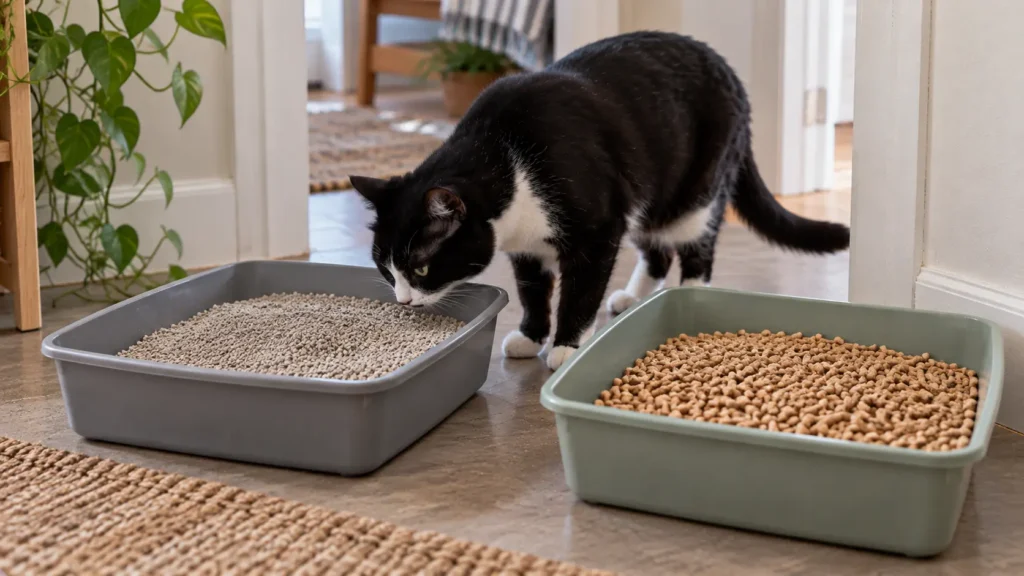
Avoid changing the litter, box style, box location, and cleaning routine at the same time. If the cat stops using the box normally, you will have no clear way to tell which change caused the problem.
Can You Mix Two Types of Cat Litter?
Yes, mixing two litters can be useful during a gradual transition.
The combination still needs to be suitable for your cat and compatible with your litter box. Mixing formulas can change texture, clumping behavior, absorbency, and dust, and it may interfere with some automatic litter boxes.
There is usually no reason to keep mixing indefinitely unless the combination genuinely works for your cat and your setup.
If one product forms firm clumps and another does not, the result may also perform differently from either litter on its own.
When a Litter Problem May Be More Than a Litter Problem
Signs your cat may dislike the litter
Possible signs of substrate or box aversion include:
- Hesitating before entering
- Standing or balancing on the edge
- Digging less than usual
- Choosing another available substrate
- Eliminating directly beside the litter box
These signs can suggest that the litter texture, cleanliness, or box setup is not working, but they are not a diagnosis. House-soiling can have several behavioral and medical causes.
When to contact a veterinarian
A sudden change in litter-box behavior deserves more attention than simply changing brands.
Contact a veterinarian if your cat develops signs such as:
- Sudden house-soiling
- Repeated litter eating
- Pain getting into or using the box
- Persistent coughing or wheezing
- Blood in the urine
- Frequent or painful attempts to urinate
Repeated straining or attempts to urinate while producing little or no urine is a veterinary emergency. A urinary blockage can become life-threatening and requires immediate treatment.
A Quick Note on “Flushable,” Biodegradable, and Compostable Litter
These terms should not be treated as interchangeable.
A biodegradable material does not automatically make used cat litter suitable for a backyard compost pile. U.S. EPA guidance specifically lists pet waste and cat litter among materials to avoid in home compost.
Likewise, a product marketed as flushable is not automatically appropriate to put down every toilet. Plumbing systems and local wastewater rules differ, and environmental guidance has raised concerns about flushing cat waste because some pathogens may survive wastewater treatment.
Check the product instructions and your local waste or sewer guidance rather than assuming “natural,” “biodegradable,” and “flushable” mean the same thing.
When You're Ready to Compare Specific Litters
Once you know which material, texture, and features make sense for your cat, compare individual formulas rather than assuming every product in the same category performs alike.
Our current cat litter picks compare specific options by their intended use and practical trade-offs.
Frequently Asked Questions
What is the healthiest type of cat litter?
There is no single material that can be called the healthiest for every cat.
Dust, fragrance, particle texture, ingestion behavior, age, mobility, and existing medical conditions can all matter. “Natural” or plant-based also does not automatically mean safer or hypoallergenic.
What type of cat litter do cats usually prefer?
Many adult cats tend to prefer a fine-textured, unscented, clumping substrate that is easy to dig in.
Individual preferences still vary, especially when a cat has used one litter successfully for a long time.
Is clumping or non-clumping litter better?
Neither is universally better.
Clumping litter can make urine easier to remove from the box, while non-clumping formulas handle moisture differently. The better choice depends on the individual cat, life stage, litter material, formula, and household setup.
Can kittens use clumping litter?
Some feline-welfare guidance recommends non-clumping litter for young kittens, particularly while they are still likely to mouth or eat unfamiliar material.
There is not strong evidence for one universal age at which every kitten can safely switch, so avoid relying on a rigid cutoff. If a kitten repeatedly eats litter, contact a veterinarian.
Does the type of cat litter really matter?
Yes, but the material name is only part of the picture.
Texture, clumping behavior, fragrance, dust, particle size, box compatibility, and your cat’s individual preference can all affect how well a litter works. A familiar litter your cat uses comfortably may be a better choice than a supposedly superior material your cat avoids.
Choosing Between the Different Types of Cat Litter
The most useful way to compare types of cat litter is not to search for one material that wins every category.
First identify what the litter is made from. Then look at whether it clumps, the size and shape of the particles, and the specific feature you care about—such as dust, tracking, odor, weight, or automatic-box compatibility.
Above all, watch the cat using it.
If your current litter is comfortable, familiar, and consistently used, there may be no reason to change it. If you do switch, solve a specific problem and introduce the new substrate gradually rather than relying on broad claims such as “natural,” “healthiest,” or “best.”