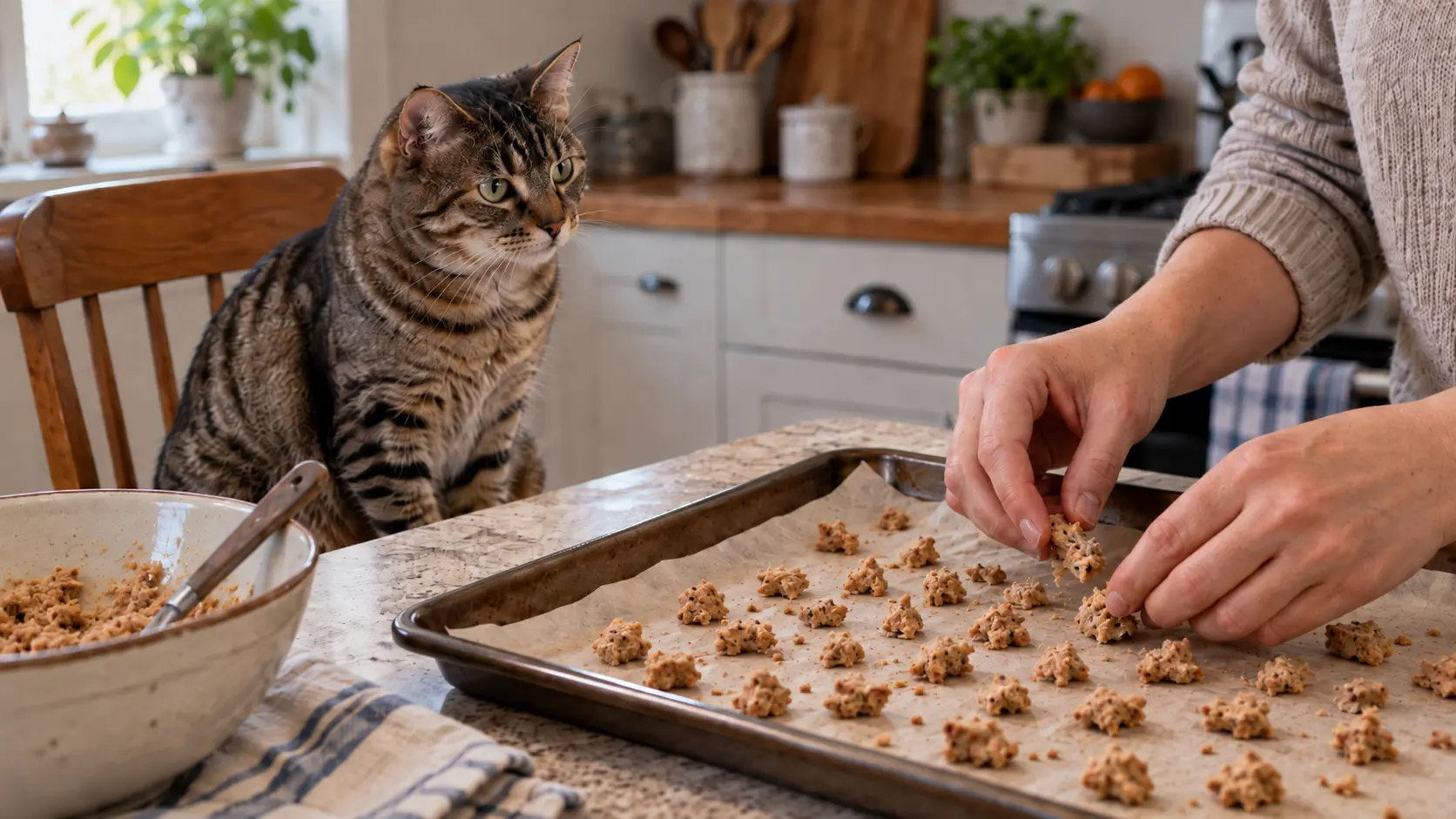
Homemade cat treats can be a simple way to give your cat an occasional reward, as long as you use appropriate ingredients, prepare them safely, and keep portions small. They are still treats, not replacements for complete and balanced cat food.
A practical rule is to keep all treats combined to about 10% or less of your cat’s daily calories. That includes homemade bites, packaged treats, table-food rewards, and training snacks. Treats are not generally required to provide complete nutrition because they should make up only a small part of the diet. (Vca)
The four recipes below use simple cooked ingredients and avoid raw animal protein, seasonings, and unnecessary extras. You’ll also find guidance on calories, storage, flour, tuna, unsafe ingredients, and situations where a veterinarian should guide your choice.
Are Homemade Cat Treats Safe?
Yes, homemade cat treats can be appropriate for healthy cats when the ingredients are suitable and the treats are prepared and stored safely.
Being homemade does not automatically make a treat healthier than one you buy. What matters more is what goes into it, how many calories it provides, and how much of the cat’s overall diet it replaces.
A homemade chicken bite, for example, can work perfectly well as an occasional reward. But plain chicken by itself is not a complete feline diet. Cornell notes that formulating an entire homemade diet for a cat is much more difficult because the right nutrients must be supplied in the correct proportions. (Cornell Vet School)
Safe homemade treats should generally be:
- made from cat-appropriate ingredients
- plain and unseasoned
- cooked when animal proteins or eggs are involved
- cut into small portions
- refrigerated when perishable
- counted within the cat's total treat allowance
If your cat eats a prescription diet, is undergoing a food trial, or has a medical condition affected by nutrition, ask your veterinarian before adding homemade treats.
Before You Start: 5 Rules for Making Cat Treats Safely
Keep treats to about 10% or less of daily calories
The 10% guideline applies to all treats together, not 10% for homemade treats plus another 10% for packaged ones.
VCA recommends getting roughly 90% of a cat’s daily calories from complete and balanced food and limiting treats and snacks to the remaining 10%. (Vca)
Use plain, unseasoned ingredients
Skip marinades, sauces, gravy, seasoning blends, onion powder, garlic powder, and heavily salted ingredients.
A piece of plain chicken is very different from chicken cooked with garlic, onion, butter, and sauce.
Cook animal ingredients properly
CDC does not recommend raw pet food or raw treats because uncooked animal proteins can carry germs such as Salmonella and Listeria. Freezing or dehydrating raw ingredients does not reliably eliminate all of those organisms. (CDC)
For poultry, the U.S. government’s safe minimum internal temperature is 165°F (74°C). Egg dishes containing poultry should also reach 165°F. (FoodSafety.gov)
Make treats genuinely small
A homemade treat can easily become several times larger than a commercial cat treat.
Aim for pea-sized pieces or similarly small portions, especially if you give several rewards during training or play.
Refrigerate perishable treats
Fresh meat- and egg-based treats should not sit on the counter for days simply because they were baked.
Government food-safety guidance recommends refrigerating perishable cooked foods promptly and generally using cooked leftovers within about four days. (FoodSafety.gov)
4 Simple Homemade Cat Treat Recipes
If you’re wondering how to make homemade cat treats without using a long list of ingredients, these recipes deliberately stay simple.
The calorie estimates below use standard USDA FoodData Central reference values for cooked chicken breast, roasted turkey breast, cooked egg, all-purpose flour, and canned pumpkin without salt. Exact calories will vary with the ingredients you buy, the amount of water lost during cooking, and the number and size of finished pieces, so treat these figures as estimates rather than guaranteed values.(What You Eat)
Recipe |
Texture |
Main ingredients |
Flour? |
Approx. kcal/treat |
Storage |
|---|---|---|---|---|---|
Simple Chicken Bites |
Soft/chewy |
Chicken |
No |
~2.1 |
Refrigerate 3–4 days |
Chicken-and-Egg Cookies |
Firmer |
Chicken, egg, flour |
Yes |
~2.5 |
Refrigerate 3–4 days |
Flour-Free Turkey Bites |
Soft-firm |
Turkey, egg |
No |
~2.8 |
Refrigerate 3–4 days |
Chicken and Pumpkin Treats |
Soft |
Chicken, pumpkin, egg |
No |
~2.6 |
Refrigerate 3–4 days |
These estimates assume the approximate yields listed below. If you make the pieces larger or smaller, the calories per treat change.
Recipe 1: Simple Chicken Cat Treat Bites
Best for: the fewest possible ingredients
Ingredients
- 100 g plain, skinless chicken breast
- Water for cooking, if needed
How to make them
- Cook the chicken completely without oil, salt, sauces, garlic, onion, or other seasonings. The thickest part should reach 165°F (74°C).
- Let the chicken cool enough to handle.
- Cut or tear it into roughly 80 very small pieces.
- Place several portions in the refrigerator and freeze any amount you will not use within a few days.
Approximate yield: 80 pieces
Estimated calories: about 2.1 kcal each
This is less a cookie recipe than a practical homemade reward—and that simplicity is useful. There is no nutritional reason a cat treat needs flour, cheese, sweetener, or decorative ingredients.
Keep the pieces small. If you cut the same chicken into only 20 pieces, each one would contain roughly four times as many calories.
Recipe 2: Chicken-and-Egg Cookies for Cats
Best for: a small, firmer baked cookie
Ingredients
- 60 g plain cooked chicken breast
- 25 g beaten egg
- 30 g all-purpose flour
- 1–2 teaspoons water, only if needed for consistency
How to make them
- Heat the oven to 350°F (177°C).
- Finely mince or blend the cooked chicken.
- Mix in the egg.
- Add the flour and combine until you have a thick dough. If it is too crumbly to shape, add water a teaspoon at a time.
- Roll or press the dough thinly on parchment paper.
- Cut it into approximately 100 tiny pieces before baking, or score the dough so it can be separated afterward.
- Bake until the cookies are firm and the center reaches at least 165°F (74°C).
- Cool completely before serving.
Approximate yield: 100 mini cookies
Estimated calories: about 2.5 kcal each
A small amount of flour works here as a binder. Cats are obligate carnivores, but that does not mean cooked starch is inherently indigestible. Merck Veterinary Manual reports that both cats and dogs can digest properly cooked starches from grains with greater than 90% efficiency. (Merck Veterinary Manual)
Flour still isn’t nutritionally necessary, and flour-free is perfectly reasonable if that better suits your cat. It simply isn’t automatically healthier.
Troubleshooting: If the dough sticks badly, chill it briefly rather than adding large amounts of extra flour. Adding more flour also increases the calories in the batch.
Recipe 3: Flour-Free Turkey and Egg Bites
Best for: owners who want a flour-free recipe without treating grain-free as a health claim
Ingredients
- 100 g plain cooked turkey breast
- 50 g beaten egg
How to make them
- Heat the oven to 350°F (177°C).
- Finely chop or process the cooked turkey.
- Mix it thoroughly with the beaten egg.
- Spread the mixture in a thin layer on a parchment-lined baking sheet, or divide it among very small silicone molds.
- Bake until fully set and the center reaches at least 165°F (74°C).
- Cool and divide into approximately 80 small bites.
Approximate yield: 80 pieces
Estimated calories: about 2.8 kcal each
These treats contain no flour, but that does not make them nutritionally superior to the previous recipe. Flour-free is simply another format.
If your cat must avoid wheat or another ingredient for a diagnosed dietary reason, follow the diet your veterinarian has recommended rather than improvising substitutions.
Recipe 4: Soft Chicken and Pumpkin Treats
Best for: cats that prefer a softer homemade bite
Ingredients
- 80 g plain cooked chicken breast
- 40 g plain canned pumpkin
- 25 g beaten egg
Use 100% plain pumpkin, not pumpkin pie filling.
How to make them
- Heat the oven to 350°F (177°C).
- Finely mince or blend the chicken.
- Stir in the pumpkin and egg until evenly combined.
- Spoon very small dots onto a parchment-lined baking sheet or use mini silicone molds.
- Bake until the bites are set and their center reaches 165°F (74°C).
- Cool completely and divide the batch into roughly 70 small pieces.
Approximate yield: 70 pieces
Estimated calories: about 2.6 kcal each
Pumpkin can add moisture and fiber to a recipe, but a pumpkin treat should not be presented as a treatment for constipation, diarrhea, hairballs, or another digestive condition. Plain pumpkin can be an acceptable ingredient in small amounts; medical digestive problems deserve their own evaluation. (Vca)
Because these bites stay soft and moist, keep them refrigerated.
Can You Make Treats From Your Cat's Regular Food?
Sometimes the simplest treat is food your cat already eats.
If you mainly use food as a reward during training, our cat training treat guide compares reward size, calories, texture, and different training uses.
VCA specifically suggests using a portion of a cat’s regular food as treats. For cats on special diets, the veterinary team may also be able to advise whether a compatible canned version can be prepared differently and used as a treat. (Vca)
This approach has a few advantages:
- you are not introducing several new ingredients
- the calories are easier to account for
- the reward comes out of the normal food allowance rather than always being extra
There is one important exception: do not modify a prescription food without checking first. A veterinary diet may depend on a specific nutrient balance or feeding protocol.
Which Ingredients Are Safe for Homemade Cat Treats?
A food can be suitable as a small treat without being appropriate as a major part of the diet.
Ingredient |
General use |
Main qualification |
|---|---|---|
Plain cooked chicken |
Good occasional option |
No seasoning |
Plain cooked turkey |
Good occasional option |
No seasoning |
Cooked egg |
Useful ingredient/binder |
Do not serve raw |
Small amount of flour |
Acceptable binder |
Not nutritionally necessary |
Plain pumpkin |
Optional |
Use plain pumpkin, not pie filling |
Tuna |
Occasional at most |
Poor choice as a routine treat base |
Dairy |
Not a good default |
Many cats tolerate lactose poorly |
Cooked meat and cooked egg can be offered to cats as occasional foods when served plain. (Vca)
Tuna needs more restraint than its popularity in homemade recipes suggests. A little tuna is not the same thing as a tuna-based diet, but Cornell cautions against relying on canned fish made for people and notes that some cats consuming such products have developed serious problems. (Cornell Vet School)
Milk and rich dairy ingredients aren’t good default additions either. Many cats digest lactose poorly and may develop gastrointestinal upset. (Cornell Vet School)
The useful distinction is simple:
Safe does not mean unlimited, nutritionally complete, or ideal for every cat.
Ingredients to Keep Out of Homemade Cat Treats
Onion, garlic, chives, and leeks
Members of the Allium family can damage red blood cells and cause anemia in cats. Cats are particularly susceptible, and concentrated forms such as onion or garlic powder deserve special attention. Raw, cooked, dried, and powdered forms can all be a problem. (Merck Veterinary Manual)
This is why leftover seasoned chicken is not equivalent to plain chicken prepared specifically for your cat.
Chocolate, cocoa, caffeine, alcohol, and raw yeast dough
These ingredients do not belong in cat cookies.
Chocolate and caffeine contain methylxanthines that can cause serious cardiovascular and neurological effects in susceptible animals. Raw yeast dough presents a separate problem because the dough can expand and produce ethanol as it ferments. (Merck Veterinary Manual)
Raw animal ingredients
Avoid using:
- raw chicken
- raw turkey
- raw seafood
- raw egg
Raw animal proteins can carry disease-causing bacteria, creating risk for both the cat and people handling the food. (CDC)
Ingredients that simply aren't useful
Not every ingredient worth excluding is a poison.
There is little reason to add:
- sugar
- artificial sweeteners
- mayonnaise
- large amounts of oil
- heavily salted foods
- rich dairy products
A cat treat does not need to resemble a human dessert.
If your cat eats onion, garlic, chocolate, caffeine, alcohol, raw yeast dough, or another potentially dangerous food, contact your veterinarian or an animal poison service promptly rather than waiting to see whether symptoms develop. (ASPCA)
How Many Homemade Treats Can a Cat Have?
Keep all treats combined to around 10% or less of daily calories unless your veterinarian gives you a different target.
That means the allowance includes:
- homemade treats
- commercial treats
- training rewards
- table-food snacks
It is not 10% for each group.
Suppose your veterinarian or feeding plan establishes a 20-kcal daily treat allowance. One 2.5-kcal homemade cookie would use about one-eighth of that allowance, while four would use half.
The actual number suitable for your cat depends on the cat’s calorie needs and everything else being fed.
If portion control is a priority, our guide to lower-calorie cat treats looks at commercial options designed to make frequent small rewards easier to manage.
How to Store Homemade Cat Treats Safely
Homemade treats don’t contain the same preservation system or validated shelf-life testing as many packaged products, so take a conservative approach.
For the four recipes above:
- refrigerate them promptly after cooling
- keep the refrigerator at 40°F (4°C) or colder
- use them within about 3–4 days
- freeze excess instead of leaving a large batch in the refrigerator
- thaw frozen portions in the refrigerator
- discard anything with obvious spoilage, unusual odor, mold, or an unexpected texture change
FoodSafety.gov advises refrigerating perishable cooked foods promptly and using cooked leftovers within four days. (FoodSafety.gov)
Do not assume a baked cat cookie is automatically shelf stable because it feels dry. True room-temperature shelf stability depends on factors such as moisture and water activity that cannot be judged reliably by appearance alone.
Are Homemade Cat Treats Healthier Than Store-Bought Treats?
Not automatically.
Homemade treats give you control over the ingredients you add. That can be useful if you want a very simple recipe made from chicken, turkey, egg, or another food your cat already tolerates.
But homemade treats also have disadvantages:
- calories have to be estimated
- storage requires more care
- nutritional completeness is not guaranteed
- portions can easily become too large
- poor food handling can create avoidable risks
Commercial treats can be convenient because the manufacturer may provide calories per piece and clear storage directions. Homemade and packaged treats can both be reasonable—or poor—choices depending on the actual product or recipe.
If you prefer a ready-made option, you can compare cat treats by type, ingredients, calories, and use in our main Cat Treats guide.
What Does “Vet-Approved” Mean for Homemade Cat Treats?
The phrase vet-approved homemade cat treats sounds reassuring, but it should be used carefully.
There is a meaningful difference between:
- a recipe created by a veterinarian
- a recipe individually reviewed by a veterinarian
- a recipe that uses ingredients supported by veterinary guidance
- a recipe that has not received individual veterinary review
The recipes in this guide use ingredient and safety guidance from veterinary, regulatory, and government food-safety sources, but they have not been individually reviewed by a veterinarian. They should therefore not be described as “vet-approved.”
That distinction matters because using evidence-based ingredients is not the same thing as having a veterinary professional assess the exact formulation, preparation, calories, and intended use.
It becomes even more important when discussing a complete homemade diet rather than occasional treats. Cornell recommends professional formulation when home-prepared food is intended to supply a cat’s main nutrition. (Cornell Vet School)
When to Ask Your Veterinarian Before Making Homemade Treats
A healthy adult cat eating a normal complete diet usually does not need veterinary permission for every small new treat.
There are important exceptions.
Check with your veterinary team before adding homemade treats if your cat:
- eats a prescription or therapeutic diet
- is undergoing an elimination diet trial
- has diagnosed food allergies
- has kidney, urinary, gastrointestinal, or metabolic disease
- is on a controlled weight-loss program
- has previously reacted badly to foods
During an elimination diet trial, seemingly harmless treats can undermine the trial by reintroducing proteins the cat is supposed to avoid. (Vca)
Kittens also need most of their calories to come from food formulated for growth. Treats should remain a small part of their intake. For commercial life-stage options, see our guide to choosing age-appropriate kitten treats. (Vca)
Common Homemade Cat Treat Mistakes
Making the treats too large. A few oversized homemade cookies can use a surprising amount of the daily treat allowance.
Forgetting the calories in every type of reward. Training snacks and packaged treats still count on days when your cat also gets homemade treats.
Using seasoned leftovers. Plain cooked chicken can be a reasonable treat. Chicken covered in onion, garlic, salty sauce, or seasoning blend is a different food.
Serving raw meat or egg. Homemade does not remove the bacterial risks associated with uncooked animal proteins.
Assuming grain-free means healthier. A flour-free treat can be useful, but avoiding grain does not automatically improve its nutritional quality.
Making tuna the default protein. An occasional small amount is different from feeding tuna-based treats every day.
Leaving soft treats at room temperature. Moist chicken, turkey, pumpkin, and egg mixtures are perishable foods.
Assuming baked means shelf stable. A dry exterior does not prove that a homemade biscuit is safe for extended room-temperature storage.
Changing several ingredients at once. If your cat develops vomiting, diarrhea, itching, or another problem, it becomes much harder to know what caused it.
Calling a recipe vet-approved without veterinary review. Evidence-based is not the same claim as individually reviewed.
Homemade Cat Treat FAQs
Can cats eat flour in homemade treats?
Yes, a small amount of properly cooked flour can work as a binder for cats that tolerate it.
Being an obligate carnivore describes a cat’s nutritional requirements; it does not mean a cat is incapable of digesting cooked starch. Merck reports greater than 90% digestibility for properly cooked starches in dogs and cats. (Merck Veterinary Manual)
If you specifically need a commercial option without grains, our grain-free cat treats guide explains why grain-free should be treated as a formula characteristic rather than an automatic health advantage.
Can I make homemade cat treats without flour?
Yes. Flour is useful for structure, not essential for every treat.
Meat-and-egg mixtures can be baked into small bites without flour, as in the turkey recipe above.
Can kittens eat homemade cat treats?
Potentially, once a kitten is eating solid food, but treats should stay secondary to a complete food formulated for growth.
VCA recommends keeping treats below 10% of a kitten’s daily calories. (Vca)
Is tuna safe in homemade cat treats?
A small occasional amount of tuna is different from making tuna a routine part of a cat’s diet.
Because human canned fish is not formulated to provide complete feline nutrition, and veterinary sources raise concerns about relying on it regularly, chicken or turkey is a simpler everyday recipe base. (Cornell Vet School)
Can homemade cat treats be frozen?
Yes, these cooked recipes can be divided into small portions and frozen rather than keeping the entire batch in the refrigerator.
Thaw only what you need in the refrigerator and treat it as perishable food once thawed.
Can I make no-bake cat treats?
You can make a no-bake treat from ingredients that are already safely cooked—for example, tiny pieces of plain cooked chicken.
“No bake” should not mean raw chicken, raw fish, or raw egg. CDC recommends against raw animal-protein treats because of pathogen risks. (CDC)
Keep Homemade Cat Treats Simple
The safest approach to homemade cat treats is usually the least complicated one: plain ingredients, small portions, proper cooking, and sensible refrigeration.
Keep treats to roughly 10% or less of your cat’s daily calories, and remember that even a well-made homemade treat is supplemental food rather than a complete meal.
The ingredient list is only part of the equation. Treat size, calories per piece, handling, and storage matter too. And if your cat has a medical condition or follows a therapeutic diet, check with your veterinary team before changing the treat routine.