The best hypoallergenic cat litter depends on what you are actually trying to reduce. For some households, airborne dust is the main concern. Others want to avoid added fragrance, clay, or a particular plant material.
For most buyers, Cat’s Pride Max Power Natural Care Unscented is our best overall pick because it combines explicit hypoallergenic positioning with an unscented clumping formula and lighter handling than many traditional clay litters. But it is not automatically the best choice for every sensitive cat or person.
“Hypoallergenic” does not mean allergy-proof. A cat or household member can still react to dust, fragrance, clay, grass, corn, paper, or another component. This guide focuses on the actual formula, dust profile, material, everyday performance, and recurring customer complaints rather than relying on the label alone.
For a broader comparison across litter types and needs, see our best cat litter guide.
Disclosure: LumaPaw may earn a commission from qualifying purchases made through links on this page, at no extra cost to you.
Best Hypoallergenic Cat Litter at a Glance
Product |
Our Pick For |
Material |
Clumping |
Scent |
Main Advantage |
Main Limitation |
|---|---|---|---|---|---|---|
Cat’s Pride Max Power Natural Care Unscented |
Best Overall |
Clay |
Yes |
Unscented |
Balanced sensitivity-focused formula |
Dust and tracking can vary |
Dr. Elsey’s R&R Respiratory Relief |
Best Respiratory-Focused Clay |
Clay |
Yes |
No perfume |
Direct respiratory/sensitivity positioning |
Herbal essences are not fully disclosed |
Dr. Elsey’s Ultra Unscented |
Best Value Hypoallergenic Clay |
Clay |
Yes |
Unscented |
Strong value and availability |
Heavy |
SmartCat All Natural Grass |
Best Single-Ingredient Plant-Based Option |
Grass |
Yes |
Unscented |
Simple non-clay material |
Tracks easily |
World’s Best Comfort Care Unscented |
Best Soft-Texture Plant-Based Option |
Corn |
Yes |
Unscented |
Softer plant-based texture |
Tracking and corn dust can occur |
ökocat Dust Free Paper Pellet |
Best for Minimizing Airborne Dust |
Paper |
No |
Unscented |
Strong dust-minimizing design |
Non-clumping cleanup |
What Does “Hypoallergenic Cat Litter” Actually Mean?
Some litter manufacturers use the word hypoallergenic, while others avoid the term and instead focus on characteristics such as low dust, no added fragrance, or simple materials.
The important point is that hypoallergenic does not mean a product cannot cause a reaction.
A litter that works well for a cat sensitive to perfume may still be unsuitable for a cat that reacts poorly to its material or texture. Likewise, a plant-based litter is not automatically better for every sensitive household.
Hypoallergenic Does Not Mean Allergy-Proof
When comparing litter for a sensitive cat or household, look beyond the front of the bag.
Useful things to check include:
- added fragrance or perfume
- airborne dust
- litter material
- additional ingredients or additives
- texture
- tracking
- cat acceptance
- clumping and cleanup
A product can be labeled hypoallergenic and still create dust for some users. Another product may not use the term at all but may have very little airborne dust and no added fragrance.
Low Dust and Unscented Are Helpful, but Not Guarantees
Low-dust litter may be useful when airborne particles are the main concern, while unscented litter avoids added perfume. Neither feature by itself makes a litter universally hypoallergenic.
The same applies to “natural.” Corn, grass, paper, wood, and other plant-derived materials may suit some households very well, but individual sensitivities still matter.
If airborne dust is your main problem rather than broader sensitivity, compare our low-dust cat litter picks.
How We Chose These Litters
LumaPaw did not conduct laboratory or in-home testing for this article.
We compared current manufacturer information, retailer listings, product versions, availability, and recurring customer feedback. We also looked for differences between what brands claim and what buyers repeatedly report in everyday use.
We considered:
- whether the manufacturer actually calls the formula hypoallergenic
- added fragrance
- litter material and disclosed ingredients
- manufacturer dust claims
- recurring dust complaints
- clumping and scoopability
- tracking
- odor control
- texture and cat acceptance
- weight and handling
- automatic-box compatibility where relevant
- value
- Amazon and Chewy availability
- repeated complaints and limitations
Ratings, review counts, bestseller badges, and marketplace labels were supporting signals only. They were not enough to earn a product a place in this roundup.
The 6 Best Hypoallergenic Cat Litters

Cat’s Pride Max Power Natural Care Unscented — Best Overall
Best for: Cat owners wanting a sensitivity-focused litter without giving up normal clumping-clay convenience.
Avoid if: You specifically want to eliminate clay or minimizing airborne dust matters more than every other feature.
Honest buying note: This is the strongest all-around starting point, but it is not the most specialized option if dust reduction is your only priority.
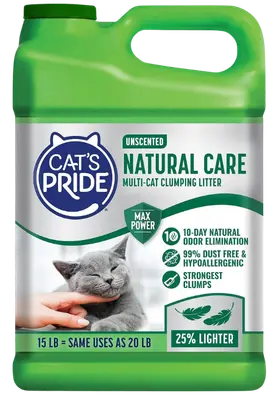
Cat’s Pride Max Power Natural Care Unscented is the most balanced option in this group for someone who wants familiar clumping clay without added perfume or dyes.
Cat’s Pride explicitly markets the formula as hypoallergenic and describes it as 99% dust-free. It is also designed to be lighter than traditional scoopable clay, which is useful if carrying and pouring heavy bags is becoming inconvenient.
Product snapshot
- Material: clay
- Type: clumping
- Scent: unscented
- Manufacturer positioning: hypoallergenic
- Dust claim: 99% dust-free
- Best for: everyday use where fragrance and dust are concerns
Customer feedback is generally favorable for clumping and cat acceptance. The familiar clay texture also makes this an easier transition than switching directly to paper pellets or another very different material.
The main limitation is that “99% dust-free” does not mean every buyer experiences almost no dust. Some owners still report dusty footprints, tracking, or more dust than expected.
Pros
- Explicitly marketed as hypoallergenic
- No added perfume or dyes
- Clumping
- Lighter than many traditional clay litters
- Familiar texture for many cats
Cons
- Some dust complaints remain
- Can still track outside the box
- Current Chewy availability should be checked before purchase

Dr. Elsey’s R&R Respiratory Relief — Best Respiratory-Focused Clay
Best for: Cats or households where fragrance and respiratory-focused litter design are the main priorities.
Avoid if: You want the simplest possible ingredient list or you want to avoid clay entirely.
Honest buying note: The respiratory-focused positioning is meaningful, but the litter should not be treated as a treatment for asthma, allergies, or another medical condition.
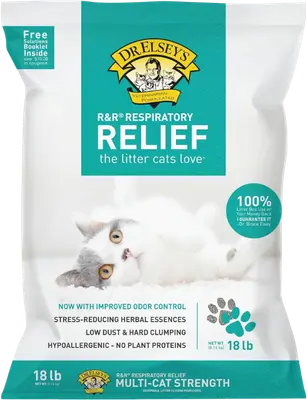
Dr. Elsey’s R&R is the most specifically targeted clay litter in this roundup for households concerned about respiratory irritation.
The formula is marketed as hypoallergenic and is made without plant proteins, perfumes, or deodorants. Dr. Elsey’s also positions it around respiratory sensitivity rather than simply describing it as another unscented clay litter.
Product snapshot
- Material: clay
- Type: clumping
- Scent: no perfume
- Manufacturer positioning: hypoallergenic and respiratory-focused
- Best for: buyers specifically prioritizing fragrance avoidance and respiratory-focused product design
Its medium-grain clay forms firm clumps, and customer feedback frequently praises the lack of perfume and easy scooping.
Dust performance is less consistent. Many buyers are happy with it, while others still report noticeable dust. The formula also contains herbal essences, and the exact composition of those essences is not clearly disclosed in the product information we reviewed.
If you want more background on this material, our clay cat litter guide covers the advantages and tradeoffs of clay in more detail.
Pros
- Explicit hypoallergenic positioning
- No plant proteins
- No perfumes or deodorants
- Firm clumping
- Widely available
Cons
- Dust experience varies
- Heavy compared with plant-based litter
- Herbal essences are not fully disclosed

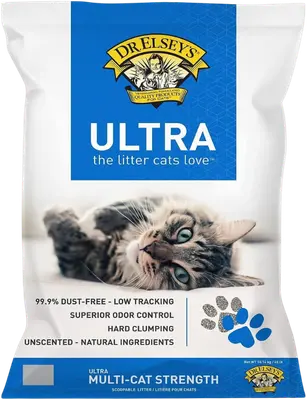
Dr. Elsey’s Ultra Unscented — Best Value Hypoallergenic Clay
Best for: Buyers who want an explicitly hypoallergenic clay litter without paying specialty-litter prices.
Avoid if: Carrying a 20- to 40-pound clay bag is difficult.
Honest buying note: Ultra is the strongest value pick here, but Cat’s Pride is easier to handle and R&R is more specifically positioned around respiratory sensitivity.
Dr. Elsey’s Ultra is one of the easiest products here to justify for value-focused buyers.
Dr. Elsey’s identifies Ultra as one of its hypoallergenic formulas. It is unscented, uses natural clay, and does not rely on added perfumes or deodorants.
The current manufacturer dust claim is 99% dust-free. Older retailer pages and articles may still show 99.9%, but we would use the current figure.
Product snapshot
- Material: clay
- Type: clumping
- Scent: unscented
- Manufacturer positioning: hypoallergenic
- Best for: lower-cost conventional clumping
Ultra forms firm clumps and works with many sifting or mechanical litter boxes. Its broad Amazon and Chewy availability is another practical advantage.
The tradeoff is weight. The larger bags are dense, and some customers also report very hard urine clumps sticking to the bottom of the box. Dust feedback is generally positive but not perfectly consistent.
Pros
- Explicitly identified as hypoallergenic
- Unscented
- Strong clumping
- Good value
- Broad availability
- Suitable for many mechanical litter boxes
Cons
- Heavy
- Dust varies between user experiences
- Hard clumps can stick to the box

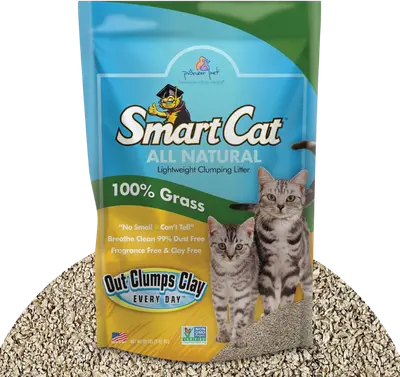
SmartCat All Natural Grass — Best Single-Ingredient Plant-Based Option
Best for: People who want to avoid clay while keeping normal clumping convenience.
Avoid if: Tracking is your biggest complaint or someone in the household has a known grass sensitivity.
Honest buying note: A simple plant ingredient is useful for understanding what you are buying, but “plant-based” should not be confused with “allergy-proof.”
SmartCat offers the simplest non-clay material story in this roundup.
The manufacturer describes the litter as 100% grass, fragrance-free, clumping, lightweight, and 99% dust-free. It gives buyers a plant-based alternative without switching to a non-clumping pellet system.
Product snapshot
- Material: grass
- Type: clumping
- Scent: unscented
- Manufacturer positioning: 99% dust-free
- Best for: buyers wanting a simple non-clay clumping material
Recurring customer feedback is strong for clumping and low dust. Many cats also adapt well to its sand-like texture.
Tracking is the biggest weakness. Because the litter is lightweight and relatively fine, granules can travel beyond the litter box. A large mat and higher-sided box may help, but they do not eliminate the issue for every cat.
SmartCat is not marketed as universally hypoallergenic, and grass itself may be unsuitable for a cat or person with a known grass sensitivity.
For more alternatives by material, see our plant-based cat litter options.
Pros
- Simple grass-based material
- No added fragrance
- Clumping
- Lightweight
- Strong low-dust feedback
Cons
- Tracks easily
- Some pets may try to eat it
- Grass sensitivity is still possible

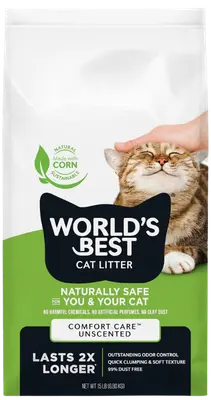
World’s Best Comfort Care Unscented — Best Soft-Texture Plant-Based Option
Best for: Cats that prefer a softer litter while their owner wants a fragrance-free, non-clay clumping option.
Avoid if: Your cat has a known corn sensitivity, persistently eats litter, or tracking is your main concern.
Honest buying note: This is a strong comfort-focused plant option, but SmartCat has the simpler material profile.
World’s Best Comfort Care Unscented is the plant-based pick to consider when paw feel matters as much as dust and fragrance.
This exact formula uses whole-kernel corn, clumps, contains no artificial perfume, and is marketed as 99% dust-free. Comfort Care is designed with a softer texture than some coarser alternatives.
Product snapshot
- Material: corn
- Type: clumping
- Scent: unscented
- Texture: soft/fine
- Best for: cats that prefer a softer clumping texture
Customer feedback is generally strong for clumping, odor control, and dust performance. The litter is also lighter to carry than dense clay.
It is not explicitly marketed as hypoallergenic, which is why we would not describe it that way. Tracking can also be noticeable, and some corn dust may develop as the granules wear down.
Because this is a food-derived material, store it tightly sealed and dry. A minority of natural-litter buyers also report cats trying to eat the granules.
Pros
- Soft texture
- No artificial perfume
- Clumping
- Lighter than clay
- Strong customer feedback for dust and odor performance
Cons
- Not explicitly hypoallergenic
- Can track
- Corn dust may increase as the litter breaks down

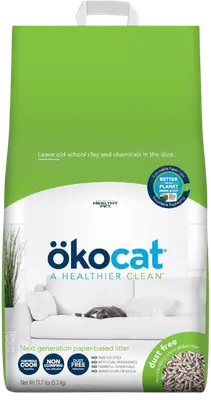
ökocat Dust Free Paper Pellet — Best for Minimizing Airborne Dust
Best for: People willing to give up clumping to minimize airborne litter dust.
Avoid if: Easy urine removal, strong odor control, or compatibility with a particular automatic box is essential.
Honest buying note: This is not the easiest litter in the roundup, but it has the clearest reason to exist for readers whose main concern is airborne dust.
ökocat Dust Free Paper is the most specialized recommendation here.
The unscented pellets are made from paper fiber without inks or dyes, and the manufacturer specifically describes the product as producing no airborne dust. It is also positioned for homes dealing with allergies or respiratory sensitivity.
The major difference is that this litter is non-clumping.
Product snapshot
- Material: paper
- Type: non-clumping pellets
- Scent: unscented
- Main advantage: very low airborne dust
- Best for: households willing to prioritize dust reduction over clumping convenience
Urine is absorbed into the pellets rather than forming removable clumps. That changes the cleaning routine and is the biggest reason this litter will not suit everyone.
Customer complaints most often focus on urine or ammonia odor, wet-pellet cleanup, and cats that dislike the larger pellet texture.
If you are considering this format, our guide to non-clumping litter options explains the maintenance differences in more detail.
Pros
- Manufacturer says no airborne dust
- No added scent
- No inks or dyes
- Lightweight
- Different material from clay and plant granules
Cons
- Non-clumping
- Wet-pellet cleanup takes more effort
- Odor control receives mixed feedback
- Pellet texture can require a gradual transition
How to Choose Hypoallergenic Cat Litter
Start With the Sensitivity You Are Trying to Reduce
Before changing litter, identify the problem as clearly as possible.
If pouring or scooping creates visible dust, prioritize airborne-dust control.
If fragrance is the concern, look for formulas without added perfume rather than assuming any product labeled “fresh” or “odor control” is suitable.
If a particular material seems problematic, changing from one clay litter to another may not address the issue.
The concern may also be the human household member rather than the cat. That can change which feature matters most.
Look Beyond the “Dust-Free” Percentage
A 99% dust-free claim is useful information, but it does not guarantee an identical experience in every home.
Dust can change as granules break down, during shipping, or as litter ages in the box. Customer feedback can therefore reveal limitations that are not obvious from the package.
If dust alone is your priority, our dedicated low-dust litter guide goes deeper into that issue.
Choose Unscented When Fragrance Is a Concern
Unscented does not mean odorless.
Corn, grass, paper, clay, and other materials may have their own natural smell. The important distinction is whether fragrance has been deliberately added.
If added perfume seems to bother your cat or household, an unscented formula is a sensible place to start.
Compare the Material, Not Just the Marketing Label
The six picks here include clay, grass, corn, and paper.
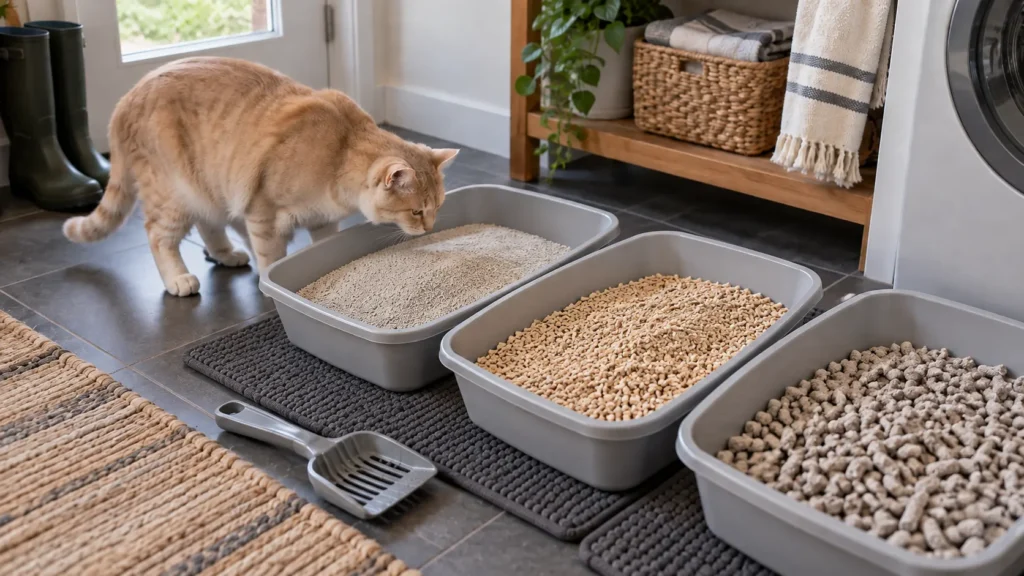
Clay gives familiar texture and strong clumping but is heavier.
Grass and corn are lighter plant-based alternatives that still clump, although they can track.
Paper pellets reduce airborne dust but change the cleaning routine because they do not clump.
No material is automatically best for every sensitive cat.
Decide Whether You Need Clumping
Five of the six products in this guide clump. ökocat Paper does not.
Clumping makes it easier to remove urine daily. Non-clumping paper absorbs urine into the pellets, so maintenance feels different and may require more frequent full changes.
If clump strength and scoopability are a priority, see our clumping litter comparison.
Do Not Ignore Texture and Cat Acceptance
A litter can look ideal on paper and still fail if your cat refuses to use it.
Changing from clay to grass or corn may be relatively easy for some cats because the texture is still granular. Moving from fine clay to paper pellets is a larger change.
Introduce a new litter gradually when possible instead of replacing the entire box overnight.
Consider Tracking, Weight, and Automatic Boxes
Sensitivity is only one part of living with a litter every day.
SmartCat may track more because it is lightweight. Large clay bags can be difficult to carry. Paper pellets may not work with every automatic litter box.
If litter all over the floor is your main frustration, compare our low-tracking litter options.
Hypoallergenic Cat Litter Safety and Quality Checklist
Before buying, check the exact formula rather than relying on the brand name alone. Brands often sell scented, unscented, clay, plant-based, and specialty versions under similar packaging.
A few practical rules help:
- Check for added fragrance if scent is a concern.
- Treat “99% dust-free” as a manufacturer claim unless independently tested.
- Do not assume natural means hypoallergenic.
- Do not assume plant-based means suitable for every sensitivity.
- Store corn, grass, and other plant-based litter sealed and dry.
- Transition gradually when changing texture or material.
- Maintain the recommended litter depth.
- Scoop regularly.
- Do not encourage cats to eat food-derived litter.
- Check your automatic litter box requirements before using pellets or unusual granule sizes.
- Wash your hands after handling used litter.
If odor control is actually your main issue, our odor-control litter options are a better place to compare products designed specifically for ammonia and litter-box smell.
Persistent coughing, wheezing, sneezing, eye or nasal discharge, skin irritation, breathing difficulty, or sudden litter-box avoidance should not automatically be blamed on litter. If symptoms persist or are significant, contact your veterinarian rather than repeatedly switching products without investigating the underlying cause.
Frequently Asked Questions
Is there really such a thing as hypoallergenic cat litter?
Yes, some manufacturers describe certain formulas as hypoallergenic.
However, the term does not guarantee that no cat or person can react to the product. Material, dust, added fragrance, texture, and individual sensitivity still matter.
Can cats be allergic or sensitive to cat litter?
Cats can react poorly to irritants or particular litter components, but sneezing, coughing, itching, or eye and nasal symptoms do not prove that litter is the cause.
If symptoms continue after a litter change, or if your cat has breathing difficulty or other concerning signs, contact your veterinarian.
Is unscented cat litter the same as hypoallergenic litter?
No.
Unscented usually means no added fragrance. A litter can still produce dust or contain a material that does not suit a particular cat or person.
Likewise, a litter marketed as hypoallergenic may still use clay or other ingredients that some households prefer to avoid.
Is low-dust cat litter better for sensitive cats?
Low-dust litter can be a sensible choice when airborne particles appear to be the problem, especially during pouring and scooping.
But low dust is only one factor. Added fragrance, litter material, texture, cleanliness, and individual sensitivity also matter.
What cat litter is best for people with allergies?
There is no single litter that is guaranteed to work for every person with allergies.
A practical starting point is an unscented formula with very low airborne dust. It may also help to choose a material you already know you tolerate well and avoid unnecessary fragrance.
If your symptoms are significant or persistent, speak with your healthcare professional rather than relying on a litter change alone.
Final Verdict
The best hypoallergenic cat litter is not simply the product with the strongest claim on the bag.
For most households, Cat’s Pride Max Power Natural Care Unscented offers the most balanced mix of explicit hypoallergenic positioning, familiar clumping, no added perfume or dyes, and easier handling.
Dr. Elsey’s R&R is the more specialized respiratory-focused clay choice, while Ultra offers better value. SmartCat and World’s Best give you clumping plant-based alternatives, and ökocat Paper is the specialist option when minimizing airborne dust matters more than clumping convenience.
Whichever material you choose, pay attention to how your cat actually responds—and seek veterinary guidance when symptoms persist.