As an Amazon Associate, LumaPaw earns from qualifying purchases. We may also earn commissions from other retailers at no extra cost to you.
A well-made leather dog collar can be comfortable, durable and easier on the coat than rough webbing. But “leather” alone does not tell you whether a collar is suitable for your dog.
The lining, width, hardware, edge finish and fit matter just as much as the outer material. A padded 2-inch collar may suit a Mastiff but overwhelm a short-necked dog. A narrow rolled leather dog collar can reduce coat matting, yet it may be a poor choice for a powerful puller.
After comparing product specifications, retailer information and recurring customer feedback, the Soft Touch Collars Leather Two-Tone Padded Dog Collar is our Best Overall pick. It offers the strongest balance of disclosed leather quality, padding, practical hardware and cross-retailer customer evidence.
For help comparing leather with other collar types, see our complete dog collar guide.
Our Top Leather Dog Collar Picks
Soft Touch Two-Tone Padded Collar — Best Overall
Best for: Medium and large dogs needing a substantial padded collar
Construction: Full-grain leather description with sheepskin-leather lining
Main limitation: Thick and initially stiff
CollarDirect Rolled Leather Collar — Best for Long-Haired Dogs
Best for: Long, curly or easily matted coats
Construction: Soft leather rolled around a nylon cord
Main limitation: Not our preferred choice for strong pullers
Riparo Adjustable Leather Collar — Best for Large and Giant Dogs
Best for: Large dogs needing a wide collar
Construction: Full-grain aniline leather description with padded lining
Main limitation: The widest sizes can feel bulky and restrictive
Circle T Latigo Leather Round Collar — Best Traditional Latigo Collar
Best for: Calm walkers and owners wanting a classic round leather design
Construction: Full-grain latigo leather description
Main limitation: Confusing sizing and a small leash-attachment area
Auburn Leathercrafters Town Collar — Best Classic USA-Made Collar
Best for: Owners wanting a simple unpadded bridle-leather collar
Construction: Top-grain bridle leather with hand-finished edges
Main limitation: Limited customer-feedback and retailer evidence
How We Chose the Best Leather Dog Collars
LumaPaw did not conduct hands-on testing for this article. We compared manufacturer specifications, retailer listings and recurring customer-feedback patterns.
To qualify, a product needed to be a standard wearable dog collar made primarily from real leather. We excluded faux leather, PU leather, waterproof coated webbing, electronic collars and products whose main purpose belonged to another category.
We compared:
- Stated leather type and lining
- Flat versus rolled construction
- Collar width and neck-size coverage
- Buckles, D-rings, rivets and stitching
- Padding and edge finishing
- Coat and dog-size suitability
- Amazon and Chewy customer feedback
- Recurring complaints
- Care requirements
- Current retailer availability
Ratings were considered, but no product earned a place solely because it had thousands of reviews. Each collar needed a clear reason for inclusion and an honest limitation.
Best Leather Dog Collars Reviewed

Soft Touch Collars Leather Two-Tone Padded Dog Collar — Best Overall
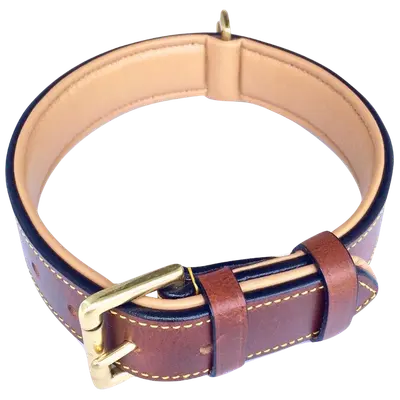
Best for: Medium and large dogs, controlled everyday walking and owners prioritizing padding.
Avoid if: Your dog swims frequently, needs a lightweight collar or requires a quick-release or breakaway design.
Honest buying note: Measure where the collar will actually sit rather than relying on breed or weight. The padding reduces the collar’s internal space, so avoid selecting a size that places your dog at the extreme end of the listed range.
The Soft Touch collar provides the most convincing overall package for owners who want a traditional padded leather dog collar.
The manufacturer describes it as full-grain, naturally tanned leather with a soft sheepskin-leather lining. It uses a large D-ring for the leash and a separate smaller ring beside the buckle for identification tags. The buckle and D-ring are described as lacquered solid brass.
Its sizes cover approximately:
- Small: 11–13.5-inch neck, 5/8-inch width
- Medium: 14.5–17.5-inch neck, 1-inch width
- Large: 18–21-inch neck, 1.5-inch width
- X-Large: 22–25-inch neck, 1.75-inch width
At the time of our research, it held a 4.6-star rating from more than 5,400 Amazon customers and a similar rating from more than 900 Chewy customers.
Owners frequently praise the soft lining, substantial stitching and accessible leash ring. Several reviews describe collars remaining usable for years, although that does not guarantee a particular lifespan.
The main issue is bulk. The leather and padding can feel stiff when new, and the Medium through X-Large versions are considerably thicker than a lightweight nylon collar. Some buyers also found the size chart difficult near the upper or lower edge of a range.
Isolated complaints mention the small tag attachment or leather surrounding the main D-ring eventually failing. Inspect both attachment areas regularly, and never clip the leash to the small tag ring.
Pros
- Full-grain leather description
- Soft sheepskin-leather lining
- Separate leash and tag rings
- Four useful size ranges
- Strong Amazon and Chewy evidence
- Substantial collar widths for larger dogs
Cons
- Stiff during the break-in period
- Bulky for some small or short-necked dogs
- Sizing can be difficult near range boundaries
- Not quick release or breakaway
- Not designed for repeated soaking

CollarDirect Rolled Leather Dog Collar — Best for Long-Haired Dogs
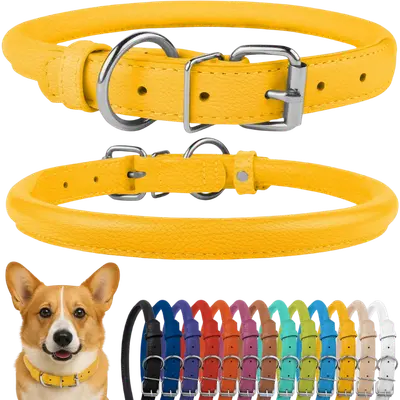
Best for: Long-haired dogs, curly coats, toy breeds and calm everyday walkers.
Avoid if: Your dog lunges, pulls strongly, is tethered or depends on the collar as its only restraint.
Honest buying note: Choose the standard smooth or textured rolled-leather version rather than assuming the reflective model has identical construction. For white or pale-coated dogs, brown or another restrained color may reduce the risk of visible dye transfer.
A flat collar can press against long or curly fur and contribute to tangling around the neck. CollarDirect reduces the amount of collar surface touching the coat by using a narrow rolled profile.
The collar is made from soft leather wrapped around an internal nylon cord. It is lighter and less bulky than the padded Soft Touch or Riparo collars.
Chewy’s listed size range extends from very small dogs to approximately 21-inch necks:
- XX-Small: about 6 inches
- X-Small: 7–8 inches
- Small: 9–11 inches
- Medium: 12–14 inches
- Large: 14–16 inches
- X-Large: 16–18 inches
- XX-Large: 19–21 inches
Numerous owners of Pomeranians, Yorkies, Collies, Poodles and similar dogs report less coat matting after switching to a rolled collar.
However, Amazon combines ratings from smooth, textured and reflective versions. Its product title, selected size and bullet points can also display conflicting measurements. Verify the exact model and its size chart before ordering.
Customer complaints include uneven stitching, keeper loops moving or detaching, color transfer onto light fur and inconsistent sizing between variations. Some reviews also describe the leather tearing when used with large, strong dogs.
Pros
- Rolled profile contacts less coat
- Lightweight and flexible
- Very small sizes available
- Broad color selection
- Traditional buckle
Cons
- Sizing information varies between listings
- Quality can differ by color or variation
- Bright dye may transfer onto light fur
- Narrow construction is unsuitable for strong pulling
- Some keeper-loop and stitching complaints

Riparo Adjustable Leather Dog Collar — Best for Large and Giant Dogs
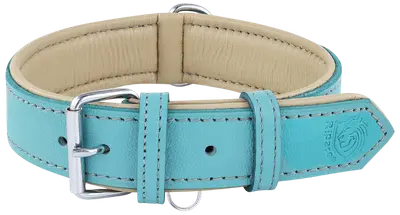
Best for: Large and giant dogs with long enough necks to wear a 1.5- to 2-inch collar comfortably.
Avoid if: Your dog has a short neck, swims frequently or needs lightweight equipment.
Honest buying note: Do not select it purely because your dog is heavy. Neck length and shape matter. A broad collar that presses against the jaw or shoulders is not a good fit, even when the neck measurement falls within the size chart.
Riparo earns its position through scale. Its larger collars are wider than most everyday leather options and cover necks up to approximately 29 inches.
The available sizes are described as:
- Small: 10–13.5-inch neck, 0.75-inch width
- Medium: 13.5–17.5-inch neck, 1-inch width
- Large: 17–21-inch neck, 1.5-inch width
- X-Large: 21–25-inch neck, 1.75-inch width
- XX-Large: 24–29-inch neck, 2-inch width
The manufacturer describes the collar as full-grain aniline leather with sheepskin padding and lacquered stainless-steel hardware. It also includes separate leash and tag attachment points.
Customer feedback from large-dog owners often mentions the substantial buckle, wide strap and visible fit through thick fur. At the time of research, the Amazon listing held a 4.3-star rating from more than 5,800 customers.
The same width that makes it useful for giant breeds is also its main drawback. A 1.75- or 2-inch collar can feel like a brace on a dog without enough neck length. Some owners said it restricted comfortable head movement until the leather softened.
Bright colors also receive more complaints about scratching, peeling and fading. Brown or black should show cosmetic wear less clearly.
Other complaints include moisture and odor absorption, rotating D-rings and occasional difficulty threading the thick leather through the keeper loops.
Pros
- Neck coverage extends to roughly 29 inches
- Widths reach 2 inches
- Padded lining
- Separate tag ring
- Strong large-dog customer evidence
- Multiple color choices
Cons
- Wide sizes can be heavy and restrictive
- Requires a break-in period
- Bright finishes may fade or flake
- Can retain odor after wet or active use

Coastal Pet Circle T Latigo Leather Round Collar — Best Traditional Latigo Collar
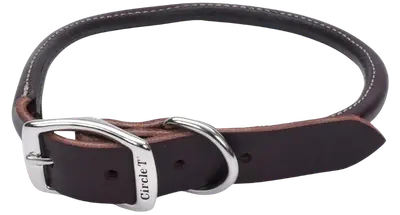
Best for: Calm walkers, identification wear and owners wanting a classic brown round collar.
Avoid if: Your dog pulls hard, is tethered, backs out of collars or requires a large, easy-to-clip leash ring.
Honest buying note: Verify the usable neck range for the exact width and length you plan to buy. Do not assume that a “20-inch collar” comfortably adjusts around every neck below 20 inches.
The Circle T is a traditional round collar for readers who prefer classic brown latigo leather over brightly colored rolled designs.
Coastal describes it as full-grain latigo leather, with widths ranging from narrow 3/8-inch versions to broader 1-inch options. Amazon and Chewy sell different lengths and widths, although availability varies substantially by size.
Long-haired-dog owners often report that the rounded shape causes less coat compression than a flat nylon collar. Some buyers also report using Circle T collars for several years.
The biggest difficulty is sizing. The listed collar length may represent the largest usable setting rather than the middle of the adjustment range. Some versions have only four holes, leaving less room for fine adjustment.
The leash-attachment area is another concern. Several owners say the ring is small or partly occupied by the loose collar strap, making it difficult to connect a larger leash clip.
More serious but less common complaints include broken rivets, failed seams and leather splitting near the adjustment holes. Recent buyers have also questioned whether the current construction is as substantial as older Circle T collars.
Pros
- Traditional latigo-leather appearance
- Rounded shape may reduce coat tangling
- Several lengths and widths
- Long Amazon sales history
Cons
- Confusing size system
- Limited adjustment on some versions
- Small leash-attachment area
- Leather may arrive stiff
- Isolated rivet and seam failures
- Size availability varies

Auburn Leathercrafters Town Collar — Best Classic USA-Made Collar
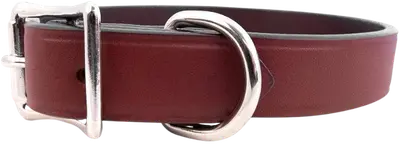
Best for: Owners wanting a traditional USA-made collar without bulky padding.
Avoid if: You require extensive retailer feedback, quick release, padding or reliable Chewy availability.
Honest buying note: Purchase from Auburn’s official store when possible. This is a craftsmanship-focused recommendation rather than the most evidence-rich product in the roundup.
The Auburn Town Collar is the simplest product in the group. It has no padded lining, bright color coating or rolled nylon core.
Auburn describes the Town Collar as a classic bridle-leather collar with beveled, hand-finished edges, smooth capped rivets and bright nickel-finished hardware.
Auburn’s current official size guide covers fit ranges from approximately 6–8 inches through 30–34 inches, with collar widths increasing for larger sizes.
The Town Collar adds genuine variety to the roundup, but the evidence is thinner than for the other four products. The Amazon listing we reviewed had no featured offer and did not display a useful customer-rating history. We also could not verify a current Chewy listing.
This means we cannot confidently identify recurring complaints about rivets, sizing or long-term leather wear. The manufacturer information is clear, but independent customer evidence is limited.
Pros
- Top-grain bridle-leather description
- Hand-finished edges
- Made in the United States
- Proportional widths by collar size
- Broad neck-size range
- Simple unpadded construction
- Direct manufacturer availability
Cons
- Limited independent customer feedback
- No verified Chewy listing
- Amazon availability is inconsistent
- No padding
- Nickel-finished hardware may not suit every dog
- Requires routine leather care
How to Choose a Leather Dog Collar
Check the Leather Type and Construction
Product descriptions often use “genuine leather” without explaining the leather type, lining or internal structure.
Look beyond the title and check:
- Full-grain or top-grain description
- Internal core or backing
- Padding material
- Number of layers
- Edge finishing
- Stitching and rivets
- Buckle and D-ring material
A rolled collar may be leather wrapped around a cord. A padded collar may use leather outside with a different lining. Neither design is automatically poor, but the construction should be disclosed accurately.
Flat versus rolled leather
Flat leather collars distribute contact across a broader area. They are usually a better starting point for medium and large dogs that walk calmly on a collar.
Rolled collars contact less coat and may reduce matting on long-haired dogs. However, their narrow shape concentrates pressure over a smaller area.
A rolled collar is best treated as an identification and calm-walking option rather than a pulling-control device.
Padded versus unpadded
Padding can soften the edges and reduce direct contact with firmer outer leather. It also adds thickness, weight and more material that can hold moisture.
Unpadded bridle or latigo leather can feel firmer initially but may be less bulky. Neither is universally better.
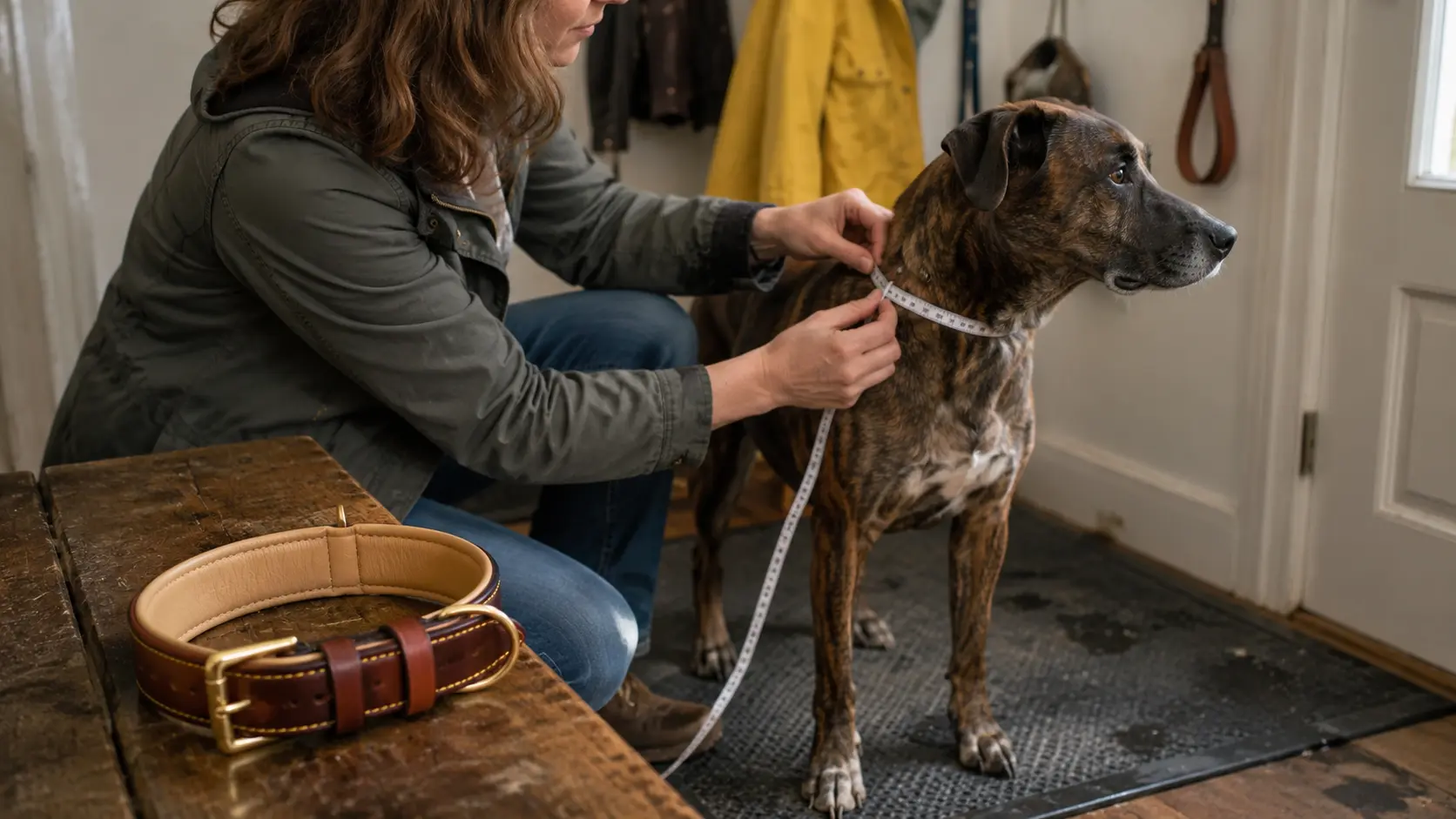
Measure the neck, not the old collar
Measure the area where the new collar will sit with a soft tape. Keep the tape snug without pulling it tight.
Then compare that measurement with the manufacturer’s usable neck range—not the product’s total length.
Avoid a size that puts your dog on the first or last adjustment hole. Padding and thick leather can make the practical fit smaller than expected.
Inspect the hardware
The collar is only as dependable as the leather surrounding its buckle and D-ring.
Check regularly for:
- Cracking around buckle holes
- Loose rivets
- Separating layers
- Frayed stitching
- A rotating or bent D-ring
- Corrosion or sharp edges
- A keeper loop that no longer secures the loose end
Replace the collar if the closure or leash attachment is no longer dependable.
Are Leather Collars Good for Every Dog?
Leather can be a practical everyday material for calm walkers and owners who are willing to clean and maintain it. It is not automatically the best option for every activity.
Another collar may be more suitable when:
- Your dog swims frequently.
- The collar is exposed to mud every day.
- Your dog backs out of standard collars.
- You need a built-in control handle.
- The collar must release if snagged.
- Your dog pulls continuously.
Frequent swimmers may be better served by one of our waterproof dog collar options.
Dogs that reverse out of flat collars may need a properly fitted martingale collar rather than a thicker leather strap.
For handles and reinforced working-style construction, see our guide to tactical collars with control handles.
A martingale, tactical collar or leather collar should not be treated as a substitute for training or an appropriately fitted harness when persistent pulling is the main issue.
Leather Versus Nylon and Waterproof Collars
Leather usually provides a more traditional appearance and can become softer with use. It also needs more attention after rain, dirt or prolonged wear.
Nylon is generally lighter, dries faster and comes in more reflective designs. Rough webbing or exposed seams may bother some dogs, but material quality varies widely.
Coated waterproof webbing is usually easier to rinse clean and better suited to swimming, mud and wet climates. It will not develop the same patina as leather, but it normally requires less maintenance.
Choose according to your dog’s routine rather than appearance alone.
How to Clean and Care for a Leather Dog Collar
Follow the care instructions for the exact collar you buy. Different dyes, finishes and linings may react differently to cleaners and conditioners.
For routine care:
- 1
Remove loose dirt with a soft cloth.
- 2
Wipe the collar with a lightly damp cloth.
- 3
Avoid soaking unless the manufacturer specifically permits it.
- 4
Let wet leather air-dry away from radiators, hair dryers and direct heat.
- 5
Use a suitable leather conditioner only when recommended.
- 6
Patch-test any cleaner before applying it to the entire collar.
Do not apply a fixed cleaning schedule to every product. A dry indoor collar and a collar worn through rain and mud will need different care.
Leather Dog Collar Safety Checklist
- Check the fit regularly, especially on puppies.
- Make sure two fingers can fit beneath the relaxed collar without leaving it loose enough to slip over the head.
- Attach the leash only to the reinforced leash D-ring.
- Do not use the smaller tag ring for walking.
- Remove the collar before crating if it can catch on the crate.
- Do not use a standard leather collar for unattended tethering.
- Replace damaged stitching, rivets or leather rather than attempting a temporary repair.
- Use an appropriately fitted harness when your dog pulls continuously.
- Ask your veterinarian about collar use if your dog has neck, airway or skin problems.
A standard buckle collar does not provide automatic snag release. For that feature, compare breakaway collars designed for safety release
Frequently Asked Questions
Are leather collars good for dogs?
A well-fitted leather collar can be comfortable and durable for everyday identification and calm leash walking. Quality varies, so check the lining, edges, hardware and fit rather than assuming every leather collar is equally good.
Are rolled leather dog collars better for long-haired dogs?
They can be. A rolled leather dog collar contacts less of the coat than a broad flat collar, and many owners report less neck matting. It is still important to brush beneath the collar and check the skin regularly.
Can dogs be allergic to leather collars?
Skin irritation can be associated with dyes, finishes, metal hardware, trapped moisture or friction rather than the leather alone. Remove the collar and contact your veterinarian if you notice redness, swelling, sores, persistent scratching or hair loss.
Can a leather dog collar get wet?
Occasional rain is different from repeated swimming. Many leather collars tolerate brief moisture, but soaking can affect the leather, lining, odor and hardware. Follow the manufacturer’s care instructions and let the collar air-dry fully.
Do leather dog collars stretch?
Some leather softens and changes shape with use. Excessive stretching, elongated buckle holes or separating layers can indicate wear. Replace the collar if its adjustment is no longer dependable.
Is leather better than nylon for dogs?
Neither material is always better. Leather offers a classic feel and may become softer over time. Nylon is normally lighter, faster-drying and easier to find with reflective details. Choose according to your dog’s size, coat, activity and exposure to water.
Can a leather collar spread a skin condition?
A collar does not usually “spread” a skin disorder by itself, but a dirty or damp collar can trap moisture and rub irritated skin. Clean the collar as directed, keep the neck dry and speak with a veterinarian before continuing collar use over an active skin problem.
Should I buy a personalized leather collar?
Personalized information can help identify a dog, but engraving and embroidery are separate buying considerations. See our comparison of personalized dog collars and nameplate options rather than choosing a leather collar solely because it includes customization.
Final Verdict: Which Leather Dog Collar Is Best?
The best leather dog collars are not simply the thickest or the most expensive. They fit correctly, use dependable hardware and match the dog’s coat, neck shape and routine.
The Soft Touch Collars Leather Two-Tone Padded Dog Collar is our Best Overall choice because it offers the strongest balance of material disclosure, comfort features, size coverage and customer evidence.
Choose CollarDirect for long coats, Riparo for genuinely large or giant dogs, Circle T for traditional latigo styling and Auburn when USA-made bridle-leather construction matters more than broad retailer feedback.
Whichever leather dog collar you select, measure carefully, inspect it regularly and use a harness when continuous pulling—not identification—is the main concern.