Choosing kitten dry food is not simply a matter of finding the bag with the highest protein percentage or the longest ingredient list. Growing kittens need a diet appropriate for their life stage, but practical details matter too: calorie density, kibble size, ingredient restrictions, bag size, price, and whether your kitten will actually eat it.
After comparing current formula information, guaranteed analyses, retailer availability, and recurring customer feedback, Purina Pro Plan Complete Essentials Kitten Chicken & Rice is our Best Overall pick. It combines a kitten-focused formula with 42% protein, DHA, live probiotics, useful calorie information, and several bag sizes.
The other picks earn their places for different reasons, from budget-friendly feeding to indoor kittens, smaller kibble, and more animal-heavy recipes. For a broader look at wet and dry feeding options, see our guide to choosing food for kittens.
Affiliate disclosure: LumaPaw may earn a commission if you buy through links on this page, at no extra cost to you. Our product positions are based on research rather than commission rates.
Best Kitten Dry Food at a Glance
Purina Pro Plan Complete Essentials Kitten Chicken & Rice — Best Overall
Protein: 42% minimum
Fat: 19% minimum
Calories: 562 kcal/cup
Main ingredient: Chicken
Sizes: 3.5, 7, and 16 lb
Best feature: Strong overall balance of nutrition, probiotics, availability, and practical bag sizes
Main drawback: More expensive than budget kibble and contains several animal and plant protein sources
Purina Kitten Chow Year One Essentials — Best Budget
Protein: 40% minimum
Fat: 13.5% minimum
Calories: 503 kcal/cup
Sizes: Up to 14 lb
Best feature: Very strong cost-per-pound value
Main drawback: More basic multi-ingredient formula than our top pick
IAMS ProActive Health Healthy Kitten Chicken — Best Small Kibble
Protein: 33% minimum
Fat: 21% minimum
DHA: 0.05% minimum
Calories: 480 kcal/cup
Main ingredient: Chicken
Sizes: 3.5, 7, and 16 lb
Best feature: Bite-sized pieces designed for small kitten mouths
Main drawback: Small pieces are still firm kibble
Hill's Science Diet Indoor Kitten Chicken — Best for Indoor Kittens
Protein: 33% minimum
Fat: 15% minimum
DHA: 0.04% minimum
Calories: 531 kcal/cup
Main ingredient: Chicken
Sizes: 3.5 and 7 lb
Best feature: Specifically formulated for indoor kittens
Main drawback: Higher cost and limited bag-size choice
Royal Canin Feline Health Nutrition Kitten — Best for Kittens 4–12 Months
Protein: 34% minimum
Fat: 16% minimum
Calories: 367 kcal/cup
Best feature: Clear later-kitten growth-stage positioning
Main drawback: Expensive compared with mainstream kitten kibble
ORIJEN Kitten — Best High-Animal-Ingredient Recipe
Protein: 40% minimum
Fat: 20% minimum
DHA: 0.4% minimum
Calories: 515 kcal/cup
Animal ingredients: 90% claimed
Best feature: Animal foods occupy the first five ingredient positions
Main drawback: Expensive and built around a complex mix of proteins and legumes
Tiki Cat Born Carnivore Baby Chicken & Egg — Best Baked Kitten Kibble
Protein: 42% minimum
Fat: 22% minimum
DHA: 0.1% minimum
Calories: 557 kcal/cup
Main ingredient: Deboned chicken
Best feature: Gently baked kibble
Main drawback: High price, and some owners find the pieces harder than expected
How We Researched the Best Dry Food for Kittens
We did not rank these foods by Amazon stars or crude protein alone. We compared current manufacturer and retailer information, guaranteed analyses, calories, life-stage positioning, kibble practicality, ingredient profiles, package sizes, value, availability, and repeated customer-feedback patterns.
Nutritional Adequacy Comes First
A dry food intended to be your kitten’s main diet should have a nutritional adequacy statement showing that it is suitable for the appropriate growth stage. “AAFCO approved” is not the correct phrase—AAFCO does not individually approve bags of cat food.
We also paid attention when the available product information was unclear or inconsistent rather than assuming that “kitten” on the front of the bag answers every nutritional question.
Protein and Fat Need Context
A higher protein percentage did not automatically move a product up our list. For example, IAMS has less crude protein than Pro Plan, but more fat and a higher stated DHA minimum. Hill’s earns its place because of its indoor-kitten positioning and feeding-test substantiation rather than because it has the highest numbers on the guaranteed analysis.
Calories matter as well. A cup of one kibble may provide very different energy from the same volume of another, so feeding guides should not be swapped between brands.
Ingredients Are Not a Shortcut to Overall Quality
We noted major protein sources, grains, legumes, eggs, fish, and other ingredients that may matter to individual kittens. We did not automatically downgrade foods for containing grains or by-products, and we did not automatically reward grain-free formulas.
If your kitten has a diagnosed food allergy or needs a restricted diet, ingredient selection should be guided by your veterinarian rather than by a general roundup.
Customer Reviews Help Find Patterns, Not Medical Proof
Owner feedback was useful for repeated practical themes such as small kibble, food refusal, smell, price, bag quality, or harder-than-expected pieces.
We excluded medical-style claims that a food “cured” vomiting, diarrhea, allergies, or another condition. Individual reviews cannot establish that.
The 7 Best Kitten Dry Foods

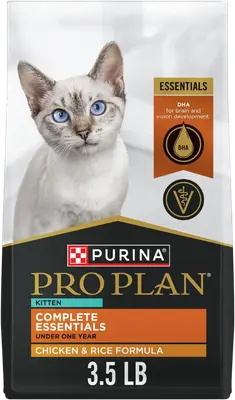
Purina Pro Plan Complete Essentials Kitten Chicken & Rice — Best Overall
Best for: Owners wanting a well-documented, nutrient-dense everyday kitten kibble with DHA, probiotics, and multiple bag sizes.
Avoid if: Your kitten needs a veterinary therapeutic diet or a tightly restricted ingredient list.
Honest buying note: This is the most rounded choice in our lineup, not necessarily the right food for every kitten.
Purina Pro Plan earns our Best Overall position because it does well across the factors that matter most without relying on one headline feature.
The Chicken & Rice formula lists chicken first and provides 42% minimum protein, 19% minimum fat, 0.02% minimum DHA, 1.0% calcium, and 0.8% phosphorus. At 562 kcal per cup, it is also one of the more calorie-dense kibbles in this roundup.
Another useful difference is the inclusion of guaranteed live Bacillus coagulans probiotics. Purina offers the food in 3.5-, 7-, and 16-lb bags, giving owners more flexibility than products sold only in small packages.
The ingredient list is not simple. Along with chicken and rice, it contains chicken and poultry by-product meals, egg, fish meal, soy ingredients, corn protein meal, and wheat flour. That does not make it unsuitable for most kittens, but it matters if you are trying to avoid specific ingredients.
Customer feedback is generally strong. Recurring positives include good acceptance and manageable pieces. Less-positive reports mention the price, noticeable food odor, and kibble that some kittens find quite crunchy.
Pros
- Chicken is the first ingredient
- 42% protein and 19% fat
- DHA plus disclosed calcium and phosphorus
- Guaranteed live probiotics
- Three useful bag sizes
Cons
- Costs considerably more than Kitten Chow
- Contains multiple proteins plus soy and wheat
- May be quite crunchy for some kittens

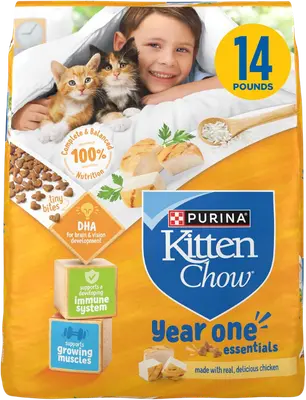
Purina Kitten Chow Year One Essentials — Best Budget
Best for: Multi-kitten households, fosters, rescues, and budget-conscious owners.
Avoid if: You specifically need to avoid soy, wheat, fish, or multiple animal protein sources.
Honest buying note: We chose it because the budget advantage is substantial, not because it looks most impressive on an ingredient list.
Kitten Chow’s reason for inclusion is straightforward: value.
In the retailer snapshot we researched, the 14-lb bag worked out dramatically cheaper per pound than Pro Plan, Hill’s, Royal Canin, ORIJEN, or Tiki Cat. That makes it especially practical for foster homes, multi-kitten households, or anyone going through a large amount of kibble.
The formula provides 40% minimum protein, 13.5% minimum fat, 0.02% minimum DHA, and about 503 kcal per cup. It is positioned specifically for kittens through their first year.
One detail worth getting right: despite marketing language about real chicken, chicken is not the first ingredient. The formula starts with poultry by-product meal, followed by corn protein meal, rice, soybean meal, animal fat, wheat, and then chicken.
That is a more basic ingredient profile than some of our higher-priced picks, but price alone does not determine nutritional adequacy. Its strongest argument is that it offers kitten-specific feeding at a much lower cost.
Owner feedback repeatedly praises the affordability, large bag, small pieces, and acceptance by kittens. Some reviews mention refusal after formula changes or individual digestive tolerance issues, but those reports are not consistent enough to establish a general problem.
Pros
- Very low cost per pound
- 40% minimum protein
- Includes DHA
- Available in a large 14-lb bag
- Extensive retailer feedback history
Cons
- Lower fat than most of our other picks
- Chicken is not the first ingredient
- Contains corn protein, soy, wheat, poultry, and fish ingredients

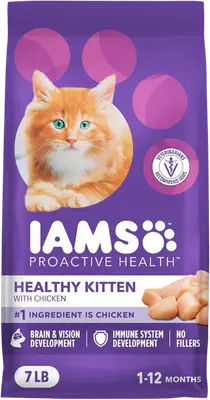
IAMS ProActive Health Healthy Kitten Chicken — Best Small Kibble
Best for: Kittens that handle smaller kibble more comfortably.
Avoid if: Your kitten has trouble with firm kibble or requires a specific restricted diet.
Common complaints: A few owners mention packaging/freshness concerns or kittens losing interest after a bag has been open for some time.
IAMS stands out for a practical reason that matters to young cats: bite-sized kibble specifically designed for small mouths.
That claim is also supported by repeated customer feedback describing the pieces as particularly small. Small does not mean soft, however. It is still firm dry kibble, and some kittens moving from wet food may prefer the pieces moistened at first.
The Chicken Recipe lists chicken first and provides 33% minimum protein, 21% minimum fat, 0.05% DHA, 1.2% calcium, 0.8% phosphorus, and about 480 kcal per cup. It also includes beet pulp and fructooligosaccharides as part of its fiber/prebiotic approach.
Bag options from 3.5 through 16 lb make it practical for both trial feeding and larger households. In our retailer snapshot, its price sat well below Hill’s, Royal Canin, ORIJEN, and Tiki Cat.
There is one reason we are more cautious with IAMS than with our top picks: the current product information we reviewed contained inconsistent nutritional-adequacy wording. The food is clearly marketed for a kitten’s first year, but owners using it as the sole diet should check the current package’s adequacy statement.
Pros
- Small, bite-sized pieces
- Chicken is the first ingredient
- 21% minimum fat
- 0.05% minimum DHA
- Large 16-lb option
- Mid-range price
Cons
- Small kibble is still hard
- Grain-inclusive formula
- Current adequacy wording deserves a package check

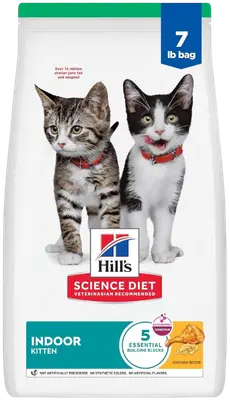
Hill's Science Diet Indoor Kitten Chicken — Best for Indoor Kittens
Best for: Indoor kittens whose owners want an indoor-specific formula with strong manufacturer documentation.
Avoid if: Price or large-bag value is your main priority.
Honest buying note: Choose this for its indoor-kitten positioning and documentation—not because indoor kittens automatically need aggressive calorie restriction.
Hill’s Indoor Kitten has a more specific purpose than a general “premium” label: it is formulated for kittens with an indoor lifestyle.
The recipe lists chicken first and provides 33% minimum protein, 15% minimum fat, 0.04% DHA, and about 531 kcal per cup. Hill’s also uses a prebiotic-fiber approach, and its nutritional adequacy is backed by AAFCO-procedure feeding-test substantiation for growth.
That level of documentation is one reason Hill’s ranks highly even though its crude protein percentage is lower than Pro Plan, Kitten Chow, ORIJEN, and Tiki Cat.
Recurring customer feedback mentions good acceptance and small kibble. Some owners also report easier litter-box cleanup or better stool consistency, but those experiences should not be treated as guaranteed digestive outcomes.
The clearest downside is price. Our Chewy snapshot put the 7-lb bag around $5 per pound, and the available 3.5- and 7-lb sizes give buyers less flexibility than Pro Plan or IAMS.
Pros
- Specifically formulated for indoor kittens
- Chicken first
- Feeding-test substantiation for growth
- DHA included
- Prebiotic-fiber approach
Cons
- Expensive
- Only 3.5- and 7-lb bags in the listings researched
- Contains chicken, egg, wheat, and several grains

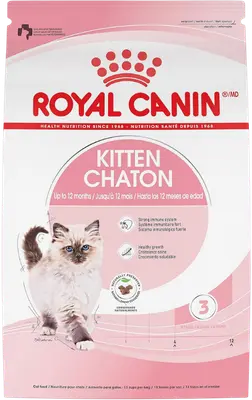
Royal Canin Feline Health Nutrition Kitten — Best for Kittens 4–12 Months
Best for: Kittens around 4–12 months, especially those moving beyond an early baby-kitten formula.
Avoid if: Budget is a major consideration or your kitten needs a simplified ingredient profile.
Royal Canin has one of the clearest age-specific roles in the roundup. This formula is designed around the later stage of kitten growth, roughly 4 months through 1 year.
It contains 34% minimum protein, 16% minimum fat, 0.93% calcium, and about 367 kcal per cup. The formula also includes beet pulp, psyllium, fructooligosaccharides, and other fiber/prebiotic ingredients.
Royal Canin describes the kibble as tailored for young mouths and emerging teeth. Customer feedback repeatedly supports the manageable kibble size, including owners transitioning kittens from the company’s Mother & Babycat line.
Chicken by-product meal is the first ingredient, followed by rice ingredients, chicken fat, wheat gluten, corn, and egg. We would not treat the use of a by-product meal as automatic evidence that the finished diet is lower quality.
Price is the real limitation. It was one of the most expensive mainstream foods in our retailer research.
Pros
- Clear 4–12-month positioning
- Complete-and-balanced growth formulation
- Manageable kibble
- Multiple package sizes
- Fiber and prebiotic ingredients
Cons
- High price per pound
- Complex ingredient list
- Not suitable as a limited-ingredient option

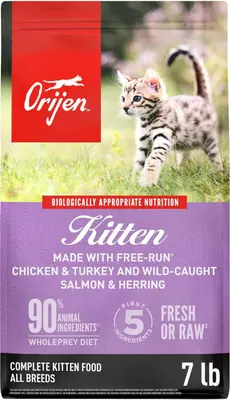
ORIJEN Kitten — Best High-Animal-Ingredient Recipe
Best for: Owners specifically prioritizing a high proportion of animal ingredients.
Avoid if: Budget matters or your veterinarian wants a simpler/restricted-protein formula.
Honest buying note: Its formulation is distinctive, but “more animal ingredients” should not be treated as an automatic overall quality score.
ORIJEN is the most obvious choice here for shoppers specifically looking for a kibble with a very high proportion of animal ingredients.
The company states that 90% of the formula comes from animal ingredients. The first five are chicken, turkey, salmon, whole herring, and chicken liver.
Its guaranteed analysis includes 40% protein, 20% fat, 0.4% DHA, 0.4% EPA, 1.4% calcium, 1% phosphorus, and about 515 kcal per cup.
That is a genuinely different formulation from our mainstream choices, but it should not be interpreted as proof that ORIJEN is automatically nutritionally superior. The recipe is also grain-free and uses red lentils, pinto beans, green lentils, navy beans, chickpeas, and peas.
Its multi-protein recipe includes chicken, turkey, salmon, herring, pollock, and egg, making it a poor fit for someone trying to keep protein sources simple.
Customer feedback frequently praises acceptance and the animal-heavy ingredient list. Complaints are more mixed around stool odor and digestive tolerance, with some owners reporting loose stools or vomiting during or after switching.
Pros
- 90% animal ingredients claimed
- First five ingredients are animal-derived
- 40% protein and 20% fat
- High stated DHA and EPA
- Kitten-sized kibble
Cons
- One of the most expensive products here
- Complex mix of animal proteins
- Contains several legumes
- Digestive feedback is more mixed than for some mainstream picks

Tiki Cat Born Carnivore Baby Chicken & Egg — Best Baked Kitten Kibble
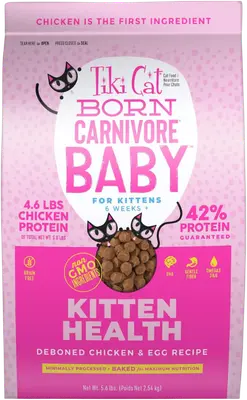
Best for: Owners specifically interested in a baked, chicken-focused kitten kibble.
Avoid if: Your kitten struggles with hard pieces, you need a budget option, or you cannot verify that the current package’s adequacy statement matches your kitten’s growth stage.
Tiki Cat earns the final position because its processing style is genuinely different. Born Carnivore Baby is described as gently baked kibble rather than a conventional dry-food option.
The formula starts with deboned chicken, chicken meal, dried egg product, chicken fat, and dehydrated chicken liver. It provides 42% minimum protein, 22% minimum fat, 0.1% DHA, and about 557 kcal per cup.
The pieces are small, but one detail matters: small does not mean soft. Several owners report that the kibble is harder than expected, including some who crush or moisten it for younger kittens.
Price is another major limitation. In our retailer snapshot, the 2.8-lb bag was among the most expensive foods per pound in the entire lineup.
Tiki markets the formula for kittens from 6 weeks onward. However, the exact nutritional adequacy statement for this specific Baby Chicken & Egg formula was not clearly available in the material we reviewed. Check the current package before relying on it as a kitten’s sole diet.
Pros
- Gently baked
- Deboned chicken first
- 42% protein and 22% fat
- DHA included
- Small pieces
Cons
- Very expensive
- Small pieces can still be hard
- Limited bag sizes
- Current nutritional-adequacy statement deserves confirmation
What to Look for in Kitten Dry Food
A bag can look impressive and still be difficult to compare with another formula. Instead of judging kitten kibble by one ingredient or one percentage, start with the information that tells you whether it actually fits a growing kitten.
Start With the Nutritional Adequacy Statement
For a dry food that will make up most or all of a kitten’s diet, check that it is a complete and balanced food appropriate for growth.
This is more useful than marketing terms such as “premium,” “natural,” or “high protein.”
Also be cautious with the phrase “AAFCO approved.” AAFCO does not individually approve bags of cat food. What matters is the nutritional adequacy statement explaining the life stage for which the food is formulated or substantiated.
If that statement is unclear, especially on a retailer page, check the current package or manufacturer information before relying on the food as your kitten’s main diet.
For a broader explanation of complete diets, wet foods, dry foods, and other kitten-feeding options, see our guide to choosing food for kittens.
Compare Calories With Protein and Fat
Protein matters during growth, but chasing the highest percentage is not a useful way to choose food.
Our seven picks range considerably in protein, fat, and calories. Tiki Cat, for example, lists 42% protein and 22% fat, while Hill’s Indoor Kitten lists 33% protein and 15% fat. Those numbers do not make one automatically better than the other.
Calorie density also changes how much food a kitten may need. Royal Canin’s formula provides far fewer calories per cup than some of the other foods in this roundup, so a cup-to-cup comparison can be misleading.
Use the feeding directions for the exact food you buy, then adjust according to your kitten’s age, growth, activity, and body condition with veterinary guidance when needed.
Check the Main Protein Sources and Known Sensitivities
Ingredient lists are most useful when you have a reason to look for or avoid something specific.
Several of our picks contain multiple animal proteins. Purina Pro Plan, for example, contains chicken along with poultry, egg, and fish ingredients. ORIJEN combines chicken, turkey, salmon, herring, egg, and other animal ingredients.
That variety may be perfectly acceptable for many kittens, but it can be inconvenient if a veterinarian is trying to identify a food sensitivity.
Similarly, grain-free does not automatically mean better. ORIJEN and Tiki Cat are grain-free, but both still need plant ingredients to make a workable dry kibble. ORIJEN uses several legumes, while Tiki Cat includes peas, chickpeas, and tapioca.
Choose based on your kitten’s actual needs rather than a front-of-bag claim.
Think About Kibble Size and Texture
Smaller kibble can be easier for young kittens to pick up, which is why IAMS earned our Best Small Kibble position.
But size and hardness are separate issues.
Tiki Cat’s pieces are small, yet several customers describe them as harder than expected. Some owners crush or moisten dry food while kittens are transitioning to firmer textures.
If your kitten repeatedly drops pieces, struggles to chew them, or avoids the food, consider whether the texture is appropriate rather than assuming the kitten simply dislikes the flavor.
Look at Bag Size, Storage, and Value
Price per bag can be deceptive.
A small premium bag may have a manageable sticker price while costing several times more per pound than a larger mainstream option. In our retailer snapshots, Kitten Chow had a major price advantage over Hill’s, Royal Canin, ORIJEN, and Tiki Cat.
Larger bags are not always the better purchase, though. If you have one small kitten, buying more food than you can keep fresh may erase part of the savings.
Keep dry food sealed in a cool, dry location and follow the manufacturer’s storage guidance.
Kitten Dry Food Safety and Quality Checklist
Before choosing or switching foods, check a few basics:
- Confirm that the exact formula is appropriate as a complete diet for kitten growth.
- Use the guaranteed analysis and feeding instructions for the current formula, not an old listing or similar recipe.
- Check for ingredients your kitten has been advised to avoid.
- Make sure the kibble size and texture are manageable.
- Store the bag tightly closed and away from heat and moisture.
- Keep clean, fresh water available at all times.
- Introduce a new food gradually rather than changing the whole diet overnight.
- Do not rely on retailer tags such as “veterinary diet” or “allergen-free” when they conflict with the actual label.
- Monitor appetite, stool quality, body condition, and growth rather than assuming a highly rated food will suit every kitten.
Contact your veterinarian if your kitten has persistent vomiting or diarrhea, poor appetite, difficulty gaining weight, suspected food reactions, or another health condition that may affect diet choice.
Is Dry Food Good for Kittens?
Yes. Dry food can be suitable for kittens when it is a complete and balanced diet appropriate for growth.
Kibble is convenient to store, relatively easy to portion, and can work well in measured meals or compatible automatic feeders. Dry food is also calorie-dense, which can be useful during a stage when kittens have substantial energy needs.
The major practical difference from wet food is moisture. Kibble contains much less water, so fresh drinking water should always be available.
There is no need to treat wet and dry food as opposing camps. Some kittens eat only an appropriate dry diet, while others eat wet food or a combination of both.
Dry vs. Wet Kitten Food
Neither format automatically wins for every kitten.
When Dry Food Can Be Practical
Kitten kibble may work particularly well when you want:
- easy storage;
- measured portions;
- a larger bag for a multi-kitten household;
- food compatible with some automatic feeders;
- a lower cost per serving than many canned diets.
Dry food also stays usable in a bowl longer than wet food, although it should still be kept fresh and protected from contamination.
When Wet Food May Be Useful
Wet food provides much more moisture and has a softer texture that some young kittens find easier to manage. It can also appeal to kittens that are less interested in crunchy food.
If you are comparing canned options, our best wet kitten food guide covers complete-and-balanced wet formulas separately.
You do not need to choose one format exclusively if a mixed approach works better for your kitten.
How Much Dry Food Should You Feed a Kitten?
There is no reliable universal number of cups that works across every kitten dry food.
The right amount depends on:
- your kitten's age;
- current weight;
- expected adult size;
- activity level;
- body condition;
- calories per cup in the specific food;
- whether wet food or treats are also being fed.
That last point matters. Purina Pro Plan in our roundup provides about 562 kcal per cup, while Royal Canin lists about 367 kcal per cup. Feeding the same volume of both would not provide the same amount of energy.
Start with the manufacturer’s feeding guide for the exact formula and monitor your kitten’s condition and growth.
If your kitten is underweight, growing poorly, becoming overweight, or has a medical condition, ask your veterinarian to help determine an appropriate intake.
When Can Kittens Start Eating Dry Food?
Kittens usually begin experimenting with solid foods during weaning.
Some dry-food manufacturers provide instructions for offering kibble moistened with warm water during this period. Purina, for example, notes that kittens may start nibbling moistened food at around 3 to 4 weeks and typically eat dry or moistened food after weaning.
That does not mean every young kitten is ready for hard kibble at exactly the same age.
Texture matters. A kitten moving from milk or soft food may find moistened kibble easier initially. Always follow age-appropriate feeding guidance, particularly for very young, orphaned, or medically fragile kittens.
How to Get a Kitten to Eat Dry Food
If your kitten will eat wet food but ignores kibble, avoid trying to force a sudden switch.
A few practical approaches can help:
- Introduce the new dry food gradually alongside the food your kitten already accepts.
- Try adding a small amount of warm water to soften the pieces during the transition.
- Use fresh kibble rather than food that has been sitting exposed for long periods.
- Make sure the pieces are not too large or difficult for your kitten to chew.
- Offer meals in a quiet location away from litter boxes and other pets that may create competition.
Palatability varies considerably. A product with thousands of positive reviews can still be rejected by an individual kitten.
If a kitten consistently refuses food or eats very little, particularly when accompanied by lethargy, vomiting, diarrhea, or poor growth, contact a veterinarian rather than repeatedly changing foods.
Can You Mix Wet and Dry Kitten Food?
Yes. Wet and dry kitten foods can be used together when the total diet remains appropriate for growth.
The main mistake is adding a full serving of wet food on top of the full recommended dry-food amount. That can result in more calories than intended.
Instead, treat both foods as parts of the same daily intake.
For example, if you introduce a wet meal, reduce the amount of dry food accordingly rather than simply adding calories.
When changing either component of the diet, transition gradually and monitor tolerance.
Frequently Asked Questions
What Is the Best Dry Kitten Food?
For this roundup, Purina Pro Plan Complete Essentials Kitten Chicken & Rice is our Best Overall dry kitten food because it offers a strong balance of growth-focused nutrition, DHA, live probiotics, calorie density, multiple bag sizes, and good retailer availability.
That does not make it the best choice for every household. Kitten Chow offers substantially better budget value, IAMS is especially useful for small kibble, and Hill’s has a more specific indoor-kitten position.
Can a Kitten Eat Dry Food?
Yes, provided the food is appropriate for the kitten’s growth stage and the kitten can comfortably eat the texture.
Very young kittens transitioning to solid food may initially do better with moistened kibble.
Should I Feed My Kitten Wet or Dry Food?
Either can work when the food is complete and balanced for kitten growth.
Dry food offers convenience and usually lower moisture, while wet food provides substantially more water and a softer texture. Many owners use both.
The broader decision is covered in our food for kittens guide.
Should I Feed My Kitten Wet and Dry Food?
You can feed both.
Just account for the calories in each food rather than feeding the full recommended portion of both at the same time.
How Much Dry Food Should a Kitten Eat?
Use the feeding chart on the exact food as your starting point.
Amounts differ because calorie density varies considerably between recipes. Age, weight, body condition, activity, and wet-food intake also change how much a kitten may need.
How Old Should a Kitten Be to Eat Dry Food?
Kittens begin transitioning to solid food during weaning, but hard kibble may not be suitable immediately.
Some formulas can be softened with warm water while kittens learn to eat solid food. Follow the food’s directions and veterinary guidance for very young kittens.
When Should I Switch My Kitten to Dry Food?
There is no need to switch exclusively to dry food if your kitten is already doing well on an appropriate wet or mixed diet.
If you are introducing kibble, do so gradually during the solid-food transition or when changing from another kitten food.
How Do I Get My Kitten to Eat Dry Food?
Introduce it slowly, serve it fresh, and consider moistening it at first. A smaller kibble size may also help.
Do not withhold appropriate food in an attempt to force a kitten to accept a particular kibble.
Should Kitten Dry Food Be Grain-Free?
Not automatically.
Grain-free food can still contain peas, lentils, chickpeas, or other carbohydrate sources. What matters more is whether the complete formula is appropriate for kitten growth and suits your individual kitten.
If you specifically want to compare formulas without grains, see our grain-free kitten food guide, where we compare those options without treating grain-free as automatically healthier.
Can Kittens Eat Adult Dry Cat Food?
Adult-maintenance food is not automatically appropriate for kitten growth.
Look for a nutritional adequacy statement covering growth or another life stage that includes growing kittens. If you are unsure whether a specific adult-looking formula is suitable, check the manufacturer information or ask your veterinarian.
Does Kitten Kibble Need to Be Small?
Not necessarily, but manageable pieces can make eating easier for young kittens.
Small kibble is still dry and can be firm, so texture matters as much as diameter.
When Should a Kitten Switch to Adult Cat Food?
Many standard kitten diets are intended through roughly the first year, but the exact timing can depend on the food, the cat’s development, and breed or individual needs.
Use the manufacturer’s life-stage guidance and ask your veterinarian if your kitten is growing unusually quickly or slowly or has special nutritional needs.
Is Kitten Food AAFCO Approved?
“AAFCO approved” is not the right term.
AAFCO establishes nutrient profiles and model regulations, but it does not individually approve commercial cat foods. Look instead for the food’s nutritional adequacy statement, which tells you the life stage the diet is intended to support.
Final Verdict: Which Kitten Dry Food Should You Choose?
The best kitten dry food depends on what you actually need from the bag.
Purina Pro Plan Complete Essentials Kitten Chicken & Rice is our Best Overall pick because it combines strong growth-focused nutrition, DHA, probiotics, useful calorie information, and several bag sizes without reaching the extreme price of the specialist options.
For tighter budgets, Purina Kitten Chow Year One Essentials offers much stronger cost-per-pound value. For indoor kittens, Hill’s Science Diet Indoor Kitten has a more specific use case and strong feeding-test documentation. Owners specifically seeking a very high proportion of animal ingredients may prefer ORIJEN Kitten, provided the higher price and complex recipe make sense for their kitten.
Whichever food you choose, check the current nutritional adequacy statement, transition gradually, provide fresh water, and use your kitten’s growth and individual tolerance—not marketing claims—as the final guide.