Choosing grain free kitten food is not as simple as finding a bag or can with “grain free” on the front. The food still needs to provide complete nutrition for growth, enough energy for a developing kitten, and a formula your kitten can actually eat and tolerate.
Just as importantly, grain free does not automatically mean healthier, lower in carbohydrates, easier to digest, or better for food allergies. In dry foods especially, grains may simply be replaced with ingredients such as peas, lentils, chickpeas, or tapioca.
For this roundup, we compared six grain free wet and dry foods using growth suitability, nutritional information, ingredient profile, availability, value, and recurring customer feedback rather than rewarding the grain free label itself.
If you are not specifically looking for grain free food, our broader guide to the best food for kittens covers more wet and dry options.
Affiliate disclosure: LumaPaw may earn a commission if you purchase through links on this page, at no extra cost to you. Our product positions are based on product information, retailer data, customer feedback, and comparison with similar options—not paid placement or personal testing.
Best Grain Free Kitten Food at a Glance
ORIJEN Kitten — Best Overall
Format: Dry
Best for: Owners who want a nutrient-dense dry formula with detailed nutritional disclosure
Main limitation: Expensive and built around multiple animal proteins plus several legumes
Purina Pro Plan Development Chicken Entrée — Best Wet Food With Feeding-Trial Evidence
Format: Wet pâté
Best for: Owners who prioritize feeding-trial evidence for kitten growth
Main limitation: Costs considerably more than Purina ONE and uses generically named meat by-products
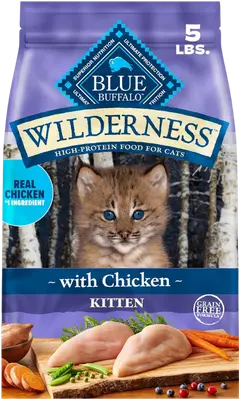
Blue Buffalo Wilderness Kitten Chicken — Best Small-Bag Dry Option
Format: Dry
Best for: Trying a grain free kibble without committing to a large bag
Main limitation: Pea protein and tapioca starch appear high in the ingredient list
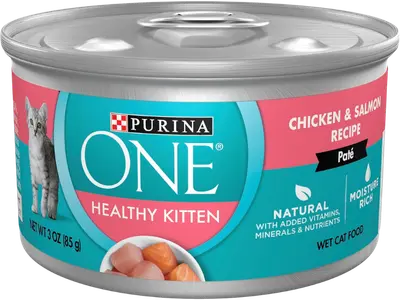
Purina ONE Healthy Kitten Chicken & Salmon — Best Value Wet Food
Format: Wet pâté
Best for: Owners wanting a more affordable grain free wet food with broad retailer availability
Main limitation: Firm texture and a multi-animal-protein recipe that includes pork lungs
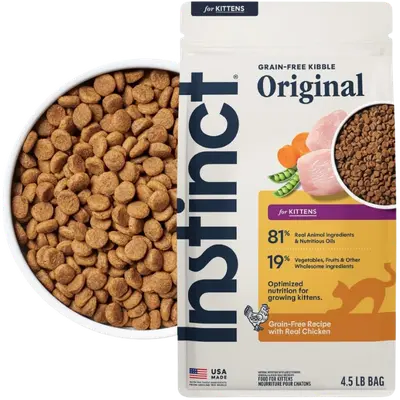
Instinct Original Kitten — Best Raw-Coated Kibble
Format: Dry, raw-coated kibble
Best for: Owners specifically interested in freeze-dried raw-coated dry food
Main limitation: Complex protein mix and less consistent palatability than our top dry choices
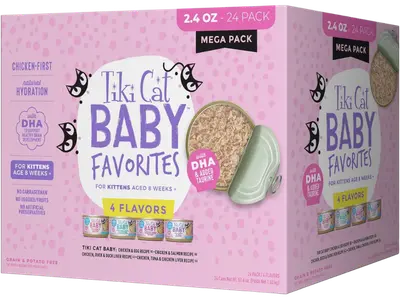
Tiki Cat Baby Whole Foods Variety Pack — Best Wet Variety Pack
Format: Wet shreds
Best for: Trying several flavors and shredded textures
Main limitation: Expensive, and digestive-tolerance complaints appear more often than with the other wet finalists
How We Chose the Best Grain Free Kitten Food
Growth suitability came first
A food did not earn a place simply because it excluded grains.
Our first question was whether it was appropriate as a kitten diet. We prioritized formulas intended for growth and looked for meaningful nutritional information such as protein, fat, calories, DHA, taurine, calcium, and phosphorus when manufacturers disclosed them.
We also treated nutritional adequacy more seriously than front-of-package claims such as “natural,” “premium,” or “high protein.”
We checked what replaced the grains
Grain free dry foods still need ingredients that help create a stable kibble.
That can mean:
- peas
- lentils
- chickpeas
- beans
- tapioca
- potatoes or other starches
Those ingredients are not automatically bad. But owners deserve to know that “grain free” does not mean “plant-free” or “carb-free.”
We compared practical fit, not just nutrient numbers
A kitten food can look impressive on paper and still be inconvenient if the only bag is large, the texture is frequently rejected, or the food is difficult to find.
We considered:
- wet versus dry format
- package size
- calorie density
- texture or kibble characteristics
- price relative to similar options
- recurring complaints
- strength of the customer-feedback evidence
Grain free status did not improve a product's score by itself
This is important.
These foods are here because they are grain free and suitable candidates for growing kittens, not because we believe removing grains automatically improves a kitten’s diet.
The 6 Best Grain Free Kitten Foods

ORIJEN Kitten — Best Overall
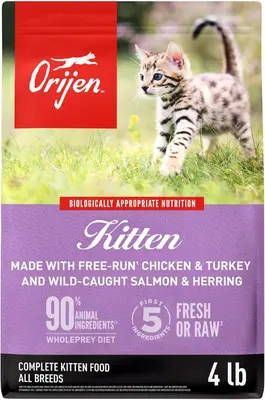
Best for: Owners seeking a premium grain free dry food with strong nutrient transparency.
Avoid if: You want a simple protein profile, want to minimize legumes, or need a lower-cost daily kibble.
Honest buying note: ORIJEN is our Best Overall pick, but that does not make it the right choice for every kitten. A wet-food household may find Purina Pro Plan more practical.
ORIJEN is our strongest overall choice because it combines a kitten-specific formula with unusually detailed nutrient disclosure and a strong animal-protein presence at the beginning of the ingredient list.
The guaranteed analysis includes 40% protein, 20% fat, 0.4% DHA, 1.4% calcium, and 1.0% phosphorus, with about 515 calories per cup. The formula uses animal ingredients including chicken, turkey, salmon, herring, and liver.
That does not mean the recipe is meat-only. Lentils, beans, chickpeas, and peas are also part of the formula, which matters for anyone choosing grain free because they want to minimize legumes.
Customer feedback is strong overall. In the research we collected, Amazon showed 4.7/5 from 978 ratings and Chewy 4.6/5 from 689 ratings. Positive themes included palatability and ingredient satisfaction, while the clearest negatives were price and a minority of digestive complaints such as loose stools or vomiting.
Pros
- Detailed DHA, calcium, and phosphorus disclosure
- Multiple named animal ingredients
- High calorie density for a dry kitten food
- Available in 4- and 7-lb bags
- Strong retailer feedback
Cons
- Expensive
- Contains several legumes
- Complex multi-protein formula

Purina Pro Plan Development Chicken Entrée — Best Wet Food With Feeding-Trial Evidence
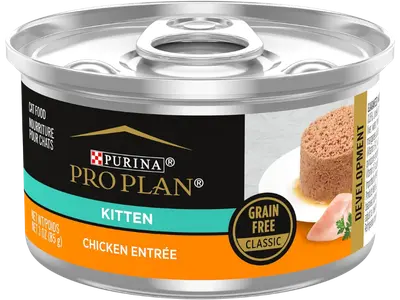
Best for: Owners prioritizing evidence for kitten growth in a wet grain free formula.
Avoid if: You prefer only specifically named animal ingredients or need a lower-cost everyday wet food.
Honest buying note: Its strongest reason for inclusion is the feeding evidence, not a claim that Pro Plan is inherently healthier because it is grain free.
Purina Pro Plan stands out for a reason that is more useful than marketing language: the product information we reviewed states that AAFCO feeding tests substantiate complete and balanced nutrition for kitten growth.
This grain free pâté starts with chicken and provides 12% protein, 6% fat, 0.01% DHA, and about 112 calories per 3-ounce can.
The formula also contains liver, meat by-products, and fish. That gives it less ingredient-source specificity than foods that name every animal ingredient, and the presence of artificial and natural flavors may matter to some buyers.
Customer feedback was generally favorable, with particularly positive comments around nutrition, texture, and palatability. The main recurring complaints were the cost, occasional oily or gelatinous consistency, and some kittens losing interest over time.
Pros
- Feeding-trial evidence for kitten growth
- Chicken is the first ingredient
- Guaranteed DHA
- Calorie-dense for a 3-ounce wet food
Cons
- More expensive than Purina ONE
- Generic meat by-products
- Artificial and natural flavors

Blue Buffalo Wilderness Kitten Chicken — Best Small-Bag Dry Option
Best for: Owners who want to test a grain free dry kitten food before committing to a bigger bag.
Avoid if: Minimizing plant-derived protein or starch is a priority.
Blue Buffalo is one of the easiest dry foods here to try without buying a large bag first.
It comes in 2-, 4-, and 5-pound sizes, giving owners more flexibility than most of the other dry finalists.
The formula provides 40% protein, 20% fat, 0.2% DHA, 1.5% calcium, and 1.2% phosphorus, at around 457 calories per cup.
Chicken and chicken meal are the first two ingredients. However, pea protein and tapioca starch are third and fourth.
That is worth knowing because the grain free label can make a dry food sound more meat-focused than the ingredient list actually shows.
Blue also has the largest retailer-feedback base in this roundup: the data we collected showed roughly 8,940 Amazon ratings and 2,074 Chewy ratings, both with high overall scores.
Pros
- Convenient 2-lb trial size
- Strong DHA, calcium, and phosphorus disclosure
- Very large customer-review base
Cons
- Pea protein appears high in the ingredient list
- Tapioca is another prominent grain replacement
- Less calorie-dense than ORIJEN and Instinct

Purina ONE Healthy Kitten Chicken & Salmon — Best Value Wet Food
Best for: Owners seeking an affordable grain free wet kitten food from a widely available brand.
Avoid if: Your kitten must avoid pork or does best with softer, more liquid wet-food textures.
Honest buying note: Persistent diarrhea, vomiting, itching, or suspected food allergy deserves veterinary attention rather than repeated trial-and-error food switching.
ONE is the value pick because it keeps the essentials strong without moving into the higher price tier of Pro Plan or Tiki Cat.
The current formula provides 11% protein, 6.5% fat, and about 105 calories per 3-ounce can. Chicken is the first ingredient, followed by liver, chicken broth, pork lungs, and salmon.
That ingredient list also creates an important limitation: this is not simply a chicken-and-salmon food. It is a multi-animal-protein recipe and is unsuitable for a kitten that needs to avoid pork.
A useful advantage is Chewy’s smaller four-can option, which lets owners test acceptance before buying a full case.
Customer feedback was strong overall, but the pâté texture comes up repeatedly. Some owners describe it as firm or relatively dry, especially after refrigeration. Digestive tolerance is also not universal.
Pros
- Strong value relative to the other wet finalists
- Chicken first
- Smaller trial-size purchase available through Chewy
- Strong review volume
Cons
- Contains pork lungs
- Limited recipe variety
- Firm pâté texture

Instinct Original Kitten — Best Raw-Coated Kibble
Best for: Owners specifically looking for a grain free raw-coated kitten kibble.
Avoid if: Your kitten is very selective or needs a simpler ingredient profile.
Honest buying note: Check the current package ingredient list before purchase if the exact freeze-dried protein source matters to you.
Instinct is the most specialized dry choice in the roundup.
Its kibble is coated with freeze-dried raw material, giving it a genuinely different format rather than another small variation on standard grain free kibble.
The current nutritional information we reviewed lists 42.5% protein, 22.5% fat, 0.2% DHA, and about 557 calories per cup—the highest protein, fat, and calorie density among our three dry finalists.
The recipe is also complex. It includes several animal proteins, including chicken, turkey, fish, egg, and lamb sources.
Customer response is generally positive, but palatability is less consistent than with ORIJEN or Blue Buffalo. Complaints include strong smell, food refusal, kibble-size variation, and difficult transitions for some kittens.
Pros
- Freeze-dried raw-coated kibble
- 42.5% protein
- 22.5% fat
- Highest calorie density among our dry picks
- Includes DHA and probiotics
Cons
- Complex multi-protein formula
- Some kittens refuse it
- Strong smell
- Retailer ingredient listings have shown a discrepancy in the exact freeze-dried coating ingredients

Tiki Cat Baby Whole Foods Variety Pack — Best Wet Variety Pack
Best for: Kittens that tolerate recipe rotation and owners who want to test several wet-food flavors.
Avoid if: Your kitten does best with one consistent formula or already has recurring digestive problems.
Tiki Cat Baby is the most useful choice for owners who want to try several wet recipes rather than committing to 24 cans of one flavor.
The pack includes four recipes:
- Chicken & Egg
- Chicken & Salmon
- Chicken, Duck & Duck Liver
- Chicken, Tuna & Chicken Liver
The recipes provide roughly 15% protein, with fat generally between 5% and 6%, plus disclosed taurine and calcium/phosphorus values that vary by recipe.
The shredded texture is also different from the Purina pâtés.
There are two important cautions.
First, all four recipes still contain chicken. This variety pack is therefore not useful for avoiding chicken.
Second, digestive complaints appear more noticeably in the customer feedback than they do for our other wet finalists. Several independent reviews describe loose stools or diarrhea. That does not prove the food causes digestive illness in kittens generally, but it is a pattern worth disclosing.
Pros
- Four different recipes
- Shredded wet texture
- Named animal proteins
- Useful for exploring flavor preferences
Cons
- Relatively expensive
- Smaller 2.4-oz cans
- All recipes contain chicken
- More digestive-tolerance complaints than the other wet finalists
- Some complaints about uneven flavor ratios or can fill levels
Is Grain Free Kitten Food Good for Kittens?
It can be. But that is different from saying grain free food is better for kittens.
A kitten still needs a diet that provides appropriate nutrition for growth. Whether the recipe contains rice, oats, peas, chickpeas, or tapioca does not tell you by itself whether the diet is nutritionally suitable.
What does grain free actually mean?
In practical terms, grain free foods exclude grains such as wheat, corn, rice, barley, or oats.
They may still contain other sources of carbohydrate.
For example:
- ORIJEN uses legumes including lentils, beans, chickpeas, and peas.
- Blue Buffalo uses pea protein and tapioca starch.
- Instinct uses peas and tapioca.
This is why “grain free” and “low carbohydrate” should not be treated as interchangeable claims.
Do kittens need grain free food?
Most kittens do not need a grain free diet simply because they are kittens.
Some owners choose one because of personal preference or veterinary guidance. But if you suspect a food allergy, intolerance, chronic diarrhea, vomiting, itching, or another health problem, changing to an arbitrary grain free diet is not a substitute for veterinary assessment.
Grain free also does not mean hypoallergenic. Several foods in this roundup contain chicken, fish, egg, pork, or multiple animal proteins.
How to Choose Grain Free Kitten Food
Check growth suitability first
Start with the nutritional adequacy statement rather than the large marketing claims on the front.
A food used as the main diet should be complete and appropriate for kitten growth.
Do not look for the phrase “AAFCO approved.” The useful information is the nutritional adequacy statement explaining the life stage for which the food is intended.
Compare protein, fat, and calories together
The product with the highest crude-protein percentage is not automatically the best.
Growing kittens also need sufficient energy and fat, and the food has to be eaten in realistic quantities.
Remember that wet and dry protein percentages cannot be compared directly without accounting for their very different moisture levels.
Look at what replaces the grains
This matters most with kibble.
If a food removes rice or corn but adds peas, lentils, chickpeas, or tapioca, that does not make the formula automatically better or worse. It simply tells you what the recipe is using instead.
Ingredient order can provide useful context.
Check the animal proteins
This is especially important if you are trying to avoid a particular ingredient.
For example:
- ORIJEN uses several poultry and fish proteins.
- Instinct is another complex multi-protein formula.
- Purina ONE contains chicken, liver, pork lungs, and salmon.
- Every Tiki Cat Baby recipe in this pack contains chicken.
A grain free kitten formula can still be a poor fit for a kitten with a known reaction to one of its animal proteins.
Grain Free Wet vs Dry Kitten Food
Neither format is automatically the better choice.
Grain free wet food
Wet food provides much more moisture and comes in textures such as pâté or shreds.
It may work well for kittens that prefer softer foods, but it tends to cost more per feeding and unused portions need refrigeration.
For a broader comparison beyond grain free formulas, see our guide to the best wet kitten food.
Grain free dry food
Dry kitten food is easier to store, usually more calorie-dense per ounce, and convenient for measuring and feeding.
The tradeoff is lower moisture, and grain free kibbles frequently use legumes or starches to create their structure.
Our kitten dry food guide compares grain-inclusive and grain free kibble options without treating either category as automatically superior.
Grain Free Kitten Food Safety & Quality Checklist
Before making a grain free food your kitten’s main diet:
- Confirm that it is a complete food appropriate for kitten growth.
- Read the current ingredient list rather than relying only on retailer filters.
- Check all animal proteins if your kitten has a known dietary restriction.
- Do not assume “natural,” “premium,” “whole foods,” or “raw-coated” proves superior nutrition.
- Transition gradually instead of changing foods overnight.
- Follow feeding guidance as a starting point and monitor your kitten's body condition.
- Watch for persistent vomiting, diarrhea, poor appetite, itching, or poor growth.
Contact your veterinarian if symptoms persist, if your kitten has a diagnosed health condition, or if you are choosing grain free food because you suspect an allergy or intolerance.
Frequently Asked Questions
What is grain free kitten food?
Grain free kitten food is a kitten-appropriate food made without grains such as wheat, corn, rice, oats, or barley.
It can still contain ingredients such as peas, lentils, chickpeas, potatoes, or tapioca. Grain free describes what is excluded; it does not tell you whether the overall diet is nutritionally superior.
Are there any benefits to grain free kitten food?
The main practical benefit is that it gives owners who specifically want or need to avoid grains an appropriate product category.
There is no good reason to assume a healthy kitten will benefit simply because grains were removed. The quality and growth suitability of the full diet matter more.
What is a grain free dry kitten food?
It is a dry kibble formulated without grains and suitable for kittens.
Because kibble needs structure, grain free dry foods often use ingredients such as peas, lentils, chickpeas, or tapioca instead. ORIJEN, Blue Buffalo Wilderness, and Instinct are examples in this roundup.
Why would someone choose grain free kitten food?
Some owners choose it because of personal feeding preferences, advice from a veterinarian, or the need to avoid a specific ingredient.
The important mistake to avoid is assuming grain free automatically means allergy-friendly, healthier, or lower in carbohydrates.
Is grain free kitten food better for sensitive stomachs?
Not necessarily.
A kitten may react to a particular animal protein, fat level, ingredient combination, rapid diet change, or something unrelated to food. Grain-free status by itself does not make a food a sensitive-stomach diet.
If vomiting, diarrhea, or appetite problems keep returning, talk to your veterinarian rather than repeatedly switching foods.
Is Fancy Feast kitten food grain free?
It depends on the exact current recipe. Product formulas can differ, so do not assume the entire Fancy Feast kitten line is grain free based on one flavor or retailer category.
Check the ingredient list and nutritional adequacy statement on the specific can you are considering.
Final Verdict: Which Grain Free Kitten Food Should You Choose?
For owners specifically shopping for grain free kitten food, ORIJEN Kitten is our Best Overall pick because of its strong growth-focused nutrient disclosure, animal-protein profile, and solid retailer evidence.
For wet food, Purina Pro Plan Development Chicken Entrée has the clearest feeding-trial evidence, while Purina ONE Healthy Kitten offers the stronger value proposition.
The grain free label should still be treated as a dietary characteristic—not a guarantee of better nutrition. Choose based on your kitten’s growth needs, preferred format, tolerance, ingredient restrictions, and budget.
If grain free is not a specific requirement, compare it with other complete options in our guide to food for kittens.