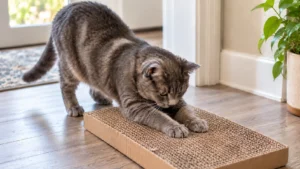
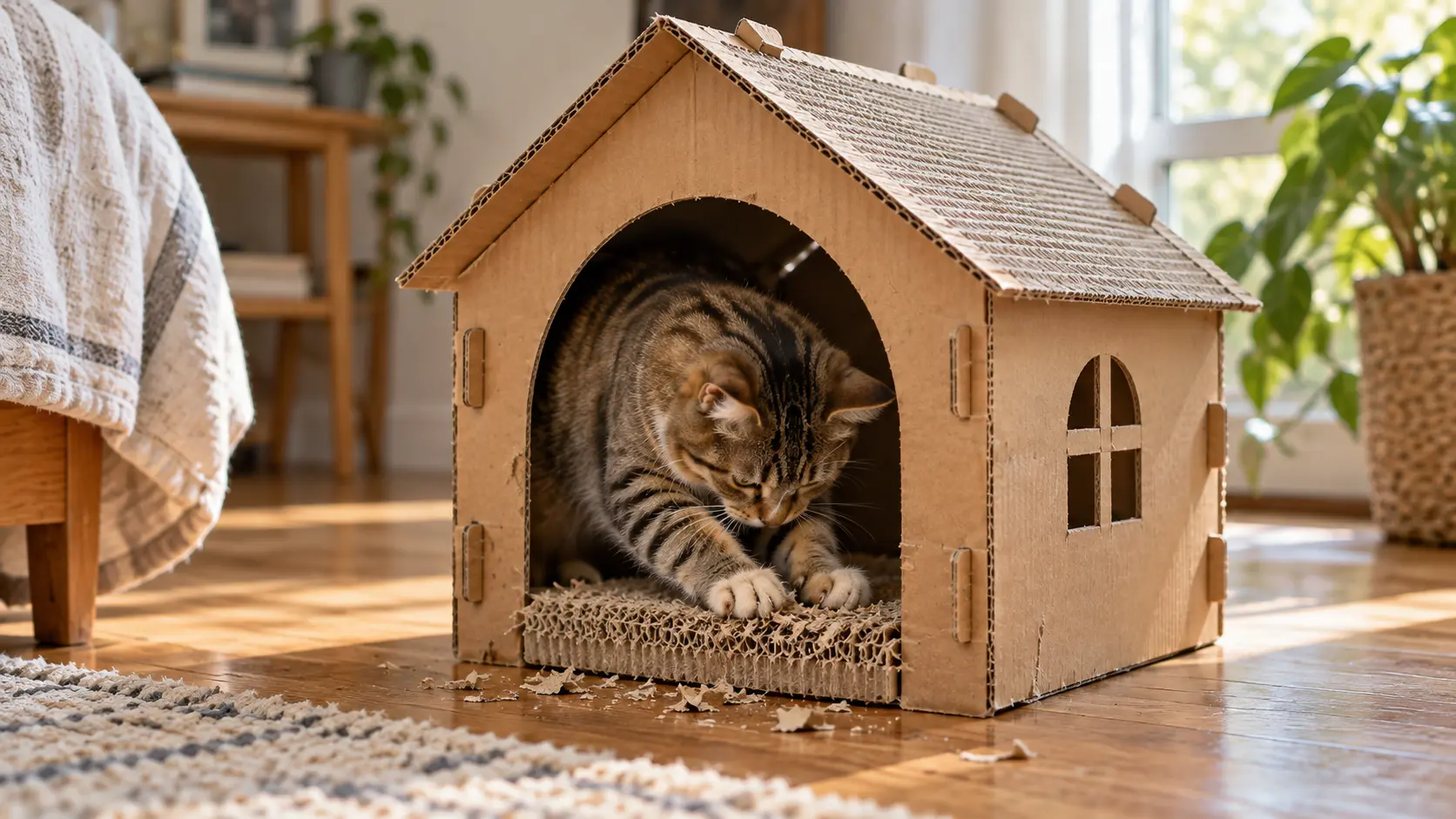
A cat scratcher house gives your cat two things in one spot: somewhere to hide or rest and a cardboard surface to scratch. Some are simple cottages with a scratching pad on the floor. Others have ramps, upper levels, and several places to dig in their claws.
The challenge is finding one that suits your cat. A house might look spacious in photographs but have a narrow entrance. Another may offer several scratching areas, yet its cardboard supports wear out before the pads do.
We compared five cat scratcher houses using product specifications, scratching layouts, replacement options, and customer feedback. The aim is to help you choose something your cat can comfortably use—not just a cardboard house that looks cute in the living room.
Affiliate disclosure: This article contains affiliate links. LumaPaw may earn a commission if you purchase through them, at no additional cost to you.
Cat Scratcher Houses at a Glance
These five options cover different scratching preferences, from enclosed floor pads to angled ramps and multi-level cardboard condos.
Cat Scratcher House |
Exterior Dimensions |
Scratching Design |
Replacement Pads |
|---|---|---|---|
Frisco Tudor House |
16.5 × 16.5 × 20.01 in |
Interior floor pad |
Yes |
FurHaven Tiger Tough Farmhouse |
27.5 × 16.5 × 31 in |
Multiple scratching areas and upper deck |
Not confirmed |
Tiger Tough Townhouse |
26 × 20 × 26 in |
Interior scratcher and angled ramp |
Not confirmed |
FUKUMARU SH02 |
16.93 × 11.81 × 14.57 in |
Angled and interior scratching surfaces |
Not confirmed |
ASPCA Cardboard Cottage |
19 × 13 × 17 in |
Interior floor pad |
Not confirmed |
Dimensions are based on the specified product listings and describe the outside of each structure, not the usable interior. The ASPCA measurements refer specifically to Amazon ASIN B07VGTY417.
The Frisco Tudor stands out for its confirmed replacement pads. FurHaven’s Farmhouse offers more levels and scratching areas, while the Townhouse adds an angled ramp. FUKUMARU takes a smaller, more open approach. ASPCA provides a traditional fold-flat cardboard cottage.
A larger house isn’t automatically a better one. Consider where your cat likes to scratch and whether there’s enough room to enter, turn around, and settle down.
How We Researched These Cat Scratcher Houses
We compared product details from Amazon, Chewy, and available manufacturer information, paying particular attention to dimensions, materials, scratching surfaces, assembly, and replacement parts.
Customer feedback helped identify problems that don’t always appear in product descriptions. These included cardboard tabs coming loose, scratch pads wearing out, difficult assembly, restricted entrances, and damage to elevated sections.
We also compared similar models rather than selecting several houses simply because they have different decorations. Products with a distinct scratching layout or practical ownership advantage received more consideration.
LumaPaw has not personally tested these houses. Our assessments are based on published product information, retailer listings, and customer experiences. Reports of long-lasting construction or early damage are treated as buyer experiences, not verified performance guarantees.
Prices and availability can change, so check the selected product version before purchasing.
Best Cat Scratcher Houses Reviewed

Frisco Tudor House Cardboard Cat House
Best for: Cats that enjoy horizontal scratching and enclosed resting spaces, especially when owners want replaceable pads.
Avoid if: Your cat destroys cardboard quickly, needs a particularly spacious hideaway, or frequently jumps onto lightweight furniture.
Buying note: If your cat tends to wear out scratching pads while leaving the surrounding structure intact, the Tudor’s replacement system is a meaningful reason to consider it over similarly priced cottages.
The Frisco Tudor is a sensible starting point for anyone who wants a traditional cat cardboard house without unnecessary extras.
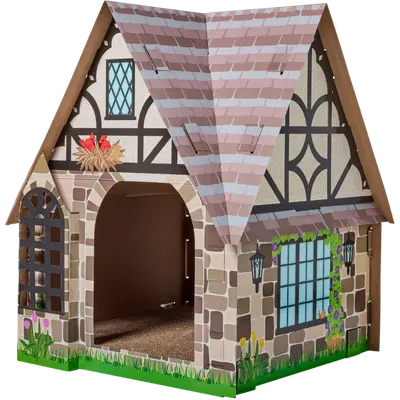
Its pitched roof and printed stone-and-timber exterior make it look like a small cottage, but the useful part is inside: a horizontal corrugated scratching pad where a cat can scratch, sit, or curl up.
The house measures 16.5 × 16.5 × 20.01 inches and has two entrances. That gives cats another way out instead of forcing them to use a single doorway.
The strongest practical feature is the replacement option. Chewy lists the Frisco Cat House Cat Scratcher Toy Refill, item 2257870, as compatible with the Tudor House.
That’s important because the scratching surface may wear out long before the rest of the structure. Being able to purchase a fresh insert avoids automatically replacing the entire house.
Customer feedback is generally positive about cats using the Tudor for both scratching and sleeping. Some owners describe months of use, although others report faster wear from cats that chew or scratch aggressively.
Loose cardboard tabs and limited space for certain larger cats also appear in reviews. The exterior height shouldn’t be mistaken for unrestricted interior room beneath the sloped roof.
Product snapshot
- Material: Cardboard and paper
- Design: Single-story enclosed house
- Scratching surface: Interior corrugated pad
- Assembly: Required
- Replacement: Compatible Frisco scratching inserts
Pros
- Confirmed replacement scratching pads
- Two entrances
- Combines scratching and enclosed resting space
- Straightforward design with relatively few levels to maintain
Cons
- Cardboard panels can loosen or deteriorate
- May feel cramped for long-bodied cats
- Not intended as a dependable elevated perch

FurHaven Tiger Tough Farmhouse Playground
Best for: Cats that enjoy cardboard play structures, exploring enclosed spaces, and using scratching surfaces at different levels.
Avoid if: Your cat makes forceful jumps onto furniture, frequently chews cardboard supports, or needs a reliably weight-rated climbing platform.
Buying note: The extra features make this appealing, but they’re only worthwhile if your cat will use them. For a cat that mostly sleeps in boxes and scratches the floor, a simpler house may be better value.
Product snapshot
- Material: Corrugated cardboard
- Design: Multi-level farmhouse with an upper deck
- Scratching surfaces: Multiple integrated areas
- Extras: Catnip and hanging toys
- Replacement scratchers: Not confirmed as separately available
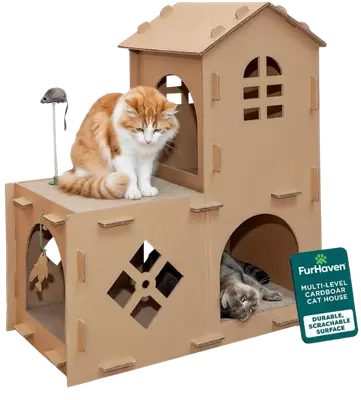
The FurHaven Tiger Tough Farmhouse offers more than a small cardboard hideaway. It’s a multi-level structure with different places to scratch, rest, and investigate.
Measuring approximately 27.5 × 16.5 × 31 inches, it has a larger overall footprint and considerably more height than the Tudor. Its layout combines a lower enclosed area with an upper house and deck.
The corrugated scratching sections are integrated into different parts of the structure. FurHaven also includes catnip and hanging toys, and the plain cardboard exterior can be decorated.
This model makes more sense for a cat that enjoys investigating different levels than one that simply wants a quiet box to sleep in.
Customer reviews describe cats scratching on different surfaces, lounging downstairs, and playing around the upper level. Some owners report extended use, even in multi-cat households.
The drawbacks deserve equal attention.
Several buyers describe confusing assembly instructions or cardboard tabs becoming damaged. Others report chewing-related deterioration and, in some cases, elevated sections collapsing after cats jumped onto them.
The opening between levels can also reduce usable upper-floor space. A large overall house doesn’t necessarily mean every compartment will comfortably accommodate a large cat.
Pros
- Several scratching positions
- Multiple hiding and resting areas
- Included toys and catnip
- More opportunities for exploratory play than a basic cottage
Cons
- More complicated assembly
- Cardboard supports require regular inspection
- No confirmed routine replacement scratch pads
- Upper sections are not a substitute for load-rated cat furniture

Tiger Tough Townhouse Playground Corrugated Cat Scratcher
Best for: Cats that prefer angled scratching and also enjoy exploring cardboard hideaways.
Avoid if: Your cat rapidly wears through cardboard ramps or needs a larger, reliably supported elevated resting area.
Buying note: Compared with FurHaven’s Farmhouse, choose the Townhouse for its angled ramp—not simply because it has two levels. That scratching surface is its most useful distinction.
Product snapshot
- Material: Corrugated cardboard
- Design: Two-level townhouse with an exterior ramp
- Scratching surfaces: Angled ramp and lower interior
- Assembly: Required, without tools
- Replacement pads: Not confirmed as available
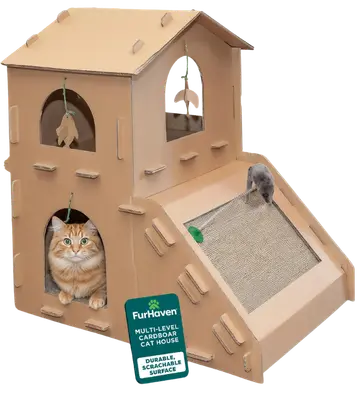
The Tiger Tough Townhouse looks similar in concept to the Farmhouse, but its scratching arrangement is quite different.
An angled corrugated ramp runs down the front of the structure, giving cats a sloping surface to scratch. There’s also scratching space in the lower compartment, with enclosed resting areas on two levels.
The entire structure measures approximately 26 × 20 × 26 inches. Its unfinished cardboard exterior can be customized, and the package includes catnip and hanging toys.
The ramp is the main reason to consider this model.
Cats that already enjoy scratching angled cardboard may find the sloped surface appealing. It also provides an alternative to houses where scratching takes place only on a flat floor.
Customer feedback includes reports of regular scratching, sleeping inside, and cats moving between compartments. Some owners describe long periods of use.
However, replacement support is a notable limitation. Buyers have reported the ramp wearing out while the rest of the house remains usable. Chewy’s product-specific information does not confirm separately available replacement inserts.
Assembly experiences are mixed, too. Some owners find the pieces straightforward to connect, while others report loose flaps, confusing instructions, or damaged cardboard.
Because the upper level is part of a lightweight cardboard structure, it shouldn’t be treated as a proven heavy-duty perch.
Pros
- Dedicated angled scratching ramp
- Two enclosed levels
- Additional scratching space downstairs
- Catnip and hanging toys included
Cons
- Worn ramp may be difficult to replace
- Scratching can create cardboard debris on the floor
- Some assembly and connection problems reported
- Upper compartments may be restrictive for bigger cats

FUKUMARU Cat Scratcher House SH02
Best for: Cats that like angled cardboard scratchers and low, partially sheltered resting spots.
Avoid if: You’re mainly shopping for a roomy enclosed house or your cat needs a larger resting area.
Buying note: The SH02 is worth considering for its scratching geometry. If your cat mainly wants privacy, a conventional cottage such as the Tudor or ASPCA house is a closer match.
Product snapshot
- Model: SH02
- Material: Cardboard
- Design: Compact triangular scratcher house
- Scratching style: Angled corrugated surfaces
- Intended use: Indoor scratching and resting
Not every cat wants to disappear inside a closed cardboard cottage. Some prefer a more open space where they can scratch, look around, and rest without feeling enclosed.
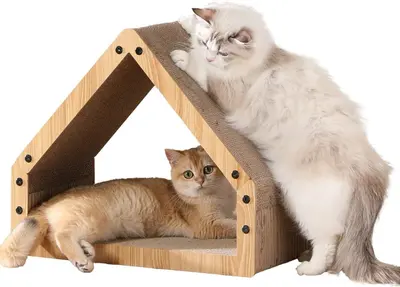
The FUKUMARU SH02 takes that approach with a triangular, house-shaped structure. Its sloping sides provide angled scratching surfaces, while the space underneath works as a small sheltered resting area or play tunnel.
The listed exterior dimensions are 16.93 × 11.81 × 14.57 inches.
This is more of a scratcher with a hideaway underneath than a full cardboard condo.
That distinction matters. A cat may enjoy scratching the sides and lying partially inside without having enough room to stretch out comfortably for a long nap.
Customer feedback repeatedly describes cats using the angled surfaces, relaxing around the opening, and returning to the scratcher throughout the day.
The most noticeable complaints involve cardboard debris, worn scratching sections, and the lack of confirmed replacement panels.
Some buyers also find the sheltered area smaller than expected.
FUKUMARU advertises a maximum load capacity of 22 pounds for this design. That is a manufacturer claim rather than an independently verified jumping or climbing safety rating. It shouldn’t be used as the sole basis for choosing the product for a heavier cat.
Pros
- Different scratching angle from ordinary floor pads
- Compact footprint
- Open sheltered area
- Useful combination of scratching and resting surfaces
Cons
- Limited enclosed sleeping space
- No confirmed replacement panels
- May shed noticeable cardboard debris
- Manufacturer load claim does not establish dynamic jumping safety

ASPCA Cardboard Cat House Hideaway Playhouse With Scratcher
Best for: Cats that enjoy a conventional cardboard hideaway and owners who appreciate easy storage.
Avoid if: Your cat is a heavy cardboard chewer, regularly jumps onto cardboard roofs, or requires verified replacement inserts.
Buying note: The ASPCA cottage is a reasonable alternative to Tudor, particularly if you prefer the folding design. Tudor has the clearer long-term advantage when replacement scratching pads matter.
Product snapshot
- Selected product: Amazon ASIN B07VGTY417
- Material: Cardboard
- Design: Fold-flat cottage
- Scratching surface: Interior corrugated board
- Exterior dimensions: 19 × 13 × 17 inches
- Official replacement scratcher: Not confirmed
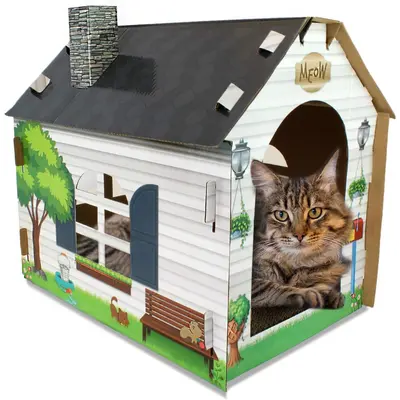
The ASPCA cardboard cottage keeps things simple: a printed house with an interior corrugated scratching board and enough shelter for a cat to investigate, rest, or nap.
It also folds flat for storage, which can be convenient if you don’t want a cardboard house permanently occupying part of the floor.
The Amazon cottage version, ASIN B07VGTY417, is listed at 19 × 13 × 17 inches. Chewy also carries an ASPCA Cat Cottage House, but confirm the exact measurements and product version before treating the two listings as interchangeable.
There is considerable customer feedback for the Amazon-listed cottage. Owners frequently describe quick assembly, cats sleeping inside, and regular use of the scratching floor.
Some owners have kept their houses in use for months. Others describe much faster deterioration, particularly when cats chew the walls or put pressure on the roof.
Loose assembly tabs are another recurring complaint. Several customers mention needing to reinforce connections, and some report damage while assembling or adjusting the house.
Replacement support is less clear than with the Frisco Tudor. The interior scratching board may be removable, but that doesn’t establish that the manufacturer sells a compatible replacement.
Pros
- Traditional enclosed cottage design
- Fold-flat storage
- Interior scratching board
- Straightforward assembly for many buyers
Cons
- Loose tabs reported by some owners
- No confirmed official replacement pads
- Durability varies with how cats use it
How to Choose a Cardboard Cat House With a Scratcher
A cardboard cat house with a scratcher shouldn’t be chosen by appearance alone. Two similarly sized products may feel quite different to a cat once you account for the doorway, floor space, and scratching surface.
Check the Entrance and Usable Interior Space
Start with your cat, not the product dimensions.
Measure your cat’s approximate body length while resting and consider shoulder width and normal sitting height. Then compare those measurements with the doorway and interior information available from the manufacturer.
A house that’s 20 inches tall on the outside may have considerably less usable height beneath a sloped roof.
Likewise, a cardboard cat condo with several levels may have smaller platforms than expected.
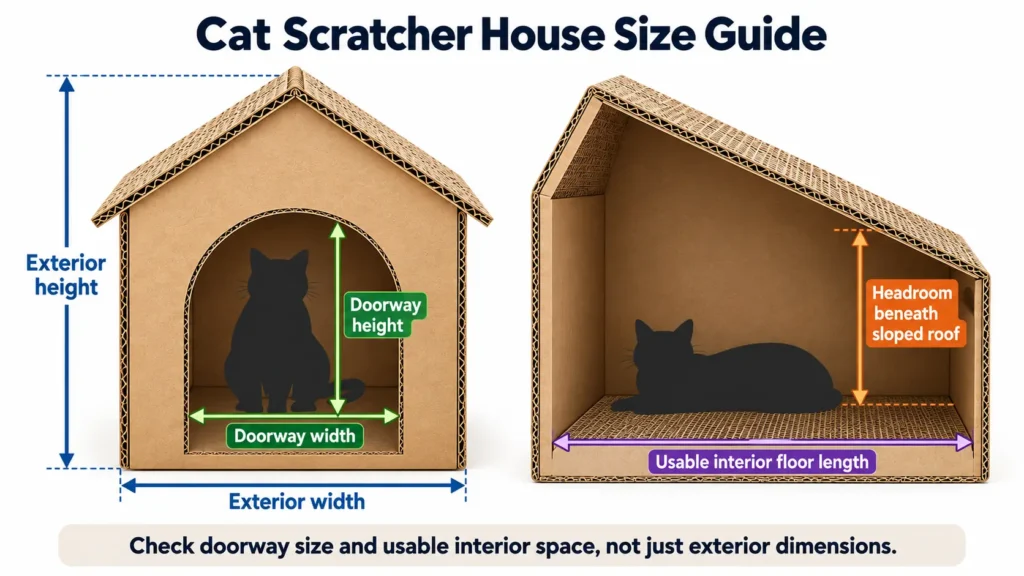
If you have a large or long-bodied cat, prioritize confirmed opening measurements and floor space over general labels such as “large cats” or “all sizes.”
For elevated structures, look for a clearly stated manufacturer capacity and remember that static weight support isn’t the same as safely absorbing a forceful jump.
Match the Scratching Surface to Your Cat
Watch what your cat already scratches.
A cat that regularly scratches carpets or flat cardboard pads may appreciate a house with an interior floor scratcher. A cat that likes sloped surfaces may get more use from the FUKUMARU or Tiger Tough Townhouse.
Cats that stretch upright against furniture may still need a separate vertical scratching post.
According to Cats Protection, matching scratching equipment to the cat’s preferred orientation can help encourage appropriate scratching.
If you’re unsure which format suits your cat, our guide to different types of cat scratchers compares vertical, horizontal, angled, and lounging designs.
A house can supplement an existing scratcher. It doesn’t necessarily need to replace it.
Single-Story Houses vs. Multi-Level Cardboard Cat Condos
A single-story cardboard house is usually easier to understand: your cat walks in, scratches the floor, and rests inside.
Multi-level houses provide more opportunities for investigation and play, but they also introduce extra joints, supports, openings, and elevated surfaces.
For kittens and smaller, relatively gentle cats, those additional features may be enjoyable. For a larger cat that jumps forcefully, cardboard construction requires more caution.
More levels do not automatically mean more comfortable sleeping space. Check where the scratch pads are located and whether the remaining platforms are large enough to use.
Look Beyond the Purchase Price
One of the easiest details to overlook is the scratcher’s replacement system.
Some cardboard houses use a separate insert that can be removed. Others have scratching surfaces integrated directly into the structure.
But removable does not always mean replaceable.
The Frisco Tudor has a compatible refill sold separately. That may extend the useful life of the house when only its scratching floor has worn out.
With other designs, a badly worn scratching panel could mean replacing the entire structure.
If you mainly need affordable surfaces for regular scratching rather than a hiding space, our comparison of cardboard cat scratch pads covers simpler alternatives.
Also consider the mess your cat creates. Some cats scratch cardboard neatly. Others shred it into small pieces that need frequent vacuuming.
Safety, Setup, and When to Replace a Cardboard Cat House
Cardboard is useful for scratching, but these houses are still lightweight furniture. Their condition matters, especially when they have upper levels or hanging toys.
Assemble and Place the House Carefully
Follow the product’s assembly instructions and check that every structural tab is properly connected before allowing your cat to use the house.
Place it on a flat, dry floor where it won’t slide or tip easily. Avoid positioning lightweight cardboard structures where cats might jump onto them from a much higher surface.
For houses with elevated floors, periodically inspect the supporting panels and connections.
In multi-cat homes, consider entrances and escape routes. A shy cat may be reluctant to use a house if another cat can block its only exit.
Start with the house near a resting place or an area your cat already likes to scratch.
Cleaning and Cardboard Maintenance
Remove loose cardboard with a vacuum or brush as needed. For ordinary surface dirt, follow the manufacturer’s cleaning instructions.
Some products recommend spot cleaning, while others advise dry cleaning only.
Avoid soaking corrugated cardboard. Moisture can soften panels, weaken connections, and make the house unsuitable for continued use.
Check scratch pads regularly, particularly where the pad meets the surrounding structure.
When Should You Replace the House?
A worn scratching surface isn’t automatically a problem. Fraying and shredded cardboard are expected with use.
Structural damage is different.
Stop using the house if you notice:
- Torn or missing load-bearing tabs
- Sagging upper floors or roof sections
- Damp or weakened cardboard
- Loose toy attachments that could be swallowed
- Large damaged sections that your cat is chewing or ingesting
No cardboard cat house is indestructible.
If your cat repeatedly eats cardboard rather than simply scratching it, remove the material and speak with your veterinarian. Seek prompt veterinary advice if your cat swallows pieces and develops vomiting, reduced appetite, or other signs of illness.
Frequently Asked Questions About Cat Scratcher Houses
Are cardboard cat houses good for scratching?
They can be, particularly for cats that enjoy corrugated cardboard.
The important detail is the scratching surface. A house with only a small floor pad might not satisfy a cat that prefers a tall vertical post.
Choose a scratching layout that resembles surfaces your cat already enjoys.
How long do cardboard cat scratcher houses last?
There isn’t one reliable lifespan for every cardboard house.
Some owners report months of use, while others describe rapid damage from chewing, scratching, or rough play.
The construction, your cat’s habits, and whether replacement pads are available all affect how long the house remains useful.
Inspect the structure rather than relying on a fixed replacement schedule.
Can large cats use cardboard cat condos?
Some can, but a large exterior doesn’t necessarily provide enough usable interior space.
Check the doorways, lower compartment, and any elevated platforms. Cat weight alone doesn’t establish fit or structural suitability.
For larger cats, pay particular attention to load-bearing parts and avoid relying on unverified customer weight anecdotes.
Can you replace the scratching pad inside a cardboard cat house?
It depends on the model.
The Frisco Tudor has a compatible replacement scratching insert sold separately through Chewy.
Other products may have removable pads without offering official refills. Check compatibility using the exact model or retailer item number before ordering replacement pieces.
What if my cat ignores the new scratcher house?
Try moving the house near a familiar resting or scratching area.
Allow your cat to investigate without forcing them inside. You can encourage interest through gentle play around the entrance or a small amount of catnip if your cat responds to it.
If your cat continues to ignore the house, the problem may be its location, entrance, scratching texture, or enclosed design.
Some cats simply prefer an open bed and a separate scratcher.
Which Cat Scratcher House Should You Choose?
The right cat scratcher house is the one that fits your cat’s body and scratching habits—not necessarily the largest or most decorative model.
For a straightforward hideaway with a replaceable scratch pad, the Frisco Tudor has a particularly practical advantage.
If your cat enjoys exploring cardboard structures with multiple scratching areas, consider the FurHaven Farmhouse or the Tiger Tough Townhouse, while paying close attention to their structural limitations.
The FUKUMARU SH02 makes more sense for angled scratching than spacious sleeping, while the ASPCA Cottage offers a traditional fold-flat alternative.
Before buying, check the exact version, entrance space, replacement options, and how your cat is likely to use the structure. Those details matter more than the design printed on the cardboard.
A dog harness for large dogs needs to do more than look sturdy. It should fit the dog’s chest and neck correctly, stay in position during walks, and give you appropriate control without uncomfortable rubbing.
That can be harder to find than expected. A harness labeled XL might fit a Labrador but be too narrow for a broad-chested Mastiff. Two harnesses with similar padding and leash clips may also behave differently when a strong dog pulls or tries to back out.
We’ve compared seven options for different needs, from affordable everyday walking to pulling management and more secure multi-strap designs. The Ruffwear Front Range is a good starting point for ordinary walks, but it isn’t automatically the right choice for every large dog.
Affiliate disclosure: LumaPaw may earn a commission when you purchase through links on this page, at no additional cost to you. Our recommendations are based on product specifications, retailer information, and customer feedback—not hands-on testing.
Our Top Dog Harness Picks for Large Dogs at a Glance
These harnesses aren’t interchangeable. Some prioritize padding, others offer more adjustment, and a few are designed for dogs that need more than a conventional two-strap fit.
| Dog Harness | Best For | Key Limitation |
|---|---|---|
| Ruffwear Front Range | Everyday walks | No grab handle |
| rabbitgoo Classic No Pull | Budget-friendly walking | Less generous fit for some very broad dogs |
| 2 Hounds Design Freedom | Pulling management | More complicated fitting |
| Julius-K9 IDC Powerharness | Very large dogs | Rear leash attachment only |
| Chai’s Choice Quick Release | Padded, easy-on design | XL fit needs careful checking |
| Ruffwear Flagline | Dogs that back out of harnesses | Higher price and fit-sensitive design |
| Blue-9 Buckle-Neck Balance | Hard-to-fit body shapes | Takes time to adjust properly |
Before choosing from this list, measure your dog’s chest. An excellent harness in the wrong size can be less useful than a simpler model that fits correctly.
How We Researched These Large-Dog Harnesses
We compared manufacturer sizing charts, materials, leash attachments, adjustment systems, padding, cleaning instructions, and retailer information from Amazon and Chewy.
Customer feedback was also important, particularly reports involving rubbing behind the front legs, shifting straps, difficult sizing, damaged buckles, and dogs slipping out.
We considered products including PetSafe Easy Walk, Carhartt Nylon Duck, OneTigris FIRE WATCHER 2.0, Embark Adventure, and Frisco Big Dog. Some offered useful features but had weaker evidence, greater overlap with our selections, or unresolved concerns about fit and hardware.
Ratings and bestseller labels helped us understand product popularity, but they didn’t decide the list. Likewise, we didn’t assume a tactical-looking harness was stronger than a simpler design.
LumaPaw has not physically tested these harnesses. The following recommendations reflect documented product features, comparisons, and reported customer experiences. Individual fit and durability can vary.
Best Dog Harnesses for Large Dogs Reviewed
1. Ruffwear Front Range — Best for Everyday Walks
Best for: Large dogs needing a comfortable everyday walking harness.
Avoid if: Your dog needs a handle, has a chest exceeding the size range, or dislikes overhead harnesses.
The Ruffwear Front Range makes sense for owners who want one padded harness for regular neighborhood walks, park visits, and everyday outings.
It has an aluminum leash ring on the back and a reinforced webbing connection at the chest. Four adjustment points help accommodate different proportions, while reflective trim and a small enclosed ID pocket add practical details.
Product snapshot
**Size examined
** Large/X-Large, 32–42-inch chest
**Leash attachments
** Front and back
**Construction
** Polyester ripstop shell, foam padding, mesh lining
**Adjustability
** Four points
**Cleaning
** Hand wash, mild detergent, air dry
Pros
- Padded construction with four adjustment points
- Front and rear leash attachments
- Reflective details and ID pocket
Cons
- No top handle
- Costs more than several alternatives
- May not fit very broad-chested dogs
Compared with the rabbitgoo Classic, Front Range has more detailed manufacturer documentation and a different approach to materials and fit. That helps justify considering the higher price, although it doesn’t prove the harness will last longer for every dog.
Customer feedback frequently praises comfort, fit, and everyday usability. Complaints include rubbing on certain body shapes, difficulty getting the harness over the head, and occasional concerns about adjustment or attachment wear.
Its biggest omission is a grab handle. The L/XL also stops at a 42-inch chest measurement, which rules it out for some giant breeds.
Buying note: Measure carefully and check the space behind the front legs. Padding cannot compensate for a harness that sits too close to the armpits.
2. rabbitgoo Classic No Pull — Best Budget Harness
Best for: Budget-conscious owners of large dogs needing an adjustable walking harness.
Avoid if: Your dog routinely backs out of harnesses or needs a particularly wide chest range.
Not every large dog needs an expensive harness for ordinary walks. The rabbitgoo Classic offers several features found on pricier models, including front and rear leash connections, adjustable straps, padding, and a handle.
Its front connection can be used when working on pulling, while the rear attachment suits normal walks. Two quick-release buckles help secure the harness after it is slipped over the dog’s head.
Product snapshot
**Version examined
** Classic No Pull, Black, Large
**Amazon model
** B01M8JT6FT
**Leash attachments
** Front and back
**Material
** Polyester Oxford fabric with cushioning and mesh
**Adjustability
** Four straps
**Extras
** Top handle and reflective details
Pros
- Affordable for the included features
- Two leash attachment options
- Padding, reflectivity, and grab handle
Cons
- Over-the-head fitting
- Not intended as a dedicated escape-resistant harness
- Sizing can be awkward for some broad or unusually proportioned dogs
The main attraction is value. The reviewed black Large version was available at a substantially lower price than Ruffwear Front Range, making it an accessible option for owners who want a versatile walking harness without spending much.
Customer feedback includes praise for everyday comfort and convenient handling. Fit-related complaints are worth watching, particularly around neck proportions, overhead removal, and possible rubbing.
The Classic isn’t a specialized escape-resistant design, and the Large label alone doesn’t establish that it will fit every large breed.
Buying note: The lower price is worthwhile only if the harness stays properly adjusted. Check both the neck and chest measurements rather than ordering by breed.
3. 2 Hounds Design Freedom — Best for Pulling Management
Best for: Owners actively working on loose-leash walking with large dogs that pull.
Avoid if: Your dog develops irritation behind the front legs or you want a simple rear-clip harness with a handle.
The Freedom harness offers something more specialized than a typical front-clip vest: a double-connection system designed to give the handler two points of contact.
The front connection helps guide the dog, while the rear loop works with the included leash arrangement. This can be useful for a strong dog that changes direction or pulls against the lead.
Product snapshot
**Version examined
** Freedom No-Pull Harness & Leash
**Largest relevant size
** XXL, manufacturer chest range 36–44 inches
**Leash attachments
** Front ring and rear control loop
**Material
** Nylon webbing with velvet lining behind the front legs
**Included accessory
** Double-ended training leash, with the reviewed bundle
Pros
- Specialized two-point leash arrangement
- Adjustable fit across several large sizes
- Velvet lining in an area vulnerable to rubbing
Cons
- More involved fitting process
- Included leash may feel short
- Some reports of rubbing and webbing wear
The design has four adjustment points, stainless-steel hardware, and velvet lining behind the front legs. Owners frequently describe improved handling once they have fitted the harness correctly.
However, there’s a learning curve. Some customers find the included training leash short, and fitting the harness takes more effort than snapping together a padded vest. Reports of chafing and fraying also deserve attention.
A no-pull harness should help support leash training, not replace it. Dogs can continue pulling even when wearing one.
Buying note: The manufacturer lists XXL at 36–44 inches, while some retailer descriptions differ. Verify the selected size and confirm that the package includes the double-ended leash.
4. Julius-K9 IDC Powerharness — Best for Very Large Dogs
Best for: Broad-chested large or giant dogs whose owners want a straightforward walking harness with a handle.
Avoid if: Your dog frequently escapes backward or needs front-clip pulling management.
Very large dogs can be difficult to fit, particularly when conventional vest harnesses stop around a 42-inch chest measurement.
The Julius-K9 IDC Powerharness offers larger sizing options and a relatively straightforward design. Its broad saddle-style back section, horizontal chest strap, and belly buckle make dressing simpler than on many multi-strap harnesses.
Product snapshot
**Version examined
** IDC Powerharness, Size 3
**Fit
** Large/XXL size range; confirm the current regional chart
**Leash attachment
** Rear ring
**Construction
** Saddle-style body with adjustable chest and belly straps
**Extras
** Securing handle, reflective details, interchangeable patches
**Cleaning
** Hand wash
Pros
- Large size options for broad dogs
- Quick, relatively simple dressing
- Handle and reflective details
Cons
- Rear-only standard leash attachment
- Some dogs can reverse out
- Chest-strap placement may not suit every build
The top handle is useful for brief close handling, and reflective sections improve visibility in low light. The adjustable handle-fixing feature also helps keep the handle from projecting unnecessarily.
Reviews from owners of Rottweilers, Mastiffs, and other large breeds often praise the convenience and fit. Complaints include shifting, unsuitable chest-strap positioning, and dogs managing to back out when the harness isn’t secure.
An important distinction: the standard IDC Powerharness uses a rear leash attachment. Despite some no-pull descriptions on retailer pages, it isn’t equivalent to a harness with a built-in front training connection.
Buying note: Size 3 measurements differ slightly between regional charts. Verify your dog’s chest circumference against the exact listing before ordering; don’t choose by weight alone.
5. Chai's Choice Quick Release — Best Padded Easy-On Harness
Best for: Large dogs that dislike overhead dressing but still need a padded everyday harness.
Avoid if: Your dog’s measurements fall outside the selected version’s confirmed fit range.
Some large dogs strongly dislike having a harness pulled over their heads. Others simply won’t stand still long enough to make overhead dressing convenient.
The updated Chai’s Choice Quick Release tackles that problem with a buckle at the neck. Open it, position the harness, fasten the buckles, and adjust the straps without forcing a fixed neck opening over the dog’s ears.
Product snapshot
**Version examined
** Premium Quick Release Outdoor Adventure
**Size examined
** X-Large
**Leash attachments
** Front and back
**Adjustability
** Four points
**Extras
** Opening neck buckle, padding, top handle, reflective stitching
**Cleaning
** Follow the current product-version care label
Pros
- Opening neck buckle
- Padded body with a grab handle
- Front and rear leash connections
Cons
- XL sizing needs close attention
- Padding may still rub on some dogs
- More expensive than a basic budget harness
Unlike a basic strap harness, this version also has padded sections, front and rear leash connections, reflective stitching, and a top handle.
Customers frequently appreciate the easy-on arrangement and comfort. However, some report underarm rubbing, fitting difficulties, and occasional buckle concerns.
The main issue to check before buying is sizing. Chewy’s listing distinguishes the harness’s overall product measurements from its chest measurements, making it easy to misunderstand the XL range.
Buying note: Choose the Quick Release version, not the older Outdoor Adventure harness without the neck buckle. They’re not interchangeable when ease of dressing is your priority.
6. Ruffwear Flagline — Best for Dogs That Back Out of Harnesses
Best for: Large dogs that have slipped backward out of simpler harnesses.
Avoid if: Your dog exceeds the available girth range or needs a very simple, low-cost walking harness.
A dog that backs out of ordinary harnesses presents a different problem from one that simply pulls forward.
The Ruffwear Flagline has an additional strap positioned farther back on the torso. Combined with its six adjustment points, this gives owners more ways to establish a secure fit than a typical two-strap vest.
Product snapshot
**Version examined
** Flagline, Large/X-Large
**Chest girth
** 32–42 inches
**Leash attachments
** Three connection points
**Adjustability
** Six points
**Construction
** Lightweight body with an additional rear securing section
**Extras
** Padded assistance handle
Pros
- Additional rear securing section
- Six fitting adjustments
- Multiple leash connections and assistance handle
Cons
- Higher purchase price
- More straps to adjust correctly
- Reported XL chest-panel durability concern
It also has multiple leash attachment options and a padded handle designed for controlled assistance over obstacles. Its relatively lightweight construction may appeal to owners who find heavier multi-strap harnesses cumbersome.
Customer feedback includes positive reports from owners of dogs that previously escaped simpler harnesses. The adjustment system and rear strap are recurring reasons for satisfaction.
There are limitations. The L/XL stops at a 42-inch chest girth, fitting takes care, and one Chewy customer reported tearing in the chest area on two XL harnesses. That report doesn’t prove a widespread defect, but it is important when considering the product for a powerful dog.
Buying note: Flagline is more escape-resistant in design, not escape-proof. Check the current L/XL reviews and examine stitching, strap position, and movement carefully before relying on it for everyday walks.
7. Blue-9 Buckle-Neck Balance — Best for Hard-to-Fit Dogs
Best for: Owners struggling to fit a conventional harness around a large dog’s proportions.
Avoid if: You need heavy padding, a top handle, or straightforward adjustments straight out of the package.
Some large dogs have a broad ribcage and narrower waist. Others have a deep chest but relatively slim neck. Those proportions can make conventional padded harnesses difficult to fit.
The Blue-9 Balance is worth considering because it offers six adjustment points rather than relying on a fixed vest shape. The buckle-neck version also opens at the neck, which can make dressing less stressful for dogs sensitive to overhead handling.
Product snapshot
**Version examined
** Buckle-Neck Balance, Black, Large
**Chest girth
** 29–43.5 inches
**Material
** Nylon webbing
**Leash attachments
** Front and back
**Adjustability
** Six points
**Extras
** Opening neck buckle
**Cleaning
** Washable nylon; follow manufacturer care instructions
Pros
- Six adjustment points
- Neck buckle and dual leash rings
- Minimal body coverage
Cons
- Initial fitting can be frustrating
- Can rotate if poorly adjusted
- No padded vest or grab handle
Its minimal body coverage is another advantage for owners who prefer not to cover much of the dog’s chest and back.
Customer feedback often praises the fit flexibility, particularly for dogs that struggled with other designs. The main complaints involve the time required to adjust it and occasional shifting or rotation once the dog starts walking.
There’s no thick padding or top handle. For some dogs that simplicity is useful; for others, a padded vest will be more comfortable.
Buying note: Make sure you’re purchasing the Buckle-Neck Balance version. After adjusting it, check whether the straps remain in place when the dog turns and walks.
How to Choose a Dog Harness for Large Dogs
Match the Harness to Your Dog's Walking Style
Start with what actually happens during walks.
A large dog that walks calmly beside you may be comfortable in a conventional padded harness such as the Ruffwear Front Range or rabbitgoo Classic.
A strong puller may benefit from the handling options on the 2 Hounds Freedom, particularly when combined with consistent loose-leash training.
A dog that backs out of harnesses needs a different approach. An additional securing strap, careful adjustment, and possibly a backup attachment may be more important than padding.
If your dog has an unusual chest shape, a more adjustable design such as Blue-9 Balance may be worth trying.
Look Beyond “Heavy-Duty” Marketing
A heavy duty dog harness shouldn’t earn that description just because it has thick fabric, military-style panels, or metal rings.
Look at the parts that actually hold the dog:
- Stitching around leash attachments
- Buckle construction and security
- Webbing condition and reinforcement
- Adjusters that stay in place under normal movement
- Suitable dimensions for the intended dog
A metal ring is only one part of the harness. The stitching and material connecting it to the body matter as well.
No walking harness should be assumed to have a particular breaking strength unless that claim is supported by relevant testing of the complete product.
Consider Padding, Chest Shape, and Ease of Dressing
Padding can improve comfort, especially during longer walks, but it won’t fix straps that rub the forelegs or restrict movement.
Low-coverage harnesses allow more air circulation and may suit dogs that dislike bulky equipment. However, thin straps can create concentrated pressure if fitted badly.
An opening neck buckle is helpful for dogs sensitive to overhead handling. For other dogs, an ordinary two-buckle design may be completely adequate.
Choose the shape that suits your dog rather than the harness with the longest feature list.
XL and XXL Dog Harness Sizing: How to Find the Right Fit
The letters on a harness label aren’t standardized. One manufacturer’s Large may fit a bigger chest than another company’s XL.
Measure Chest Girth Before Choosing Large, XL, or XXL
With your dog standing comfortably:
- Wrap a flexible tape measure around the widest part of the ribcage, usually just behind the front legs.
- Keep the tape snug without compressing the body.
- Record the measurement in inches.
- Measure the neck or front chest if the manufacturer’s sizing instructions require it.
- Compare those numbers with the exact harness chart—not just the suggested breed or weight.
Check the fit after dressing the dog. The harness should stay positioned without digging into the skin, shifting excessively, or preventing comfortable movement.
Why XL in One Brand May Not Equal XL in Another
These published ranges show how different the labels can be.
| Harness | Size | Published Chest Range |
|---|---|---|
| Ruffwear Front Range | L/XL | 32–42 inches |
| Ruffwear Flagline | L/XL | 32–42 inches |
| Blue-9 Balance | Large | 29–43.5 inches |
| 2 Hounds Freedom | XXL | 36–44 inches |
| Julius-K9 IDC | Size 3 | Approximately 32.5–45.5 inches on one US chart |
Measurements can change between versions and regional charts. Check the seller’s current measurements for the exact variation you intend to buy.
Chai’s Choice also demonstrates why reading the chart labels matters: a product-size measurement isn’t necessarily the same as the dog’s actual chest circumference.
Check for Rubbing, Rotation, and Backward Escape
Once you’ve adjusted the harness, let your dog walk a short distance in a secure area.
Watch how the straps move around the shoulders and front legs. A harness that looks fine while the dog stands still might shift during turns or when leash tension changes.
Check the fit with the dog standing and moving naturally. You should generally be able to fit a couple of fingers beneath the straps, but the manufacturer’s fitting instructions take priority.
If the harness rotates, exposes a large gap, slides toward the throat, or allows the dog to slip backward out of it, don’t rely on it until the fit problem has been resolved.
Front-Clip vs. Back-Clip vs. Dual-Clip Harnesses for Large Dogs
The leash connection changes how a harness handles tension.
| Design | Useful For | Main Limitation |
|---|---|---|
| Front clip | Redirecting dogs during leash training | Can rotate or shift when fitted poorly |
| Back clip | Everyday walking and some outdoor activities | Doesn’t inherently discourage pulling |
| Dual clip | Switching between walking and training arrangements | Requires the correct leash setup |
A front clip can help guide a dog away from pulling straight ahead, but it isn’t an automatic training solution.
Back-clip harnesses are practical for dogs that already walk with a loose leash. Dual-clip models offer more flexibility, especially when both connection points are designed to work with a double-ended leash.
For dogs that pull intensely, work on leash manners in addition to choosing suitable equipment. A qualified reward-based trainer can help if walks are becoming difficult or unsafe.
Large-Dog Harness Safety: What to Check Before Every Walk
Large dogs can place substantial tension on their walking equipment, especially if they lunge suddenly. Checking the harness regularly is more useful than assuming an expensive or thick-looking design will remain reliable indefinitely.
Before walking:
- Examine buckles for cracks, deformation, or unexpected opening.
- Check leash rings, stitching, and webbing for damage.
- Confirm that adjustable straps haven’t slipped.
- Look for rubbing, redness, or coat wear near the front legs.
- Make sure the harness sits correctly when the dog moves.
- Replace damaged equipment rather than attempting an unreliable repair.
Don’t leave a regular walking harness on an unsupervised dog when straps or handles could catch on crate hardware, furniture, or other objects.
A walking harness is not automatically a car safety restraint. Use an appropriate vehicle-restraint product with credible crash-testing evidence for car travel.
Likewise, a grab handle doesn’t necessarily mean you can safely lift the dog’s entire body weight. Owners of large senior dogs with mobility difficulties may need a purpose-built support harness and veterinary advice.
A collar can still be useful for identification even when the dog walks in a harness. Our guide to everyday dog collars explains the differences between collar styles and their limitations.
Frequently Asked Questions About Large-Dog Harnesses
A 100-pound dog might need Large, XL, XXL, or another manufacturer-specific size. Weight doesn’t tell you enough about chest circumference or body proportions. Measure your dog and follow the chart for the exact harness model.
They can be helpful. A front leash connection gives the handler a way to redirect some dogs instead of allowing them to lean straight forward against a back attachment. Results depend on fit, dog behavior, and training. A front clip alone won’t teach loose-leash walking.
Not across different brands. XXL isn’t a universal measurement. A particular company’s XL may offer a wider fit than another company’s XXL, so always compare actual measurements.
Yes. Dogs can sometimes back out of loose or poorly positioned harnesses, particularly when frightened or resisting movement. Multi-strap designs may make backward escape more difficult for some dogs, but none should be treated as completely escape-proof.
No. Tactical styling, MOLLE panels, and thick fabric don’t automatically make a harness stronger. Secure attachments, appropriate stitching, reliable buckles, good adjustment, and a stable fit matter more for ordinary large-dog walking.
Which Large-Dog Harness Should You Choose?
The best dog harness for large dogs is the one that fits properly and matches how your dog behaves on a leash.
For ordinary walking, Ruffwear Front Range is a sensible starting point if your dog’s chest falls within its range. rabbitgoo Classic offers a lower-cost alternative, while 2 Hounds Freedom provides more specialized pulling-management options.
Julius-K9 deserves consideration for very large dogs, Chai’s Choice for easier padded dressing, and Blue-9 for challenging body proportions. Ruffwear Flagline offers another approach when backing out of conventional harnesses is a concern.
Before buying, measure your dog, check the current size chart, and read the limitations of the specific version you’re considering. A secure, comfortable fit matters more than the label on the packaging.