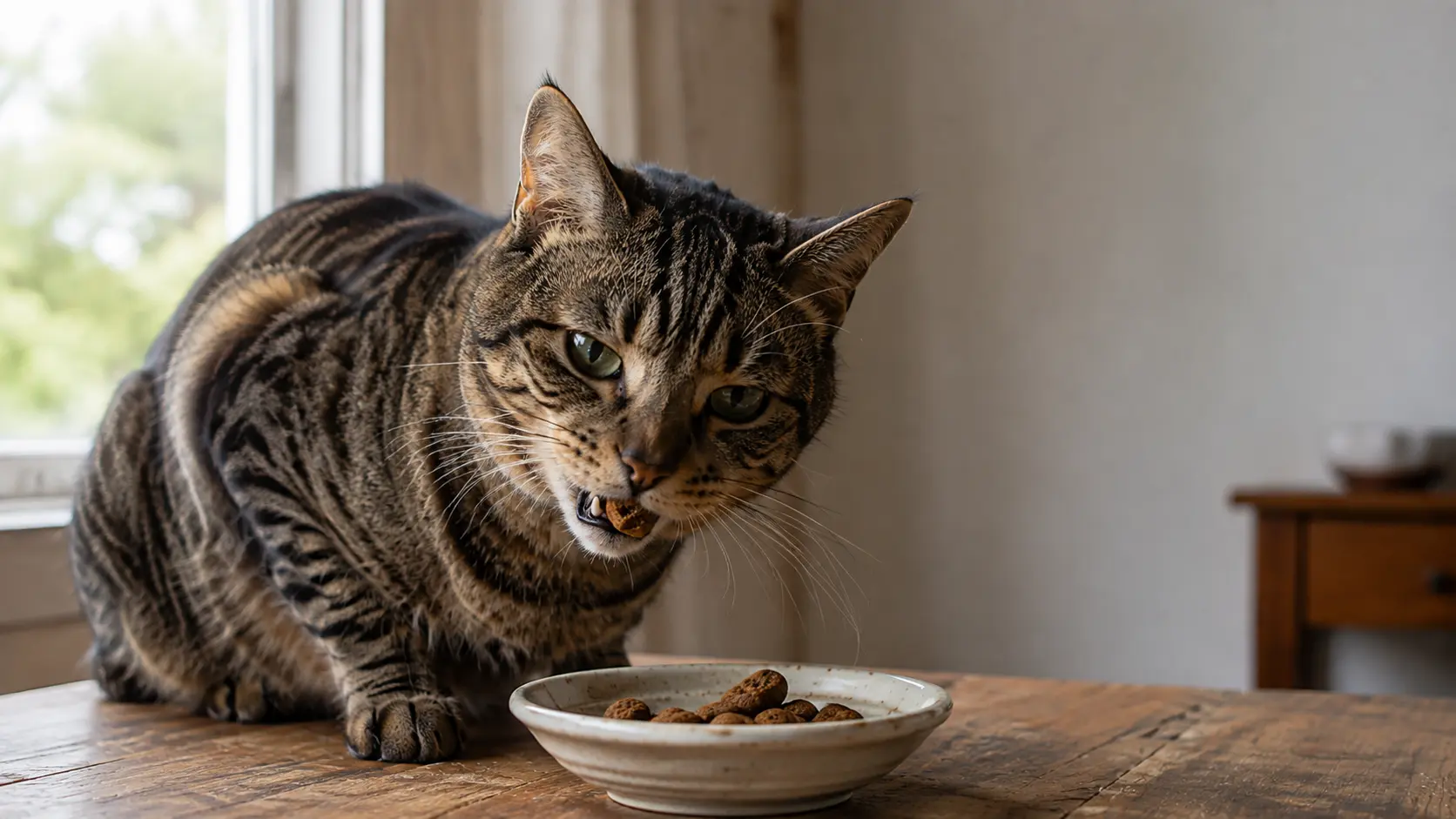
Cat dental treats can be a useful part of an oral-care routine, but the products are not equally well supported. Some carry Veterinary Oral Health Council (VOHC) accepted claims, some rely on product-specific studies, and others mainly depend on texture or manufacturer claims.
There is also a practical issue that gets overlooked: a treat only helps mechanically if your cat actually chews it. Calories matter too. A product advertised as “less than two calories per treat” can add more than 20 calories a day when the recommended dental routine requires 16 or 17 pieces.
We compared these cat dental treats by dental evidence, chewing design, full daily serving calories, feeding burden, ingredients, customer feedback, value, and availability.
If you are shopping for everyday rewards rather than dental-specific products, see our broader guide to the best cat treats by type.
Affiliate disclosure: LumaPaw may earn a commission from qualifying purchases made through links on this page, at no extra cost to you.
Best Cat Dental Treats at a Glance
Purina Pro Plan Veterinary Diets Dental Bites — Best Overall
Dental evidence: VOHC accepted for plaque and tartar
Texture: Large, firm crunchy bites
Recommended routine: 17 treats daily for eligible adult cats
Full routine calories: About 25.5 kcal
Best for: Cats with healthy chewing ability when dental evidence is the priority
Main limitation: Hard pieces, high serving count, and a small pouch
Purina DentaLife Tasty Chicken — Best Value VOHC Pick
Dental evidence: VOHC accepted for tartar
Texture: Large, porous crunchy treats
Recommended routine: 17 treats daily
Full routine calories: Roughly 23.8–25.5 kcal based on currently conflicting manufacturer and retailer calorie figures
Best for: Owners wanting a VOHC-backed option in a much larger package
Main limitation: The size can be difficult for some cats
Feline Greenies Oven Roasted Chicken — Best Widely Available
Dental evidence: VOHC accepted for tartar
Texture: Crunchy dental treat
Recommended routine: 16 treats daily for the researched 10-lb adult-cat example
Full routine calories: About 22.4 kcal
Best for: Easy availability, flavor choice, and package-size flexibility
Main limitation: Some cats swallow them with little chewing
Virbac C.E.T. IntelliDent — Best Lower-Calorie Daily Routine
Dental evidence: Controlled feline study; no current feline VOHC acceptance
Texture: Very firm bite
Recommended routine: 3 bites daily
Full routine calories: About 7.83 kcal
Best for: Strong chewers and owners who want fewer daily treat calories
Main limitation: The texture is too hard for some cats
Tartar Shield Daily Dental Cat Treats — Best Small-Bite Evidence-Backed Alternative
Dental evidence: Controlled feline calculus study; no current feline VOHC acceptance
Texture: Smaller crunchy pieces
Recommended routine: 10–15 treats daily
Full routine calories: 10–15 kcal
Best for: Cats that do not handle very hard dental bites comfortably
Main limitation: Some cats swallow the smaller pieces whole
How We Chose the Best Cat Dental Treats
We did not rank products by star ratings or review counts alone. For dental chews for cats, the quality of the dental evidence matters more.
Dental evidence came first
Our evidence hierarchy was:
Current VOHC acceptance → controlled product-specific feline studies → manufacturer claims → customer feedback.
VOHC acceptance is especially useful because plaque and tartar are separate claims. A product accepted for tartar should not automatically be described as accepted for both plaque and tartar. Our research found that Pro Plan Dental Bites carries the strongest accepted claim in this group, while DentaLife and Greenies are accepted for tartar.
We looked at whether cats actually chew the treat
Large or porous cat teeth cleaning treats may encourage chewing, but there is no guarantee. Repeated customer reports of gulping, excessive hardness, or difficulty biting are useful when evaluating real-world usability.
We used customer feedback for questions such as palatability and chewing behavior—not as proof that a product reduces plaque or tartar.
We compared the full daily calories
Calories per treat can be misleading. We calculated the calories involved in following the manufacturer’s recommended dental routine whenever reliable figures were available.
That reveals a major difference: Virbac’s three-piece routine is under eight calories, while several mainstream options add more than 20 calories when given at their full recommended amounts. If calorie control matters more than dental function, our guide to low-calorie cat treats compares everyday rewards specifically by calorie burden and portioning.
We considered practical value
Package size, daily serving burden, retailer availability, ingredients, repeated complaints, age or weight restrictions, and overall evidence confidence also influenced our rankings.
The 5 Best Cat Dental Treats

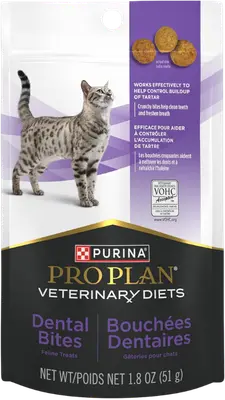
Purina Pro Plan Veterinary Diets Dental Bites — Best Overall
Best for: Adult cats 5 lb and over with healthy chewing ability when dental evidence is the main priority.
Avoid if: Your cat has painful teeth, significant missing teeth, trouble chewing firm foods, or weighs under 5 lb.
Honest buying note: This is our Best Overall because of the dental evidence, not because it is the cheapest or easiest product to feed.
Purina Pro Plan Dental Bites takes our top position because it has the strongest current accepted dental claim among the products we researched: VOHC acceptance for plaque and tartar.
The feeding directions call for 17 treats per day for adult cats weighing at least 5 pounds. At approximately 1.5 calories each, that is about 25.5 calories per day.
The bites are relatively large and firm. That can be useful for cats that tend to swallow smaller treats, and repeated customer feedback suggests the size makes some cats stop and chew. The tradeoff is obvious: other cats find them too hard or difficult to bite.
The formula includes corn, chicken meal, animal-derived ingredients and fish meal, so owners managing specific food sensitivities should check the current ingredient panel.
Pros
- VOHC accepted for plaque and tartar
- Firm size encourages chewing in many cats
- Clear feeding and calorie information
- Strong palatability pattern overall
Cons
- 17 treats per day
- About 25.5 daily calories at the full routine
- Small package
- Too hard for some cats

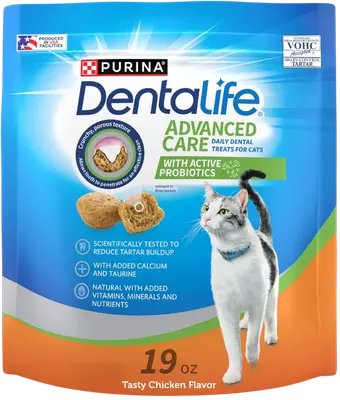
Purina DentaLife Tasty Chicken — Best Value VOHC Pick
Best for: Owners who want a VOHC-backed dental treat in a larger, more economical package.
Avoid if: Your cat struggles with large crunchy pieces or must avoid ingredients such as chicken or corn.
Honest buying note: DentaLife’s strongest advantage is the combination of legitimate dental evidence and value—not its probiotic or ingredient marketing.
DentaLife is the better fit when you want a VOHC-accepted tartar claim without paying Pro Plan’s much higher price per ounce.
Its main physical feature is a porous texture designed to let the tooth penetrate the treat rather than simply shatter the surface. Many customers also report that the relatively large pieces encourage their cats to chew.
The recommended routine is again 17 treats daily for adult cats weighing at least 5 pounds.
There is one current data inconsistency worth knowing. Purina has listed about 1.4 calories per treat, while Chewy has listed 1.5. That puts the daily routine at roughly 23.8–25.5 calories. Because these sources currently differ, check the calorie figure on the package you buy.
Pros
- VOHC accepted for tartar
- Large 19-oz package researched
- Strong value per ounce
- Porous texture encourages chewing
- Generally strong palatability
Cons
- 17-piece daily serving
- More than 20 daily treat calories
- Pieces can be too large for some cats
- Current calorie sources disagree slightly

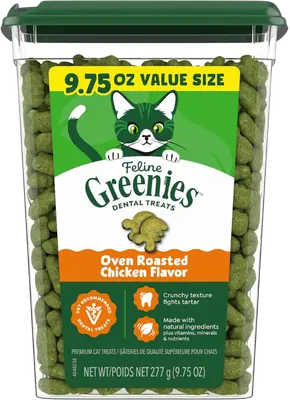
Feline Greenies Oven Roasted Chicken — Best Widely Available
Best for: Adult cats whose owners want an easy-to-find VOHC option with several flavors and package sizes.
Avoid if: Your cat consistently swallows this size of treat whole or is under one year old.
Honest buying note: Popularity does not make Greenies our Best Overall, but their combination of evidence, availability and acceptance makes them one of the easiest options to try.
Greenies is the easiest recommendation for owners who value convenience. It is widely sold, comes in several package sizes and flavors, and has VOHC acceptance for tartar control.
For the researched 10-lb adult-cat example, the feeding guidance is eight treats twice daily, or 16 per day. At about 1.4 calories each, that works out to roughly 22.4 calories daily. Greenies are formulated for cats at least one year old.
Palatability is one of the clearest strengths in the customer feedback we reviewed. The more important limitation is chewing: some cats crunch them properly, while others swallow them quickly.
Repeated Chewy feedback also included cracked large tubs during shipping. That is more of a packaging/shipping issue than a problem with the treats themselves.
Pros
- VOHC accepted for tartar
- Several flavors and sizes
- Strong palatability
- Reasonable mainstream value
Cons
- Some cats gulp them
- Full routine still adds meaningful calories
- Grain-containing formula
- Large tubs can be damaged during shipping

Virbac C.E.T. IntelliDent — Best Lower-Calorie Daily Routine
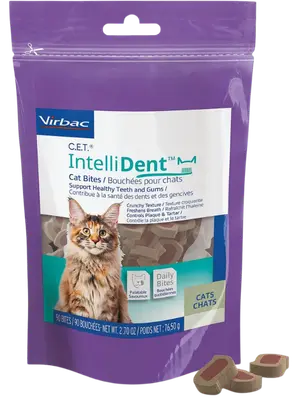
Best for: Cats with strong, healthy teeth when minimizing daily treat calories and serving count matters.
Avoid if: Your cat has sensitive teeth, dental pain, missing teeth that affect chewing, or difficulty with very firm foods.
Honest buying note: The low-calorie routine is genuinely different, but it is only useful if your cat can safely and comfortably chew the bites.
Virbac is the standout if feeding 16 or 17 dental treats a day feels excessive.
The directions call for just three bites daily. At 2.61 calories each, the complete routine is approximately 7.83 calories per day—far below the other leading products in this comparison.
IntelliDent does not currently have feline VOHC acceptance, but it has more evidence than a typical manufacturer-only dental claim. A controlled 28-day feline study found significantly less calculus accumulation in cats receiving three bites daily. The study involved 50 cats, but it was funded by Virbac and authored by Virbac employees, so we do not treat it as equivalent to VOHC acceptance.
The major weakness is texture. These bites are very firm. Some owners like that because their cats must chew them; others report that their cats cannot comfortably break them.
Pros
- Only 3 bites per day
- About 7.83 calories for the full routine
- Controlled feline calculus study
- Very firm texture can encourage chewing
Cons
- No current feline VOHC acceptance
- Too hard for many cats
- Palatability is mixed
- Some package-weight information has been inconsistent across retailers

Tartar Shield Daily Dental Cat Treats — Best Small-Bite Evidence-Backed Alternative
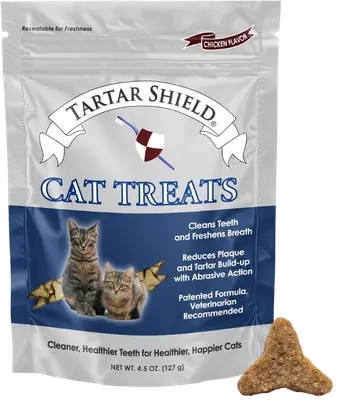
Best for: Cats that reject very hard bites but whose owners still want a product with feline calculus data and a relatively modest calorie burden.
Avoid if: Your cat routinely gulps small crunchy treats without chewing.
Honest buying note: Tartar Shield is a useful alternative, but the evidence is not as strong as the VOHC-backed choices above.
Tartar Shield provides another lower-calorie option without Virbac’s extremely hard texture.
The recommended routine is 10–15 treats daily, with each piece listed at about one calorie. That means roughly 10–15 calories per day.
The product does not currently have a feline VOHC Seal, but a controlled 28-day study of 14 adult cats reported less calculus formation in cats receiving 15 treats per day. The study is small, and the accessible evidence is less thoroughly documented than Virbac’s published trial, so we give it less weight.
Customer feedback suggests the smaller pieces are easier for many cats to manage, although that creates another problem: some cats simply swallow them.
Pros
- Controlled feline calculus data
- About 10–15 calories per daily routine
- Smaller pieces than Virbac
- Generally good palatability
Cons
- No current feline VOHC acceptance
- Small study
- Some cats swallow pieces whole
- Higher price per ounce than mainstream options
How Do Cat Dental Treats Work?
Mechanical cleaning depends on chewing
Dental treats generally use size, shape, firmness or porous texture to increase contact between the treat and the tooth.
That means chewing behavior matters. A cat that bites repeatedly through a porous treat is using it differently from a cat that swallows the same treat almost whole.
This is also why an ordinary crunchy snack should not automatically be treated as a dental product.
Plaque and tartar are not the same claim
Plaque is the softer film that develops on teeth. Over time, mineralized buildup can become tartar or calculus.
VOHC recognizes separate claims for plaque and tartar, so we record the exact accepted claim instead of using “VOHC dental treat” as if every accepted product has demonstrated the same outcome.
Dental treats have limits
Cat dental treats can support an oral-care routine, but they do not replace brushing, routine veterinary examinations, or professional dental treatment when it is needed.
They also should not be treated as a way to fix a painful mouth. If chewing seems uncomfortable, switching to an even harder dental chew is not the answer.
Cat Dental Treat Safety Checklist
When introducing cat chews for teeth, watch your cat rather than assuming the package size is suitable.
- Supervise the first few feeding sessions.
- Stop if your cat repeatedly coughs, gags, struggles to bite the treat, or tries to swallow pieces that seem too large.
- Do not give hard dental treats to work around obvious dental pain.
- Follow the product's age, weight and feeding directions.
- Include treat calories when considering the day's total food intake.
- Keep fresh water available.
- Replace or avoid a product if the texture clearly does not suit your cat.
Persistent bad breath can be more than a cosmetic problem. Red or bleeding gums, drooling, loose teeth, pawing at the mouth, difficulty eating, or obvious oral pain deserve veterinary attention rather than another bag of treats.
Frequently Asked Questions About Cat Dental Treats
Do cat dental treats work?
Some do have evidence for helping control plaque, tartar, or both. The strength of that evidence varies substantially. VOHC-accepted products give the clearest independently reviewed claims, while other products may rely on smaller product studies or manufacturer evidence.
Treats still work best as one part of a broader dental-care routine.
Are dental treats good for cats?
They can be appropriate when the product suits the cat’s age, weight, diet and chewing ability. They also add calories, and hard treats are not appropriate for every mouth.
The important question is not simply whether dental treats are “good,” but whether a specific product has useful evidence and your cat can chew it safely.
What does the VOHC Seal mean?
The Veterinary Oral Health Council reviews submitted data and awards acceptance for specific oral-health claims when its criteria are met.
Pay attention to the exact claim. A product accepted for tartar should not automatically be described as proven for plaque as well.
Are dental treats a substitute for brushing?
No. They can support oral hygiene, especially when brushing is difficult, but they should not replace brushing when it is feasible or routine veterinary dental care.
What if my cat swallows dental treats whole?
A treat designed around mechanical chewing may be a poor fit if your cat repeatedly gulps it.
Try a different size or texture rather than assuming every dental chew works the same way. If chewing itself appears painful or difficult, ask your veterinarian to examine your cat’s mouth.
How often should cats have dental treats?
Follow the instructions for the exact product. The researched products range from only three bites per day to 17 treats per day.
Giving fewer treats than the tested or recommended dental routine may not produce the same expected benefit, while giving extra treats unnecessarily increases calories.
Can kittens have dental treats?
It depends on the product. Greenies, for example, is formulated for cats one year and older, while other products have different age or weight rules.
For kittens, use an age-appropriate product and ask your veterinarian if you are uncertain, especially during tooth development. For everyday non-dental rewards selected specifically for younger cats, see our guide to kitten treats.
Can dental treats remove tartar already on my cat's teeth?
Do not rely on treats to remove established dental disease or heavy tartar. Dental treats are better viewed as preventive or maintenance tools.
If you can already see substantial buildup, or your cat has bad breath plus gum redness, bleeding, pain, drooling or eating difficulty, a veterinary dental assessment is the appropriate next step.
Are Greenies dental treats bad for cats?
Greenies are not inherently “bad” for cats and currently have a VOHC-accepted tartar claim. But they are not ideal for every cat.
They are intended for cats at least one year old, the full routine adds calories, and some cats swallow them without much chewing. Ingredient restrictions and individual tolerance also matter.
Final Verdict
The best cat dental treats depend on what matters most for your cat.
Purina Pro Plan Veterinary Diets Dental Bites is our Best Overall because it has the strongest accepted dental claim in the group. DentaLife offers the better value among the VOHC-backed choices, while Greenies is the easiest mainstream option to find in different flavors and sizes.
For owners focused on calories and serving burden, Virbac IntelliDent stands out with only three bites and about 7.83 calories per day. Tartar Shield is a useful smaller-piece alternative with feline calculus research, although its evidence is more limited.
Whichever option you choose, the useful one is the product your cat can safely chew, that fits the daily calorie budget, and that complements—not replaces—regular dental care.