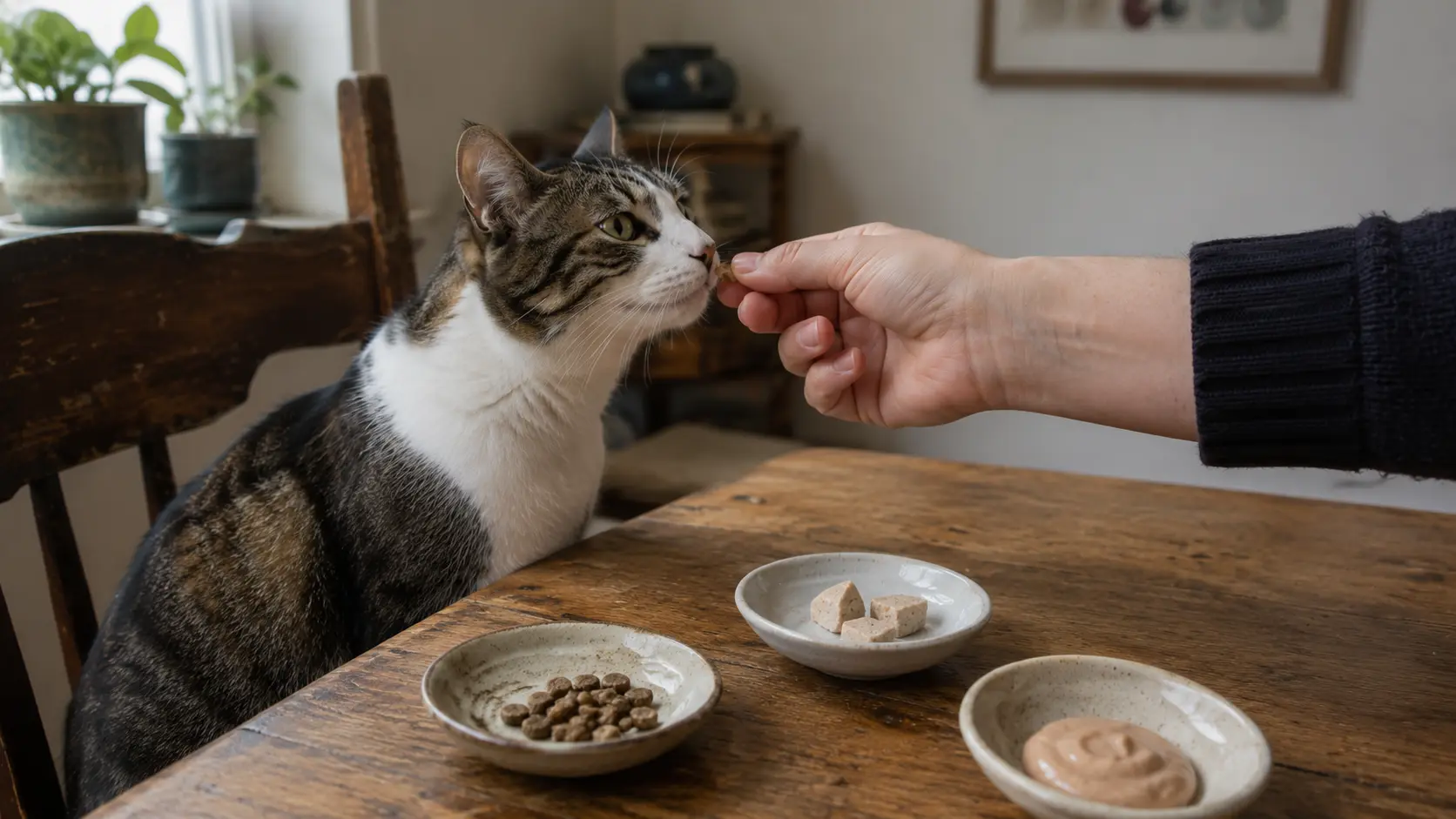
The best cat treats are not all trying to do the same job. A lickable treat can be useful for hand-feeding or topping food, while a tiny crunchy piece is easier for repeated training rewards. Dental treats need a higher evidence bar, and a single-ingredient freeze-dried treat may appeal to owners who want a simpler ingredient list.
For this guide, we compared seven cat snacks across ingredients, calories, texture, palatability, portioning, value, customer feedback, and practical use. We also looked closely at limitations instead of treating “grain-free,” “raw,” “natural,” or a short ingredient list as automatic proof that one product is healthier than another.
Most treats should complement your cat’s normal diet rather than crowd out nutritionally appropriate meals. Cats with diabetes, kidney or urinary disease, diagnosed food allergies, chronic digestive problems, or prescription diets may need veterinarian-approved treat choices.
Affiliate disclosure: LumaPaw may earn a commission if you buy through links on this page, at no extra cost to you.
Best Cat Treats at a Glance
INABA Churu — Best Overall
Texture: Lickable purée
Calories: 6 kcal per 0.5-oz tube
Best for: Hand-feeding, bonding, topping food, cats that prefer soft treats
Main limitation: Ingredients vary between flavors and variety packs
Churu offers the broadest mix of palatability, high moisture, portioning, and practical uses in this roundup.
Feline Greenies Oven Roasted Chicken — Best Dental Treat
Texture: Crunchy
Calories: About 1.4 kcal per treat
Best for: Adult cats whose owners want a treat with recognized tartar-control evidence
Main limitation: The dental feeding amount can contribute a meaningful number of daily calories
Greenies stands apart because its dental position is supported by VOHC acceptance for tartar control rather than by a generic claim that crunchy food cleans teeth.
Temptations Classic Tasty Chicken — Best Budget Treat
Texture: Crunchy exterior with a softer center
Calories: Under 2 kcal per treat
Best for: Everyday rewards and multicat households
Main limitation: More complex ingredient list than the simpler meat-based options
Temptations combines small pieces, strong palatability, large package options, and low cost per treat.
PureBites Chicken Breast — Best Single-Ingredient Treat
Texture: Freeze-dried
Calories: About 2 kcal per average piece
Best for: Owners who want a chicken-only ingredient list
Main limitation: Raw freeze-dried format, premium price, and frequent crumbling
The ingredient list is unusually straightforward: chicken breast.
Dr. Elsey’s cleanprotein Protein Bites — Best for Training
Texture: Tiny crunchy pieces
Calories: About 0.84 kcal per piece
Best for: Frequent small rewards, training, puzzle toys
Main limitation: Much smaller customer-review history than long-established products
The tiny pieces need no breaking and make repeated reinforcement easier to portion.
SHEBA Meaty Tender Sticks Chicken — Best Soft Treat
Texture: Soft, moist solid stick
Calories: 13 kcal per full stick
Best for: Cats that prefer a chewable soft treat instead of crunchy pieces or purée
Main limitation: Multi-protein formula and more calories per full stick
The stick can be divided into smaller sections, which makes the 13-calorie total easier to manage.
ORIJEN Original Freeze-Dried Cat Treats — Best Breakable Freeze-Dried Treat
Texture: Soft freeze-dried pieces
Calories: 1 kcal per treat
Best for: Owners who want freeze-dried treats that are easy to split into smaller rewards
Main limitation: Recurring complaints about crumbs and powder
ORIJEN combines a low per-piece calorie count with a softer texture that is easy to divide.
How We Chose the Best Cat Treats
We started with products that were relevant to the broad best cat treats search rather than building a list entirely around one format. That meant comparing lickable, crunchy, soft, dental, single-ingredient, and freeze-dried options.
Ingredients and formula
We checked the complete ingredient list where possible, not just the flavor name on the front.
That matters because a treat labeled “Chicken” may still contain pork, fish ingredients, or several other animal proteins. A single-ingredient product is easier to evaluate when ingredient avoidance matters, but fewer ingredients do not automatically make a treat nutritionally superior.
Calories and portioning
Calories only make sense in context.
One 1-calorie piece is different from a 6-calorie tube or a 13-calorie stick, but the larger product may also be divided or served less often. We considered how people are likely to use each treat rather than simply ranking the lowest number first.
Texture and practical use
Cats can be very particular about texture. We looked at whether the treat is crunchy, soft, lickable, or freeze-dried and whether it is easy to break into smaller portions.
Texture also affects use. Tiny pieces are convenient during training, while a purée is easier for hand-feeding and requires no chewing.
Customer feedback
High ratings helped establish that a product has meaningful market experience, but ratings did not determine the winners.
We looked for repeated patterns such as:
- strong or inconsistent palatability;
- crushed treats or powder;
- unusually hard pieces;
- damaged packaging;
- difficulty portioning;
- cats gulping large pieces;
- ease of using the treat during training.
Retailer shipping problems were separated from problems with the actual product whenever possible.
Functional claims
Functional treats received a higher evidence bar.
A crunchy texture by itself was not enough for us to call a product a dental winner. Greenies earned its place because Feline Greenies is accepted by the Veterinary Oral Health Council for tartar control.
Value and availability
We considered Amazon and Chewy availability, package sizes, and price relative to the way each product is normally used.
We did not rank a product higher simply because it was cheaper, had an Amazon’s Choice badge, or had more reviews.
The 7 Best Cat Treats

INABA Churu — Best Overall
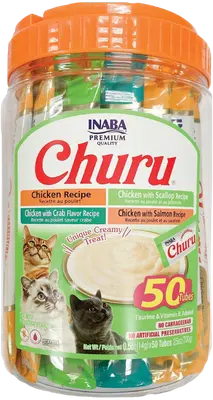
Best for: Cats that enjoy lickable treats, hand-feeding, food topping, or a high-value reward.
Avoid if: You need a strict single-protein treat or want the lowest-cost option for frequent treating.
Honest buying note: Churu is not our winner because lickable treats are inherently healthier. It wins because its calories, moisture, palatability, and versatility make it useful for a wide range of cats.
Churu is our best overall choice because it works in more everyday situations than the other products here.
The chicken-based Churu varieties come in 0.5-ounce tubes at about 6 calories each, with approximately 91% moisture. The purée can be offered directly from the tube, squeezed into a bowl, or added over regular food.
Customer feedback was especially consistent around palatability. Even among cats that are picky about solid treats, many owners report strong interest in Churu. Its lickable texture also removes the need for chewing, which gives it a practical advantage over crunchy or freeze-dried choices.
That does not make every Churu flavor appropriate for every cat. Different variety packs contain different combinations of chicken, seafood, cheese, and flavoring ingredients. Check the exact pack rather than assuming one Churu ingredient list represents the whole range.
Pros
- 91% moisture
- 6 calories per tube
- Very strong palatability pattern
- No chewing required
- Easy to portion and hand-feed
Cons
- More expensive than many crunchy treats
- Ingredients vary between flavors
- Individual tubes create more packaging waste
- Some reviewers report occasional watery tubes

Feline Greenies Oven Roasted Chicken — Best Dental Treat
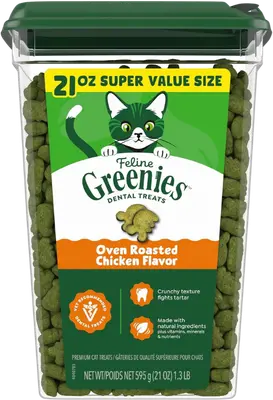
Best for: Adult cats that chew crunchy treats and owners specifically seeking a tartar-control treat with recognized evidence.
Avoid if: Your cat is under 1 year old, has painful teeth, struggles to chew, or needs a tightly controlled ingredient list.
Honest buying note: Choose Greenies for its specific dental role, not because every crunchy treat is good for teeth.
Greenies is the most defensible dental choice in this roundup because its purpose is backed by more than a crunchy texture.
Feline Greenies Dental Treats are VOHC accepted for tartar control. That is a more meaningful reason to choose them for dental use than marketing language about ordinary crunchy treats “cleaning” teeth.
The Oven Roasted Chicken formula contains about 1.4 calories per treat and is intended for cats 1 year and older. For a 10-pound adult cat, the manufacturer’s dental feeding instructions call for eight treats twice daily, so the total treat calories are not trivial.
That is the main tradeoff. Dental treats still contribute to daily calorie intake, and they do not replace tooth brushing, veterinary examinations, or professional dental treatment when needed.
Customer feedback is generally strong for palatability. A more practical recurring complaint involves damaged plastic tubs during shipping rather than the treats themselves.
Pros
- VOHC accepted for tartar control
- About 1.4 calories each
- Strong retailer availability
- Long customer-use history
- Good palatability evidence
Cons
- Requires regular feeding for the intended dental use
- Calories can add up quickly at the recommended amount
- Not intended for kittens under 1
- Multi-ingredient formula
- Repeated shipping complaints about cracked tubs

Temptations Classic Tasty Chicken — Best Budget Treat
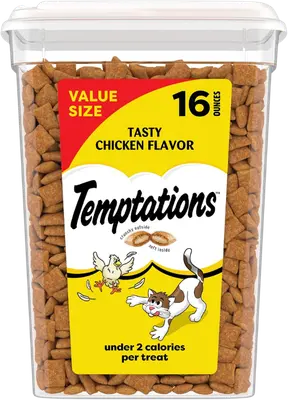
Best for: Affordable daily rewards, multicat households, and owners who need a large number of small treats.
Avoid if: Ingredient simplicity or strict protein control is the priority.
Honest buying note: Temptations earns this position on practicality and value, not because its formula is simpler than the premium options.
Each Tasty Chicken treat contains under 2 calories, and the small crunchy-outside, soft-center pieces are easy to hand out individually or use in puzzle toys. Large package sizes also make them much more economical than most freeze-dried treats.
The strongest customer-feedback pattern is straightforward: many cats find them extremely appealing. That can be useful for everyday rewards, but it also makes portion control important. A cat asking for more does not mean another handful fits the day’s calorie budget.
The ingredient list is considerably longer than PureBites. It includes chicken by-product meal, corn, animal fat, wheat flour, brewer’s rice, and other ingredients. That does not make Temptations automatically “bad,” but it makes this a poor match for someone specifically seeking a limited-ingredient snack.
An unusual point is that the formula carries a complete-and-balanced adult-maintenance claim. We still prefer treating it as a reward in this roundup rather than suggesting that owners replace their cat’s normal meals with treats.
Pros
- Under 2 calories per piece
- Excellent value
- Very strong palatability
- Convenient small pieces
- Widely available
Cons
- Long ingredient list
- Not suitable for strict limited-ingredient feeding
- Easy to give too many because pieces are small and highly appealing
- Plastic-container damage appears in retailer feedback

PureBites Chicken Breast — Best Single-Ingredient Treat
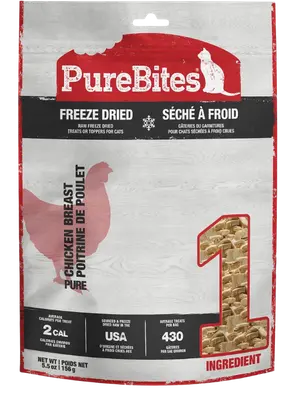
Best for: Owners who specifically want a chicken-only treat or topper.
Avoid if: Your cat needs to avoid chicken, or your household prefers not to handle raw freeze-dried products.
Honest buying note: Single ingredient is useful for transparency, but it is not proof that the treat is automatically healthier than every multi-ingredient option.
PureBites has the simplest ingredient panel among our final picks:
Chicken breast.
The current chicken product is a raw freeze-dried treat with roughly 2 calories per average piece and 74% minimum crude protein. It can be served as individual chunks or crumbled over food.
That ingredient transparency is useful when an owner specifically wants to know which animal protein is being offered. It does not mean chicken is suitable for every cat, and a one-ingredient treat should not be confused with a complete diet.
The biggest practical complaint is fragility. Freeze-dried chicken can break during shipping, and repeated reviews mention crumbs or powder collecting in the bag. Those crumbs are still usable as a topper, but they are less useful if you bought the product for neat individual rewards.
Because PureBites identifies this formula as raw freeze-dried, handle it accordingly. Wash your hands after handling raw animal-protein treats and clean surfaces they contact. This is general raw-food hygiene guidance, not a claim that the specific bag is contaminated.
Pros
- One ingredient
- About 2 calories per average treat
- High protein
- Can be broken or crumbled as a topper
Cons
- Expensive compared with conventional treats
- Raw freeze-dried format
- Frequent crumbs and powder
- Natural pieces are not perfectly uniform

Dr. Elsey’s cleanprotein Protein Bites — Best for Training
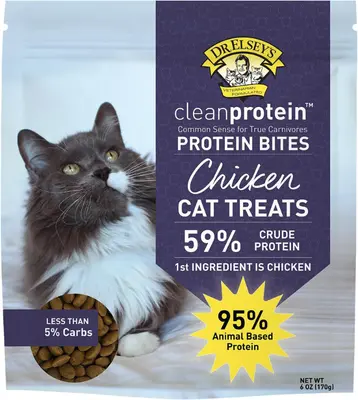
Best for: Clicker work, carrier training, grooming rewards, puzzle toys, or any situation where many small rewards are useful.
Avoid if: Your cat must avoid pork or fish ingredients, or has difficulty chewing crunchy treats.
Honest buying note: The small size is the real reason to buy these. High protein alone would not be enough to make them our training choice.
Dr. Elsey’s Protein Bites stand out for one simple reason: the pieces are genuinely tiny.
The Chicken formula provides 59% minimum crude protein, and the manufacturer’s nutritional information puts each piece at about 0.84 calories. Customer reviews repeatedly describe them as very small—closer to tiny pellets than conventional cat treats—which works well when a training session requires several rewards.
Unlike ORIJEN, there is no need to break each piece before rewarding the cat. They also cost much less per ounce than most premium freeze-dried options.
The front-of-pack “Chicken” wording should not be mistaken for chicken-only. The actual ingredient list also includes hydrolyzed pork, pork plasma, gelatin, chicken fat, and salmon oil.
One limitation is evidence depth. The product has far fewer customer reviews than Temptations, Greenies, or Churu, so there is less long-term feedback to draw from.
Pros
- About 0.84 calories each
- Very small pieces
- 59% minimum protein
- Easy to portion repeatedly
- Lower cost than premium freeze-dried treats
Cons
- Smaller customer-review base
- Pieces may feel too tiny for casual treating
- Not chicken-only
- Crunchy texture will not suit every cat

SHEBA Meaty Tender Sticks Chicken — Best Soft Treat
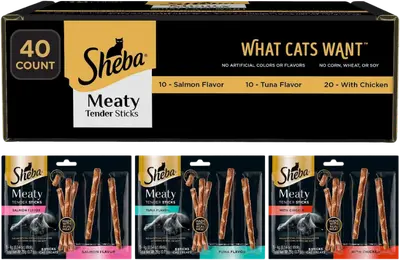
Best for: Cats that prefer a soft solid treat and owners who want something that can be torn into different portion sizes.
Avoid if: You need a single-protein formula, very low calories per entire treat, or your cat struggles to chew even soft food.
Honest buying note: Soft does not mean appropriate for painful teeth or dental disease. If chewing suddenly becomes difficult, a veterinarian should assess the cause.
SHEBA fills the space between a crunchy biscuit and a lickable purée.
The Chicken Meaty Tender Sticks are soft, moist, and designed to break into smaller sections. The current Chicken formula contains about 13 calories per full stick, 34% minimum crude protein, and up to 30% moisture.
That 13-calorie figure sounds high next to a one-calorie training treat, but a full stick does not have to be given at once. Breaking it into smaller pieces gives you more control over portions.
Customer feedback strongly supports the soft texture and palatability. Some owners also report cats swallowing larger sections quickly, which is a good reason to tear the stick into smaller pieces for cats that tend to gulp.
“Chicken” again does not mean single-protein. The current formula also includes pork, pork liver, turkey, and other ingredients.
Pros
- Soft, flexible texture
- Easy to divide
- Strong palatability
- Individually wrapped
- Different feeding experience from crunchy or lickable treats
Cons
- 13 calories per full stick
- Contains multiple animal proteins
- Individual wrappers create waste
- Larger pieces may be gulped

ORIJEN Original Freeze-Dried Cat Treats — Best Breakable Freeze-Dried Treat
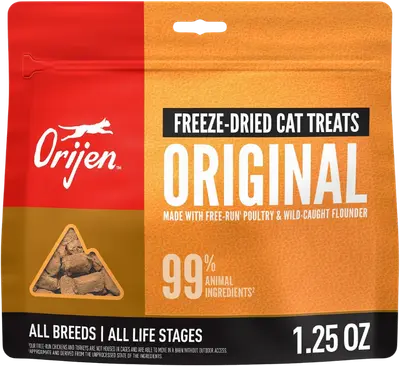
Best for: Cats that like freeze-dried texture and owners who want soft pieces that can be divided easily.
Avoid if: You need a strict single-protein treat, dislike crumbly products, or want the best value per ounce.
Honest buying note: ORIJEN’s strongest feature is its portionable texture. We would not pay the premium solely for the “99% animal ingredients” marketing claim.
ORIJEN Original earns the final place because its freeze-dried pieces are soft enough to divide easily while still providing only about 1 calorie per whole treat.
The Original recipe contains chicken, turkey, poultry organs, and flounder, with 45% minimum crude protein. It is therefore very different from PureBites: ORIJEN is a multi-protein formula rather than a one-ingredient chicken treat.
Owners repeatedly describe the pieces as easy to break, which can be convenient when you want smaller rewards. The drawback is that the same friable texture makes the product vulnerable to crumbling. Bags containing broken pieces and powder are one of the clearest recurring complaints.
That powder is usable as a topper, but it is still disappointing if you paid for intact treats.
Pros
- 1 calorie per treat
- Easy to break into smaller rewards
- 45% minimum protein
- Strong palatability evidence
- Useful as a topper when pieces crumble
Cons
- Premium price
- Recurring crumbs and powder complaints
- Multiple animal proteins
- Very low moisture
How to Choose Cat Treats
The best cat treats for one cat may be a poor fit for another. Before comparing brands, decide what you actually want the treat to do.
Start With What the Treat Is For
An everyday reward does not need the same qualities as a training treat or dental product.
For frequent training, small pieces such as Dr. Elsey’s Protein Bites make portioning easier. A lickable option such as Churu makes more sense for hand-feeding or cats that strongly prefer purées. Greenies has a specific dental role, while PureBites is more useful when ingredient simplicity matters.
This is also why we would not choose a product just because it has the shortest ingredient list or highest protein percentage. The treat still needs to suit the situation and your cat.
Compare Calories by the Amount You Actually Feed
Calories per treat are useful, but only when you consider serving size.
For example:
- Dr. Elsey’s Protein Bites are about 0.84 calories each.
- ORIJEN Original is about 1 calorie per piece.
- Greenies are about 1.4 calories each.
- Churu is about 6 calories per tube.
- A full SHEBA Meaty Tender Stick is about 13 calories.
That does not automatically make the 13-calorie stick a poor choice. It can be broken into several portions instead of served all at once.
The same applies to dental treats. A low calorie count per piece can still add up when the recommended dental routine calls for several pieces every day.
Look at the calories your cat actually receives, not just the smallest number printed on a product page.
Read the Full Ingredient List, Not Just the Flavor Name
A product labeled “Chicken” is not necessarily chicken-only.
Dr. Elsey’s Chicken Protein Bites also contain pork ingredients and salmon oil. SHEBA Chicken Meaty Tender Sticks contain several animal proteins. Some lickable variety packs combine chicken with seafood or cheese.
That matters if your cat is avoiding a specific ingredient.
PureBites is much simpler because its Chicken Breast formula contains only chicken breast. Even then, a single-ingredient recipe is useful mainly because it makes the ingredient source easy to identify. It does not automatically make the treat better for every cat.
If your veterinarian is using an elimination diet to investigate a food reaction, check every treat before adding it.
Choose a Texture Your Cat Will Actually Eat
Ingredient quality means little if your cat refuses the texture.
Crunchy treats are convenient, clean to handle, and easy to use as quick rewards. Temptations and Dr. Elsey’s are examples.
Soft treats such as SHEBA sticks can be divided by hand and may appeal to cats that dislike hard biscuits.
Lickable treats such as Churu work well for hand-feeding and cats that prefer wet textures.
Freeze-dried treats can range from firm pieces to very crumbly ones. PureBites offers simple chicken chunks, while ORIJEN has a softer multi-protein texture that is easy to break apart.
Individual preference matters. A treat that looks excellent on paper is not much use for training if your cat walks away from it.
Look Beyond “Natural,” “Premium,” Raw, and Grain-Free
These terms can describe a product, but they do not prove that it is healthier.
Grain-free treats are not automatically better for cats. Raw or freeze-dried products are not automatically more nutritious than every cooked treat. “Premium” has little practical meaning unless the underlying ingredients, calories, use case, quality control, and feeding instructions support the claim.
A more useful question is:
Does this treat fit my cat’s normal diet, calorie needs, ingredient restrictions, and reason for giving treats?
That standard works better than relying on marketing terms.
If you specifically want formulas without grains, our grain-free treat guide compares those options in more detail.
Consider Age and Health Needs
Life stage matters.
Greenies Dental Treats, for example, are intended for cats 1 year and older. Other products may carry all-life-stage labeling, but kittens still need treats that are easy to eat and that do not displace the complete growth diet they rely on.
If you are feeding a young kitten, our guide to what kittens can eat explains the main foods that should come first.
Cats with diabetes, kidney disease, urinary problems, diagnosed food allergies, chronic digestive conditions, obesity, or prescription diets need more individual consideration. A product being low in carbohydrates, high in protein, grain-free, or single-ingredient does not make it automatically suitable for a medical condition.
Ask your veterinarian before adding treats that could interfere with a therapeutic diet.
For actual reward options designed around young cats, see our guide to age-appropriate kitten treats.
Types of Cat Treats: Which Format Fits Your Cat?
Cat snacks come in several very different forms. Understanding the basic formats can make shopping easier before you compare individual brands.
Crunchy Cat Treats
Crunchy treats are easy to store and portion, and they work well for quick everyday rewards.
Temptations represents the affordable mainstream end of this category, while Dr. Elsey’s offers much smaller high-protein pieces that are particularly convenient for repeated training rewards.
Crunchy alone does not mean a product provides meaningful dental benefits.
Soft Cat Treats
Soft treats are still solid and chewable, but they require less crunching than traditional biscuits.
SHEBA Meaty Tender Sticks can be torn into smaller sections, which is useful when you want control over portion size.
Soft texture should not be treated as a solution for dental pain. A cat that suddenly struggles to chew should be examined rather than simply switched to softer treats.
If this is the texture your cat prefers, our soft cat treat guide compares chewable options without mixing them with purées or tube treats.
Lickable and Squeezable Treats
Lickable treats are high-moisture purées usually packaged in tubes or pouches.
They can be served directly, squeezed into a bowl, or used as a topper. Churu is our overall pick because its 6-calorie tubes combine high moisture with unusually broad practical use.
These treats can be highly motivating, so they are still worth counting as part of the day’s treat intake.
For more options in this format, see our comparison of lickable and squeezable cat treats.
Freeze-Dried Cat Treats
Freeze-dried treats often emphasize animal ingredients and a lightweight, dry texture.
Some are single-ingredient, such as PureBites Chicken Breast. Others, including ORIJEN Original, combine several animal proteins and organs.
They can also be fragile. Powder and broken pieces were recurring complaints for several freeze-dried products we researched.
Some freeze-dried products are made from raw ingredients, so check the exact product rather than assuming every freeze-dried treat is processed the same way.
Our freeze-dried cat treat guide compares single-ingredient and multi-protein options in more detail.
Dental Treats
Dental treats deserve more scrutiny than ordinary cat snacks because they make a functional claim.
We prefer products with recognized evidence for plaque or tartar control rather than assuming that any crunchy treat cleans teeth. Feline Greenies earned its place in this guide because it is accepted by the Veterinary Oral Health Council for tartar control.
Even a dental treat is only one part of oral care. It does not replace veterinary dental examinations or treatment when needed.
If dental support is your main goal, our cat dental treat comparison looks more closely at evidence, calories, and product limitations.
Training and Lower-Calorie Treats
Frequent reinforcement is easier when each reward is small.
Dr. Elsey’s pieces are about 0.84 calories each, while ORIJEN Original provides about 1 calorie per full piece and can be divided further.
The goal is not simply to find the smallest calorie number. Choose something your cat values enough to work for, then use portions that fit the rest of the diet.
For repeated reinforcement, our cat training treat guide compares small rewards that are easier to portion during a session.
If calorie control matters more, our lower-calorie treat guide compares options by calories and practical portion size.
How Many Treats Should a Cat Have?
There is no useful universal answer such as “five treats a day.”
Five Churu tubes and five tiny Dr. Elsey’s pieces are obviously not nutritionally equivalent.
A commonly used guideline is to keep treats to a relatively small part of total daily calories, often around 10% or less, with the rest coming from an appropriate complete diet. Your cat’s actual needs depend on body size, body condition, activity, age, and health.
Start with the calorie content on the package and look at how much you really give.
A cat receiving dental treats every day may already be getting a meaningful number of treat calories before any additional snacks are added. Likewise, a training session can involve many rewards even when each piece is small.
For cats that are gaining unwanted weight, do not simply keep the normal meal size and add more treats on top. Discuss an appropriate calorie target with your veterinarian, particularly if your cat is already overweight or has another health condition.
Cat Treat Safety and Quality Checklist
A treat does not need to be complicated to use safely, but a few checks are worthwhile.
- Read the exact ingredient panel. Flavor names do not always reveal every animal protein in the formula.
- Check the life-stage directions. A product intended for adult cats may not be appropriate for a kitten.
- Know the calories. Count the amount you actually feed, including treats used during training.
- Break large pieces when needed. Cats that gulp treats may handle smaller portions more comfortably.
- Watch unfamiliar textures. Freeze-dried chunks and soft sticks vary in size and firmness.
- Do not assume crunchy means dental. Look for evidence behind dental claims.
- Store treats as directed. Close resealable packaging and discard products that appear spoiled, smell abnormal, or have damaged packaging.
- Use good hygiene with raw animal products. Wash your hands after handling raw freeze-dried treats and clean contacted surfaces.
- Check formulas periodically. Ingredients, calorie values, package sizes, and feeding directions can change.
- Be cautious with health claims. Customer reports about urinary health, digestion, allergies, weight loss, or other conditions are not substitutes for clinical evidence.
- Ask your veterinarian about medical diets. Even a seemingly simple treat can interfere with a prescription or elimination diet.
Treats should also stay secondary to the main diet. For kittens in particular, an age-appropriate complete food needs to provide the nutrition required for growth. Our food for kittens guide explains how complete kitten foods fit into that bigger picture.
Frequently Asked Questions About Cat Treats
What are the best cat treats?
There is no single product that wins every use case. INABA Churu is our best overall choice because it combines strong palatability, 91% moisture, 6 calories per tube, and an easy-to-feed lickable texture.
Greenies is the stronger choice when dental function is the priority, Temptations makes more sense for inexpensive everyday rewards, and PureBites is better when you specifically want one animal ingredient.
Which cat treats are best for dental health?
Feline Greenies is our dental choice because the feline dental treats are accepted by the Veterinary Oral Health Council for tartar control.
That is stronger evidence than simply being crunchy.
Dental treats still do not replace tooth brushing where tolerated, routine veterinary examinations, or professional dental treatment when a cat needs it.
What are good cat treats for picky eaters?
Palatability varies from cat to cat, but Churu and Temptations produced some of the strongest repeated acceptance patterns in the customer feedback we reviewed.
Texture can be as important as flavor. A cat that ignores crunchy snacks may respond to a lickable purée, while another cat may strongly prefer a crisp or freeze-dried reward.
Buying a smaller package first can reduce waste when trying an unfamiliar texture.
What makes a cat treat a healthy choice?
A sensible treat is one that fits your individual cat.
Look at:
- calories;
- serving size;
- ingredient compatibility;
- life-stage suitability;
- how the treat fits alongside the normal diet;
- evidence behind any functional health claims.
“Natural,” grain-free, raw, high-protein, or single-ingredient can describe a product, but none of those terms by itself proves that the treat is healthier.
Can cats have treats every day?
Many cats can have treats daily when portions stay appropriate and the treats do not displace their normal diet.
The number of pieces matters less than the total calories. One product may contain under a calorie per piece, while another provides more than 10 calories per full serving.
Cats on weight-loss plans or therapeutic diets may need more specific guidance from a veterinarian.
Are grain-free cat treats better?
Not automatically.
A cat without a reason to avoid a particular ingredient does not necessarily benefit just because a treat is grain-free. Evaluate the whole product instead: calories, proteins, ingredients, portion size, palatability, and intended use.
If you suspect a food allergy, do not choose a new treat based only on a grain-free label. Work with your veterinarian to identify which ingredients actually need to be avoided.
Are freeze-dried cat treats safe?
Freeze-dried products vary.
Some, such as PureBites Chicken Breast, are explicitly raw freeze-dried products. Freeze-drying should not be treated as a guarantee that a raw animal product is sterile.
Follow package storage instructions, wash your hands after handling raw animal-protein treats, and clean surfaces they contact.
That general precaution does not mean a specific bag is contaminated.
Are crunchy treats good for cats’ teeth?
Crunchiness alone is not enough to establish a dental benefit.
If dental support is the goal, look for evidence specific to the product. Organizations such as the Veterinary Oral Health Council evaluate products for demonstrated plaque or tartar-control claims.
Greenies is included in this guide because it has that type of recognized tartar-control evidence.
Can kittens eat cat treats?
Some treats are labeled for all life stages, while others are intended for adult cats.
For kittens, prioritize appropriately formulated complete kitten food and keep extras modest. Treat size and texture should also suit a small, developing cat.
If you are unsure what belongs in a kitten’s diet, see our guide to what kittens can eat.
Are soft treats better for senior cats?
Not necessarily.
A senior cat that simply prefers softer food may find a product such as SHEBA Meaty Tender Sticks easier to manage than a very hard biscuit. But age alone does not mean a cat needs soft treats.
Difficulty chewing, dropping food, mouth pain, bad breath, or suddenly avoiding crunchy foods can point to dental disease and should be discussed with a veterinarian.
Final Verdict
For most cats, INABA Churu is our best overall pick among these best cat treats because it combines strong palatability with high moisture, modest calories per tube, and a format that works for hand-feeding, topping food, or simply giving a reward.
If you have a more specific goal, the answer changes. Feline Greenies is the stronger choice for evidence-backed tartar control, while Temptations Classic Tasty Chicken offers a much more economical everyday cat snack. PureBites is the clearest option when a chicken-only ingredient list matters, and Dr. Elsey’s is particularly practical for frequent training rewards.
The most useful treat is not necessarily the one with the shortest ingredient list or the highest protein percentage. It is one your cat will actually accept, that fits their calorie and dietary needs, and that does the job you bought it for.